Reference table
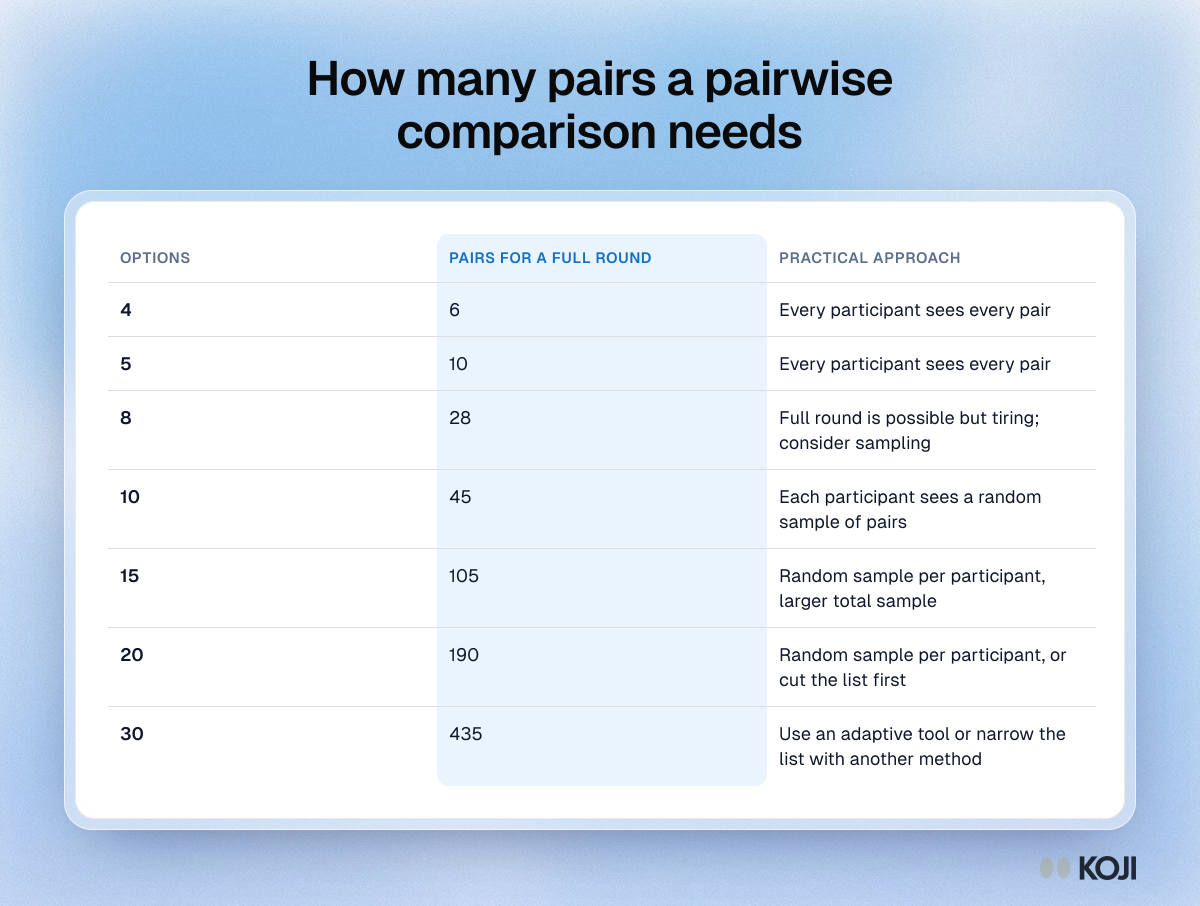
How many pairs a pairwise comparison needs
A full round needs n x (n - 1) / 2 pairs, so the count grows fast
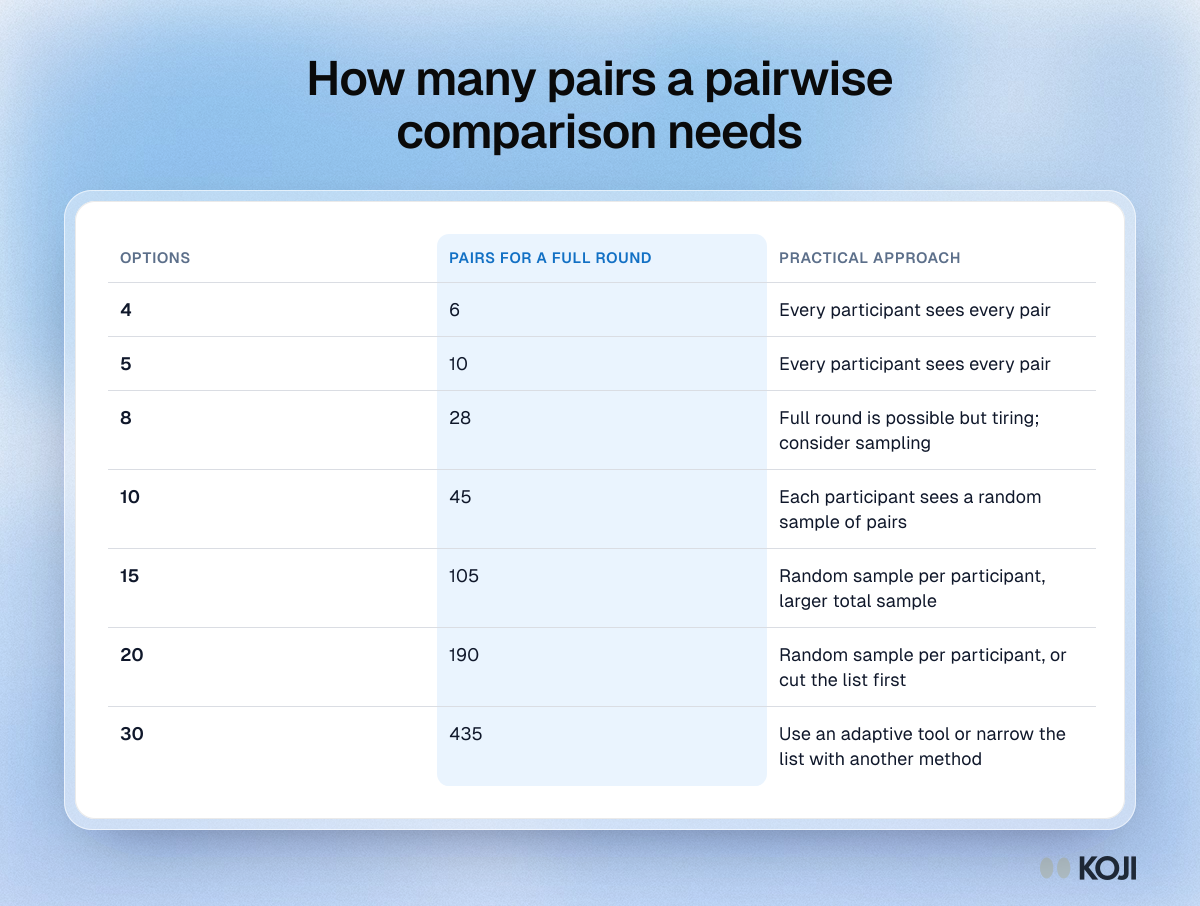
A quick reference for planning a pairwise comparison study. It lists how many pairs a full round needs for 4 to 30 options, using the formula n x (n - 1) / 2, and when to switch from showing everyone every pair to giving each participant a random sample. Researchers and product managers can use it to size a prioritisation study. In Koji each pair can be asked as a single choice question with a follow-up about why.
Where this appears
What's in this reference table
| Options | Pairs for a full round | Practical approach |
|---|---|---|
| 4 | 6 | Every participant sees every pair |
| 5 | 10 | Every participant sees every pair |
| 8 | 28 | Full round is possible but tiring; consider sampling |
| 10 | 45 | Each participant sees a random sample of pairs |
| 15 | 105 | Random sample per participant, larger total sample |
| 20 | 190 | Random sample per participant, or cut the list first |
| 30 | 435 | Use an adaptive tool or narrow the list with another method |
Use this image
Free to use in your docs, decks and posts under CC BY 4.0, as long as you credit Koji with a link to this page. To embed it, paste this into your page:
html
<a href="https://www.koji.so/visuals/pairwise-comparison-number-of-pairs"><img src="https://www.koji.so/visuals/pairwise-comparison-number-of-pairs/pairwise-comparison-number-of-pairs.png" alt="Table showing how many pairs a full pairwise comparison needs for 4 to 30 options, and the practical approach for each size" width="1200" height="906" /></a>
<p>Source: <a href="https://www.koji.so/visuals/pairwise-comparison-number-of-pairs">How many pairs a pairwise comparison needs</a>, Koji</p>