Guide
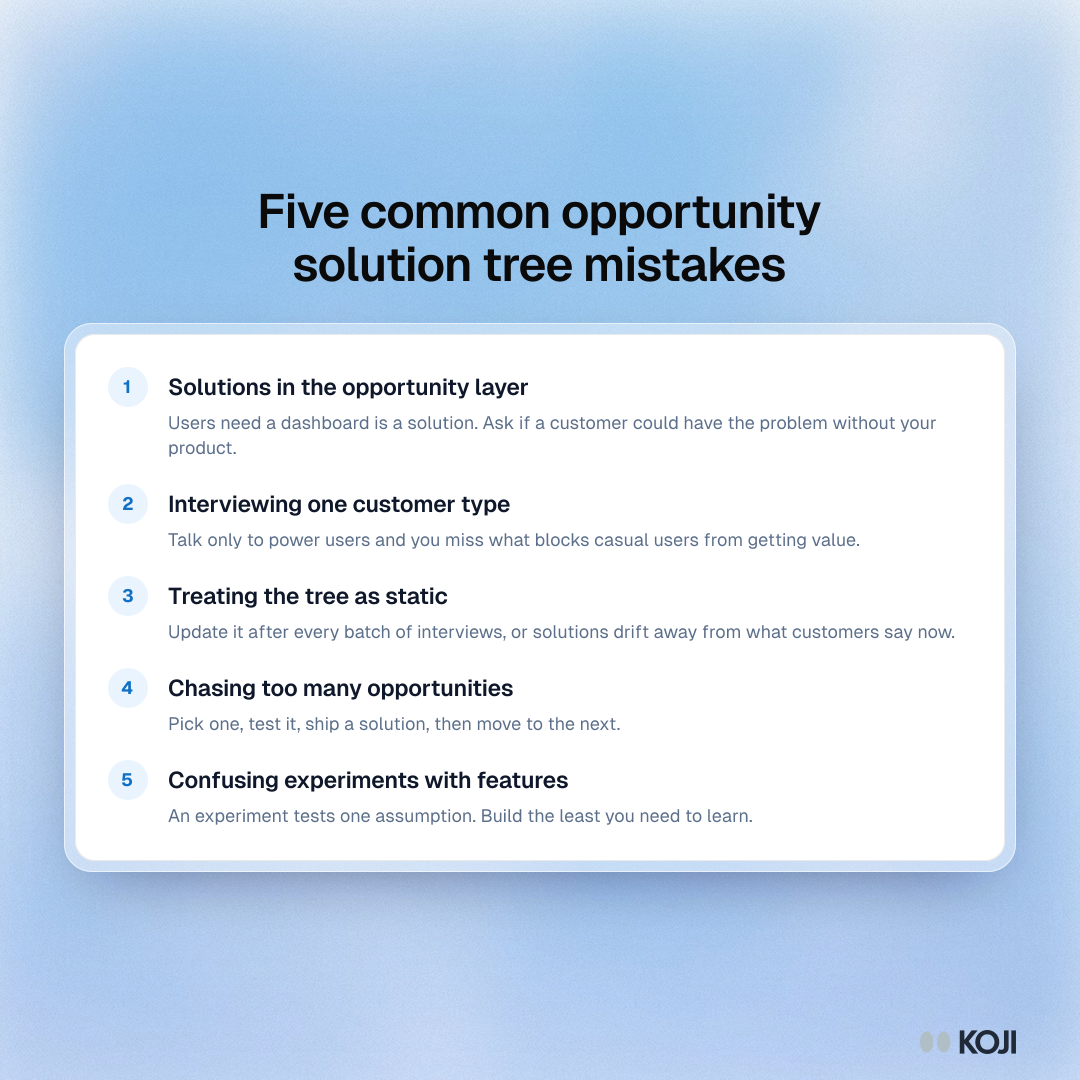
Five common opportunity solution tree mistakes
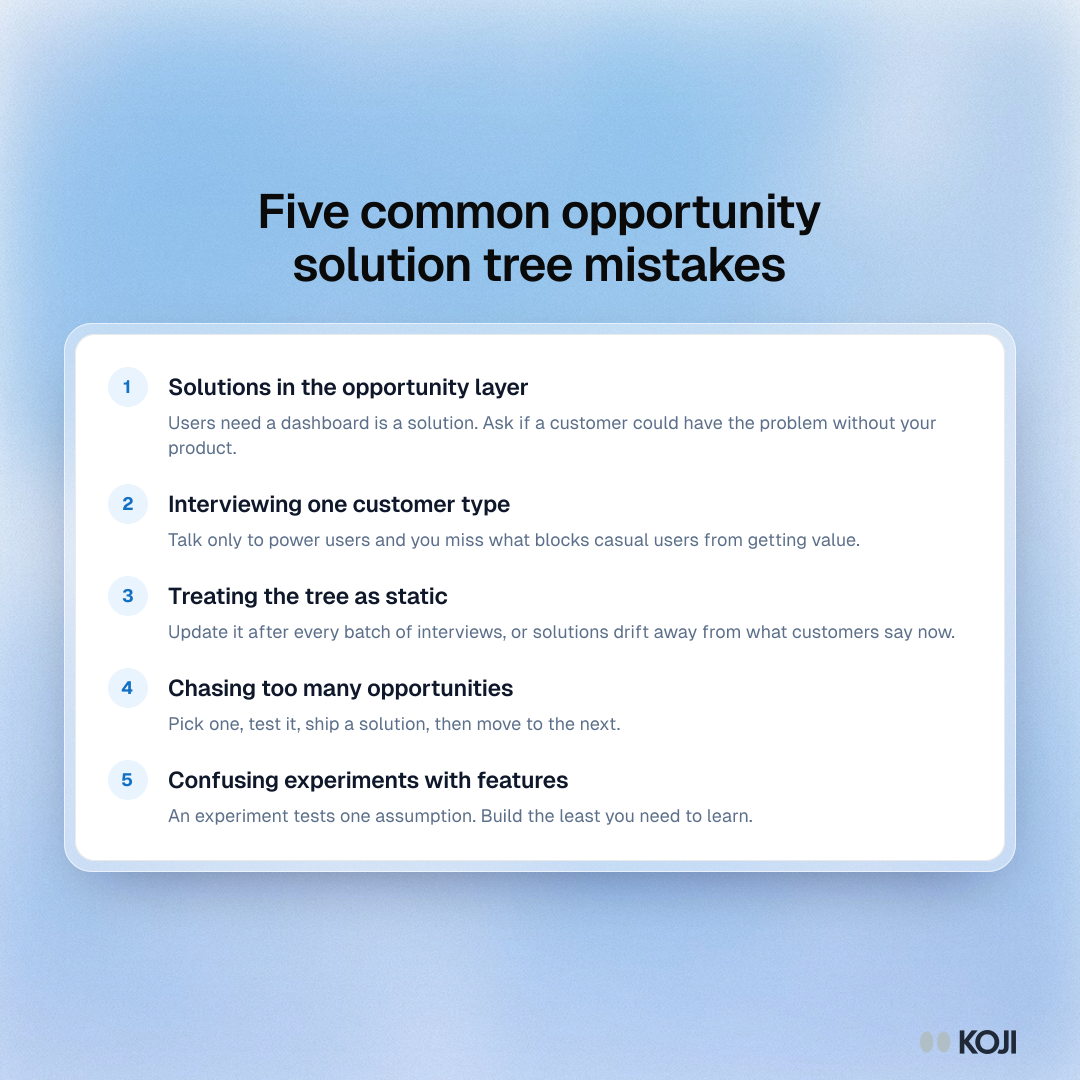
Five mistakes teams make with an opportunity solution tree: writing solutions where opportunities belong, interviewing only one kind of customer, letting the tree go stale, chasing several opportunities at once and building full features when a small experiment would do. Use it as a review list when your product trio updates the tree. Regular Koji interviews help keep the opportunity layer current.
Where this appears
What's in this guide
- Solutions in the opportunity layer: Users need a dashboard is a solution. Ask if a customer could have the problem without your product.
- Interviewing one customer type: Talk only to power users and you miss what blocks casual users from getting value.
- Treating the tree as static: Update it after every batch of interviews, or solutions drift away from what customers say now.
- Chasing too many opportunities: Pick one, test it, ship a solution, then move to the next.
- Confusing experiments with features: An experiment tests one assumption. Build the least you need to learn.
Use this image
Free to use in your docs, decks and posts under CC BY 4.0, as long as you credit Koji with a link to this page. To embed it, paste this into your page:
html
<a href="https://www.koji.so/visuals/opportunity-solution-tree-common-mistakes"><img src="https://www.koji.so/visuals/opportunity-solution-tree-common-mistakes/opportunity-solution-tree-common-mistakes.png" alt="List of five common opportunity solution tree mistakes, from putting solutions in the opportunity layer to treating experiments like features." width="1080" height="1080" /></a>
<p>Source: <a href="https://www.koji.so/visuals/opportunity-solution-tree-common-mistakes">Five common opportunity solution tree mistakes</a>, Koji</p>