Comparison
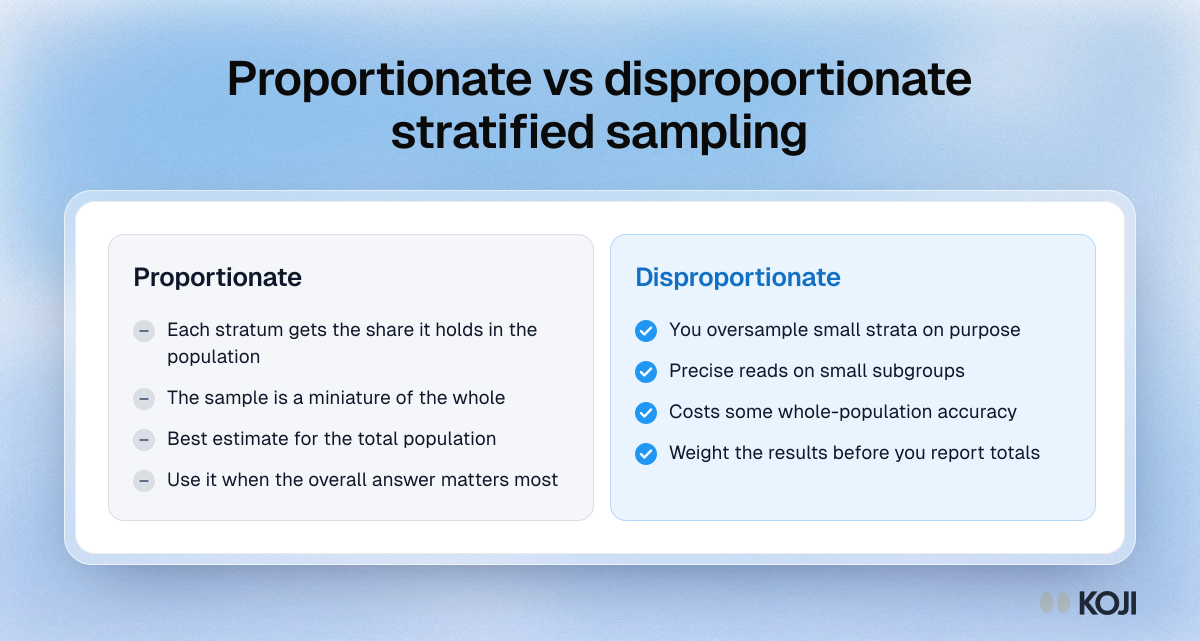
Proportionate vs disproportionate stratified sampling
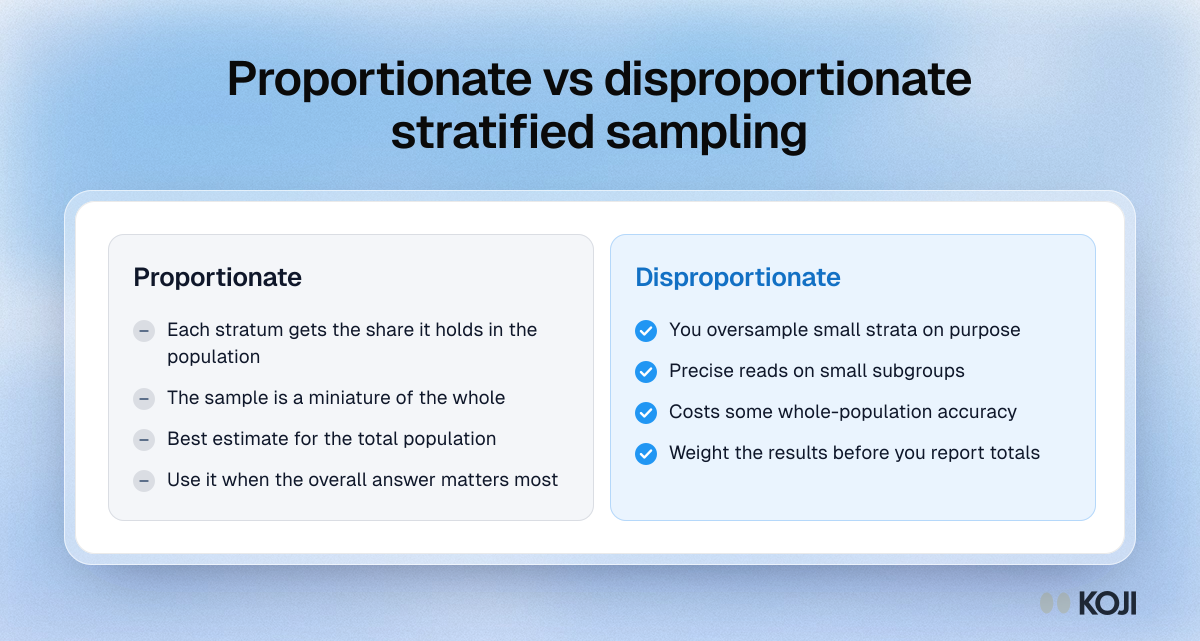
A side-by-side comparison of the two ways to allocate a stratified sample. Proportionate allocation gives each stratum its population share and the best whole-population estimate. Disproportionate allocation oversamples small strata to get precise subgroup estimates, and needs weighting before you report totals. In Koji, screener questions sort each participant into a segment before the interview starts.
Where this appears
What's in this comparison
Proportionate
- Each stratum gets the share it holds in the population
- The sample is a miniature of the whole
- Best estimate for the total population
- Use it when the overall answer matters most
Disproportionate
- You oversample small strata on purpose
- Precise reads on small subgroups
- Costs some whole-population accuracy
- Weight the results before you report totals
Use this image
Free to use in your docs, decks and posts under CC BY 4.0, as long as you credit Koji with a link to this page. To embed it, paste this into your page:
html
<a href="https://www.koji.so/visuals/proportionate-vs-disproportionate-stratified-sampling"><img src="https://www.koji.so/visuals/proportionate-vs-disproportionate-stratified-sampling/proportionate-vs-disproportionate-stratified-sampling.png" alt="Comparison of proportionate and disproportionate stratified sampling: mirror population shares for totals, or oversample small groups for subgroup reads." width="1200" height="641" /></a>
<p>Source: <a href="https://www.koji.so/visuals/proportionate-vs-disproportionate-stratified-sampling">Proportionate vs disproportionate stratified sampling</a>, Koji</p>