Guide
Five types of purposive sampling
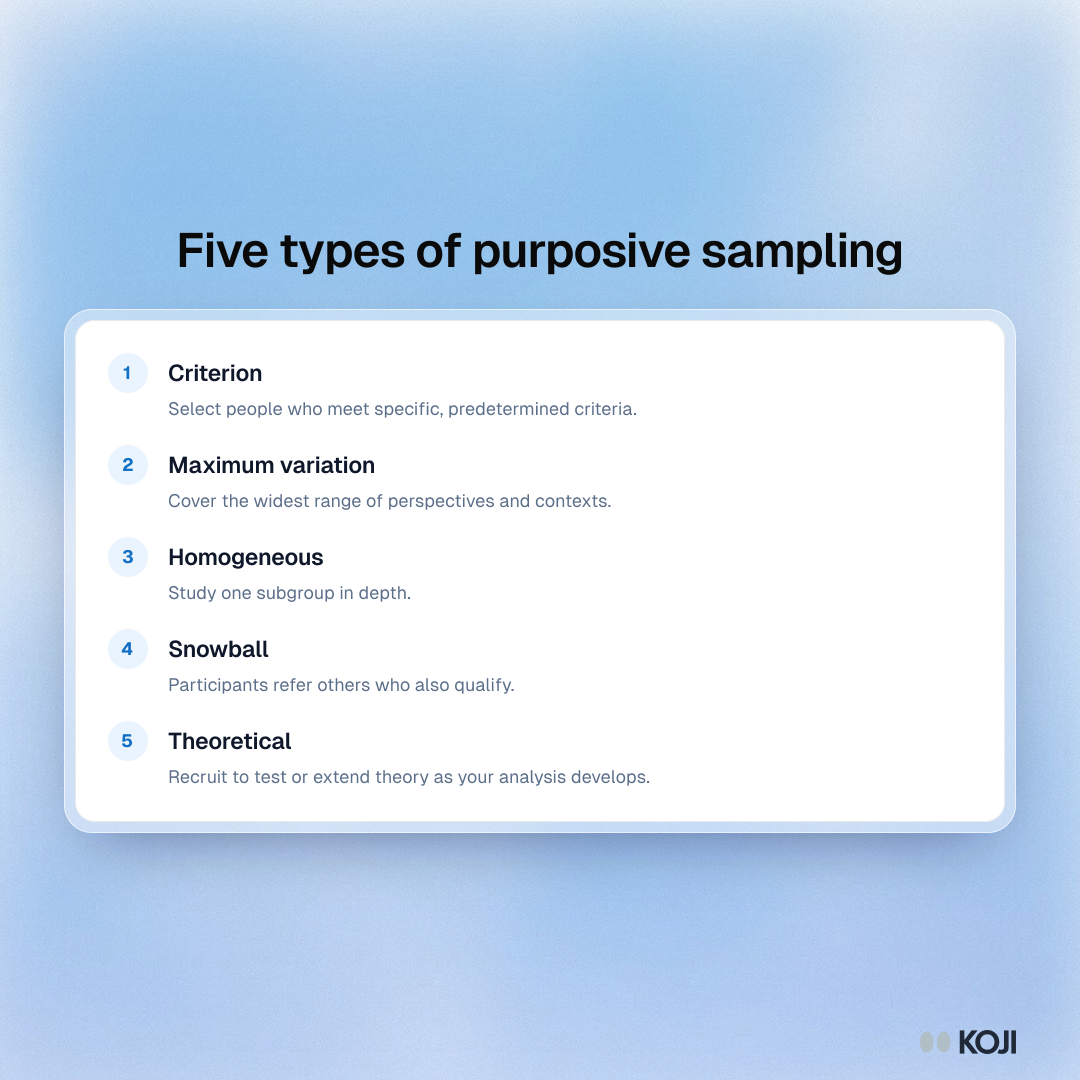
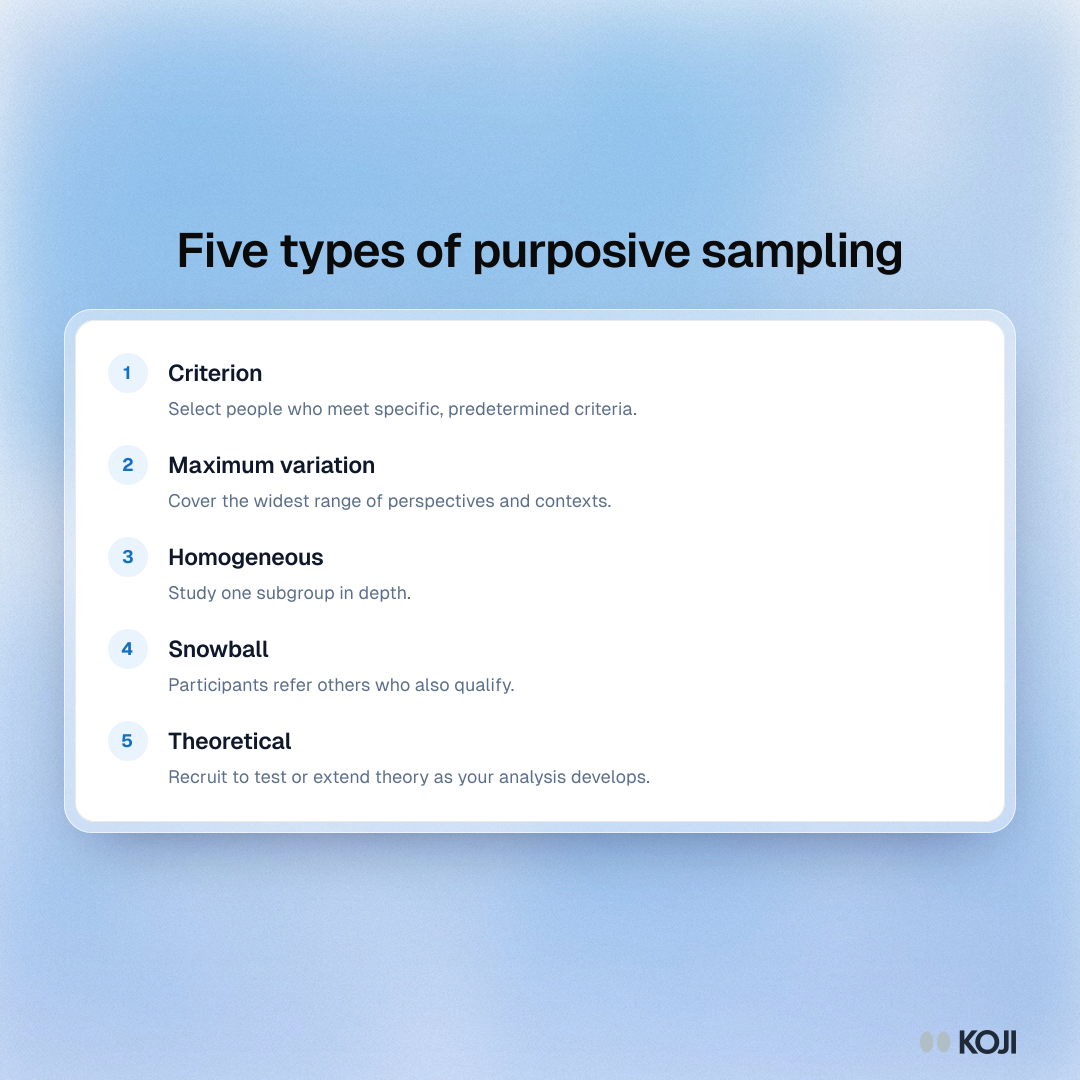
Purposive sampling has up to 16 recognized types, but five cover most product, UX and market research. Criterion and homogeneous sampling go deep on a defined group, maximum variation looks for patterns across contexts, snowball reaches hard-to-find people and theoretical sampling follows your emerging analysis.
Where this appears
What's in this guide
- Criterion: Select people who meet specific, predetermined criteria.
- Maximum variation: Cover the widest range of perspectives and contexts.
- Homogeneous: Study one subgroup in depth.
- Snowball: Participants refer others who also qualify.
- Theoretical: Recruit to test or extend theory as your analysis develops.
Use this image
Free to use in your docs, decks and posts under CC BY 4.0, as long as you credit Koji with a link to this page. To embed it, paste this into your page:
html
<a href="https://www.koji.so/visuals/purposive-sampling-five-types"><img src="https://www.koji.so/visuals/purposive-sampling-five-types/purposive-sampling-five-types.png" alt="Listicle of the five most useful types of purposive sampling for product and UX research: criterion, maximum variation, homogeneous, snowball and theoretical." width="1080" height="1080" /></a>
<p>Source: <a href="https://www.koji.so/visuals/purposive-sampling-five-types">Five types of purposive sampling</a>, Koji</p>