Reference table
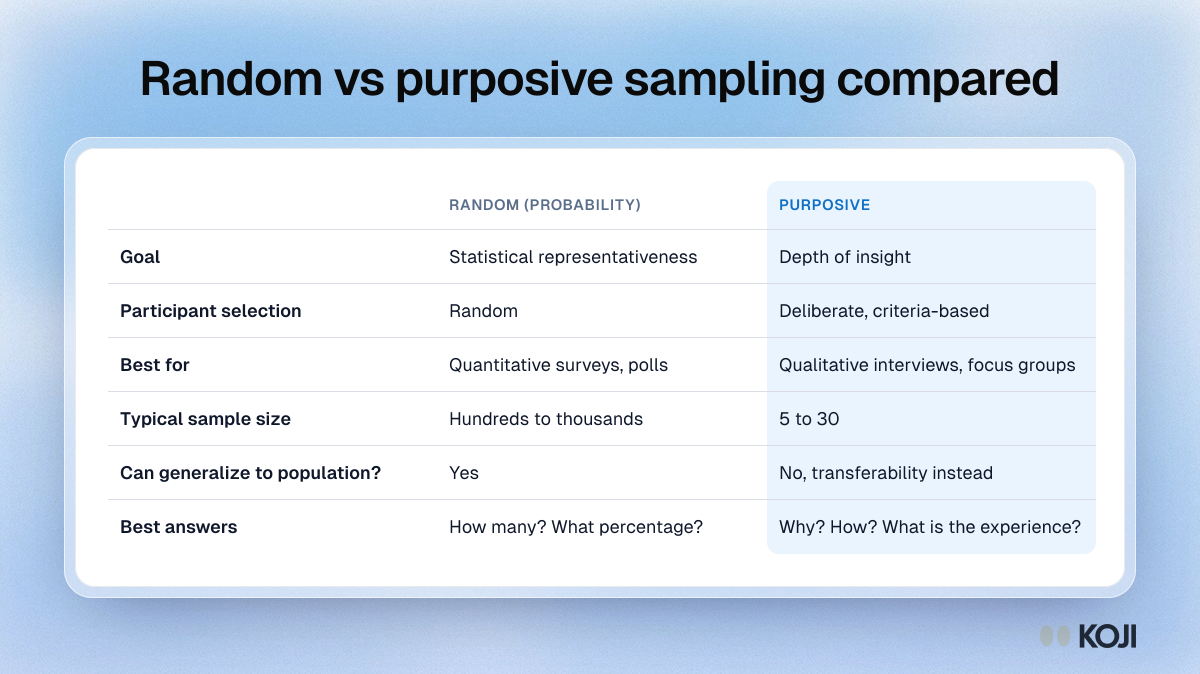
Random vs purposive sampling compared
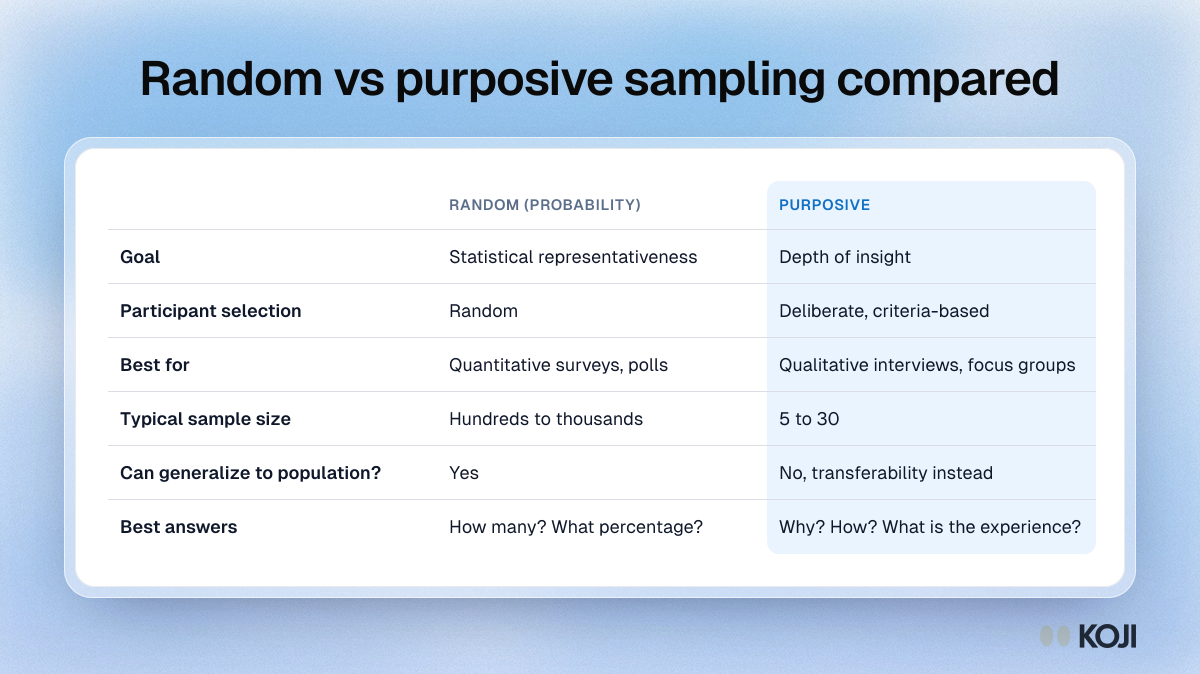
Purposive sampling is a non-probability technique where researchers choose participants for how relevant their experience is to the research question. Random sampling aims for statistical representativeness instead. This table sets the two side by side for researchers deciding between a survey and a qualitative study.
Where this appears
What's in this reference table
| Random (probability) | Purposive | |
|---|---|---|
| Goal | Statistical representativeness | Depth of insight |
| Participant selection | Random | Deliberate, criteria-based |
| Best for | Quantitative surveys, polls | Qualitative interviews, focus groups |
| Typical sample size | Hundreds to thousands | 5 to 30 |
| Can generalize to population? | Yes | No, transferability instead |
| Best answers | How many? What percentage? | Why? How? What is the experience? |
Use this image
Free to use in your docs, decks and posts under CC BY 4.0, as long as you credit Koji with a link to this page. To embed it, paste this into your page:
html
<a href="https://www.koji.so/visuals/random-vs-purposive-sampling-comparison"><img src="https://www.koji.so/visuals/random-vs-purposive-sampling-comparison/random-vs-purposive-sampling-comparison.png" alt="Table comparing random probability sampling with purposive sampling across goal, selection, best use, sample size, generalizing and the questions each answers." width="1200" height="674" /></a>
<p>Source: <a href="https://www.koji.so/visuals/random-vs-purposive-sampling-comparison">Random vs purposive sampling compared</a>, Koji</p>