Reference table
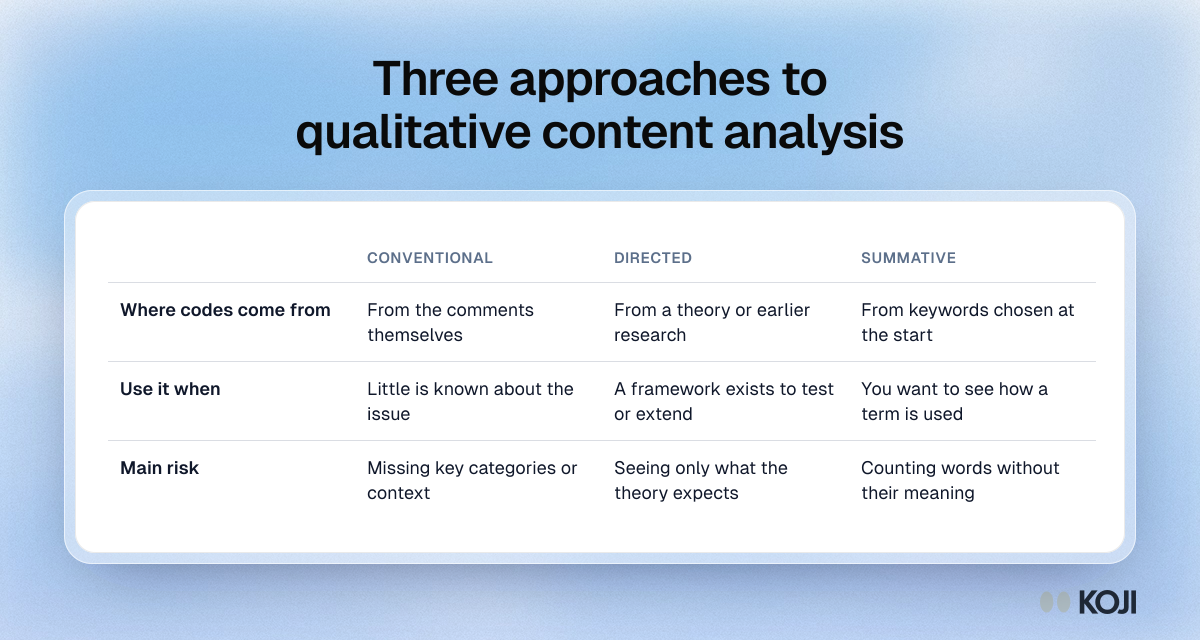
Three approaches to qualitative content analysis
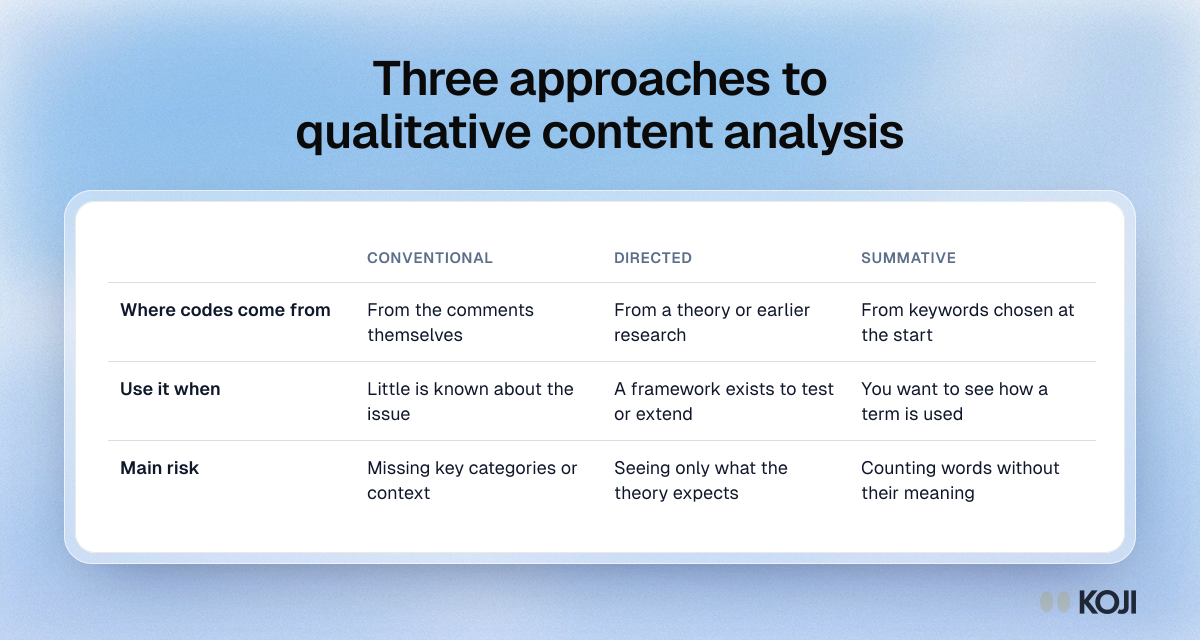
A comparison of the three approaches to qualitative content analysis set out by Hsieh and Shannon (2005): conventional, directed and summative. It is for quality officers and researchers who code open-text course feedback and need to choose a method and explain that choice in a report. Koji codes interview answers into themes that come from the data, which is closest to the conventional approach.
What's in this reference table
| Conventional | Directed | Summative | |
|---|---|---|---|
| Where codes come from | From the comments themselves | From a theory or earlier research | From keywords chosen at the start |
| Use it when | Little is known about the issue | A framework exists to test or extend | You want to see how a term is used |
| Main risk | Missing key categories or context | Seeing only what the theory expects | Counting words without their meaning |
Use this image
Free to use in your docs, decks and posts under CC BY 4.0, as long as you credit Koji with a link to this page. To embed it, paste this into your page:
html
<a href="https://www.koji.so/visuals/qualitative-content-analysis-three-approaches-compared"><img src="https://www.koji.so/visuals/qualitative-content-analysis-three-approaches-compared/qualitative-content-analysis-three-approaches-compared.png" alt="Table comparing conventional, directed and summative qualitative content analysis by where codes come from, when to use each and the main risk." width="1200" height="640" /></a>
<p>Source: <a href="https://www.koji.so/visuals/qualitative-content-analysis-three-approaches-compared">Three approaches to qualitative content analysis</a>, Koji</p>