Reference table
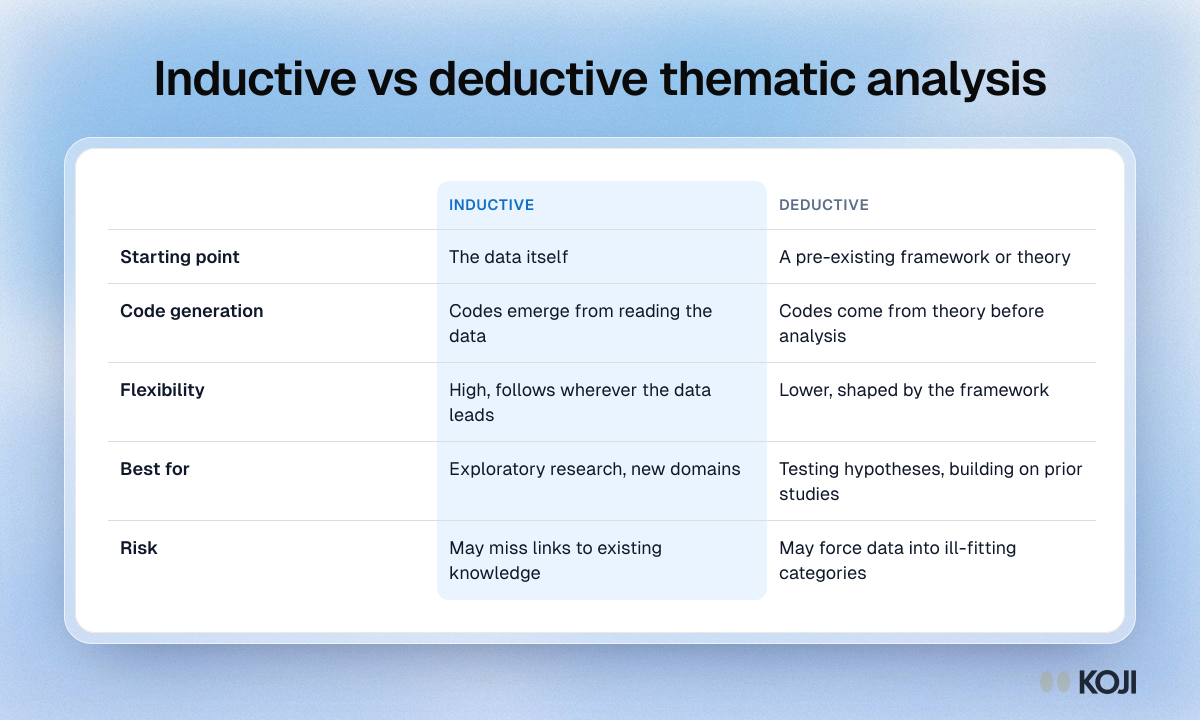
Inductive vs deductive thematic analysis
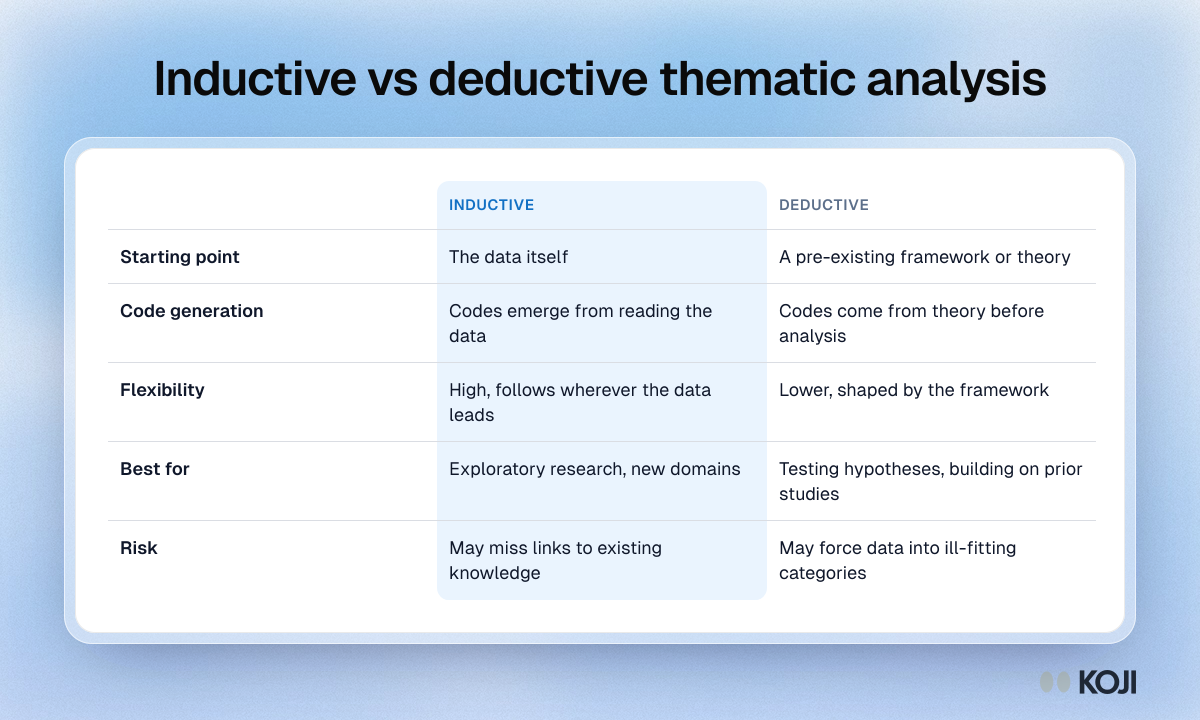
A side-by-side comparison of inductive and deductive thematic analysis. It covers where each approach starts, how codes are generated, how flexible it is, what it suits and where it can go wrong. Use it to choose a coding approach before you start analyzing interviews. Many product teams mix the two.
Where this appears
What's in this reference table
| Inductive | Deductive | |
|---|---|---|
| Starting point | The data itself | A pre-existing framework or theory |
| Code generation | Codes emerge from reading the data | Codes come from theory before analysis |
| Flexibility | High, follows wherever the data leads | Lower, shaped by the framework |
| Best for | Exploratory research, new domains | Testing hypotheses, building on prior studies |
| Risk | May miss links to existing knowledge | May force data into ill-fitting categories |
Use this image
Free to use in your docs, decks and posts under CC BY 4.0, as long as you credit Koji with a link to this page. To embed it, paste this into your page:
html
<a href="https://www.koji.so/visuals/inductive-vs-deductive-thematic-analysis-comparison"><img src="https://www.koji.so/visuals/inductive-vs-deductive-thematic-analysis-comparison/inductive-vs-deductive-thematic-analysis-comparison.png" alt="Table comparing inductive and deductive thematic analysis on starting point, code generation, flexibility, best use and risk." width="1200" height="720" /></a>
<p>Source: <a href="https://www.koji.so/visuals/inductive-vs-deductive-thematic-analysis-comparison">Inductive vs deductive thematic analysis</a>, Koji</p>