Comparison
10-point vs 6-point teaching evaluation scales and the gender gap
What happened when one professional school cut its scale from 10 points to 6
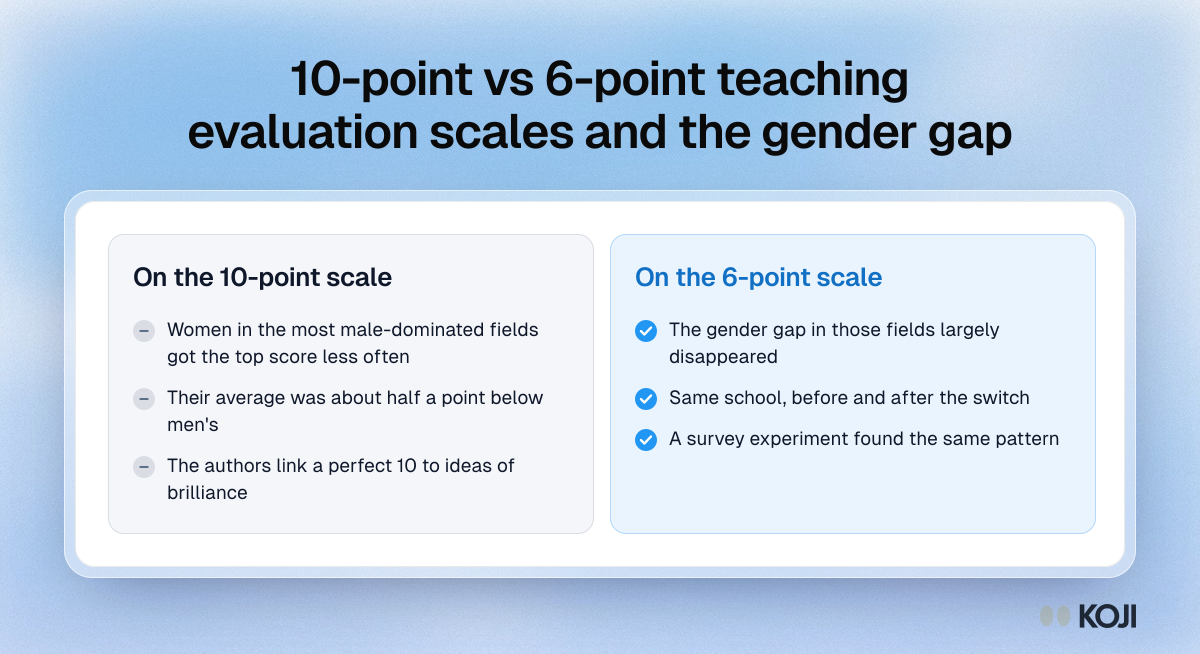
A side-by-side summary of Rivera and Tilcsik's 2019 study of 105,034 student ratings of 369 instructors at a professional school that switched its teaching evaluations from a 10-point to a 6-point scale. For quality and institutional research staff reviewing whether scale length affects how gender bias shows up in teaching scores. Use it in instrument reviews and promotion-committee briefings. Koji lets evaluation owners pick the range of each scale question, including 1 to 6.
What's in this comparison
On the 10-point scale
- Women in the most male-dominated fields got the top score less often
- Their average was about half a point below men's
- The authors link a perfect 10 to ideas of brilliance
On the 6-point scale
- The gender gap in those fields largely disappeared
- Same school, before and after the switch
- A survey experiment found the same pattern
Use this image
Free to use in your docs, decks and posts under CC BY 4.0, as long as you credit Koji with a link to this page. To embed it, paste this into your page:
html
<a href="https://www.koji.so/visuals/rating-scale-length-gender-gap-10-vs-6-point"><img src="https://www.koji.so/visuals/rating-scale-length-gender-gap-10-vs-6-point/rating-scale-length-gender-gap-10-vs-6-point.png" alt="Comparison of 10-point and 6-point teaching scales: women in male-dominated fields scored lower on 10 points, a gap that largely disappeared on 6" width="1200" height="654" /></a>
<p>Source: <a href="https://www.koji.so/visuals/rating-scale-length-gender-gap-10-vs-6-point">10-point vs 6-point teaching evaluation scales and the gender gap</a>, Koji</p>