Reference table
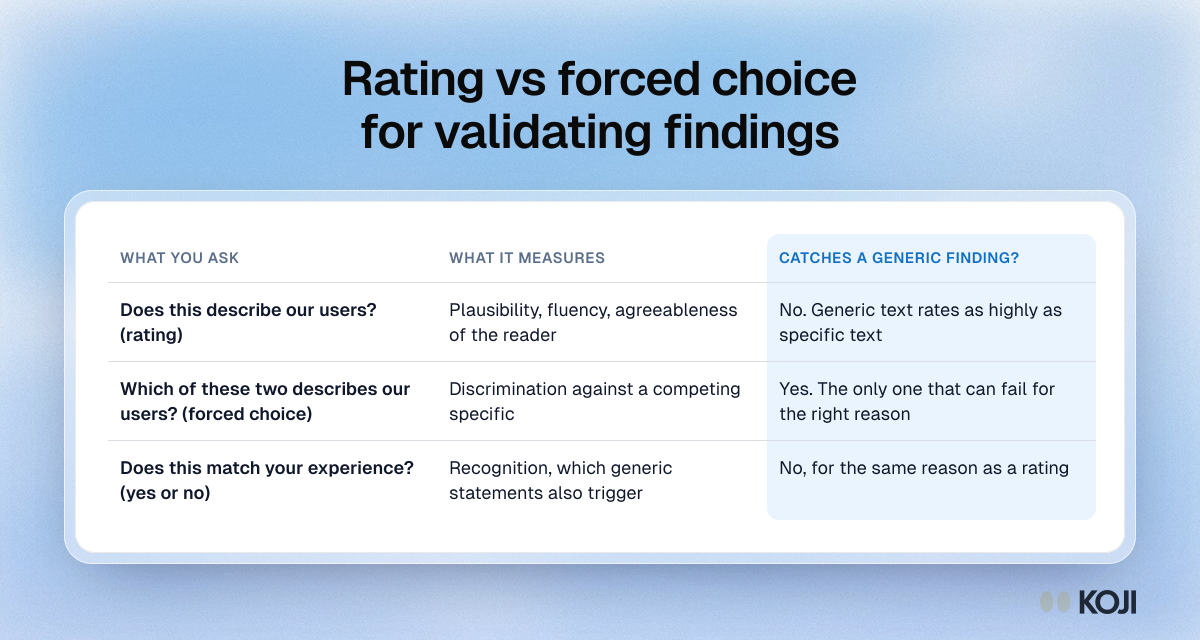
Rating vs forced choice for validating findings
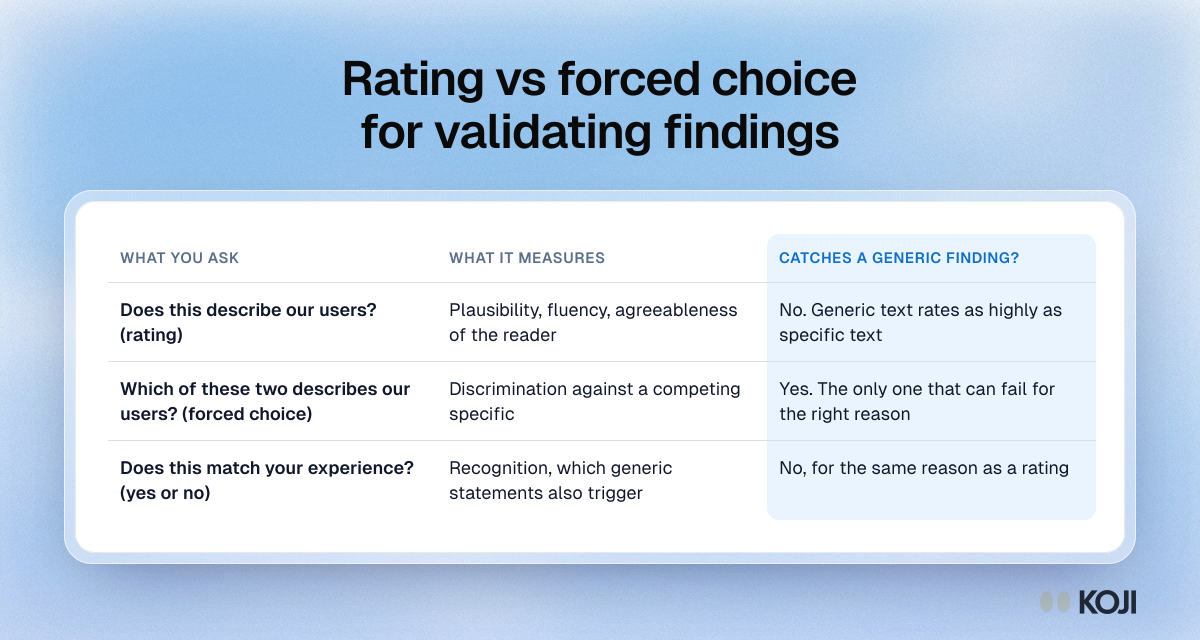
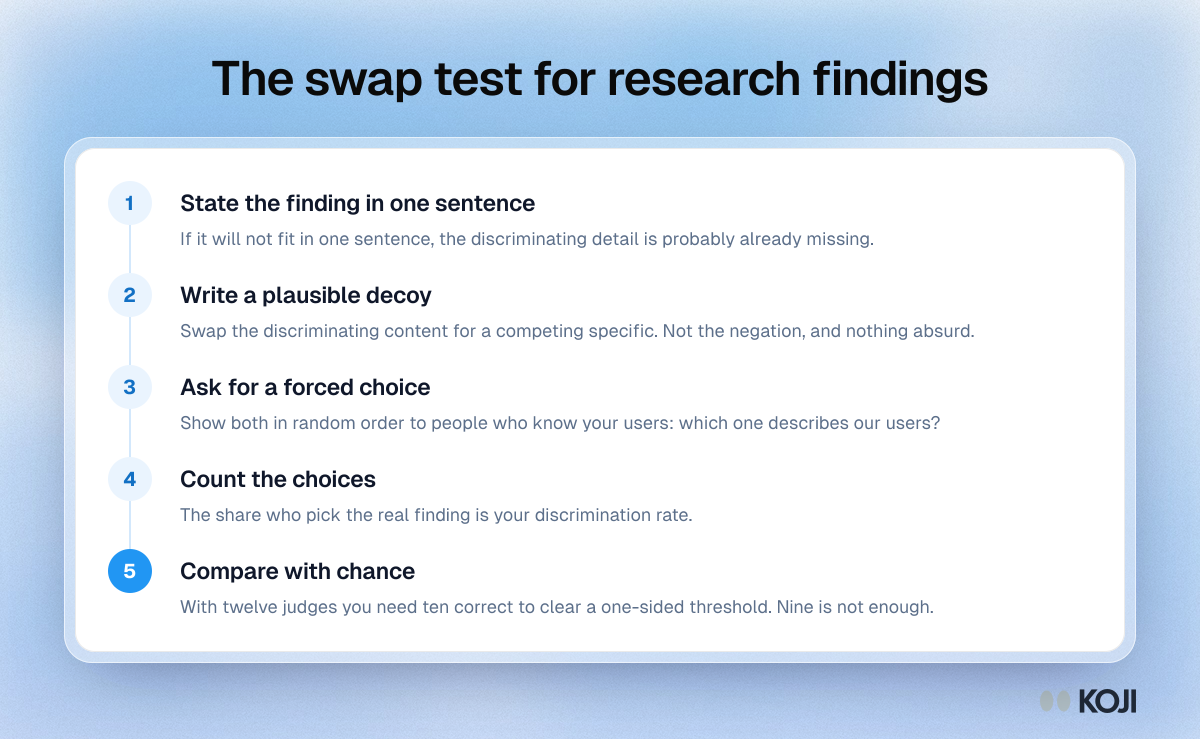
A reference table comparing three ways teams check a research finding with stakeholders: an accuracy rating, a forced choice between the finding and a decoy, and a yes or no recognition question. Only the forced choice can tell a finding about your users from one that would fit any company, as Wyman and Vyse showed with personality and astrology summaries. Use it to choose how to validate a readout before it goes on a slide.
Where this appears
What's in this reference table
| What you ask | What it measures | Catches a generic finding? |
|---|---|---|
| Does this describe our users? (rating) | Plausibility, fluency, agreeableness of the reader | No. Generic text rates as highly as specific text |
| Which of these two describes our users? (forced choice) | Discrimination against a competing specific | Yes. The only one that can fail for the right reason |
| Does this match your experience? (yes or no) | Recognition, which generic statements also trigger | No, for the same reason as a rating |
Use this image
Free to use in your docs, decks and posts under CC BY 4.0, as long as you credit Koji with a link to this page. To embed it, paste this into your page:
html
<a href="https://www.koji.so/visuals/rating-vs-forced-choice-generic-findings"><img src="https://www.koji.so/visuals/rating-vs-forced-choice-generic-findings/rating-vs-forced-choice-generic-findings.png" alt="Table comparing a rating, a forced choice and a yes or no question for validating findings: only the forced choice can catch a generic one." width="1200" height="640" /></a>
<p>Source: <a href="https://www.koji.so/visuals/rating-vs-forced-choice-generic-findings">Rating vs forced choice for validating findings</a>, Koji</p>