Process
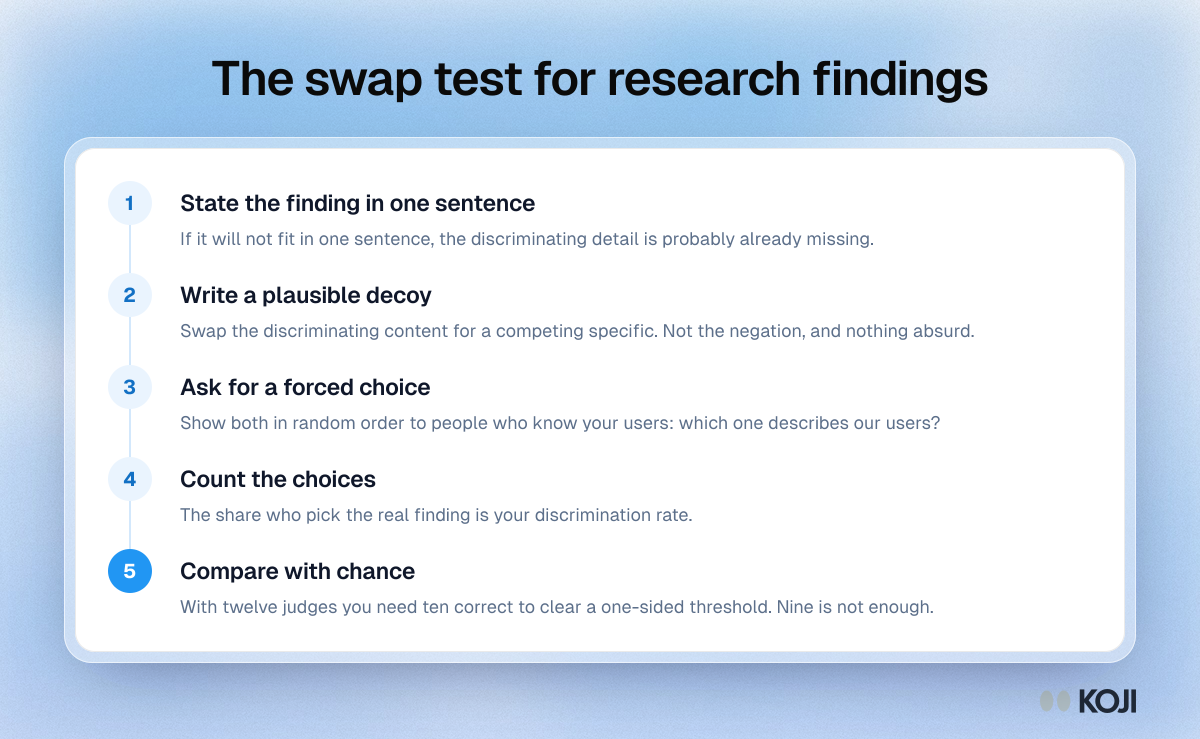
The swap test for research findings
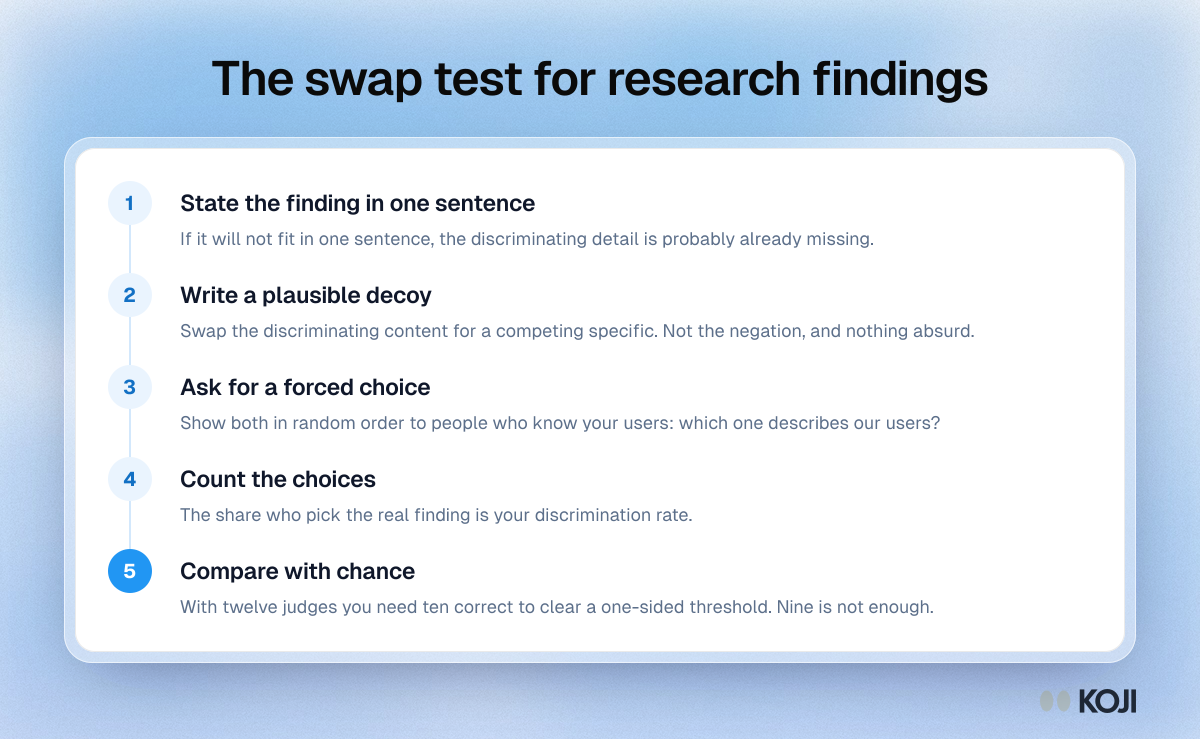
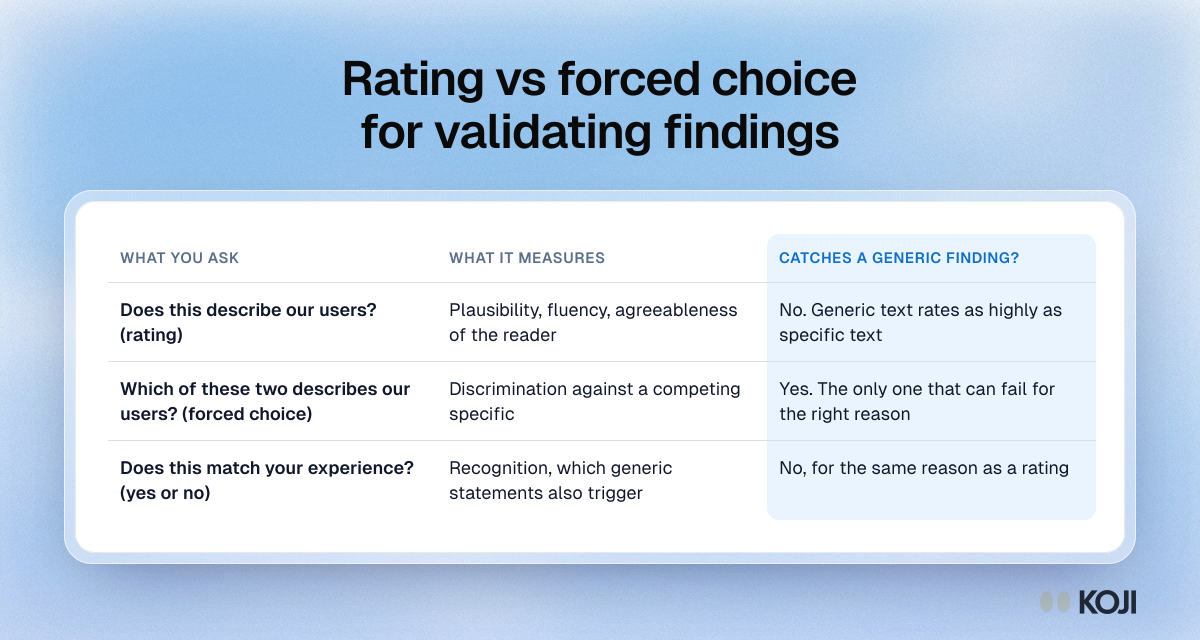
A five-step procedure for checking whether a research finding says anything specific about your users. You pit the finding against a plausible decoy, ask people who know your users to choose between them, and compare the count with what chance would give. It replaces the room nodding along with a result that can fail, and the forced choice can run as a single choice question in a Koji study.
Where this appears
What's in this process
- State the finding in one sentence: If it will not fit in one sentence, the discriminating detail is probably already missing.
- Write a plausible decoy: Swap the discriminating content for a competing specific. Not the negation, and nothing absurd.
- Ask for a forced choice: Show both in random order to people who know your users: which one describes our users?
- Count the choices: The share who pick the real finding is your discrimination rate.
- Compare with chance: With twelve judges you need ten correct to clear a one-sided threshold. Nine is not enough.
Use this image
Free to use in your docs, decks and posts under CC BY 4.0, as long as you credit Koji with a link to this page. To embed it, paste this into your page:
html
<a href="https://www.koji.so/visuals/swap-test-research-findings-steps"><img src="https://www.koji.so/visuals/swap-test-research-findings-steps/swap-test-research-findings-steps.png" alt="Five-step process for the swap test: state the finding, write a plausible decoy, ask for a forced choice, count the choices, then compare with chance." width="1200" height="739" /></a>
<p>Source: <a href="https://www.koji.so/visuals/swap-test-research-findings-steps">The swap test for research findings</a>, Koji</p>