Process
Five levels of careers service evidence
From who used the service to where graduates ended up
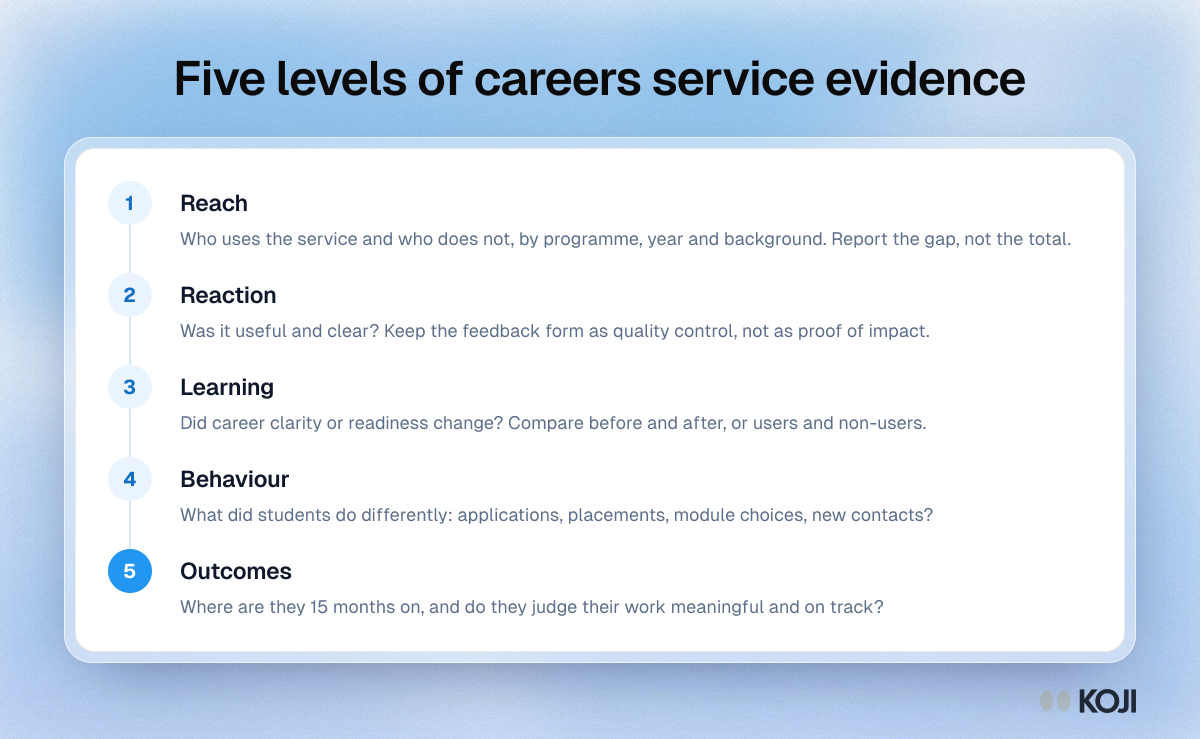
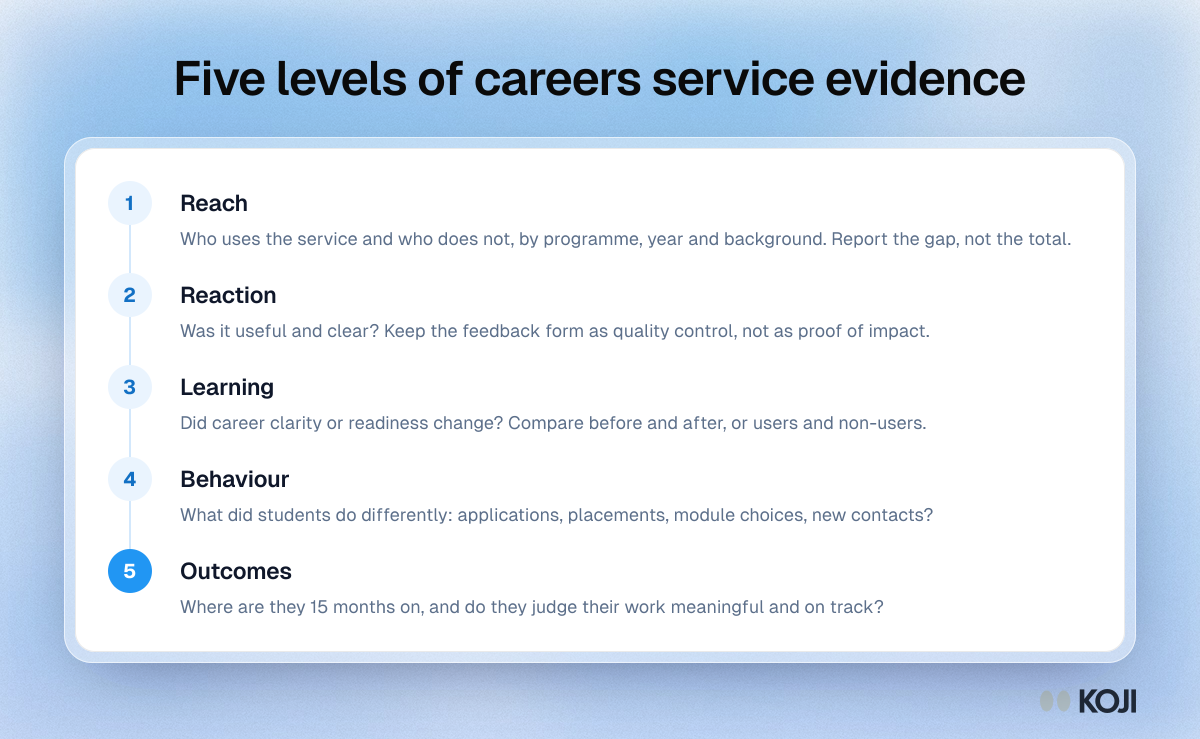
A five-step process for evaluating a university careers service, moving from reach and reaction to learning, behaviour and graduate outcomes. It is meant for careers managers and quality leads who want evidence of impact beyond appointment counts and satisfaction scores. Keep each level separate and say how much of the final outcome the service can claim. Koji can collect the learning and behaviour evidence through short conversational interviews.
What's in this process
- Reach: Who uses the service and who does not, by programme, year and background. Report the gap, not the total.
- Reaction: Was it useful and clear? Keep the feedback form as quality control, not as proof of impact.
- Learning: Did career clarity or readiness change? Compare before and after, or users and non-users.
- Behaviour: What did students do differently: applications, placements, module choices, new contacts?
- Outcomes: Where are they 15 months on, and do they judge their work meaningful and on track?
Use this image
Free to use in your docs, decks and posts under CC BY 4.0, as long as you credit Koji with a link to this page. To embed it, paste this into your page:
html
<a href="https://www.koji.so/visuals/careers-service-evaluation-five-levels-of-evidence"><img src="https://www.koji.so/visuals/careers-service-evaluation-five-levels-of-evidence/careers-service-evaluation-five-levels-of-evidence.png" alt="Process showing five levels of careers service evidence: reach, reaction, learning, behaviour and outcomes, each with what to measure." width="1200" height="739" /></a>
<p>Source: <a href="https://www.koji.so/visuals/careers-service-evaluation-five-levels-of-evidence">Five levels of careers service evidence</a>, Koji</p>