Process
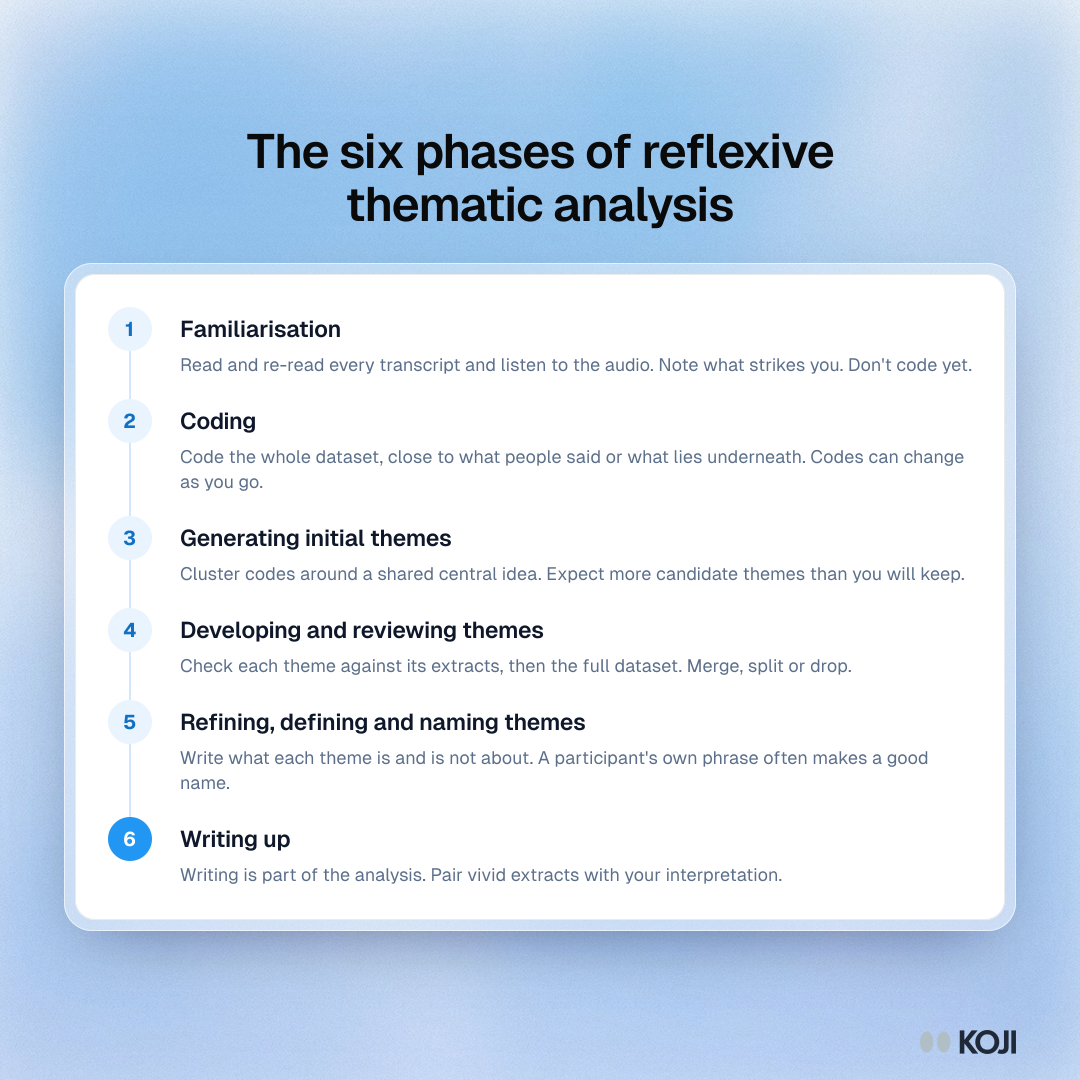
The six phases of reflexive thematic analysis
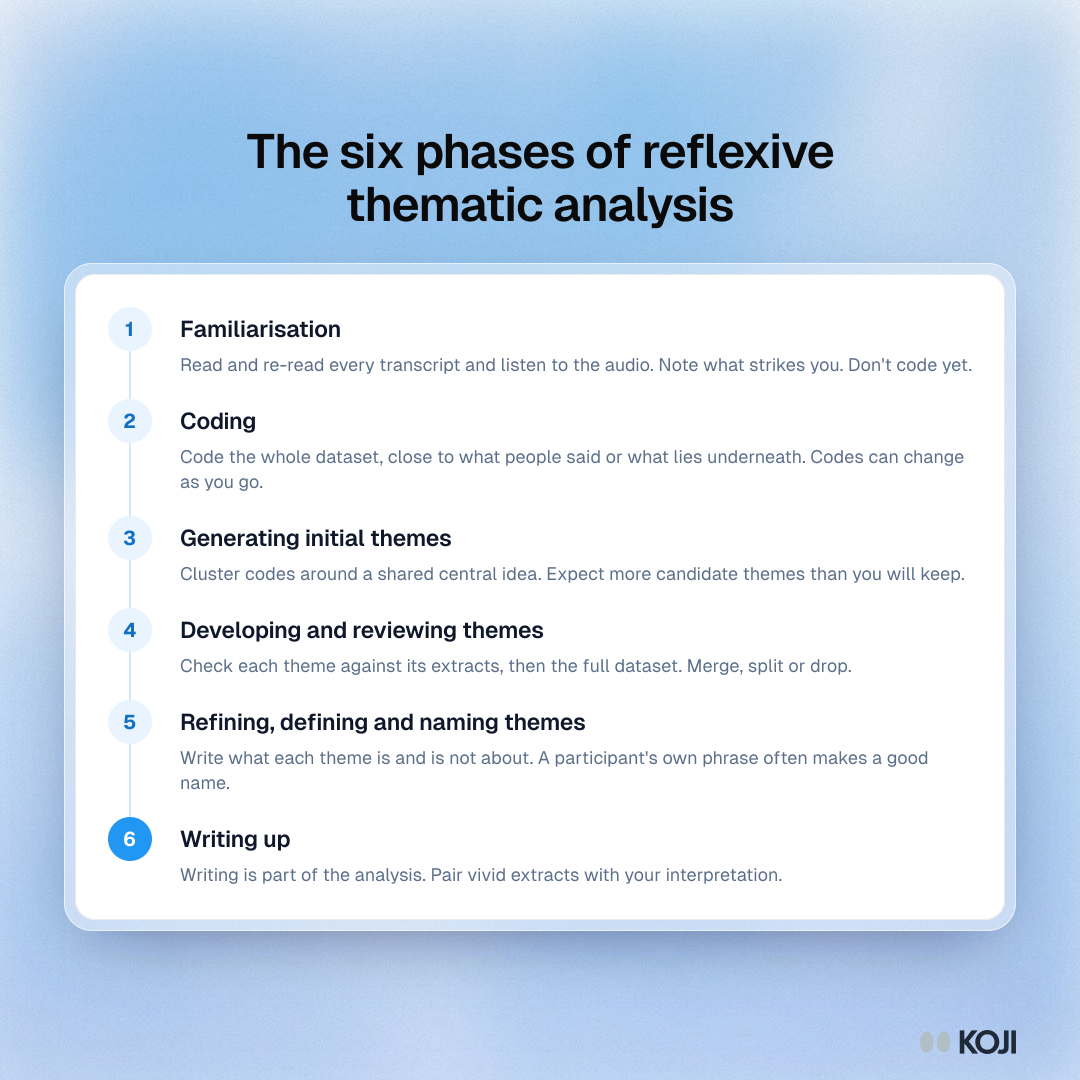
The six phases of Braun and Clarke's reflexive thematic analysis, using the names from their later writing, which stress that themes are generated rather than found. Use it as a checklist while you analyse interviews, and remember the phases are recursive. Koji can collect and transcribe the interviews so more of your time goes into phases 2 to 6.
Where this appears
What's in this process
- Familiarisation: Read and re-read every transcript and listen to the audio. Note what strikes you. Don't code yet.
- Coding: Code the whole dataset, close to what people said or what lies underneath. Codes can change as you go.
- Generating initial themes: Cluster codes around a shared central idea. Expect more candidate themes than you will keep.
- Developing and reviewing themes: Check each theme against its extracts, then the full dataset. Merge, split or drop.
- Refining, defining and naming themes: Write what each theme is and is not about. A participant's own phrase often makes a good name.
- Writing up: Writing is part of the analysis. Pair vivid extracts with your interpretation.
Use this image
Free to use in your docs, decks and posts under CC BY 4.0, as long as you credit Koji with a link to this page. To embed it, paste this into your page:
html
<a href="https://www.koji.so/visuals/reflexive-thematic-analysis-six-phases"><img src="https://www.koji.so/visuals/reflexive-thematic-analysis-six-phases/reflexive-thematic-analysis-six-phases.png" alt="Process showing the six phases of reflexive thematic analysis: familiarisation, coding, initial themes, reviewing, naming themes and writing up." width="1080" height="1080" /></a>
<p>Source: <a href="https://www.koji.so/visuals/reflexive-thematic-analysis-six-phases">The six phases of reflexive thematic analysis</a>, Koji</p>