Reference table
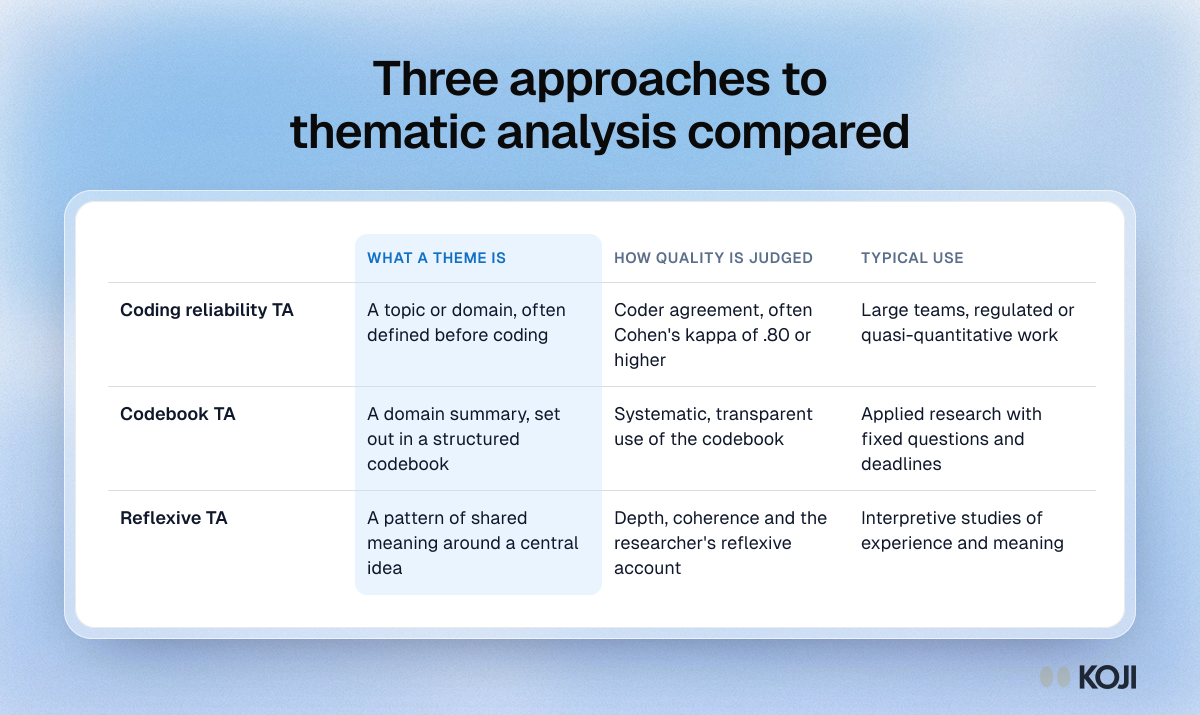
Three approaches to thematic analysis compared
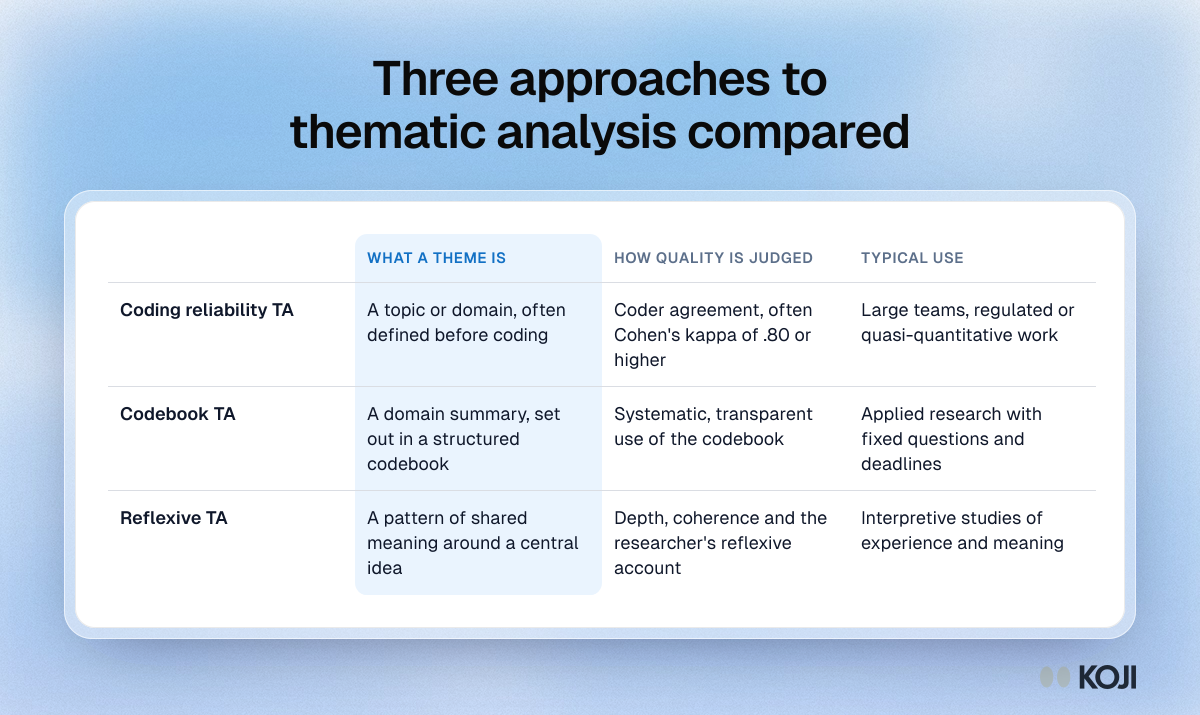
A side-by-side view of the three families of thematic analysis: coding reliability, codebook (framework, template and matrix analysis) and Braun and Clarke's reflexive approach. It shows what each one means by a theme and how each judges quality, so you can choose the right one before you start coding and avoid mixing them.
Where this appears
What's in this reference table
| What a theme is | How quality is judged | Typical use | |
|---|---|---|---|
| Coding reliability TA | A topic or domain, often defined before coding | Coder agreement, often Cohen's kappa of .80 or higher | Large teams, regulated or quasi-quantitative work |
| Codebook TA | A domain summary, set out in a structured codebook | Systematic, transparent use of the codebook | Applied research with fixed questions and deadlines |
| Reflexive TA | A pattern of shared meaning around a central idea | Depth, coherence and the researcher's reflexive account | Interpretive studies of experience and meaning |
Use this image
Free to use in your docs, decks and posts under CC BY 4.0, as long as you credit Koji with a link to this page. To embed it, paste this into your page:
html
<a href="https://www.koji.so/visuals/three-approaches-to-thematic-analysis-compared"><img src="https://www.koji.so/visuals/three-approaches-to-thematic-analysis-compared/three-approaches-to-thematic-analysis-compared.png" alt="Table comparing coding reliability, codebook and reflexive thematic analysis on what a theme is, how quality is judged and typical use." width="1200" height="715" /></a>
<p>Source: <a href="https://www.koji.so/visuals/three-approaches-to-thematic-analysis-compared">Three approaches to thematic analysis compared</a>, Koji</p>