Comparison
Secondary vs primary market research
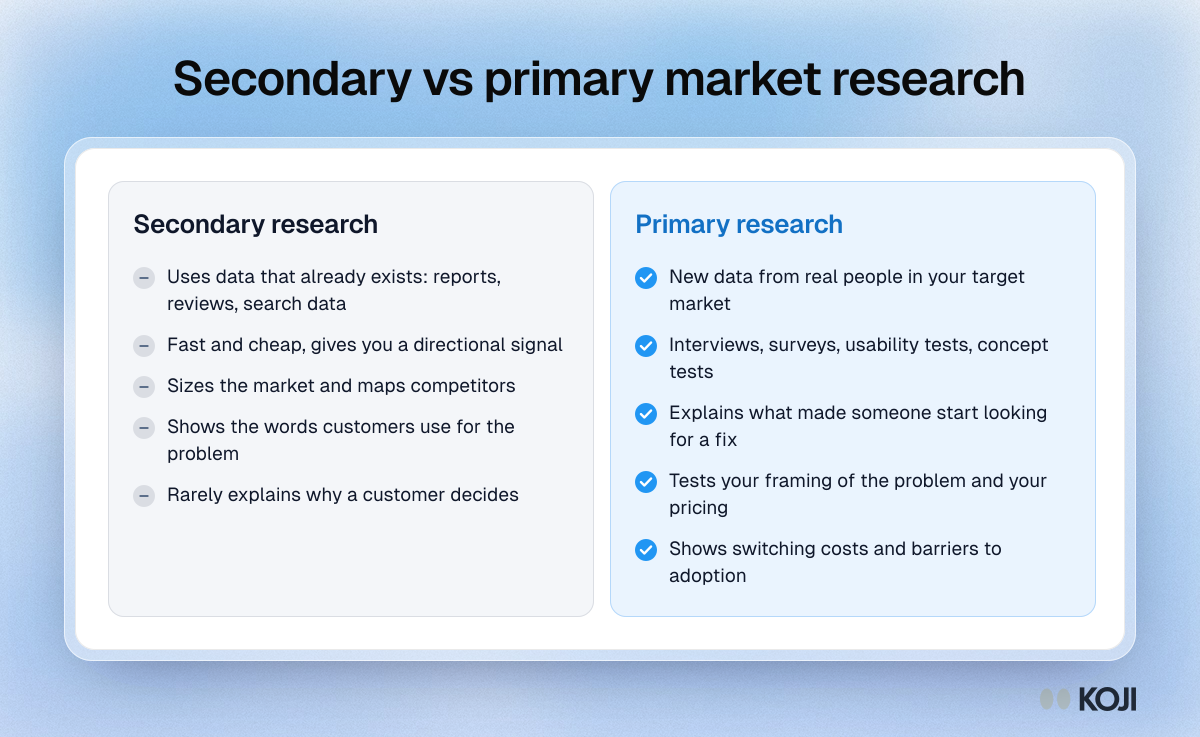
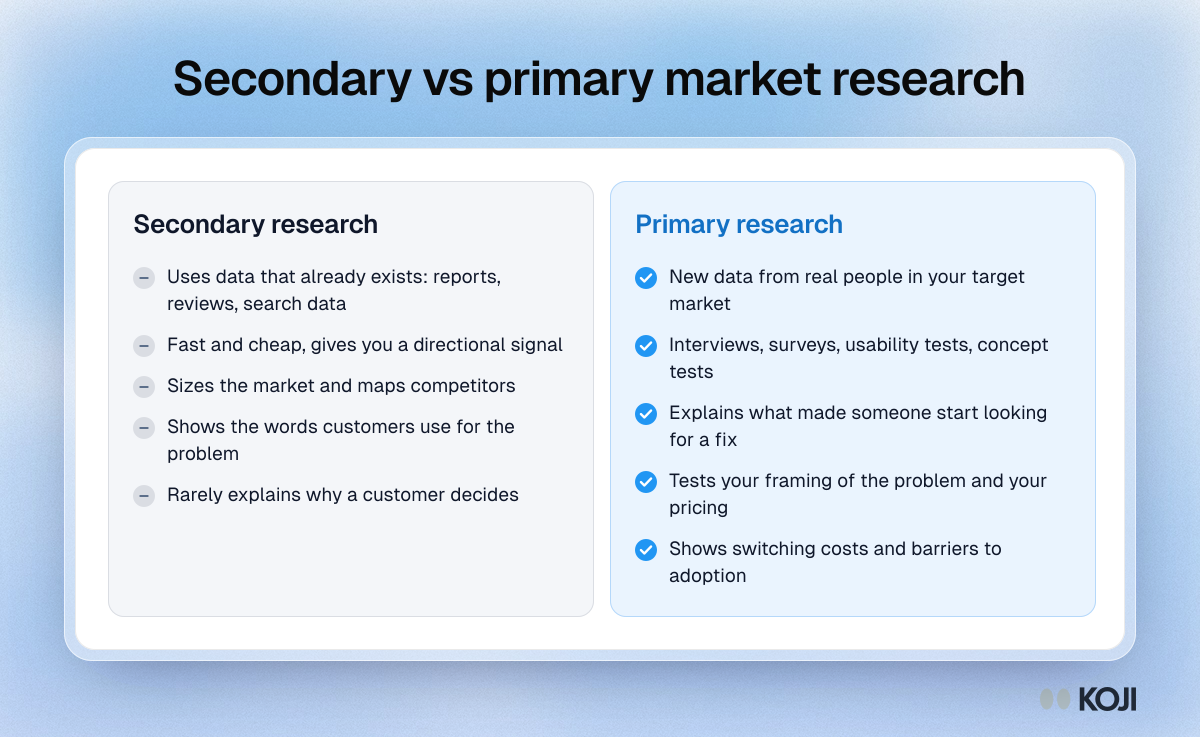
A side-by-side of secondary and primary market research for a new product. Secondary research uses existing reports, reviews and search data to size the market and map competitors; primary research collects new data from people in your target market to explain triggers, test framing and pricing, and find barriers to switching. Founders and product teams can use it to plan which to do first. Koji runs the primary side as AI-moderated interviews, voice or text.
Where this appears
What's in this comparison
Secondary research
- Uses data that already exists: reports, reviews, search data
- Fast and cheap, gives you a directional signal
- Sizes the market and maps competitors
- Shows the words customers use for the problem
- Rarely explains why a customer decides
Primary research
- New data from real people in your target market
- Interviews, surveys, usability tests, concept tests
- Explains what made someone start looking for a fix
- Tests your framing of the problem and your pricing
- Shows switching costs and barriers to adoption
Use this image
Free to use in your docs, decks and posts under CC BY 4.0, as long as you credit Koji with a link to this page. To embed it, paste this into your page:
html
<a href="https://www.koji.so/visuals/secondary-vs-primary-market-research-comparison"><img src="https://www.koji.so/visuals/secondary-vs-primary-market-research-comparison/secondary-vs-primary-market-research-comparison.png" alt="Comparison of secondary and primary market research: existing data that sizes the market versus new data from customers that explains why they decide." width="1200" height="737" /></a>
<p>Source: <a href="https://www.koji.so/visuals/secondary-vs-primary-market-research-comparison">Secondary vs primary market research</a>, Koji</p>