Reference table
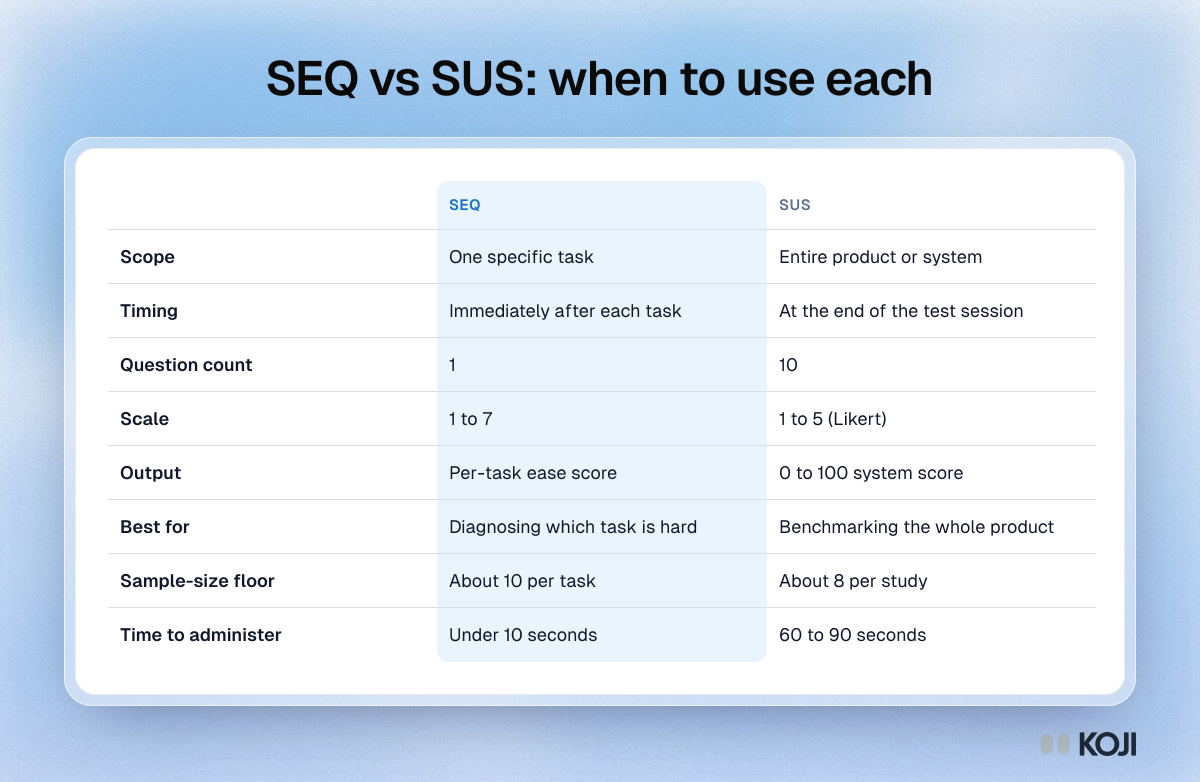
SEQ vs SUS: when to use each
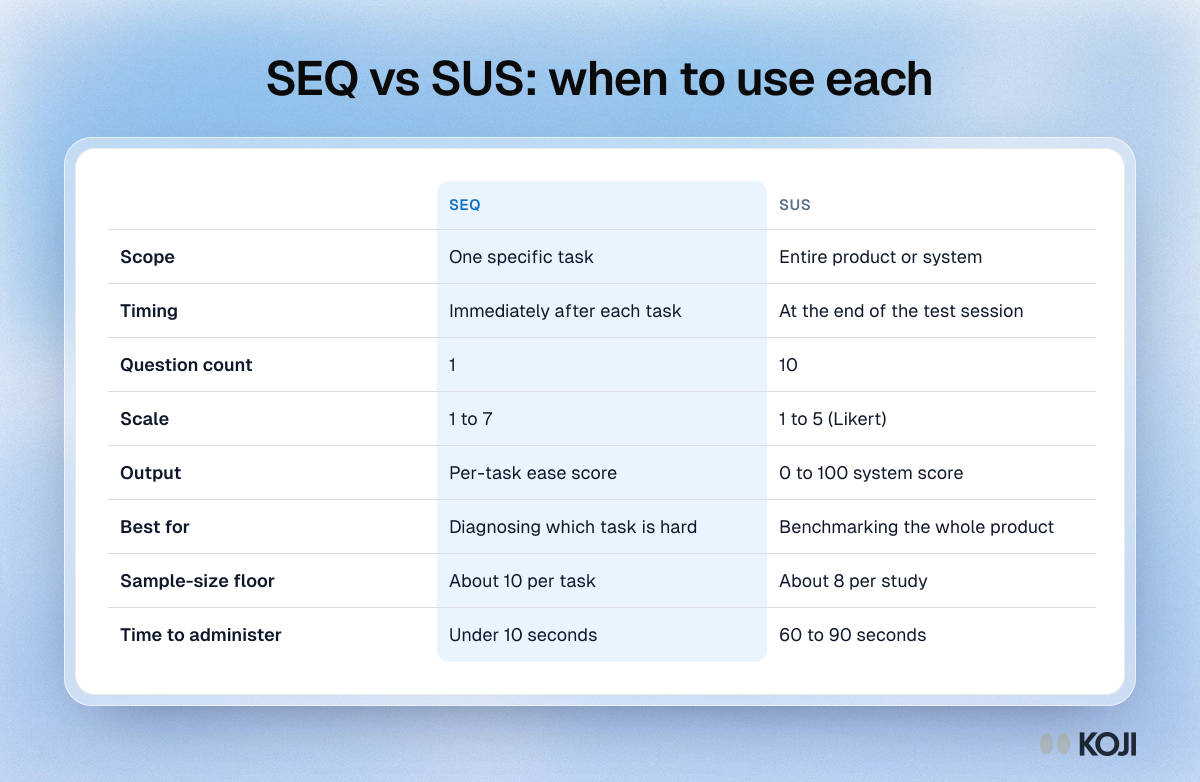
A side-by-side comparison of the Single Ease Question (SEQ) and the System Usability Scale (SUS). SEQ is one question about one task, asked straight after it. SUS is ten questions about the whole product, asked at the end of the session. Use SEQ to find which task is hard and SUS to benchmark the product.
Where this appears
What's in this reference table
| SEQ | SUS | |
|---|---|---|
| Scope | One specific task | Entire product or system |
| Timing | Immediately after each task | At the end of the test session |
| Question count | 1 | 10 |
| Scale | 1 to 7 | 1 to 5 (Likert) |
| Output | Per-task ease score | 0 to 100 system score |
| Best for | Diagnosing which task is hard | Benchmarking the whole product |
| Sample-size floor | About 10 per task | About 8 per study |
| Time to administer | Under 10 seconds | 60 to 90 seconds |
Use this image
Free to use in your docs, decks and posts under CC BY 4.0, as long as you credit Koji with a link to this page. To embed it, paste this into your page:
html
<a href="https://www.koji.so/visuals/seq-vs-sus-comparison-table"><img src="https://www.koji.so/visuals/seq-vs-sus-comparison-table/seq-vs-sus-comparison-table.png" alt="Table comparing the Single Ease Question and the System Usability Scale on scope, timing, question count, scale, output, sample size and time to administer." width="1200" height="782" /></a>
<p>Source: <a href="https://www.koji.so/visuals/seq-vs-sus-comparison-table">SEQ vs SUS: when to use each</a>, Koji</p>