Process
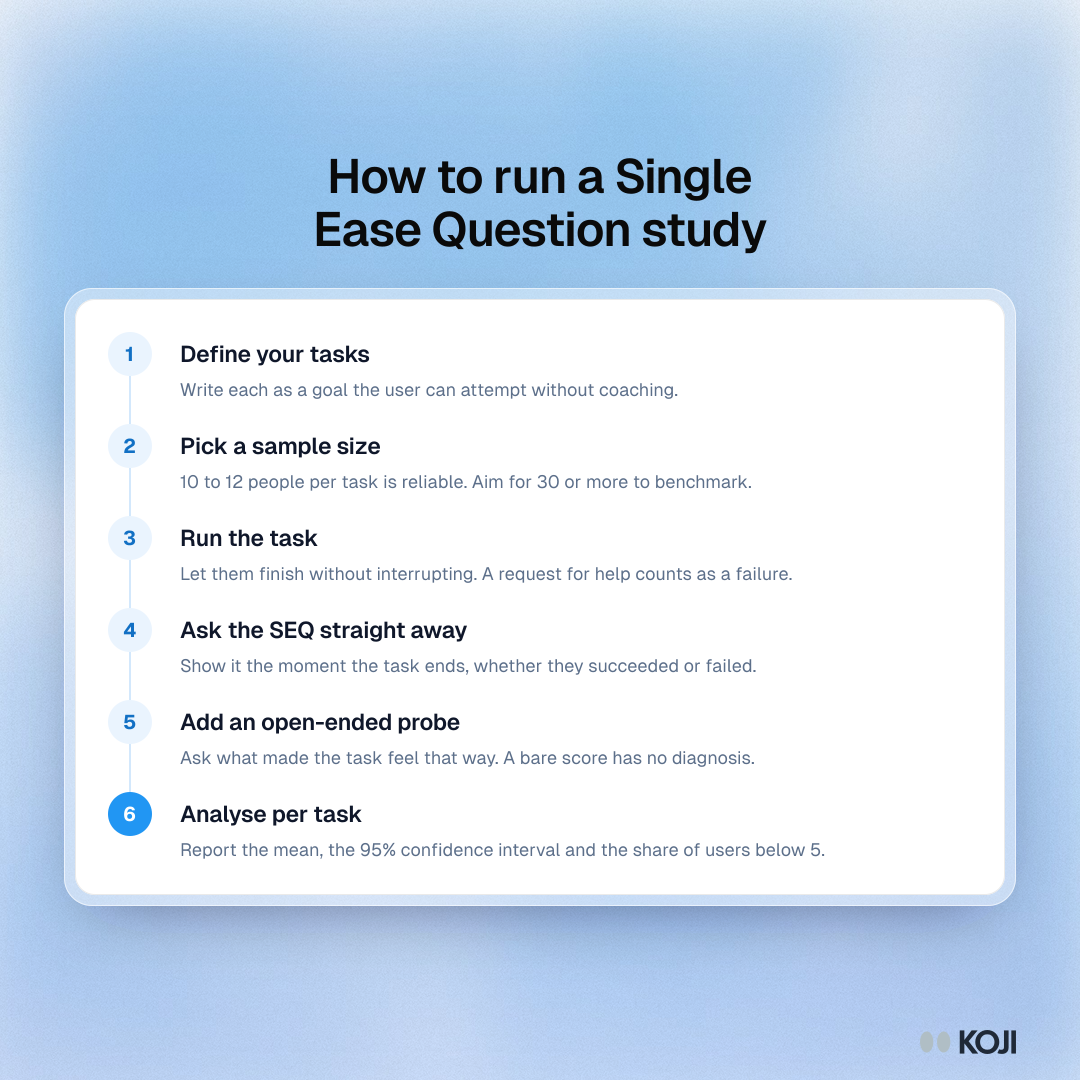
How to run a Single Ease Question study
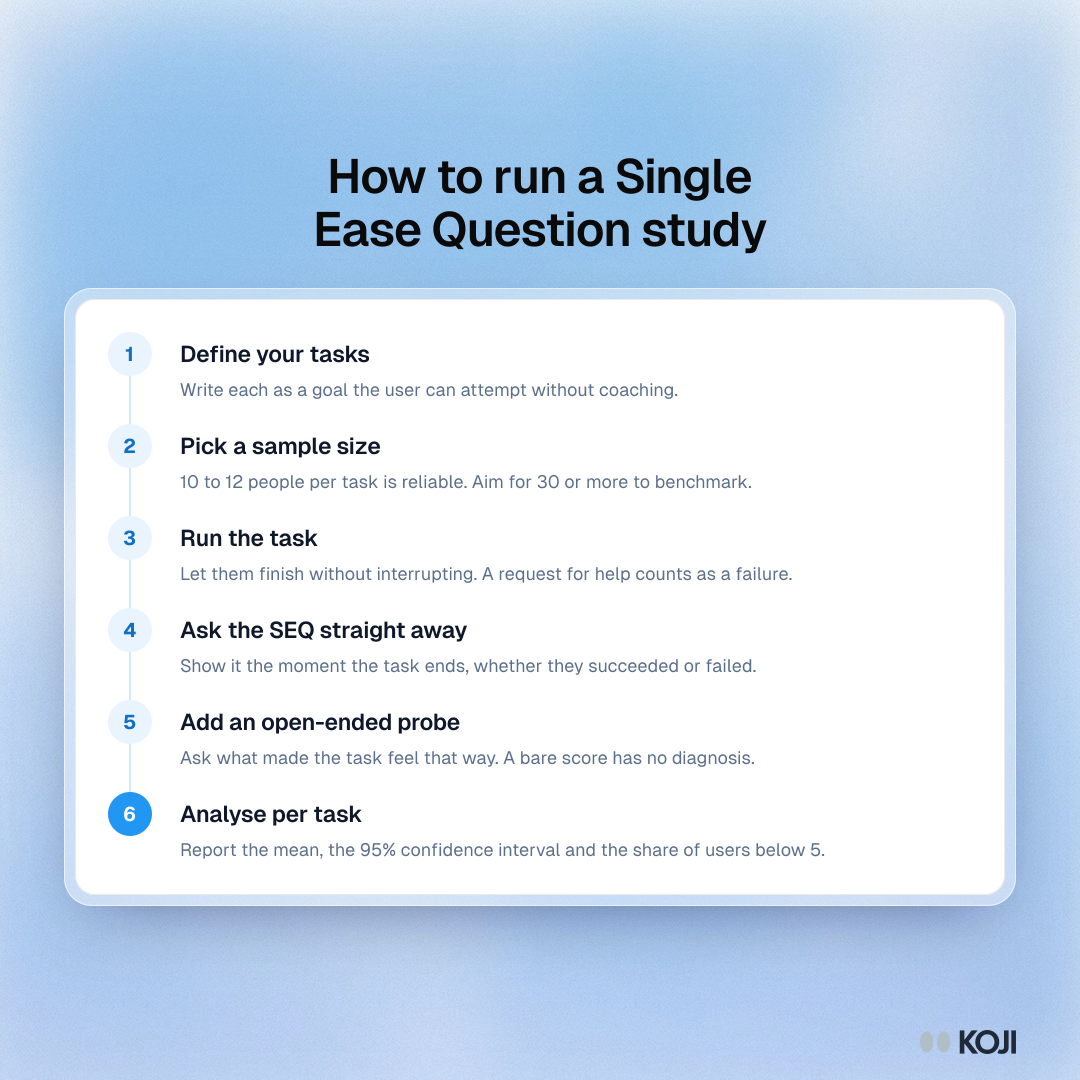
A six-step process for running a Single Ease Question (SEQ) study in a usability test. Define tasks, choose a sample size, run each task, ask the SEQ straight after, add an open-ended probe and analyse the results per task. It is for UX researchers and product teams who want a task-level ease score they can act on.
Where this appears
What's in this process
- Define your tasks: Write each as a goal the user can attempt without coaching.
- Pick a sample size: 10 to 12 people per task is reliable. Aim for 30 or more to benchmark.
- Run the task: Let them finish without interrupting. A request for help counts as a failure.
- Ask the SEQ straight away: Show it the moment the task ends, whether they succeeded or failed.
- Add an open-ended probe: Ask what made the task feel that way. A bare score has no diagnosis.
- Analyse per task: Report the mean, the 95% confidence interval and the share of users below 5.
Use this image
Free to use in your docs, decks and posts under CC BY 4.0, as long as you credit Koji with a link to this page. To embed it, paste this into your page:
html
<a href="https://www.koji.so/visuals/seq-study-six-steps"><img src="https://www.koji.so/visuals/seq-study-six-steps/seq-study-six-steps.png" alt="Six steps to run a Single Ease Question study, from defining tasks and sample size to asking the SEQ, adding an open-ended probe and analysing per task." width="1080" height="1080" /></a>
<p>Source: <a href="https://www.koji.so/visuals/seq-study-six-steps">How to run a Single Ease Question study</a>, Koji</p>