Comparison
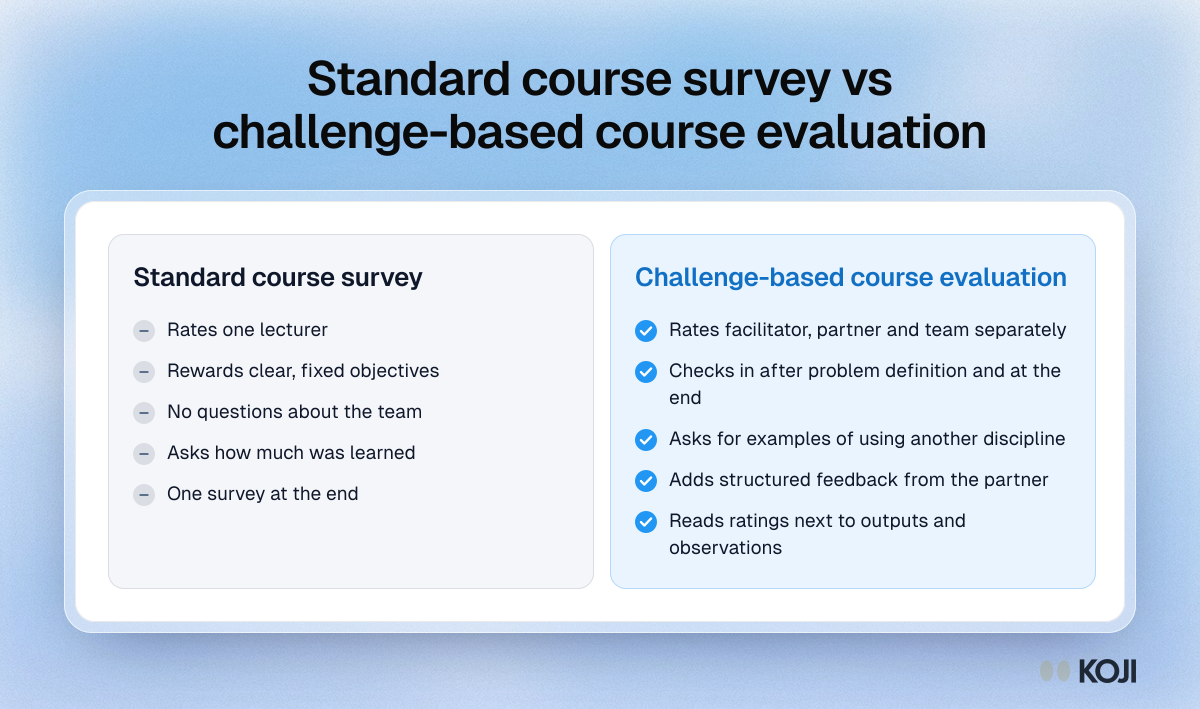
Standard course survey vs challenge-based course evaluation
What to change when students define the problem and work in mixed teams
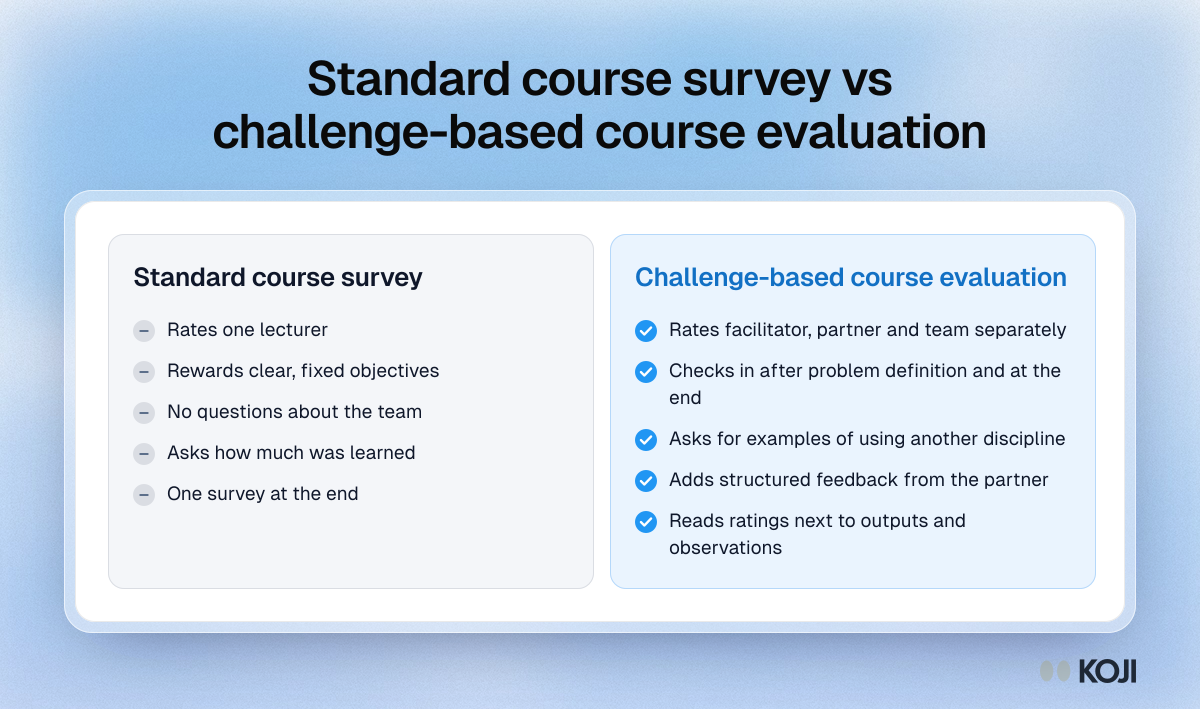
A side-by-side guide for quality and teaching teams evaluating challenge-based or interdisciplinary courses. It shows where a standard end-of-course questionnaire misfires and what a fitted evaluation asks instead: separate ratings for facilitator, partner and team, a mid-course check-in, examples of integration and partner feedback. Koji can run the mid-course and end-of-course interviews with follow-up questions.
What's in this comparison
Standard course survey
- Rates one lecturer
- Rewards clear, fixed objectives
- No questions about the team
- Asks how much was learned
- One survey at the end
Challenge-based course evaluation
- Rates facilitator, partner and team separately
- Checks in after problem definition and at the end
- Asks for examples of using another discipline
- Adds structured feedback from the partner
- Reads ratings next to outputs and observations
Use this image
Free to use in your docs, decks and posts under CC BY 4.0, as long as you credit Koji with a link to this page. To embed it, paste this into your page:
html
<a href="https://www.koji.so/visuals/standard-survey-vs-challenge-based-course-evaluation"><img src="https://www.koji.so/visuals/standard-survey-vs-challenge-based-course-evaluation/standard-survey-vs-challenge-based-course-evaluation.png" alt="Comparison of a standard course survey with an evaluation built for challenge-based courses, set out across who is rated, what is asked and when." width="1200" height="709" /></a>
<p>Source: <a href="https://www.koji.so/visuals/standard-survey-vs-challenge-based-course-evaluation">Standard course survey vs challenge-based course evaluation</a>, Koji</p>