Bar chart
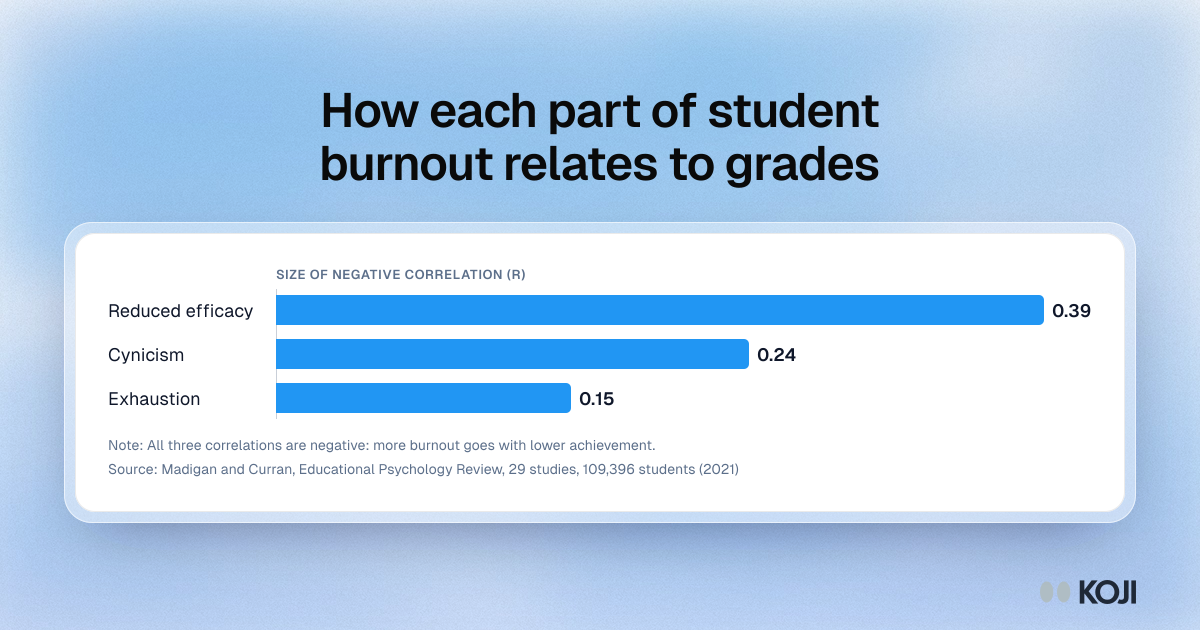
How each part of student burnout relates to grades
Pooled correlations from 29 studies and 109,396 students
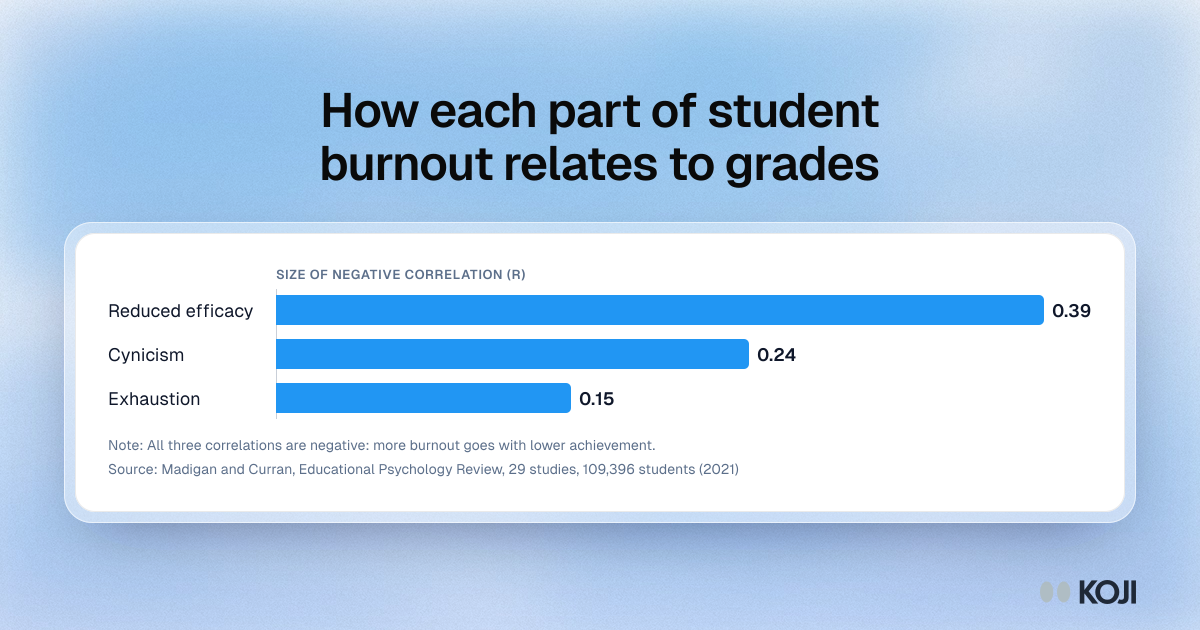
Correlations between three dimensions of student burnout and academic achievement, from Madigan and Curran's 2021 meta-analysis of 29 studies with 109,396 students. Reduced efficacy shows the strongest link and exhaustion the weakest. For quality teams, it suggests that course evaluations asking only about workload miss the stronger signal: whether students feel they are making progress. Koji course evaluations can pair a progress rating with a follow-up asking what is behind the score.
What's in this bar chart
| Correlation with achievement | |
|---|---|
| Reduced efficacy | 0.39 |
| Cynicism | 0.24 |
| Exhaustion | 0.15 |
All three correlations are negative: more burnout goes with lower achievement.
Use this image
Free to use in your docs, decks and posts under CC BY 4.0, as long as you credit Koji with a link to this page. To embed it, paste this into your page:
<a href="https://www.koji.so/visuals/student-burnout-dimensions-academic-achievement-correlation"><img src="https://www.koji.so/visuals/student-burnout-dimensions-academic-achievement-correlation/student-burnout-dimensions-academic-achievement-correlation.png" alt="Bar chart of burnout dimensions and academic achievement: reduced efficacy r = -.39, cynicism r = -.24, exhaustion r = -.15." width="1200" height="630" /></a>
<p>Source: <a href="https://www.koji.so/visuals/student-burnout-dimensions-academic-achievement-correlation">How each part of student burnout relates to grades</a>, Koji</p>