Comparison
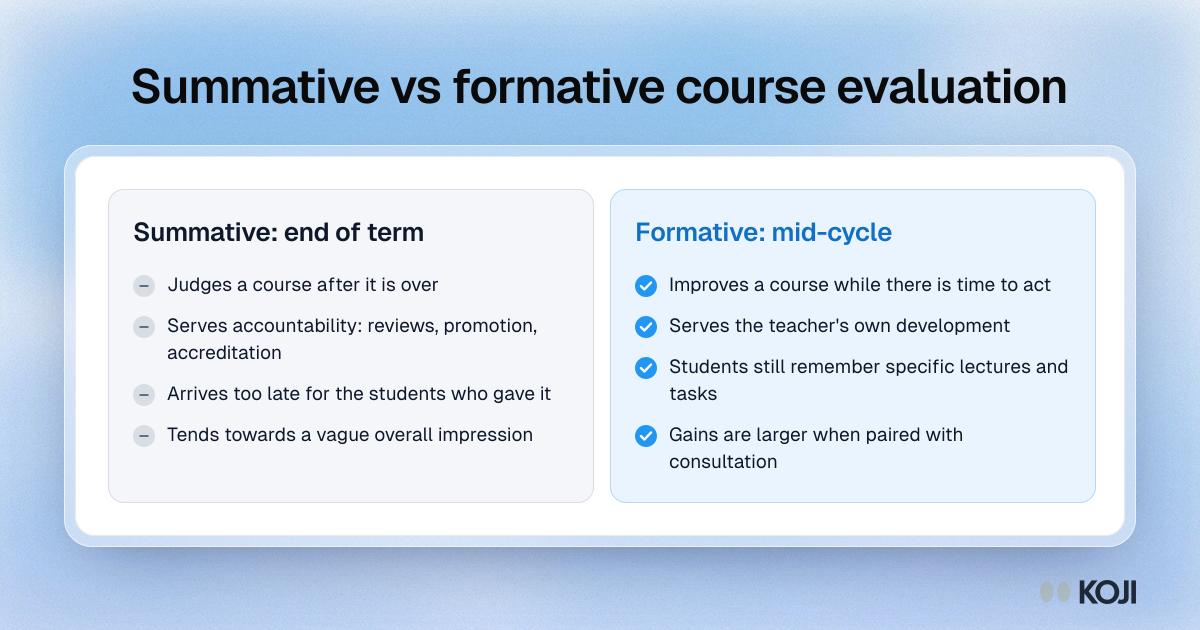
Summative vs formative course evaluation
Why one end-of-term survey cannot do both jobs
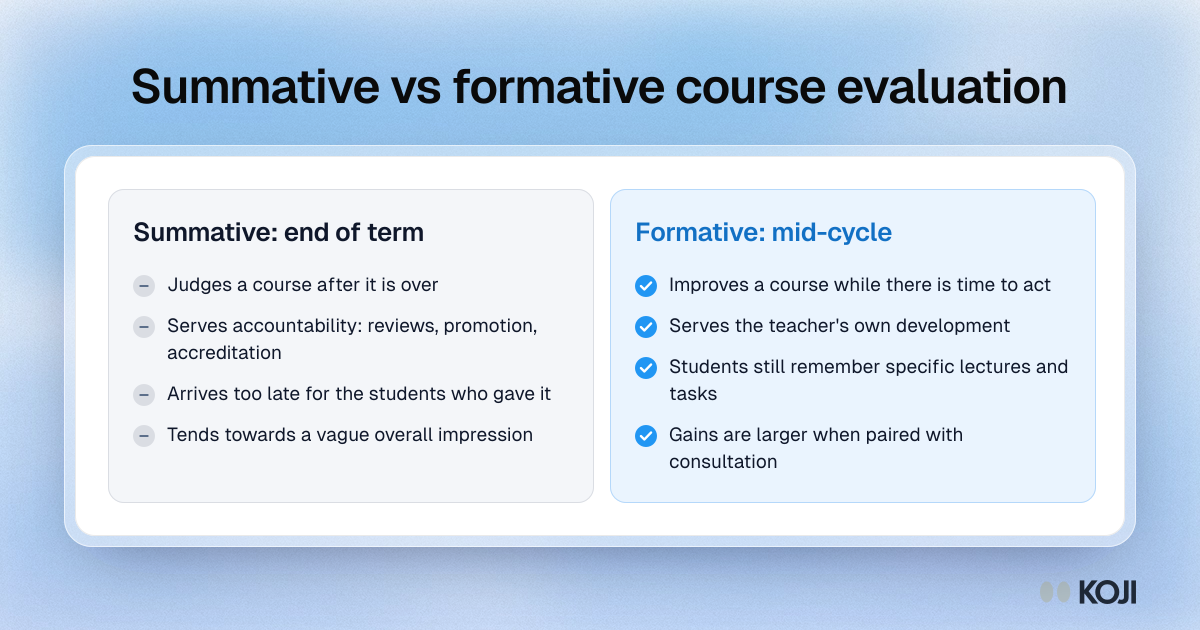
A side-by-side comparison of summative course evaluation, the end-of-term survey that judges a course, and formative mid-cycle feedback, which aims to improve it while students are still taking it. It is meant for quality assurance teams and programme directors planning an evaluation calendar. Koji supports mid-cycle collection through conversational interviews, so formative feedback does not depend on a second static form.
What's in this comparison
Summative: end of term
- Judges a course after it is over
- Serves accountability: reviews, promotion, accreditation
- Arrives too late for the students who gave it
- Tends towards a vague overall impression
Formative: mid-cycle
- Improves a course while there is time to act
- Serves the teacher's own development
- Students still remember specific lectures and tasks
- Gains are larger when paired with consultation
Use this image
Free to use in your docs, decks and posts under CC BY 4.0, as long as you credit Koji with a link to this page. To embed it, paste this into your page:
html
<a href="https://www.koji.so/visuals/summative-vs-formative-course-evaluation-comparison"><img src="https://www.koji.so/visuals/summative-vs-formative-course-evaluation-comparison/summative-vs-formative-course-evaluation-comparison.png" alt="Comparison of summative end-of-term course evaluation and formative mid-cycle feedback: purpose, timing, who benefits and the quality of what students recall." width="1200" height="630" /></a>
<p>Source: <a href="https://www.koji.so/visuals/summative-vs-formative-course-evaluation-comparison">Summative vs formative course evaluation</a>, Koji</p>