Guide
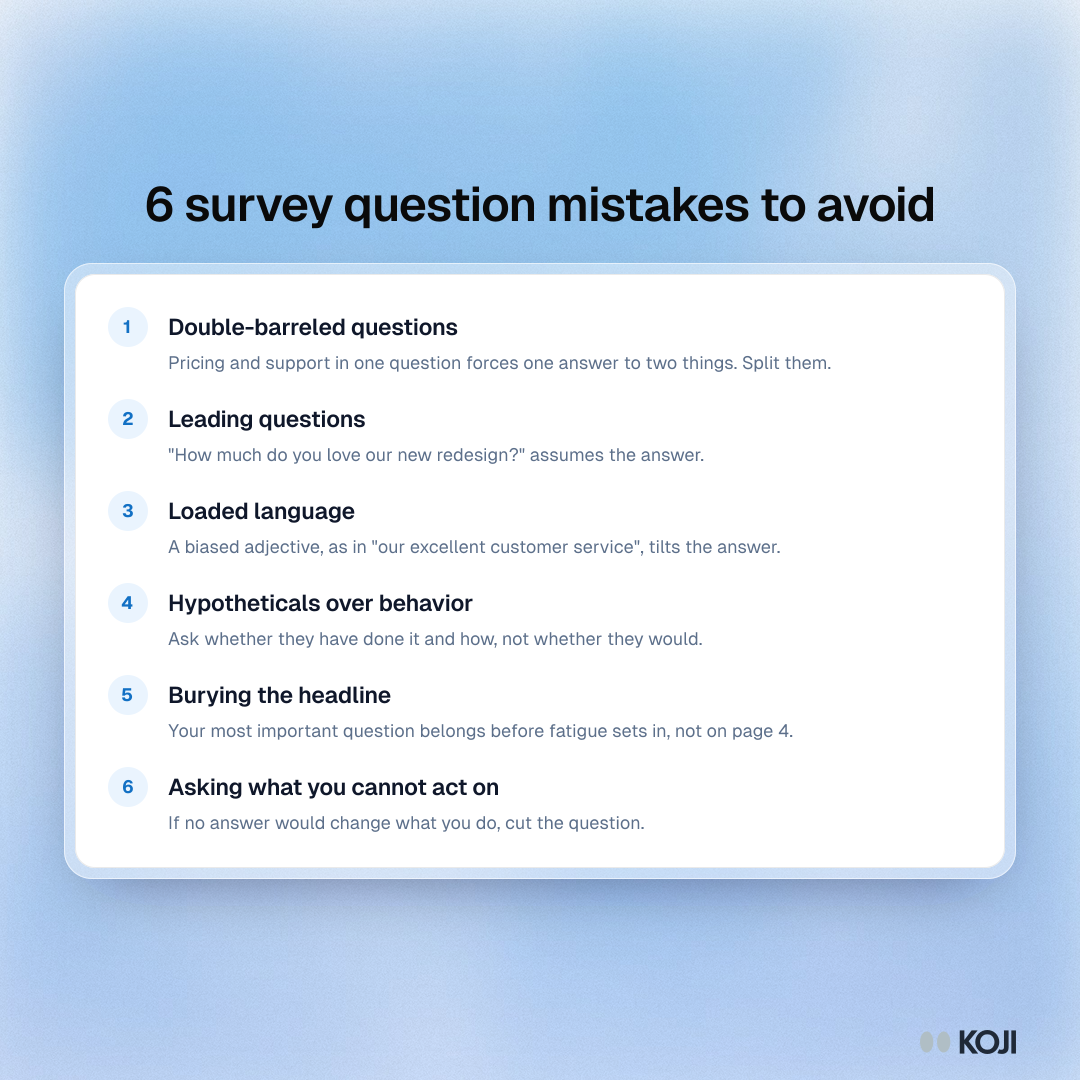
6 survey question mistakes to avoid
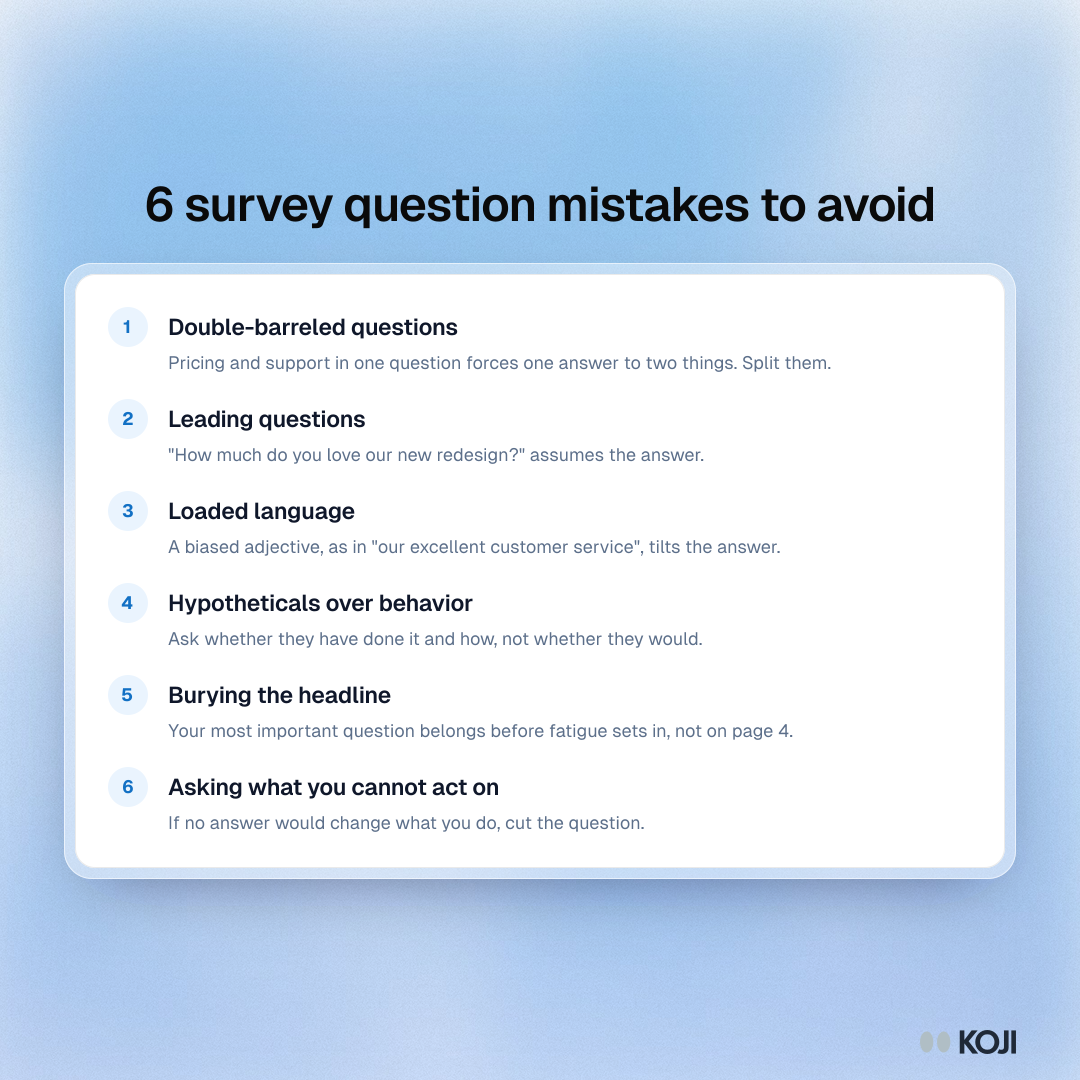
Six mistakes that weaken any survey question, whatever its type: double-barreled questions, leading questions, loaded language, asking about hypotheticals when behavior is available, burying the most important question late in the survey and asking things you cannot act on. Use it as a final check before a survey or interview guide goes out. Koji AI interviews follow up on answers, which helps catch vague replies these mistakes produce.
Where this appears
What's in this guide
- Double-barreled questions: Pricing and support in one question forces one answer to two things. Split them.
- Leading questions: "How much do you love our new redesign?" assumes the answer.
- Loaded language: A biased adjective, as in "our excellent customer service", tilts the answer.
- Hypotheticals over behavior: Ask whether they have done it and how, not whether they would.
- Burying the headline: Your most important question belongs before fatigue sets in, not on page 4.
- Asking what you cannot act on: If no answer would change what you do, cut the question.
Use this image
Free to use in your docs, decks and posts under CC BY 4.0, as long as you credit Koji with a link to this page. To embed it, paste this into your page:
html
<a href="https://www.koji.so/visuals/survey-question-mistakes-six-to-avoid"><img src="https://www.koji.so/visuals/survey-question-mistakes-six-to-avoid/survey-question-mistakes-six-to-avoid.png" alt="List of six survey question mistakes: double-barreled, leading and loaded questions, hypotheticals, burying the key question and asking what you cannot act on." width="1080" height="1080" /></a>
<p>Source: <a href="https://www.koji.so/visuals/survey-question-mistakes-six-to-avoid">6 survey question mistakes to avoid</a>, Koji</p>