Reference table
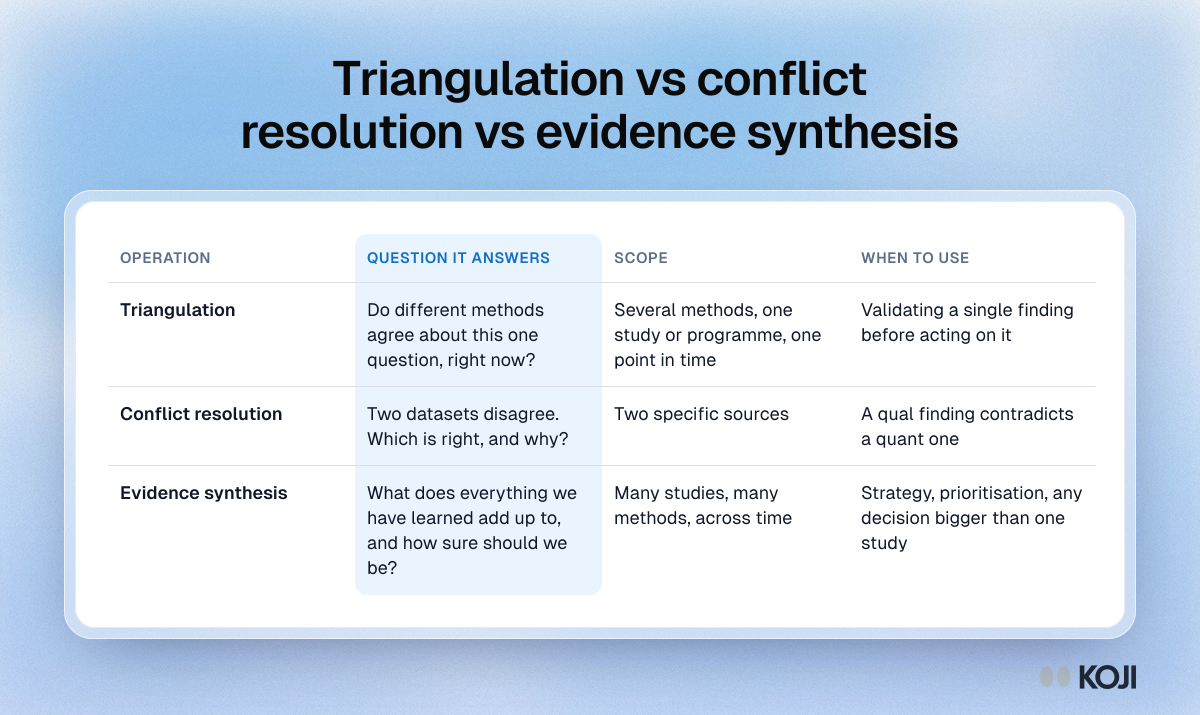
Triangulation vs conflict resolution vs evidence synthesis
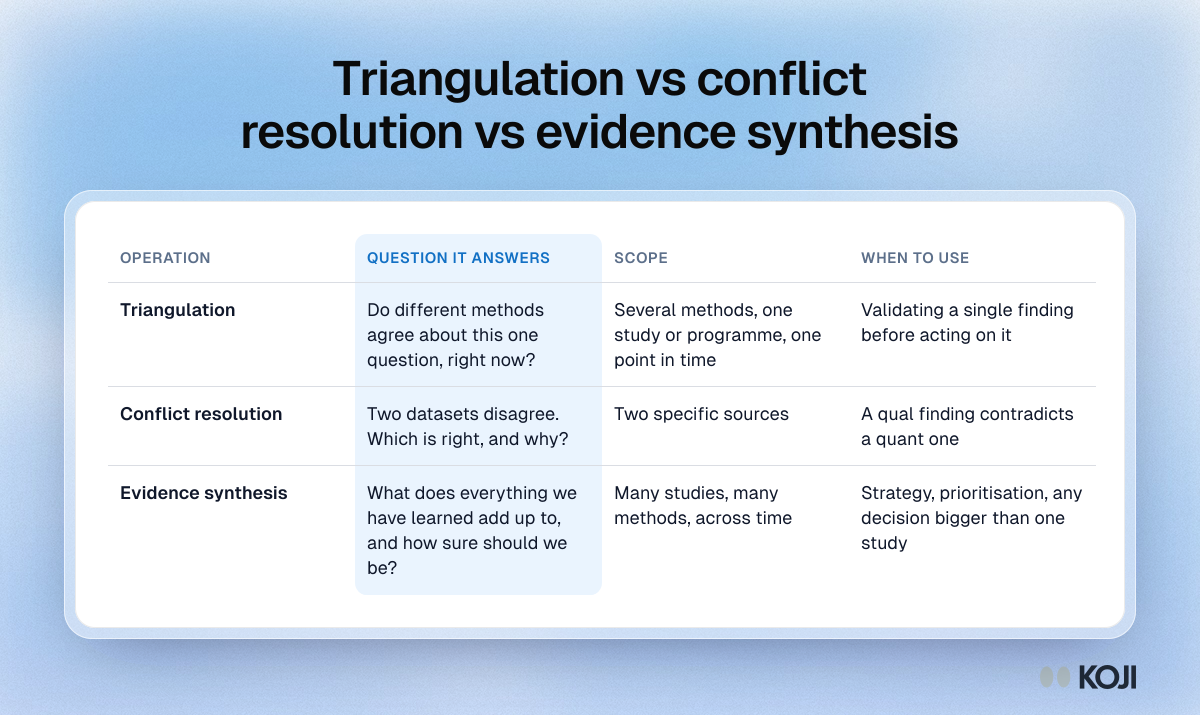
A comparison of three operations researchers often lump together as synthesis. Triangulation checks whether methods agree on one question at one point in time, conflict resolution settles a clash between two sources, and evidence synthesis combines everything learned across many studies into one rated conclusion. Use it to check which one your team is actually doing.
Where this appears
What's in this reference table
| Operation | Question it answers | Scope | When to use |
|---|---|---|---|
| Triangulation | Do different methods agree about this one question, right now? | Several methods, one study or programme, one point in time | Validating a single finding before acting on it |
| Conflict resolution | Two datasets disagree. Which is right, and why? | Two specific sources | A qual finding contradicts a quant one |
| Evidence synthesis | What does everything we have learned add up to, and how sure should we be? | Many studies, many methods, across time | Strategy, prioritisation, any decision bigger than one study |
Use this image
Free to use in your docs, decks and posts under CC BY 4.0, as long as you credit Koji with a link to this page. To embed it, paste this into your page:
html
<a href="https://www.koji.so/visuals/triangulation-vs-conflict-resolution-vs-evidence-synthesis"><img src="https://www.koji.so/visuals/triangulation-vs-conflict-resolution-vs-evidence-synthesis/triangulation-vs-conflict-resolution-vs-evidence-synthesis.png" alt="Table comparing triangulation, conflict resolution and evidence synthesis by the question each answers, its scope and when to use it." width="1200" height="715" /></a>
<p>Source: <a href="https://www.koji.so/visuals/triangulation-vs-conflict-resolution-vs-evidence-synthesis">Triangulation vs conflict resolution vs evidence synthesis</a>, Koji</p>