Reference table
Five types of user interviews compared
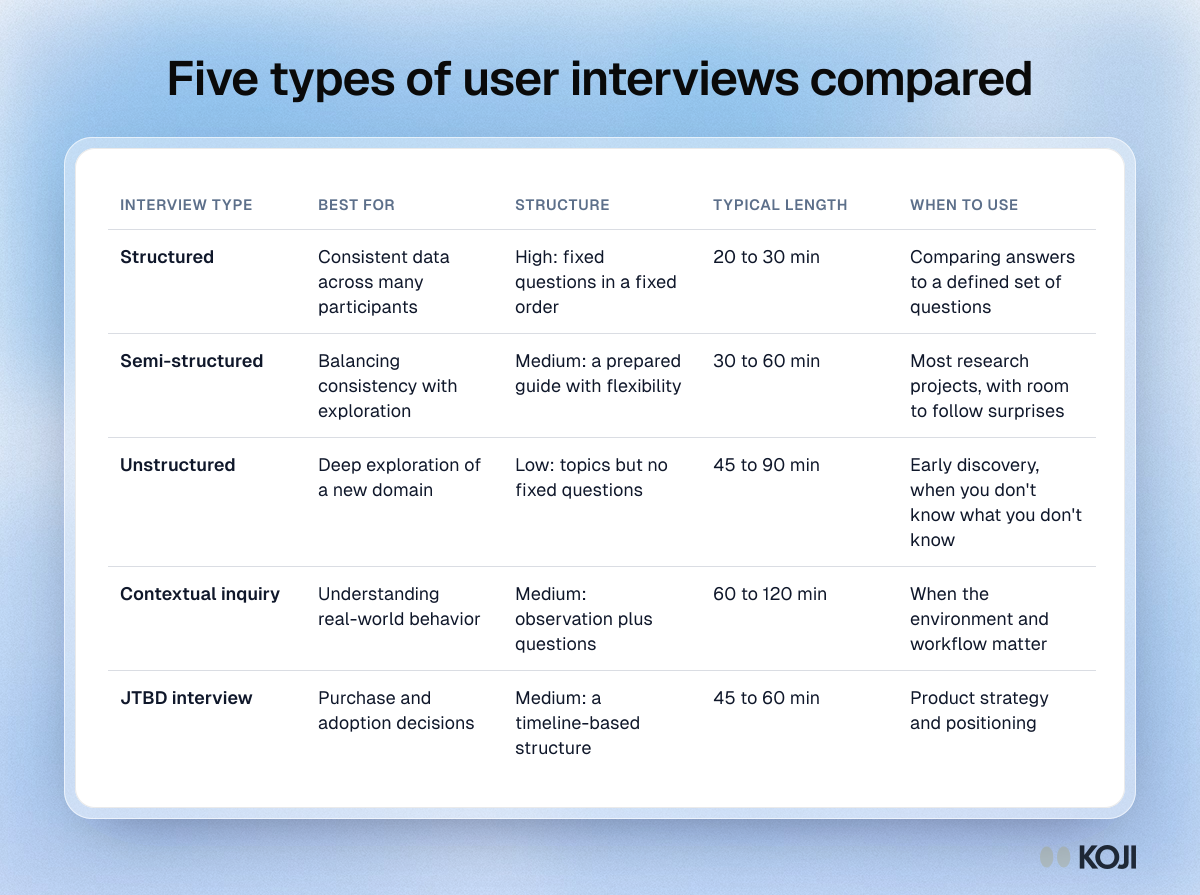
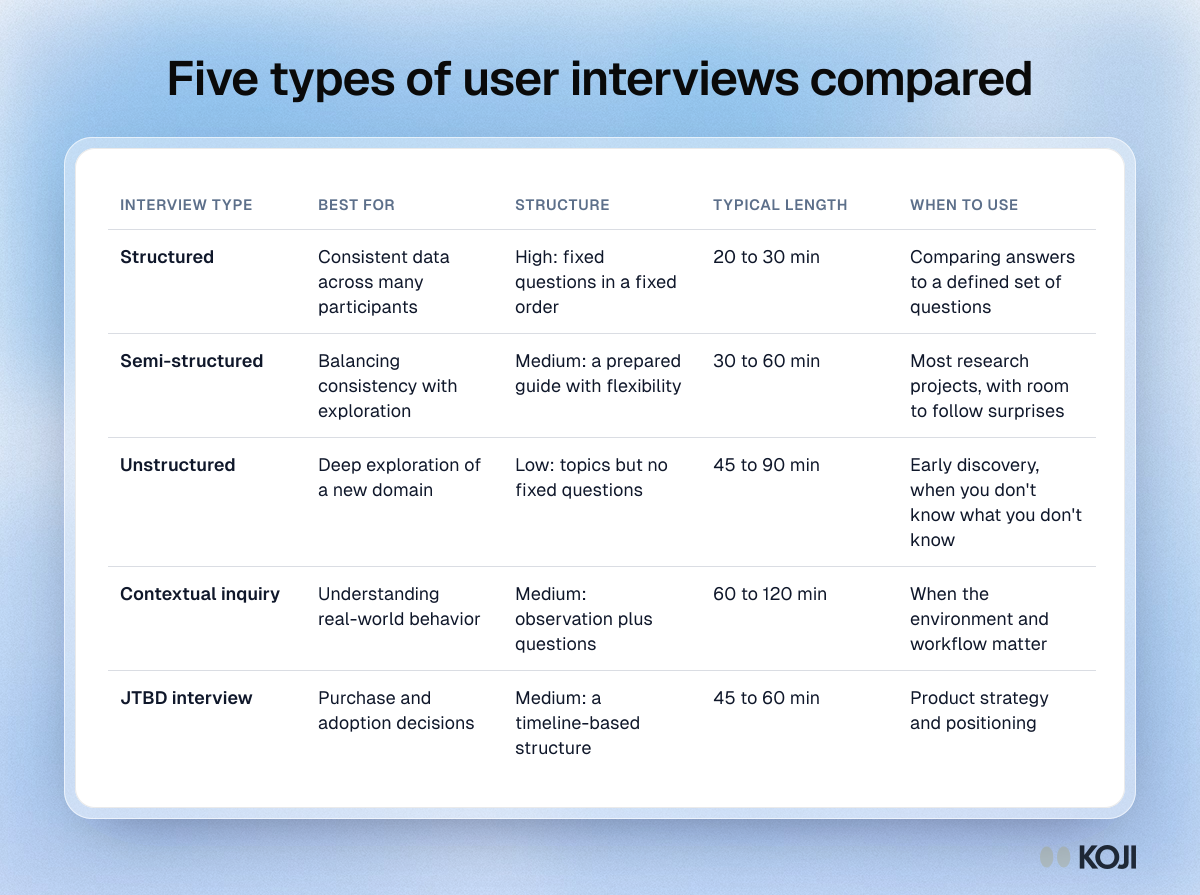
A side-by-side view of five kinds of user interview: structured, semi-structured, unstructured, contextual inquiry and Jobs to Be Done. Each row gives what the type is best for, how much structure it has, how long a session usually runs and when to pick it. Use it to choose a format before you write your interview guide.
Where this appears
What's in this reference table
| Interview type | Best for | Structure | Typical length | When to use |
|---|---|---|---|---|
| Structured | Consistent data across many participants | High: fixed questions in a fixed order | 20 to 30 min | Comparing answers to a defined set of questions |
| Semi-structured | Balancing consistency with exploration | Medium: a prepared guide with flexibility | 30 to 60 min | Most research projects, with room to follow surprises |
| Unstructured | Deep exploration of a new domain | Low: topics but no fixed questions | 45 to 90 min | Early discovery, when you don't know what you don't know |
| Contextual inquiry | Understanding real-world behavior | Medium: observation plus questions | 60 to 120 min | When the environment and workflow matter |
| JTBD interview | Purchase and adoption decisions | Medium: a timeline-based structure | 45 to 60 min | Product strategy and positioning |
Use this image
Free to use in your docs, decks and posts under CC BY 4.0, as long as you credit Koji with a link to this page. To embed it, paste this into your page:
html
<a href="https://www.koji.so/visuals/types-of-user-interviews-compared-table"><img src="https://www.koji.so/visuals/types-of-user-interviews-compared-table/types-of-user-interviews-compared-table.png" alt="Table comparing five types of user interviews, from structured to contextual inquiry and JTBD, by what each is for, structure and typical length." width="1200" height="895" /></a>
<p>Source: <a href="https://www.koji.so/visuals/types-of-user-interviews-compared-table">Five types of user interviews compared</a>, Koji</p>