Reference table
5 user interview approaches and when to use each
JTBD, exploratory, evaluative, critical incident and continuous discovery compared
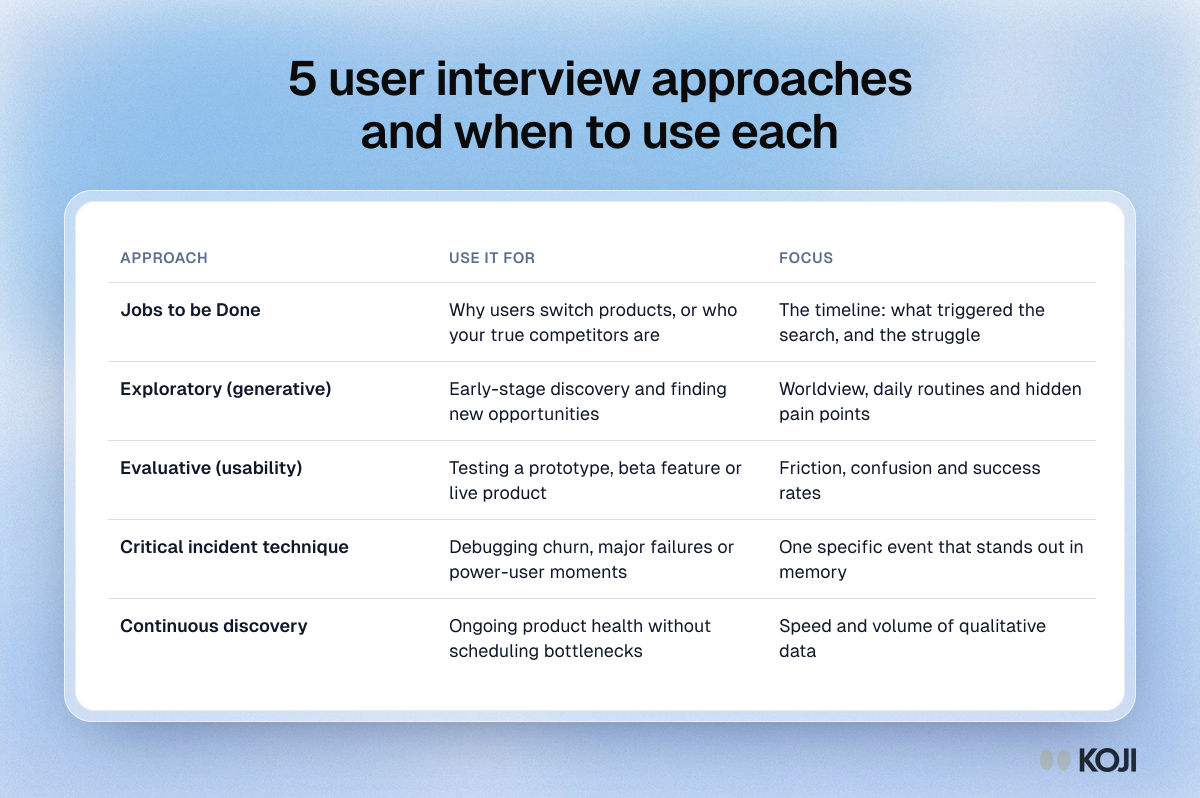
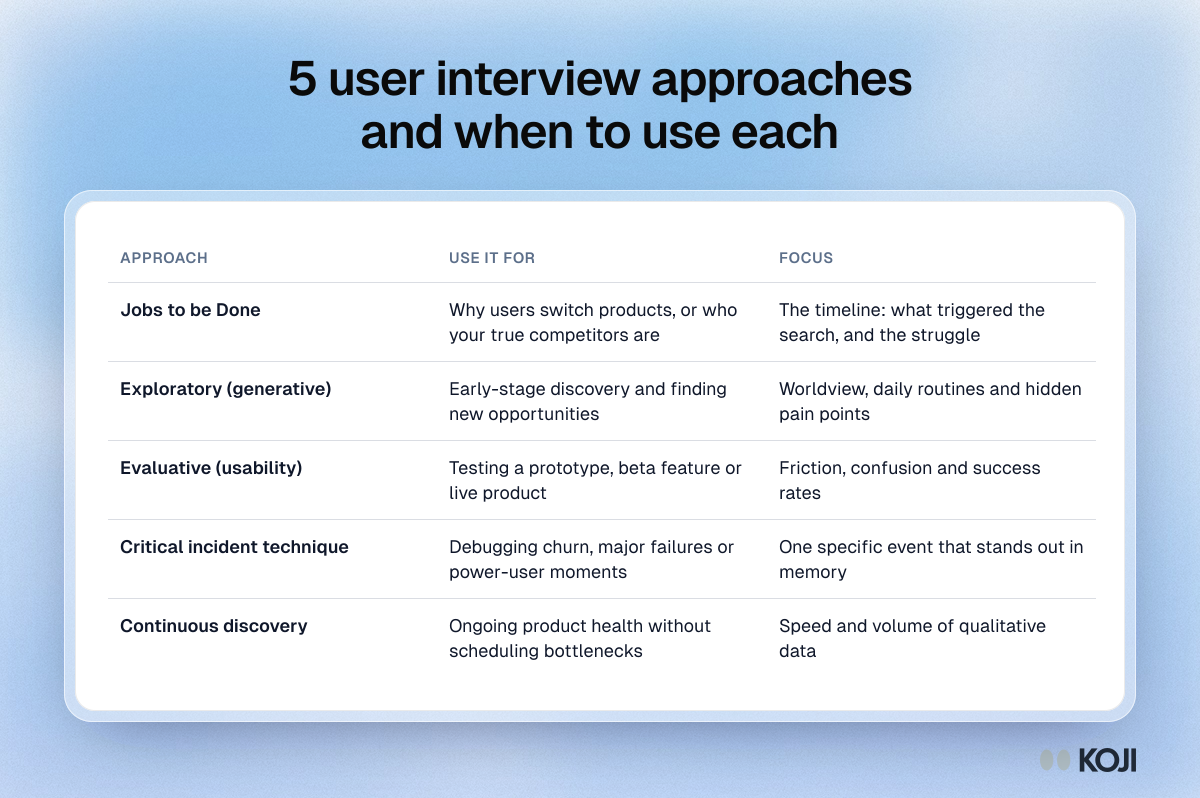
A comparison of five user interview approaches. Jobs to be Done interviews explain why people switch and who you really compete with. Exploratory interviews suit early discovery, evaluative sessions test a prototype or live product, the critical incident technique digs into one memorable failure or high point, and continuous discovery keeps a steady flow of interviews running. Use it to choose a method when you plan a study. Koji runs continuous AI-moderated interviews around the clock.
Where this appears
What's in this reference table
| Approach | Use it for | Focus |
|---|---|---|
| Jobs to be Done | Why users switch products, or who your true competitors are | The timeline: what triggered the search, and the struggle |
| Exploratory (generative) | Early-stage discovery and finding new opportunities | Worldview, daily routines and hidden pain points |
| Evaluative (usability) | Testing a prototype, beta feature or live product | Friction, confusion and success rates |
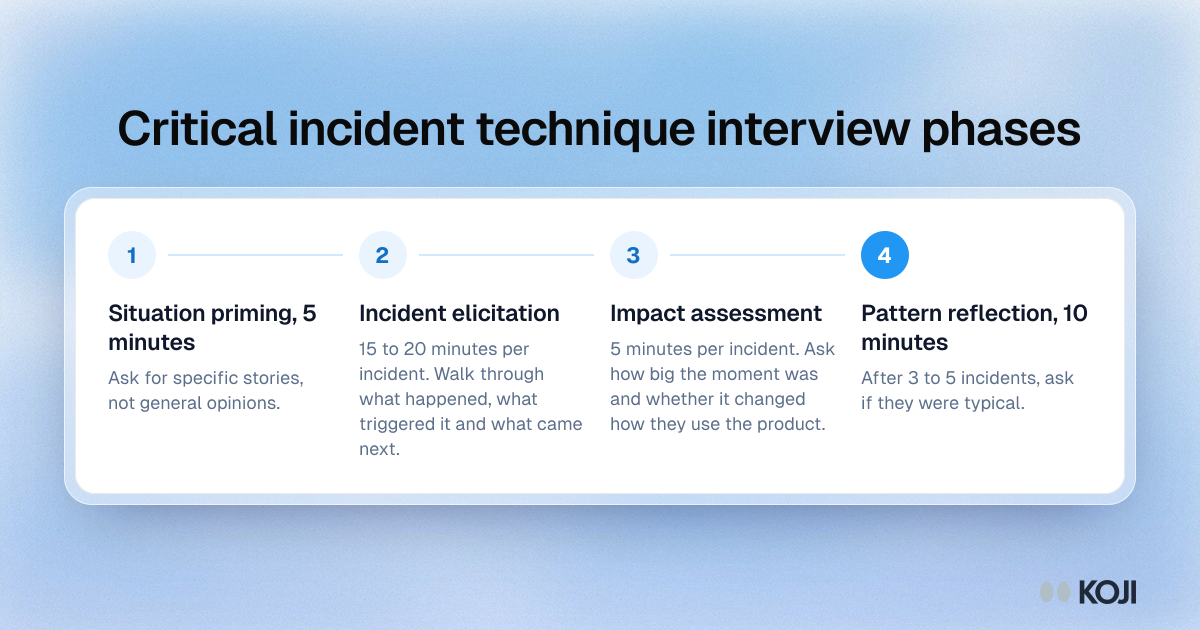
| Critical incident technique | Debugging churn, major failures or power-user moments | One specific event that stands out in memory |
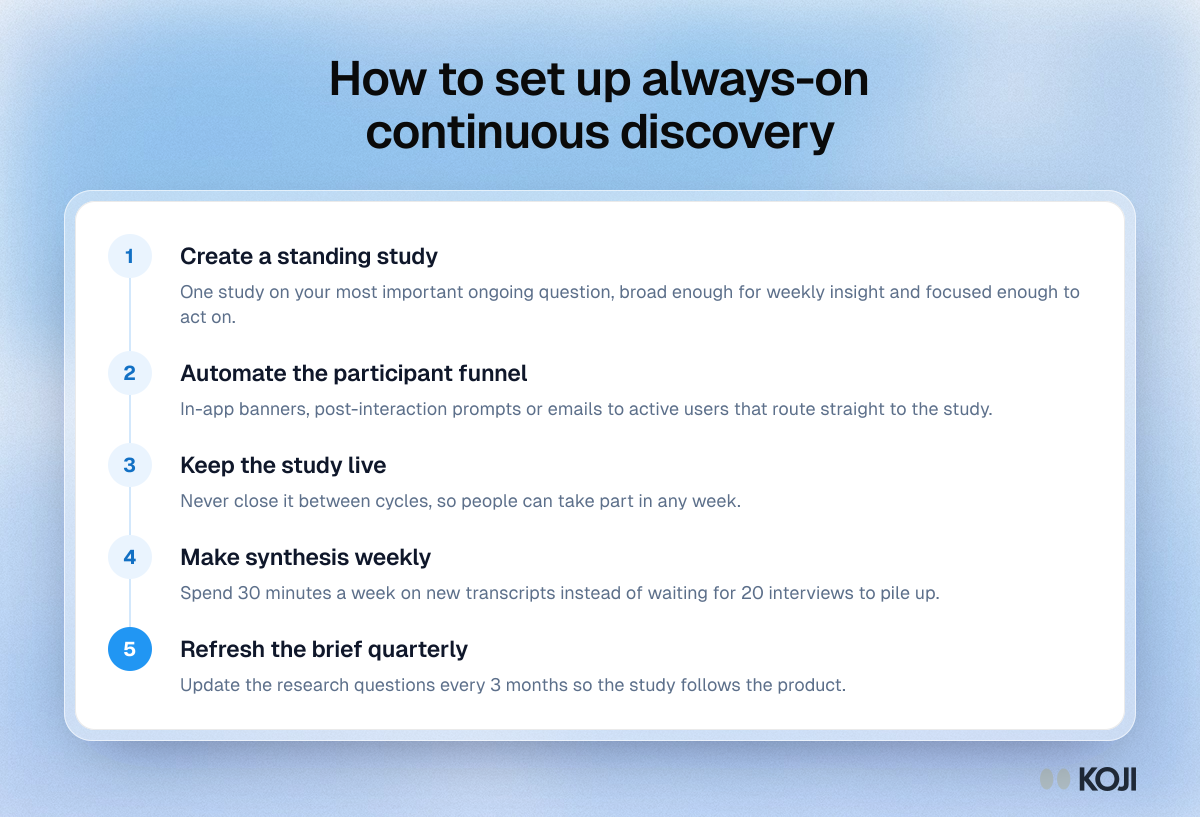
| Continuous discovery | Ongoing product health without scheduling bottlenecks | Speed and volume of qualitative data |
Use this image
Free to use in your docs, decks and posts under CC BY 4.0, as long as you credit Koji with a link to this page. To embed it, paste this into your page:
html
<a href="https://www.koji.so/visuals/five-user-interview-approaches-compared"><img src="https://www.koji.so/visuals/five-user-interview-approaches-compared/five-user-interview-approaches-compared.png" alt="Table comparing five user interview approaches, from Jobs to be Done and exploratory to critical incident, with what each is for and focuses on." width="1200" height="798" /></a>
<p>Source: <a href="https://www.koji.so/visuals/five-user-interview-approaches-compared">5 user interview approaches and when to use each</a>, Koji</p>