Comparison
Unipolar vs bipolar rating scales
How to tell which scale your question needs
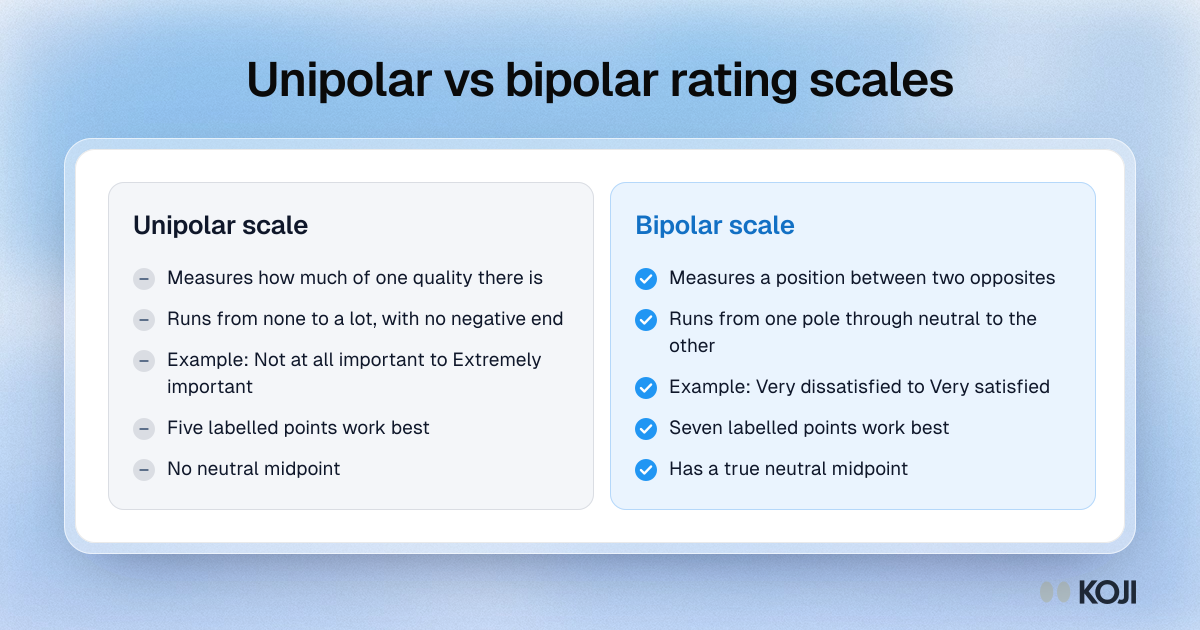
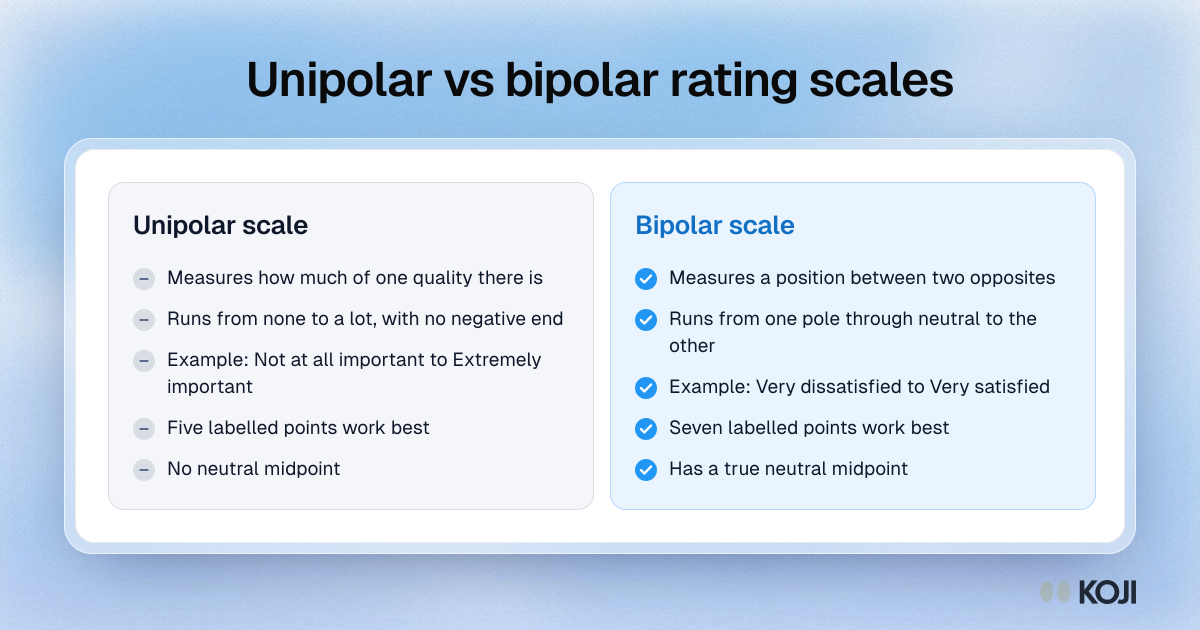
A comparison of unipolar and bipolar rating scales for survey and interview questions. A unipolar scale measures the amount of one quality from none to a lot; a bipolar scale measures a position between two opposites with a neutral middle. The guidance on five points for unipolar and seven for bipolar comes from Krosnick and Tahk's 2008 meta-analysis. Koji lets you set the range and end labels of each scale question.
Where this appears
What's in this comparison
Unipolar scale
- Measures how much of one quality there is
- Runs from none to a lot, with no negative end
- Example: Not at all important to Extremely important
- Five labelled points work best
- No neutral midpoint
Bipolar scale
- Measures a position between two opposites
- Runs from one pole through neutral to the other
- Example: Very dissatisfied to Very satisfied
- Seven labelled points work best
- Has a true neutral midpoint
Use this image
Free to use in your docs, decks and posts under CC BY 4.0, as long as you credit Koji with a link to this page. To embed it, paste this into your page:
html
<a href="https://www.koji.so/visuals/unipolar-vs-bipolar-rating-scales-comparison"><img src="https://www.koji.so/visuals/unipolar-vs-bipolar-rating-scales-comparison/unipolar-vs-bipolar-rating-scales-comparison.png" alt="Comparison of unipolar and bipolar rating scales: one runs from none to a lot, the other runs between two opposites with a neutral middle" width="1200" height="630" /></a>
<p>Source: <a href="https://www.koji.so/visuals/unipolar-vs-bipolar-rating-scales-comparison">Unipolar vs bipolar rating scales</a>, Koji</p>