Reference table
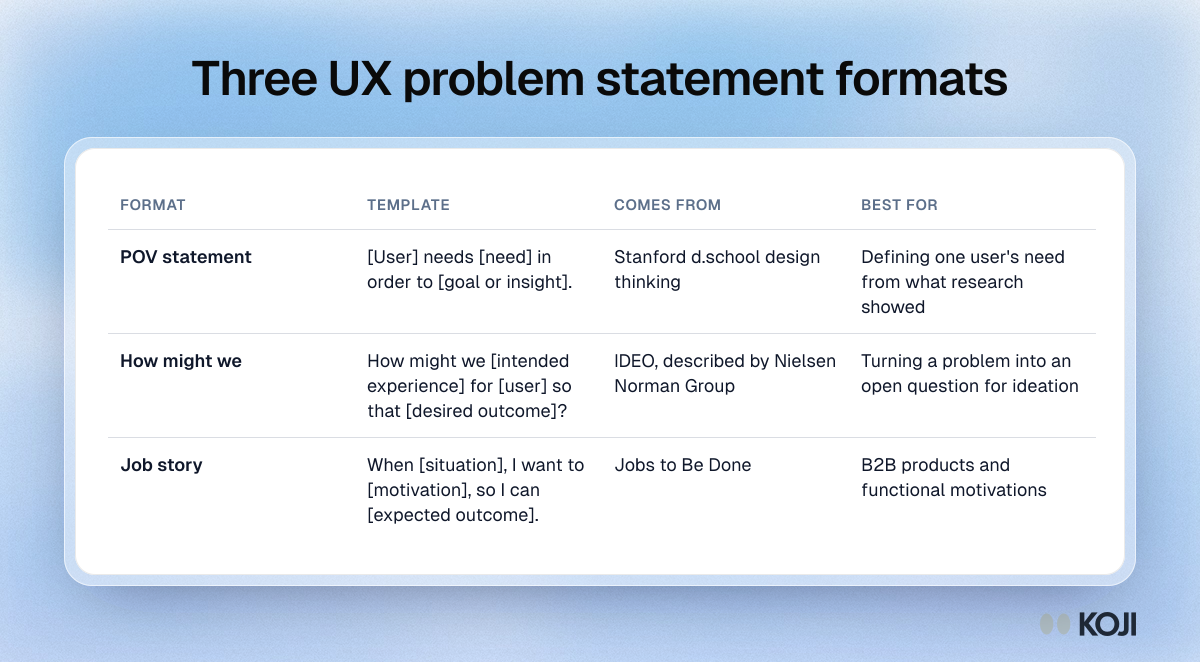
Three UX problem statement formats
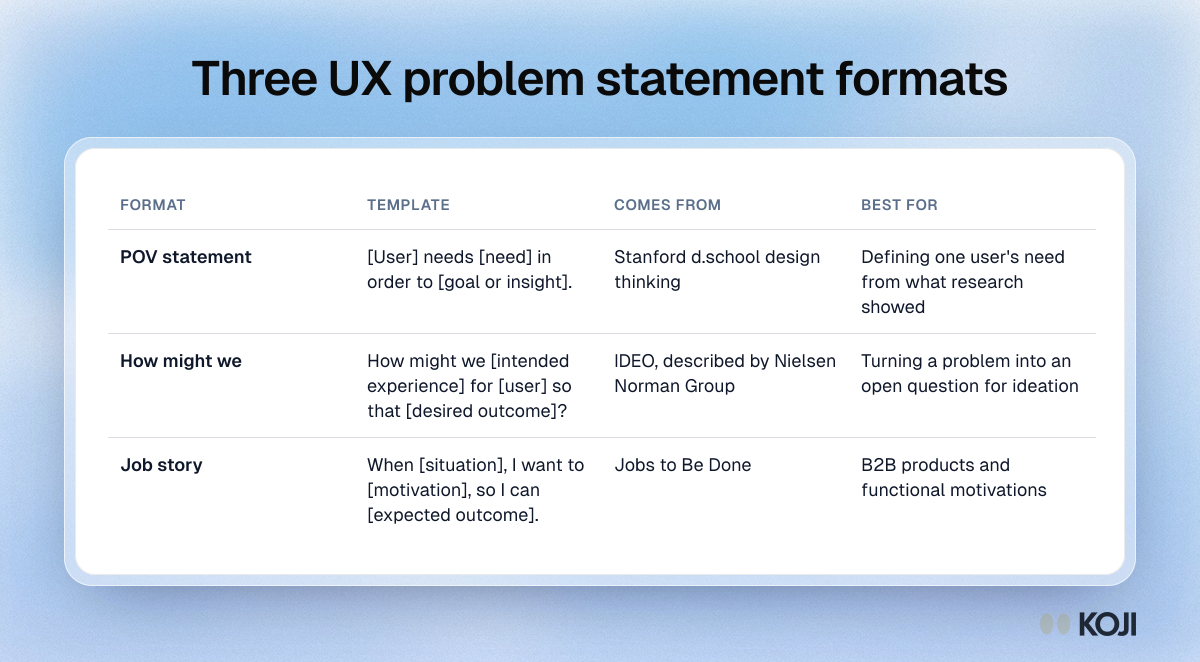
A side-by-side reference for the three common ways to write a UX problem statement: the point-of-view statement from Stanford d.school, the How might we question popularized by IDEO, and the job story from Jobs to Be Done. Each row gives the fill-in template and when to use it. Designers and product managers can copy the templates straight into a research brief. Koji interviews give you the research to fill in the brackets.
Where this appears
What's in this reference table
| Format | Template | Comes from | Best for |
|---|---|---|---|
| POV statement | [User] needs [need] in order to [goal or insight]. | Stanford d.school design thinking | Defining one user's need from what research showed |
| How might we | How might we [intended experience] for [user] so that [desired outcome]? | IDEO, described by Nielsen Norman Group | Turning a problem into an open question for ideation |
| Job story | When [situation], I want to [motivation], so I can [expected outcome]. | Jobs to Be Done | B2B products and functional motivations |
Use this image
Free to use in your docs, decks and posts under CC BY 4.0, as long as you credit Koji with a link to this page. To embed it, paste this into your page:
html
<a href="https://www.koji.so/visuals/ux-problem-statement-formats-table"><img src="https://www.koji.so/visuals/ux-problem-statement-formats-table/ux-problem-statement-formats-table.png" alt="Table of three UX problem statement formats, POV statement, How might we and job story, with the template, origin and best use of each." width="1200" height="662" /></a>
<p>Source: <a href="https://www.koji.so/visuals/ux-problem-statement-formats-table">Three UX problem statement formats</a>, Koji</p>