Process
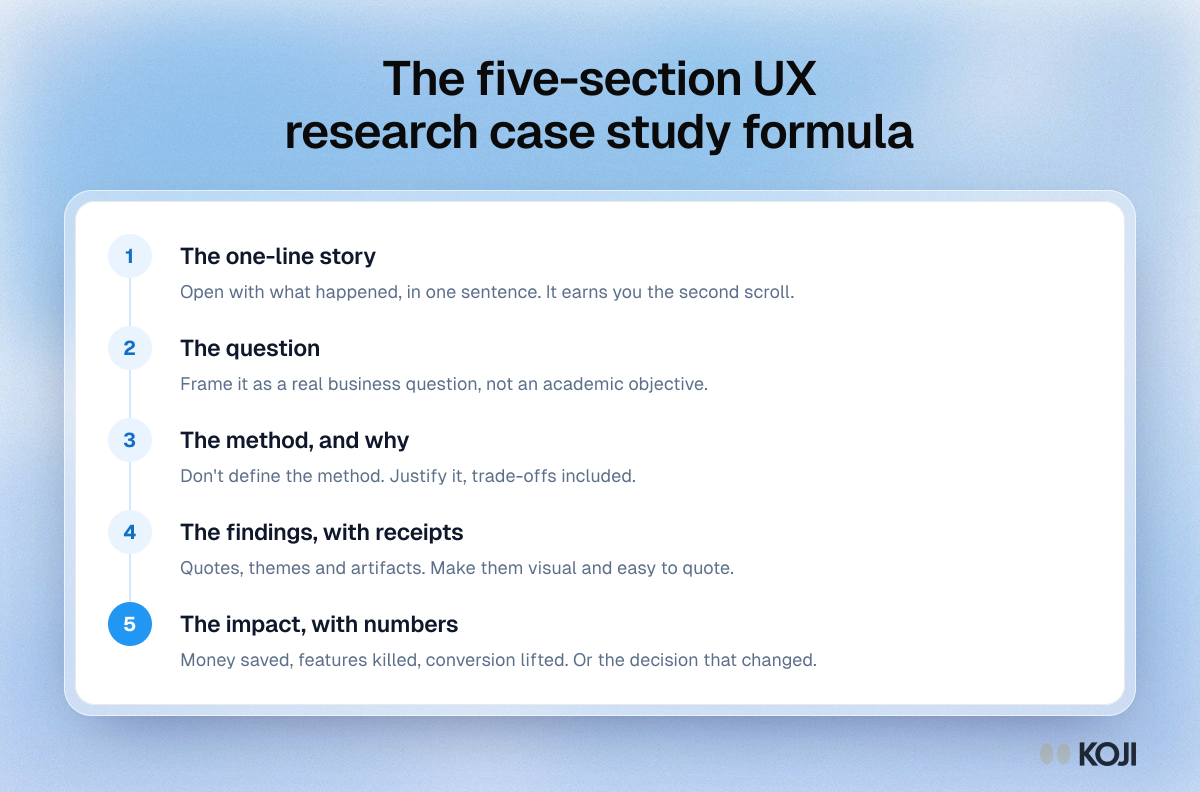
The five-section UX research case study formula
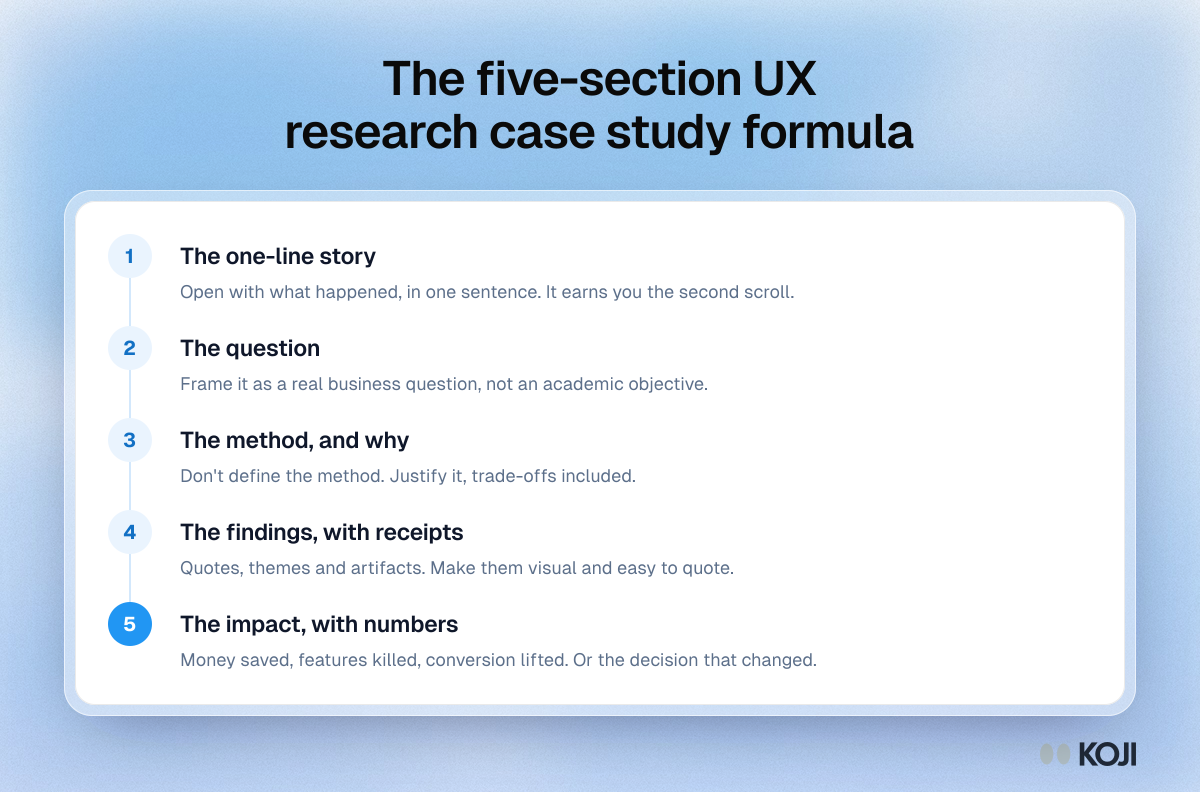
A five-section structure for writing UX research case studies in a portfolio: a one-line story of what happened, the business question, the method with the reason you chose it, the findings with quotes and artifacts, and the impact in numbers or a changed decision. It is for UX researchers at any level preparing a portfolio. If a case study has no impact section, the guide's advice is to leave it out.
Where this appears
What's in this process
- The one-line story: Open with what happened, in one sentence. It earns you the second scroll.
- The question: Frame it as a real business question, not an academic objective.
- The method, and why: Don't define the method. Justify it, trade-offs included.
- The findings, with receipts: Quotes, themes and artifacts. Make them visual and easy to quote.
- The impact, with numbers: Money saved, features killed, conversion lifted. Or the decision that changed.
Use this image
Free to use in your docs, decks and posts under CC BY 4.0, as long as you credit Koji with a link to this page. To embed it, paste this into your page:
html
<a href="https://www.koji.so/visuals/ux-research-case-study-five-section-formula"><img src="https://www.koji.so/visuals/ux-research-case-study-five-section-formula/ux-research-case-study-five-section-formula.png" alt="Process of five sections for a UX research case study: one-line story, the question, the method and why, findings with receipts, impact with numbers." width="1200" height="792" /></a>
<p>Source: <a href="https://www.koji.so/visuals/ux-research-case-study-five-section-formula">The five-section UX research case study formula</a>, Koji</p>