Framework
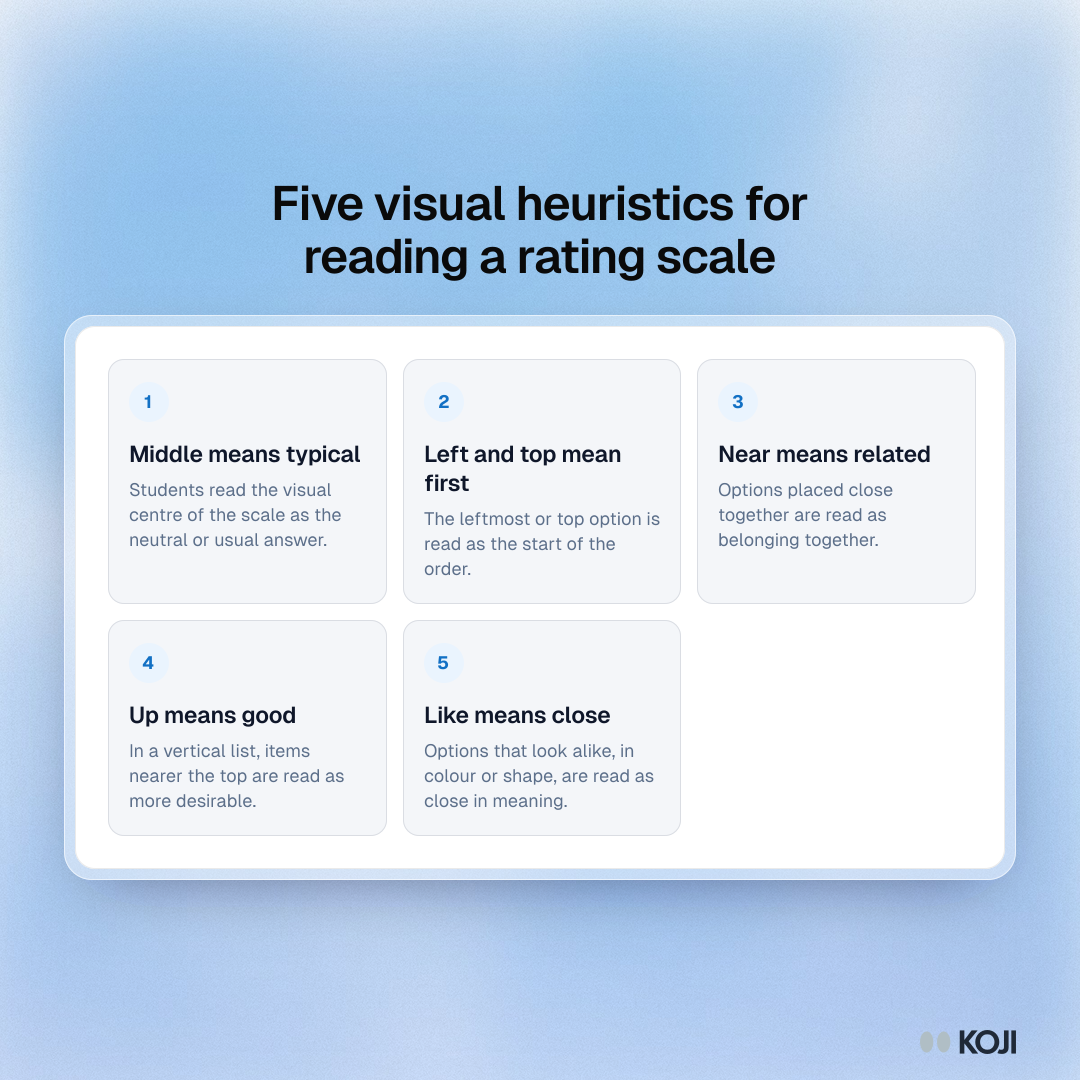
Five visual heuristics for reading a rating scale
How layout changes what a course evaluation scale seems to mean
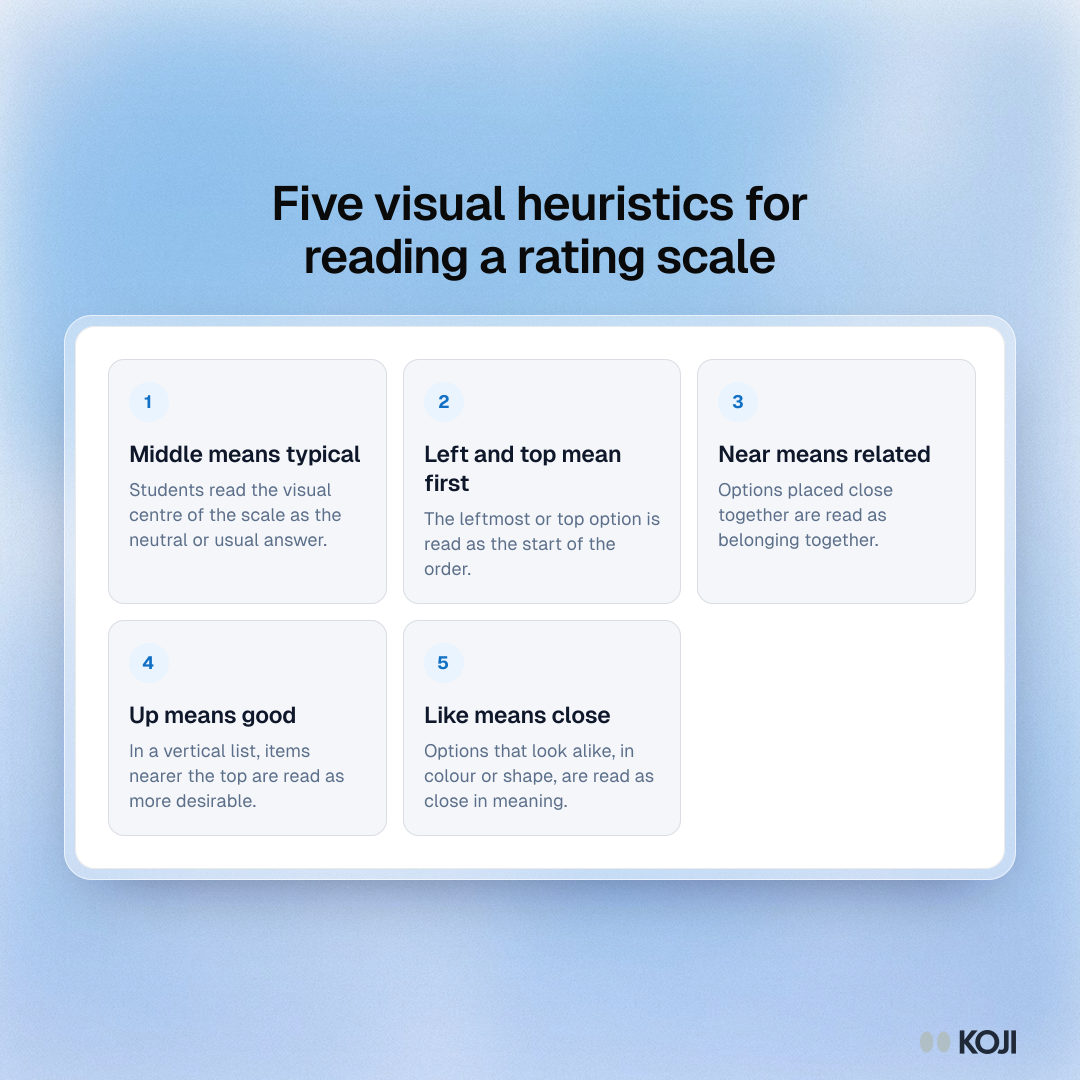
A framework of the five interpretive heuristics Tourangeau, Couper and Conrad proposed for how respondents read the visual layout of survey questions. It is for quality officers and survey designers who build course evaluation forms. Use it as a check on spacing, option order and where items like not applicable sit. Koji draws its rating scales as equal-width points in one low-to-high direction with this in mind.
What's in this framework
- Middle means typical: Students read the visual centre of the scale as the neutral or usual answer.
- Left and top mean first: The leftmost or top option is read as the start of the order.
- Near means related: Options placed close together are read as belonging together.
- Up means good: In a vertical list, items nearer the top are read as more desirable.
- Like means close: Options that look alike, in colour or shape, are read as close in meaning.
Use this image
Free to use in your docs, decks and posts under CC BY 4.0, as long as you credit Koji with a link to this page. To embed it, paste this into your page:
html
<a href="https://www.koji.so/visuals/visual-heuristics-rating-scale-framework"><img src="https://www.koji.so/visuals/visual-heuristics-rating-scale-framework/visual-heuristics-rating-scale-framework.png" alt="Framework of five visual heuristics for reading a rating scale: middle means typical, left and top first, near is related, up is good, like is close." width="1080" height="1080" /></a>
<p>Source: <a href="https://www.koji.so/visuals/visual-heuristics-rating-scale-framework">Five visual heuristics for reading a rating scale</a>, Koji</p>