Comparison
Warm vs cold syllabus tone: what students infer
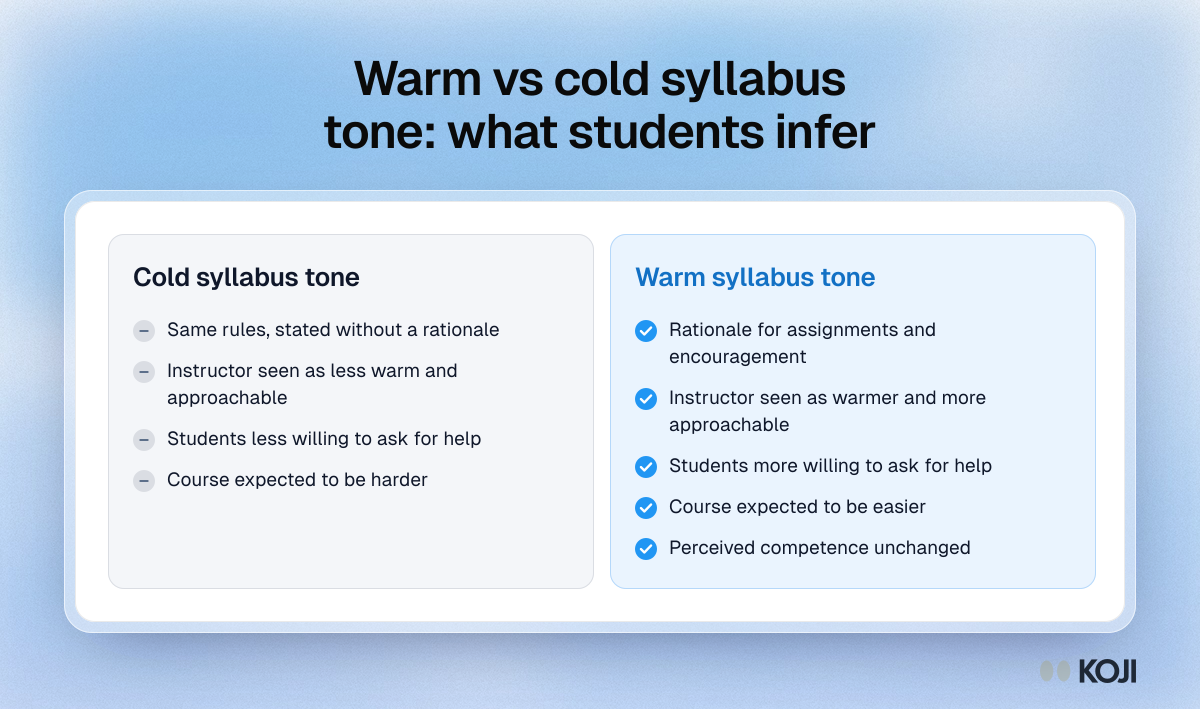
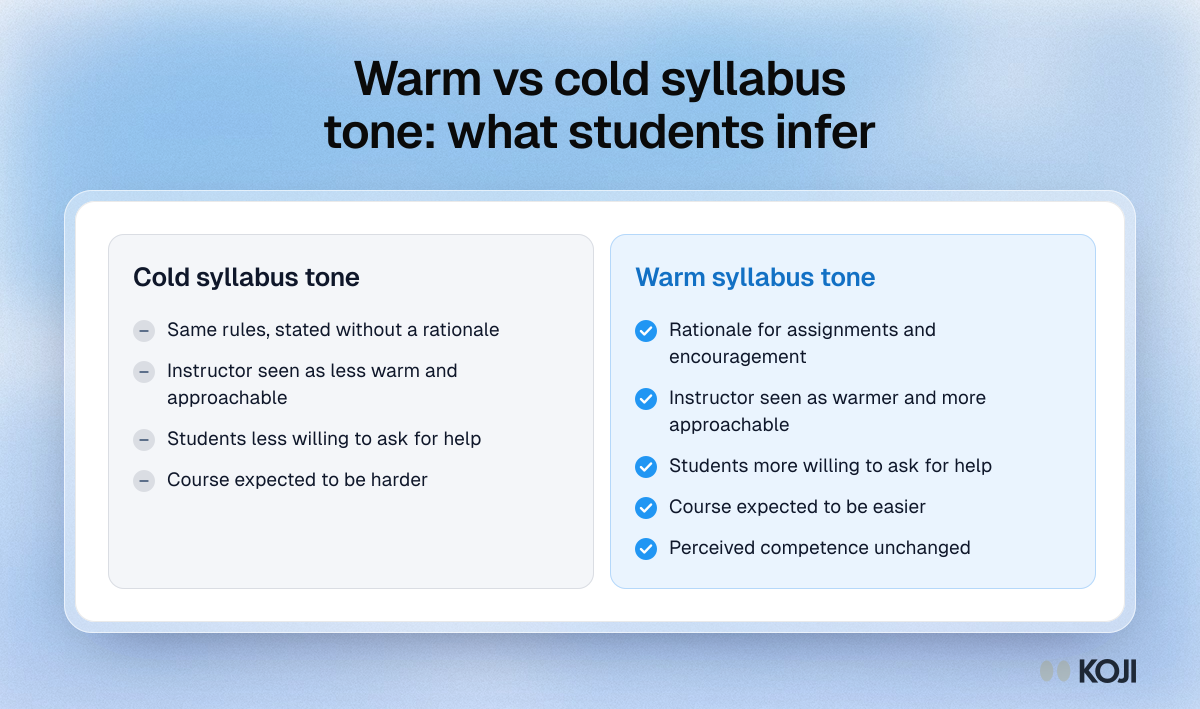
A side by side summary of experiments on syllabus tone. In Harnish and Bridges (2011), students who read a warm version of the same syllabus saw the instructor as warmer and more approachable and expected an easier course. Gurung and Galardi (2021) found warm tone made students more willing to ask for help without changing perceived competence. Useful for programme leads reviewing module handbooks before an evaluation cycle.
What's in this comparison
Cold syllabus tone
- Same rules, stated without a rationale
- Instructor seen as less warm and approachable
- Students less willing to ask for help
- Course expected to be harder
Warm syllabus tone
- Rationale for assignments and encouragement
- Instructor seen as warmer and more approachable
- Students more willing to ask for help
- Course expected to be easier
- Perceived competence unchanged
Use this image
Free to use in your docs, decks and posts under CC BY 4.0, as long as you credit Koji with a link to this page. To embed it, paste this into your page:
html
<a href="https://www.koji.so/visuals/warm-vs-cold-syllabus-tone-student-perceptions"><img src="https://www.koji.so/visuals/warm-vs-cold-syllabus-tone-student-perceptions/warm-vs-cold-syllabus-tone-student-perceptions.png" alt="Comparison of a cold and a warm syllabus tone and how each shifts student views of the instructor, help seeking and expected course difficulty." width="1200" height="709" /></a>
<p>Source: <a href="https://www.koji.so/visuals/warm-vs-cold-syllabus-tone-student-perceptions">Warm vs cold syllabus tone: what students infer</a>, Koji</p>