Guide
Four reasons annual engagement surveys fall short
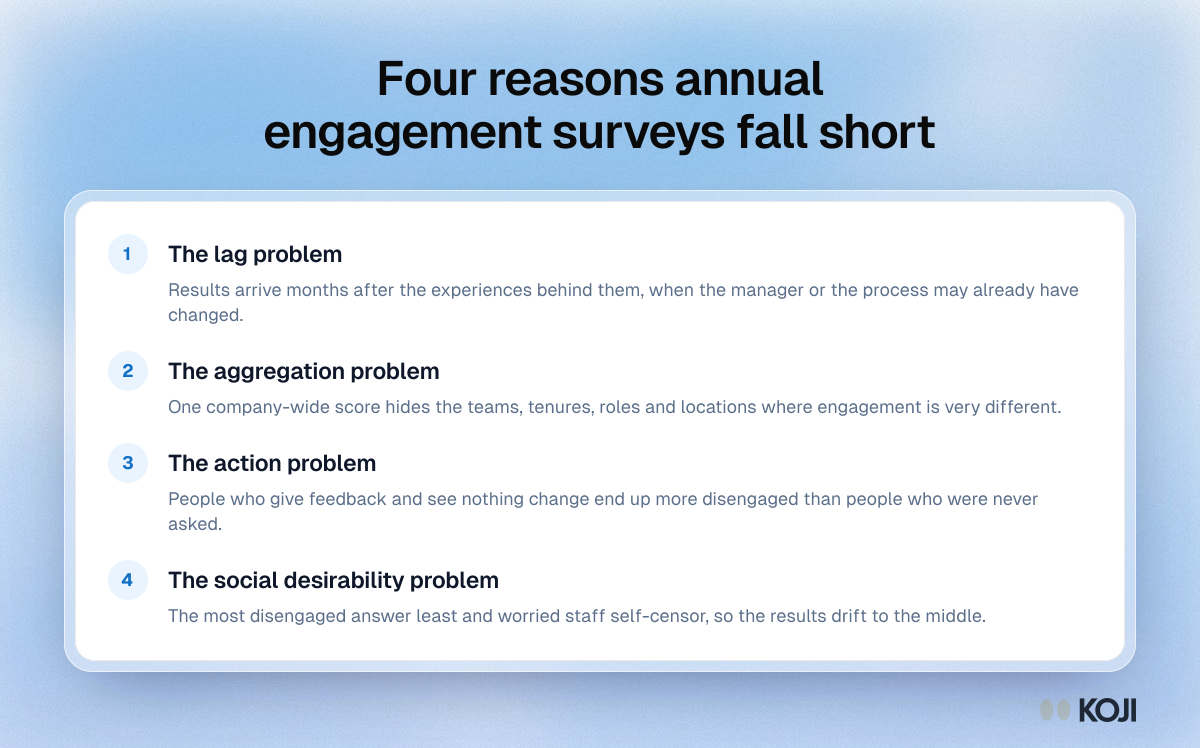
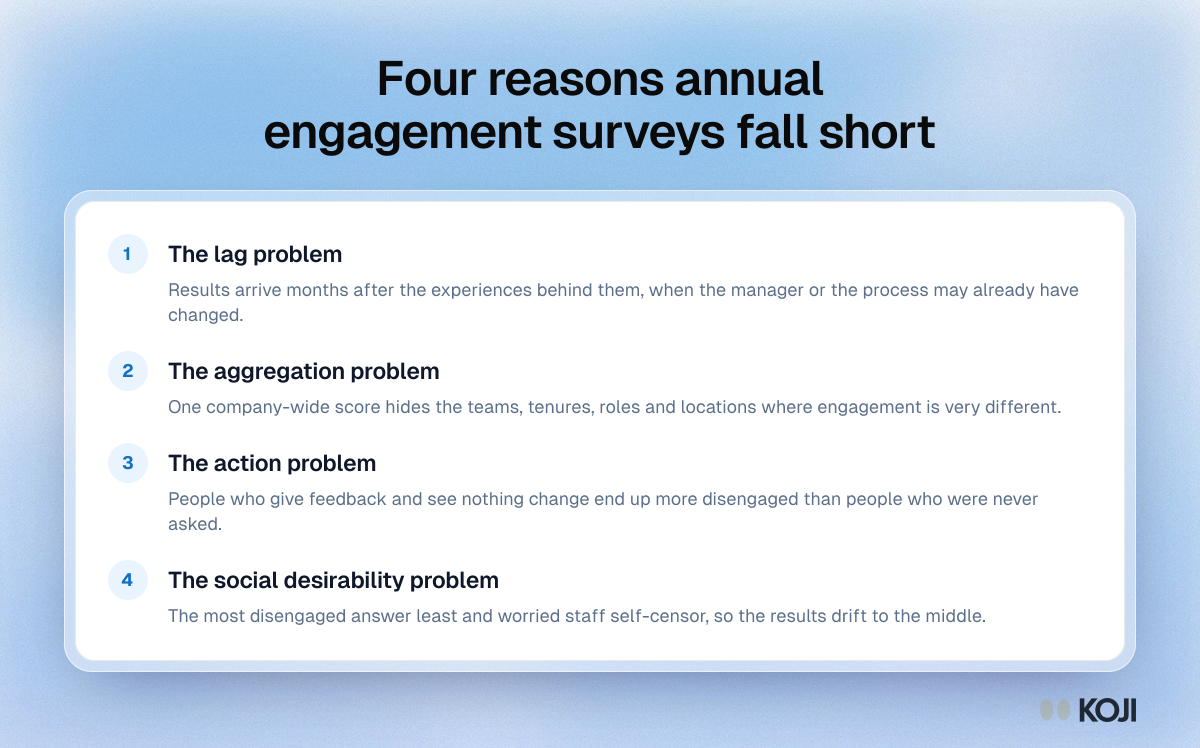
A list of the four structural reasons an annual engagement survey can't carry a Voice of the Employee program on its own: results arrive late, averages hide the teams that differ, slow follow-up makes people more disengaged, and the least engaged people answer least. It is for HR and people teams deciding what to add next to the yearly survey, such as pulse surveys, stay interviews and AI-moderated interviews.
Where this appears
What's in this guide
- The lag problem: Results arrive months after the experiences behind them, when the manager or the process may already have changed.
- The aggregation problem: One company-wide score hides the teams, tenures, roles and locations where engagement is very different.
- The action problem: People who give feedback and see nothing change end up more disengaged than people who were never asked.
- The social desirability problem: The most disengaged answer least and worried staff self-censor, so the results drift to the middle.
Use this image
Free to use in your docs, decks and posts under CC BY 4.0, as long as you credit Koji with a link to this page. To embed it, paste this into your page:
html
<a href="https://www.koji.so/visuals/why-annual-engagement-surveys-fall-short"><img src="https://www.koji.so/visuals/why-annual-engagement-surveys-fall-short/why-annual-engagement-surveys-fall-short.png" alt="List of four reasons annual engagement surveys fall short: the lag, aggregation, action and social desirability problems." width="1200" height="748" /></a>
<p>Source: <a href="https://www.koji.so/visuals/why-annual-engagement-surveys-fall-short">Four reasons annual engagement surveys fall short</a>, Koji</p>