Short answer: The best Discuss.io alternative depends on which part of Discuss.io you want to replace. If you want the same live video interviews and focus groups with observers, look at Recollective or Lookback. If you want live group conversations at a scale no video room can hold, look at Remesh. If you want to stop scheduling moderators altogether, look at AI-moderated interview platforms: Koji, Outset, Conveo or Listen Labs. Koji is the one you can start today on published prices, by voice, text or phone, with your own customers or a research panel.
Why teams look past Discuss.io
Discuss.io is a mature platform for live video qualitative research. Researchers run one-to-one interviews and focus groups in video rooms, stakeholders watch from a hidden backroom, and sessions are recorded and clipped. Its AI assistant, Genie, summarises each question with supporting quotes and clips and pulls themes across transcripts, and the company has added an AI Interview Agent for self-paced interviews.

Photo by Compare Fibre on Unsplash
So why switch? The reasons we hear most:
- Live sessions need a moderator, every time. Each interview is booked against someone's calendar. That caps how many conversations a team can run in a week.
- The price is not published. Discuss.io sells through sales, and reviewers on Capterra describe it as priced like a service.
- Many questions do not need video. Why did a customer churn? What were they using before? Those answers come through just as well by voice or text.
The market is moving the same way. Qualitative work is a small slice of research spend: in ESOMAR's Global Market Research figures for 2023, qualitative made up about 14% of global research turnover against about 70% for quantitative. Teams that want more qual on the same budget are turning to AI. In the 2025 GRIT Business Outlook, 67% of research suppliers said they now build generative AI directly into client deliverables. And in-house demand keeps rising: 66% of respondents to Maze's Future of User Research Report 2026 said demand for research had grown in the past year.
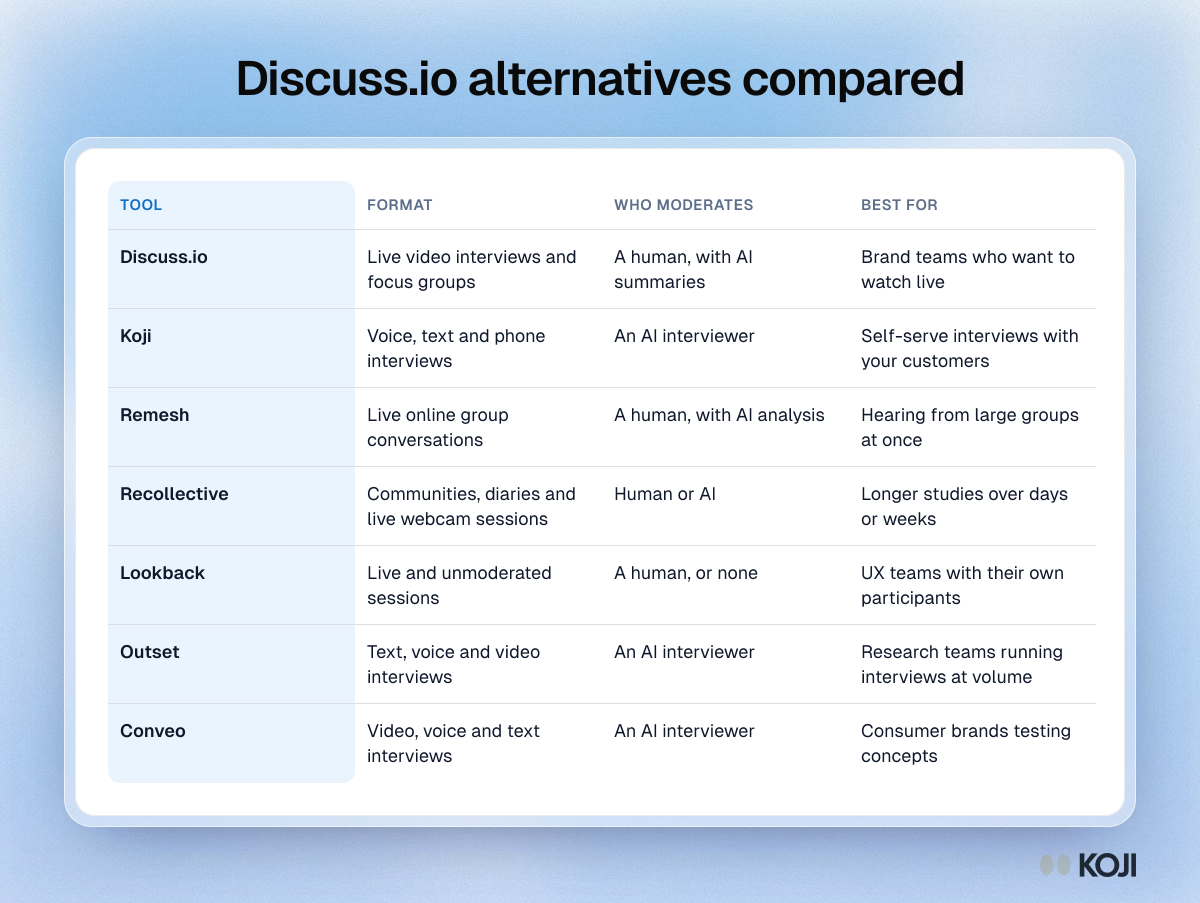
Discuss.io alternatives at a glance
| Tool | Format | Who moderates | Best for |
|---|---|---|---|
| Discuss.io | Live video interviews and focus groups | A human, with AI summaries | Brand teams who want to watch live |
| Koji | Voice, text and phone interviews | An AI interviewer | Self-serve interviews with your customers |
| Remesh | Live online group conversations | A human, with AI analysis | Hearing from large groups at once |
| Recollective | Communities, diaries and live webcam sessions | Human or AI | Longer studies over days or weeks |
| Lookback | Live and unmoderated sessions | A human, or none | UX teams with their own participants |
| Outset | Text, voice and video interviews | An AI interviewer | Research teams running interviews at volume |
| Conveo | Video, voice and text interviews | An AI interviewer | Consumer brands testing concepts |
1. Koji: AI interviews without scheduling
Koji replaces the moderator rather than the video room. You describe what you want to learn, an assistant drafts the brief and questions, and an AI interviewer runs every conversation, asking follow-ups based on each answer. Participants pick voice or text, or take a phone call, in any of 28 interview languages, at a time that suits them.
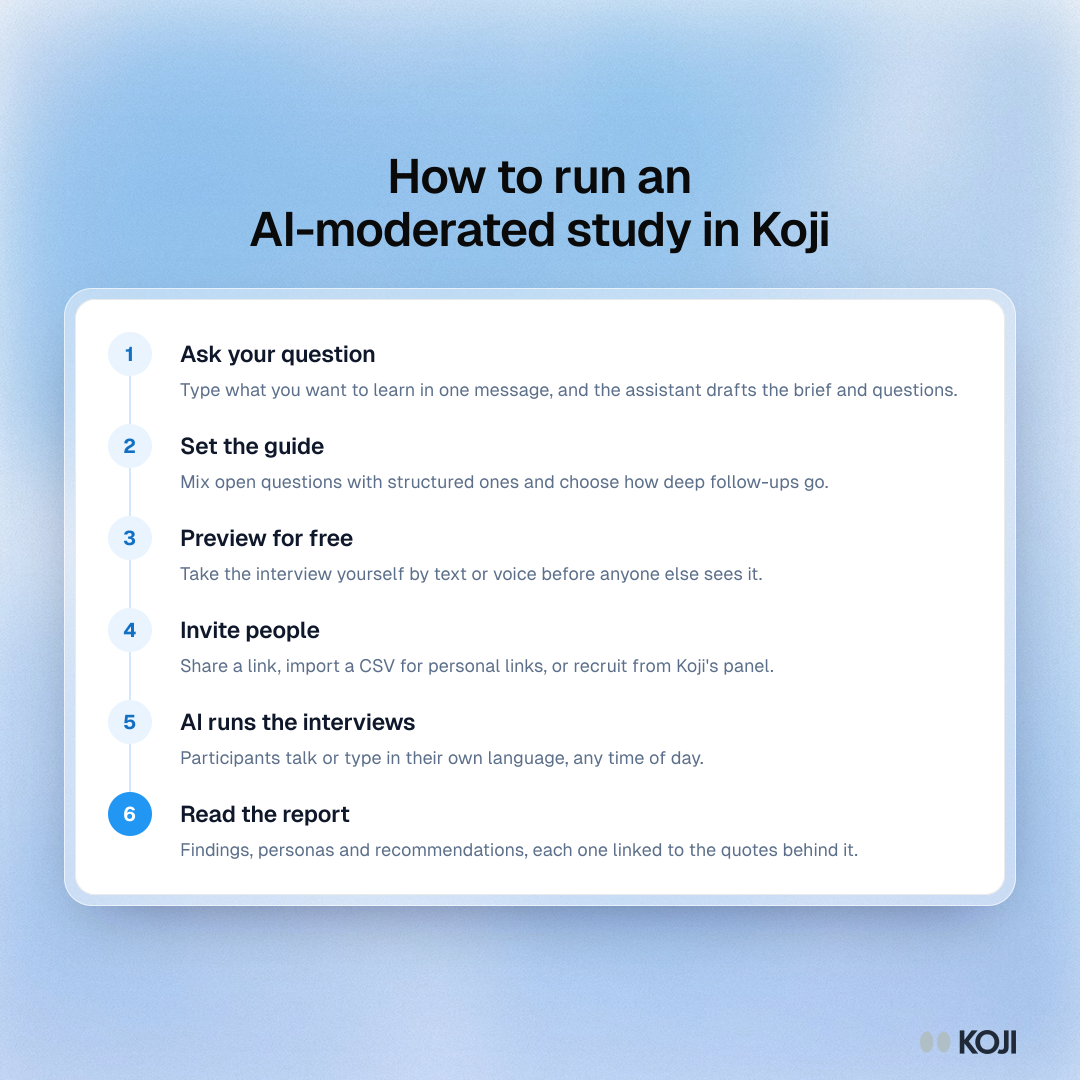
Here is how a study runs:
- Ask your question. Type what you want to learn in one message, and the assistant drafts the brief and questions.
- Set the guide. Mix open questions with structured ones and choose how deep follow-ups go.
- Preview for free. Take the interview yourself by text or voice before anyone else sees it.
- Invite people. Share a link, import a CSV for personal links, or recruit from Koji's panel.
- AI runs the interviews. Participants talk or type in their own language, any time of day.
- Read the report. Findings, personas and recommendations, each one linked to the quotes behind it.
What it costs: You start free with 10 credits. Insights is €29 a month with 29 credits, Interviews is €79 a month with 79 credits, and Enterprise is priced on request. A text interview uses 1 credit and a voice interview 3. Only interviews with a quality score of 3 or more out of 5 use credits.
Good to know: Koji has no live video rooms or backroom. If watching faces in real time matters to your stakeholders, keep a video tool for those sessions. For the rest, see how voice interviews work and how panel recruitment works.
2. Remesh: live conversations with large groups
Remesh runs live online conversations where a moderator asks open questions, participants type answers, and then they vote on each other's responses. Agreement and differences between segments show up in real time, so you can hear from far more people than a focus group holds. In 2026 Remesh expanded its AI assistant, Remy, to help plan, build, recruit for and analyse studies, and added video interview tools.
Pricing: custom quote, not published.
Pick it if you want the energy of a live group at survey scale, such as reacting to a message or policy with several hundred people at once.
3. Recollective: communities, diaries and live sessions
Recollective covers the longer side of qual: online communities, diaries, mobile tasks and pop-up groups, plus live webcam interviews and focus groups. Its AI features include transcription, summaries, themes, automatic translation and AI-moderated interviews.
Pricing: unusually open for this category. Recollective's pricing page lists a live-only option with no platform fee, where you pay for video minutes at $2 a minute or less, and larger plans priced by the number of participants and studies.
Pick it if you run studies over days or weeks and want live sessions in the same place.
4. Lookback: live and unmoderated sessions for UX teams
Lookback records moderated and unmoderated sessions on websites, apps and prototypes, with observers able to watch live. You bring your own participants; it has no panel.
Pricing: published, billed annually. Lookback's help centre lists plans from $299 a year for 10 sessions, with larger team plans priced by session volume.
Pick it if you mainly need moderated usability sessions with your own users and want a lighter tool than an enterprise qual platform.
5. Outset: AI-moderated interviews at volume
Outset runs AI-moderated interviews where participants answer by text, voice or video, in more than 40 languages. You can bring your own participants or recruit through Outset. It raised a $30 million Series B in December 2025, led by Radical Ventures.
Pricing: custom subscription, not published.
Pick it if you are a research team that wants AI moderation with video responses and is happy to buy through sales.
6. Conveo: AI video interviews for consumer brands
Conveo is a Belgian, Y Combinator-backed platform for AI-moderated consumer interviews by video, voice or text, with automatic theming. It raised a $50 million Series A in September 2026, led by DST Global, mainly to grow in the US.
Pricing: not published.
Pick it if you are a consumer brand or agency testing concepts and want to see faces without booking moderators.
7. Listen Labs: enterprise AI interviews
Listen Labs runs AI-moderated interviews by video, voice and text with a large recruiting network. On September 29, 2026, Salesforce signed a deal to acquire it, with closing expected in Salesforce's fiscal fourth quarter of 2027. Pricing is not published. Read our Listen Labs vs UserTesting comparison for more.
How to choose
Ask three questions, in this order.
Do stakeholders need to watch live? If yes, stay with live video: Discuss.io, Recollective or Lookback. If they mainly read the findings, an AI interviewer saves the most time.
One-to-one or group? For large groups reacting together, Remesh. For individual stories, an interview tool.
How do you want to buy? Remesh, Outset, Conveo and Listen Labs sell through sales. Lookback, Recollective and Koji publish prices, and Koji lets you run a real study before you talk to anyone.
Moving a live video study to AI interviews
Most teams do not switch everything at once. A practical first step is to take one recurring study, such as churn or onboarding interviews, and run it with an AI interviewer alongside your next live round. Use the same guide in both. Compare the themes, the depth of the quotes and the time it took. If the AI round finds the same story, move that study over and keep live video for the sessions where watching matters.
Try Koji on your next study
Pick the question you would normally book five live sessions for. Start a free study on Koji, preview the interview yourself, and send it to your customers. You will have voice and text interviews, and a report you can check against the quotes, without filling a single moderator slot.