Short answer: Listen Labs and UserTesting solve different problems. Listen Labs runs AI-moderated interviews: an AI interviewer talks to participants by video, voice or text, asks follow-up questions and writes up the findings. UserTesting records people using your product or prototype while they think out loud, and adds live moderated sessions and AI summaries on top. Pick Listen Labs when you need to understand why people choose, switch or churn, at volume. Pick UserTesting when you need to watch people struggle with a screen. Both are enterprise contracts with no public price list, and both changed shape on the same day in 2026. If you want AI interviews you can start this week on published prices, with your own customers, Koji is the third option worth a look.
One sold, one renamed, on the same day
On September 29, 2026, both companies made news. Salesforce signed a definitive agreement to acquire Listen Labs, describing it as an AI customer research platform whose recruiting network reaches more than 50 million potential participants, with interviews possible in more than 120 languages. Salesforce plans to bring it into Marketing Cloud and Service Cloud and expects the deal to close in the fourth quarter of its fiscal 2027, subject to regulatory approval. Terms were not disclosed; press reports put the price at around $2 billion.
The same day, UserTesting announced it was renaming the company Auros. Auros is now the parent of UserTesting and User Interviews, which it bought in January 2026, plus a growing business supplying people to train and evaluate AI models. The company puts its network at 7.6 million verified people and says existing contracts and day-to-day operations are unchanged. UserTesting stays as a product name.
Neither change breaks anything today. But both mean the tool you buy in 2026 sits inside a bigger strategy than it did a year ago. Ask each vendor what your contract looks like at renewal.
Why this choice comes up more often now
Research teams are being asked for more with the same headcount. In Maze's Future of User Research Report 2026, 66% of respondents said demand for research had grown, up from 55% the year before, and 69% said they use AI in at least some of their research projects. A year earlier, Maze's 2025 report found time and bandwidth were the top challenge for 63% of teams.
That pressure pushes teams toward tools that run sessions for them. Listen Labs and UserTesting both promise that, in very different ways.
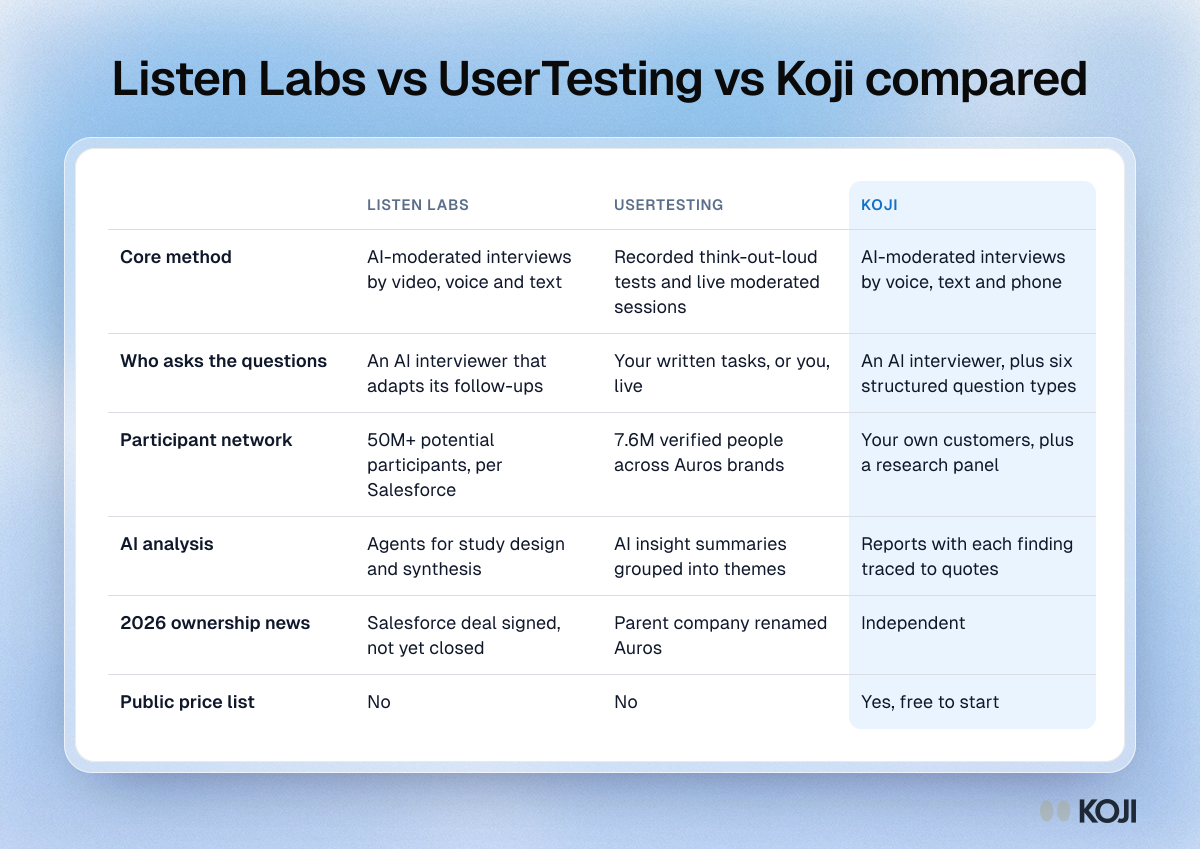
Listen Labs vs UserTesting at a glance
| Listen Labs | UserTesting | Koji | |
|---|---|---|---|
| Core method | AI-moderated interviews by video, voice and text | Recorded think-out-loud tests and live moderated sessions | AI-moderated interviews by voice, text and phone |
| Who asks the questions | An AI interviewer that adapts its follow-ups | Your written tasks, or you, live | An AI interviewer, plus six structured question types |
| Participant network | 50M+ potential participants, per Salesforce | 7.6M verified people across Auros brands | Your own customers, plus a research panel |
| AI analysis | Agents for study design and synthesis | AI insight summaries grouped into themes | Reports with each finding traced to quotes |
| 2026 ownership news | Salesforce deal signed, not yet closed | Parent company renamed Auros | Independent |
| Public price list | No | No | Yes, free to start |
What Listen Labs does well
Interviews that adapt. Listen Labs' AI interviewer asks an opening question and then follows the participant's answer, the way a good moderator would. That makes it a tool for "why" questions: why people picked a competitor, why a feature never caught on, how a buyer describes the problem in their own words.
Scale and reach. A recruiting network that Salesforce puts above 50 million people, and more than 120 languages, makes multi-country consumer studies practical in days rather than months.
Money and momentum. Listen Labs raised a $69 million Series B in January 2026, led by Ribbit Capital with Sequoia, Conviction and Pear VC, and said it had run more than one million interviews.
Where it is weaker. It is sold through a demo and pilot, not self-serve. Listen Labs' own pricing guide puts per-interview pricing for most enterprise customers at $85 to $150, before platform access. And with the Salesforce deal pending, its packaging after closing is an open question.
What UserTesting does well
Watching behaviour. UserTesting's core is the recorded session: a participant works through tasks on your site, app or prototype while saying what they think, and you get the video, a synced transcript, clips and highlight reels. Nothing in an interview replaces seeing someone miss the button you thought was obvious.
Live sessions when you need them. Live Conversation lets a researcher moderate in real time, and newer AI summaries are built from the transcript at session and study level.
AI summaries tied to evidence. On completed tests, AI insight summaries group responses into themes and link each theme back to the sessions behind it.
Design workflow. In January 2026 it launched UserTesting for Figma, which generates test plans from prototypes.
Where it is weaker. Sessions are scripted tasks, so you get what people do and say, not a probing conversation about their motives. Pricing is not published: Vendr's purchase data puts typical contracts between about $12,000 and $113,642 a year, with a median around $40,000. And its press release on the User Interviews deal shows who it is built for: more than 3,000 customers, including 75 of the Fortune 100.
When you need to watch people use the product
Some questions can only be answered by watching. Can a new customer finish onboarding without help? Do people understand the pricing page? Where does checkout lose them? For these, UserTesting's recorded sessions are the stronger tool, and an interview, AI or human, is a weak substitute. People are poor reporters of their own clicks.

Photo by Vitaly Gariev on Unsplash
Other questions can only be answered by asking. Why did a customer cancel? What were they using before? What would make them pay more? Here a screen recording tells you very little. You need someone to ask, listen and ask again, which is what Listen Labs and Koji do.
Most product teams need both, at different moments. The mistake is buying one platform and forcing every question through it.
Questions to ask either vendor before you sign
Both companies sell annual contracts, and both are in the middle of a corporate change. Get answers in writing.
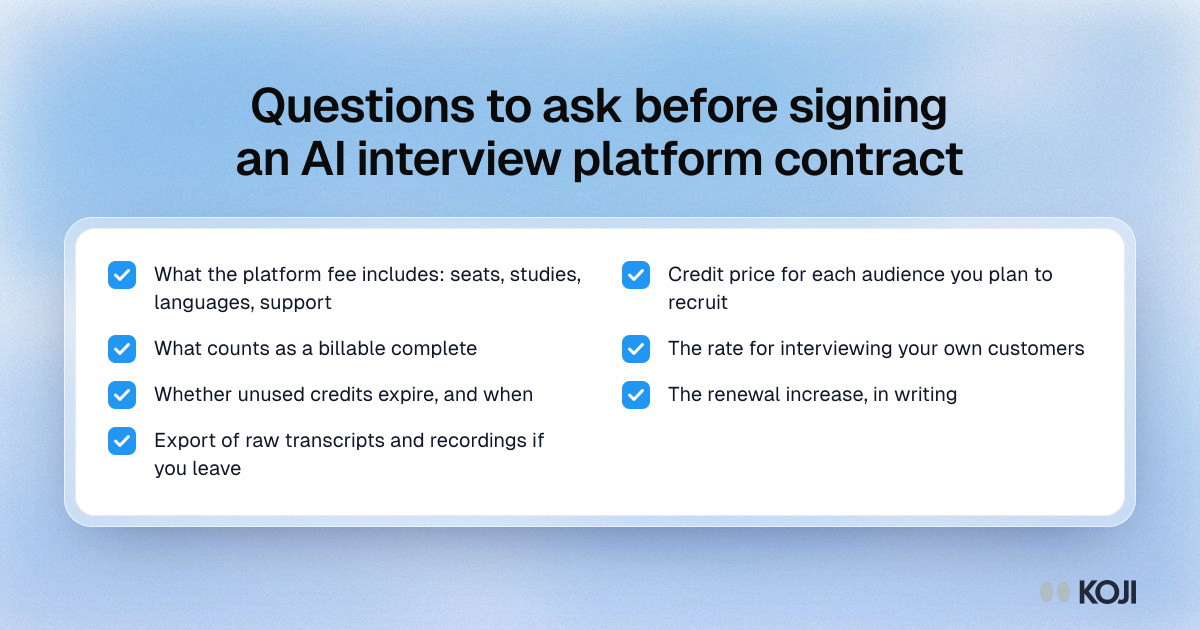
For Listen Labs, also ask whether you will need other Salesforce products after the deal closes. For UserTesting, ask which participant network your plan draws on now that User Interviews sits under the same roof.
Where Koji fits
Koji is an AI interview platform like Listen Labs, sold the way most software is: you sign up and start. It suits teams who want the "why" without a five-figure contract.
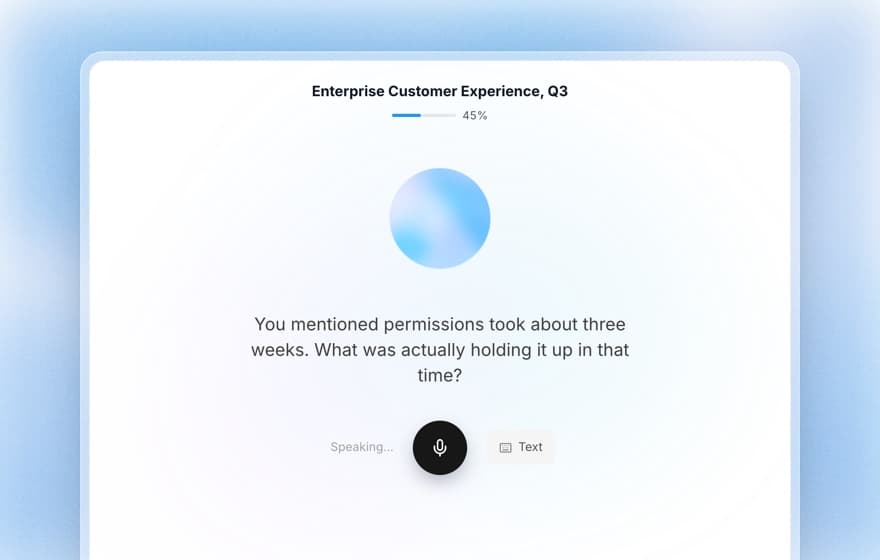
- Published prices. You start free with 10 credits. Insights is €29 a month with 29 credits, Interviews is €79 a month with 79 credits, and Enterprise is priced on request. A text interview uses 1 credit, a voice interview 3, and a phone interview 0.6 credits a minute.
- You pay for usable interviews only. Every interview gets a quality score from 1 to 5, and only those scoring 3 or more use credits or enter the report. See understanding quality scores.
- Voice, text and phone. Participants choose how to answer, in 28 interview languages. Every question, including answer options and scale labels, is translated when you publish.
- Your customers or a panel. Interview your own users with a link or personal invites, or recruit from Koji's research panel on paid plans.
- Reports you can check. Findings link to the quotes behind them, and you can preview your interview for free before launch.
What Koji does not do: video interviews or recorded screen sessions. If you need to watch someone use a prototype, pair Koji with a usability tool rather than expecting one platform to do both.
For a head-to-head on the AI interview side, read Koji vs Listen Labs.
How to choose
- You need to see people use a product or prototype: UserTesting.
- You are an enterprise insights team running large multi-country interview studies, and Salesforce is your stack: Listen Labs.
- You want AI interviews with your own customers this week, on prices you can read: Koji.
Try it on one question
The fastest way to decide is to run one real study. Write the question you most need answered, send it to 20 customers, and read the report. Start a free study on Koji and you will have interviews back the same day.