Engagement survey follow-up interviews are short, confidential conversations you run with employees in the three weeks after engagement results land, to find out why the scores that matter moved before anyone writes an action plan. Run with AI-moderated interviews, every employee in a flagged area can answer the same questions in their own words at a time that suits them, nobody has to say it in front of their manager, and you get counts and quotes by area instead of a focus group's loudest voice. By the end of this playbook you will have a rule for which results to follow up, a 21-day timeline, an interview guide you can paste into any tool, and a readout that turns into three actions with owners.
Why engagement survey follow-up matters now
Engagement is falling, and the people who are meant to fix it are falling with it. Gallup's State of the Global Workplace 2026 puts global engagement at 20% in 2025, down from 23% in 2022, and it is the first time Gallup has recorded two years of decline in a row. Manager engagement fell from 31% in 2022 to 22% in 2025. Gallup puts the cost of low engagement at about $10 trillion in lost productivity, roughly 9% of global GDP.
HR is not short of data. It is short of reasons. In a September 2026 Remesh survey of 107 HR leaders in the US and UK, 80% said they run a formal employee listening programme, but only 18% called their approach very effective, and just 11% at large organisations. Asked what makes listening effective, 23% ranked "leads to meaningful change" first. Only 3% put "explains why employees think and feel as they do" first, which tied for last. Remesh sells listening software, so read the numbers with that in mind, but the pattern is familiar: teams collect scores and skip the why, then wonder why nothing changes.
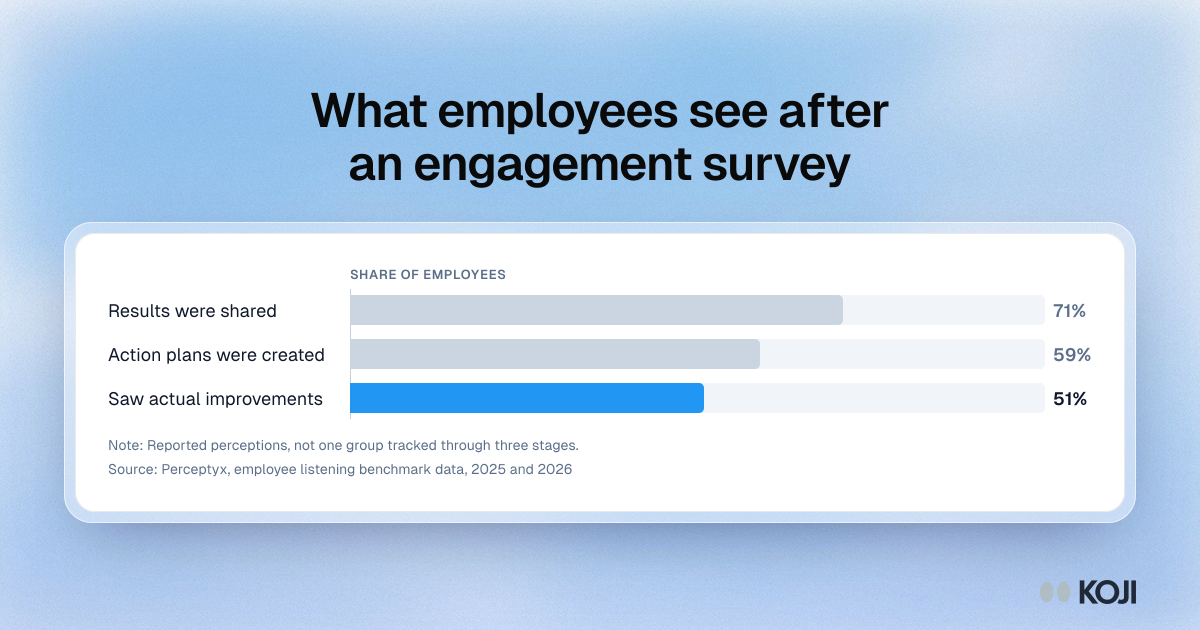
Employees notice. Perceptyx benchmark data shows that 71% of employees say survey results were shared and 59% say action plans were created, but only 51% saw actual improvements. These are reported perceptions, not one group followed through three stages, and Perceptyx sells action-planning tools. Still, half your workforce looking at the last cycle and seeing nothing is the reason next year's response rate drops.
And the pressure on HR to show results is rising. In Perceptyx's 2026 State of Employee Listening, 37% of companies named employee performance and productivity as their top talent priority, up from 23% in 2024, and the number of HR leaders citing budget as a barrier to listening rose 65% from 2025 to 2026. You are being asked to prove the survey was worth it, with less money to do it.
The cost of skipping the follow-up is concrete. Leaders guess at causes from item scores, pick actions that do not touch the real problem, and the same items fall again next year. Gallup's own engagement checklist is blunt: if you just run a survey and do nothing more, engagement will likely fall, and turnover may follow.
What good looks like
We have watched a lot of post-survey action planning go wrong in the same ways. The teams that get it right run a short, tight sprint between results and action plans, and they treat it as research, not a listening tour.
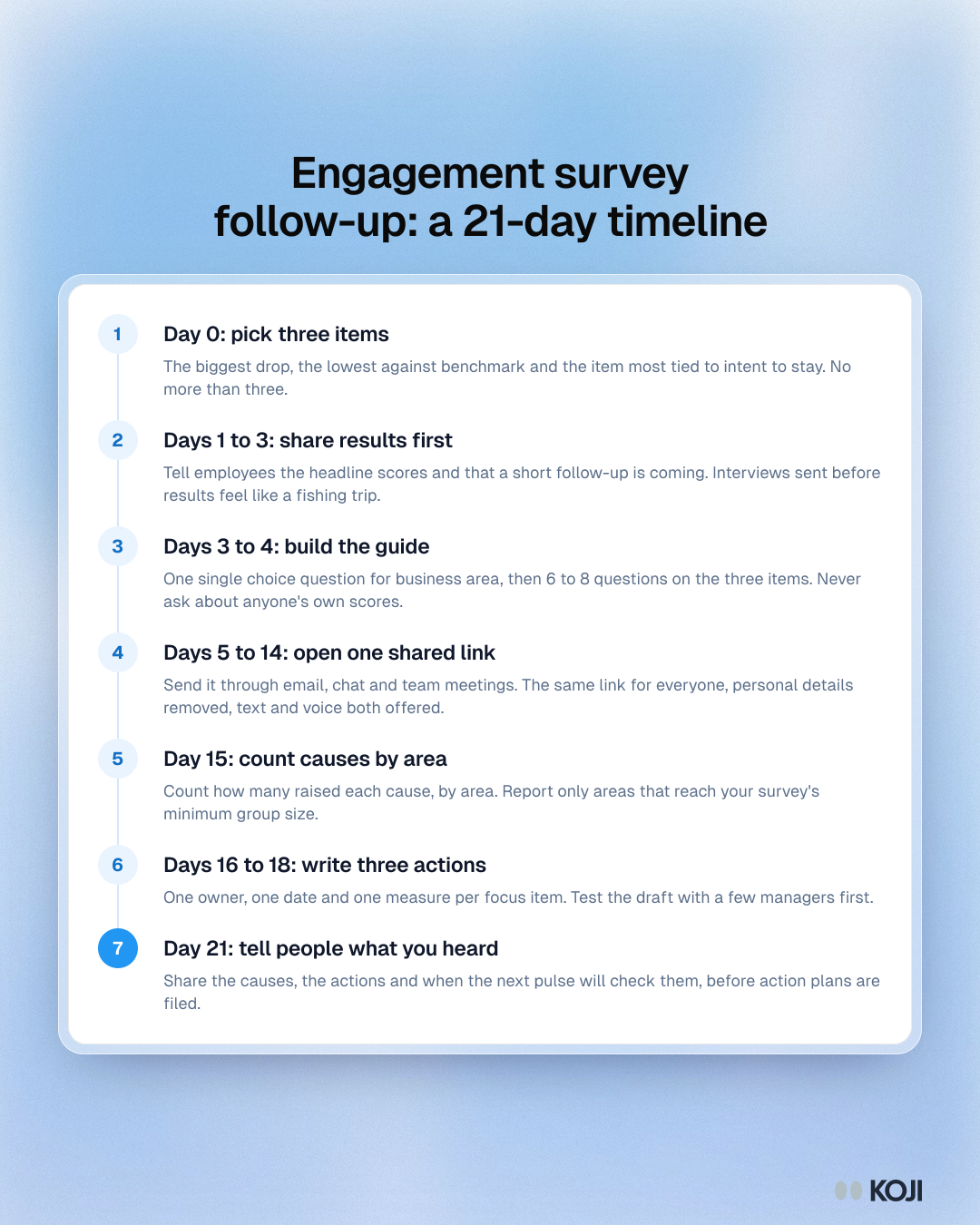
Follow up three items, not twelve. Pick from your results: the item that fell the most since last cycle, the item furthest below your benchmark, and the item most closely tied to intent to stay or eNPS in your survey tool's driver analysis. If one item is all three, pick the next one down. Three is the most you can investigate properly and act on in a quarter.
Share results before you ask for more. Tell employees the headline scores first, then tell them a short follow-up is coming and why. Interviews sent before results feel like a fishing trip, and people answer accordingly.
Use the survey as context, never as a mirror. You can say "many people in your area said they cannot see how to grow here". You never say "you scored 3 on growth". Referring to anyone's own answers breaks the anonymity of the survey you just ran.
Invite everyone in a flagged area, not a hand-picked sample. The point of the follow-up is to hear people who did not write comments. Open the interview to every employee in the areas you are investigating. Aim for at least 12 to 15 completed interviews per area you plan to report on; below that, you are reading anecdotes.
Report only groups big enough to protect people. Use the same minimum reporting group as your survey platform, and never cut results smaller than that. A "finding" from four people in one team identifies them. Our guide to k-anonymity for segment reporting sets out how small is too small.
Count, then quote. A readout line such as "41% of interviewees in Operations described shift swaps decided by one supervisor" (an illustration, not a real result) beats three vivid quotes. Lead with how many raised each cause, by area, then show two or three quotes per cause.
End in actions with owners and dates. One owner, one date and one measure per focus item, and a date by which you will tell employees what you heard.
Here is the timeline we recommend, counted from the day results land:
Common mistakes
- Running focus groups with the manager's own team in the room. People will not describe a manager problem in front of colleagues who report to the same person.
- Asking "what should we do?" first. You get wish lists. Ask about the last time the problem showed up, then ask what would help.
- Sending personal, tracked links for an anonymous follow-up. If the link knows who you are, people will assume HR does too.
- Following up every item that dropped. Twelve focus areas produce twelve weak actions and no visible change.
- Letting the follow-up drift past action-plan deadlines. Insight that arrives after plans are filed changes nothing.
- Reporting the whole company's themes only. The causes in Sales and in Operations are rarely the same. Cut by area, as far as your minimum group size allows.
Copy this interview guide
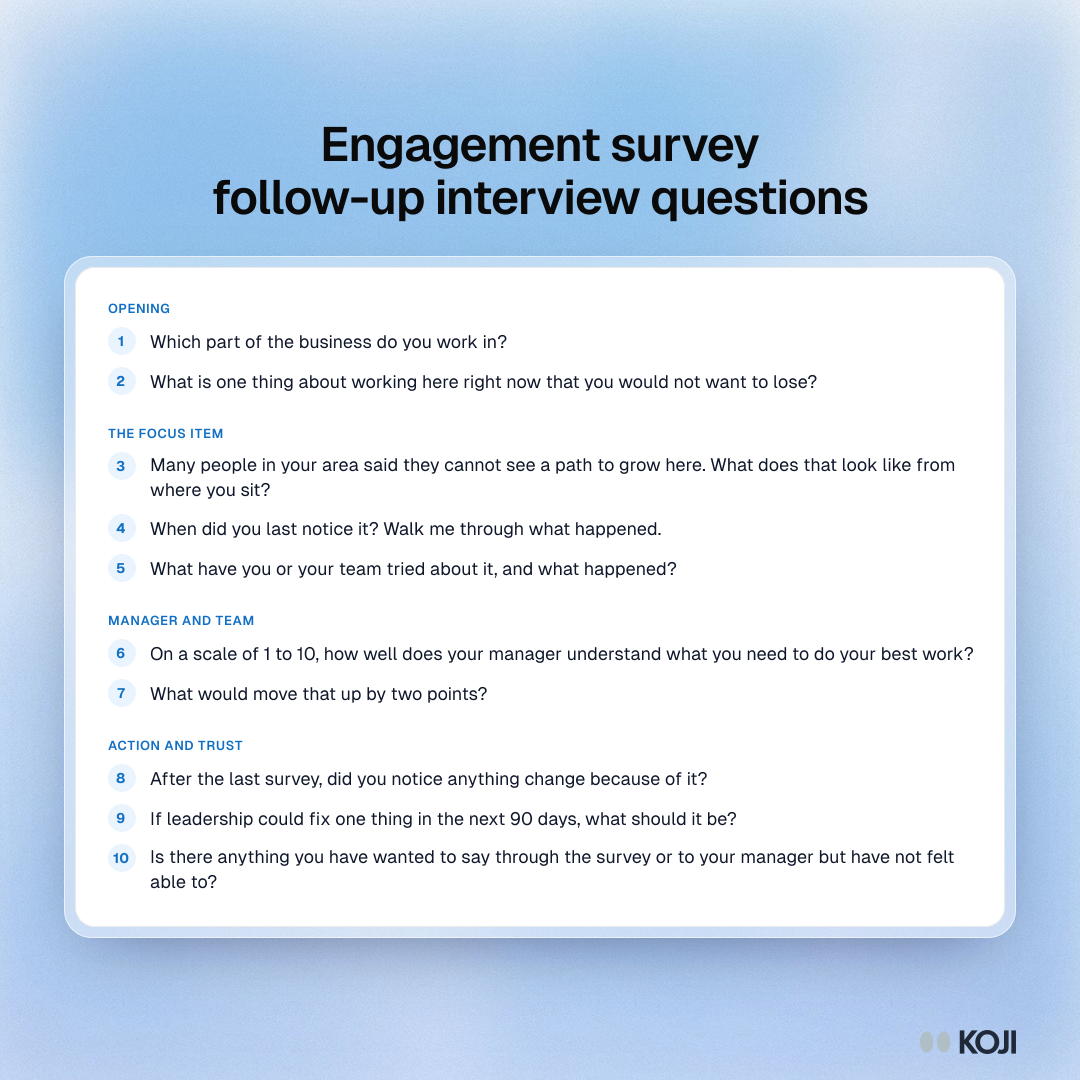
Paste this into Koji or any interview tool. It runs about 10 to 12 minutes. Replace the bracketed text with your own focus items.
Opening line: "Thanks for taking the engagement survey. Results showed a few areas we want to understand better before we decide what to change. This takes about 10 minutes, it is confidential, and nothing you say will be linked to your name or shared with your manager."
- Which part of the business do you work in? (single choice, with broad areas only, such as Sales, Operations, Product and Engineering, Corporate functions) No probe. This lets you cut results by area.
- What is one thing about working here right now that you would not want to lose? (open) Probe: "What makes that work?"
- Many people in your area said [focus item 1, e.g. they cannot see a path to grow here]. What does that look like from where you sit? (open) Probe: "When did you last notice it? Walk me through what happened."
- What have you or your team tried about it, and what happened? (open) Probe: "What got in the way?"
- On a scale of 1 to 10, how well does your manager understand what you need to do your best work? (1 to 10 scale) Probe: "What would move that up by two points?"
- [Focus item 2, phrased the same way as question 3.] (open) Probe: "Is that new, or has it been true for a while?"
- After the last survey, did you notice anything change because of it? (yes/no) Probe: "What was it?" or "What would you have wanted to see?"
- If leadership could fix one thing in the next 90 days, what should it be? (open) Probe: "How would you know it had been fixed?"
Closing question: "Is there anything you have wanted to say through the survey or to your manager but have not felt able to?"
Research brief to paste into Koji's "What do you want to research?" box: "Find out why [focus items] scored low in our [month] engagement survey, which causes differ by business area, and what employees would need to see in the next 90 days to believe the survey led to change."
How to set it up in Koji, step by step
- Start from the template. In the dashboard template gallery, filter to HR and open Engagement Pulse Interviews. It comes with a brief for understanding the story behind engagement scores, a mix of open, scale and yes/no questions, and guardrails such as never referring to individual survey scores. Or paste the research brief above into "What do you want to research?" and the research assistant drafts the study.
- Shape the brief. Name your three focus items in the problem statement and say what decision the research informs (which actions go into the plan, for which areas). Upload a short summary of the aggregate results as a study context file (PDF, TXT or Markdown, up to 25 MB), so the interviewer knows what employees are reacting to. Never upload item-level or individual results.
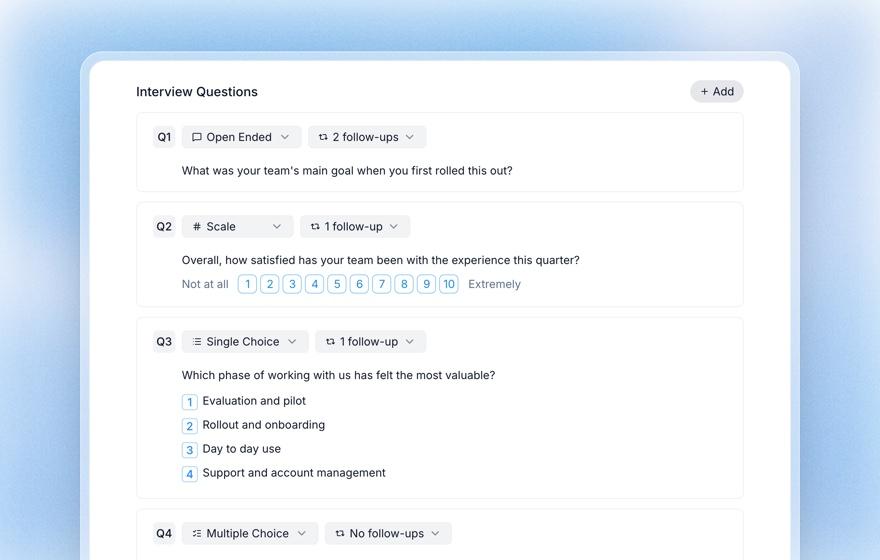
- Add structured questions where you need a number or a cut. Make the business area question a single choice, keep the manager question as a 1 to 10 scale, and use Who's asked on any question to show it only to the areas it applies to, for example a question about shift patterns only for Operations. Koji describes each rule in plain words before you save it and skips the question for everyone else, in text and voice.
- Set privacy and format. In Branding & Settings, open Privacy and turn on Remove personal details, so names, emails, phone numbers and employers are taken out of each transcript when the interview finishes. Offer both text and voice in the experience settings; many employees in open-plan offices will choose text. If your workforce works in several languages, turn them on and Koji translates every question when you publish.
- Preview, then share one link. Take the interview yourself from the Preview tab; previews are free and never count as responses. Then share the single study link through your own channels: an email from the CHRO, Slack or Teams, and a slide at team meetings. Use one shared link for everyone. Personal invite links and recruitment emails tie each interview to a named person and do not show the Anonymous badge, which is right for customer research and wrong here.
- Read the report as interviews come in. Each interview gets a quality score from 1 to 5, and only those scoring 3 or more enter the report. The report gives findings with the share of participants behind each one and the quotes that support it, plus charts for your structured questions.
Which plan you need. You can build and preview the whole study on the Free plan, which includes 10 interviews to try. A company-wide follow-up of a few hundred interviews needs a paid plan; check pricing for interview allowances and for voice. Enterprise adds SAML SSO, SCIM provisioning, audit logs, custom data retention and a pre-signed DPA, which works councils and IT security teams often ask for.
What you get, and what to send whom
The output is a report you can take straight into action planning.
- For the CHRO and the executive team: the three focus items, the main causes behind each with how many people raised them, and a short list of proposed actions. Download the report as an editable PowerPoint deck or a PDF and drop it into the leadership meeting.
- For HR business partners: the causes by business area, so each HRBP walks into their action-planning session with their own area's story rather than the company average. You can invite HRBPs as workspace viewers, which costs no seat. Viewers can read reports and download transcripts, so give that access to HR only.
- For managers: a one-page summary of what people in their area said, at the level of the area, never their own team when it is below your minimum group size.
- For employees: within 21 days, a short note saying what you heard, the three actions, who owns them and when the next pulse will check progress. This is the step most companies skip, and the one that decides whether people answer next year.
The same playbook elsewhere
The shape of this sprint, scores first and then interviews to find the why, works well beyond HR.
- Customer Success teams use it after an NPS or CSAT drop: survey the base, then interview detractors and passives within two weeks to find the cause. Our piece on why NPS alone misleads explains the gap.
- HR after a restructure runs the same sprint on a narrower group. See the span-of-control check after delayering and layoff survivor interviews, both of which borrow this timeline.
- Total rewards teams use it before publishing pay ranges, in our pay transparency employee research playbook.
What HR can borrow from Customer Success: CS teams close the loop with each customer who gave a low score. You cannot do that one to one with anonymous employees, but you can close it with every area, publicly, with a date.
Every HR playbook we have published is collected at /use-cases/hr.
Why Koji for engagement survey follow-up
Most HR teams follow up results in one of four ways: reading the comment box, running focus groups, turning on AI follow-up questions inside the survey itself, or running AI-moderated interviews after results. Each has a place.
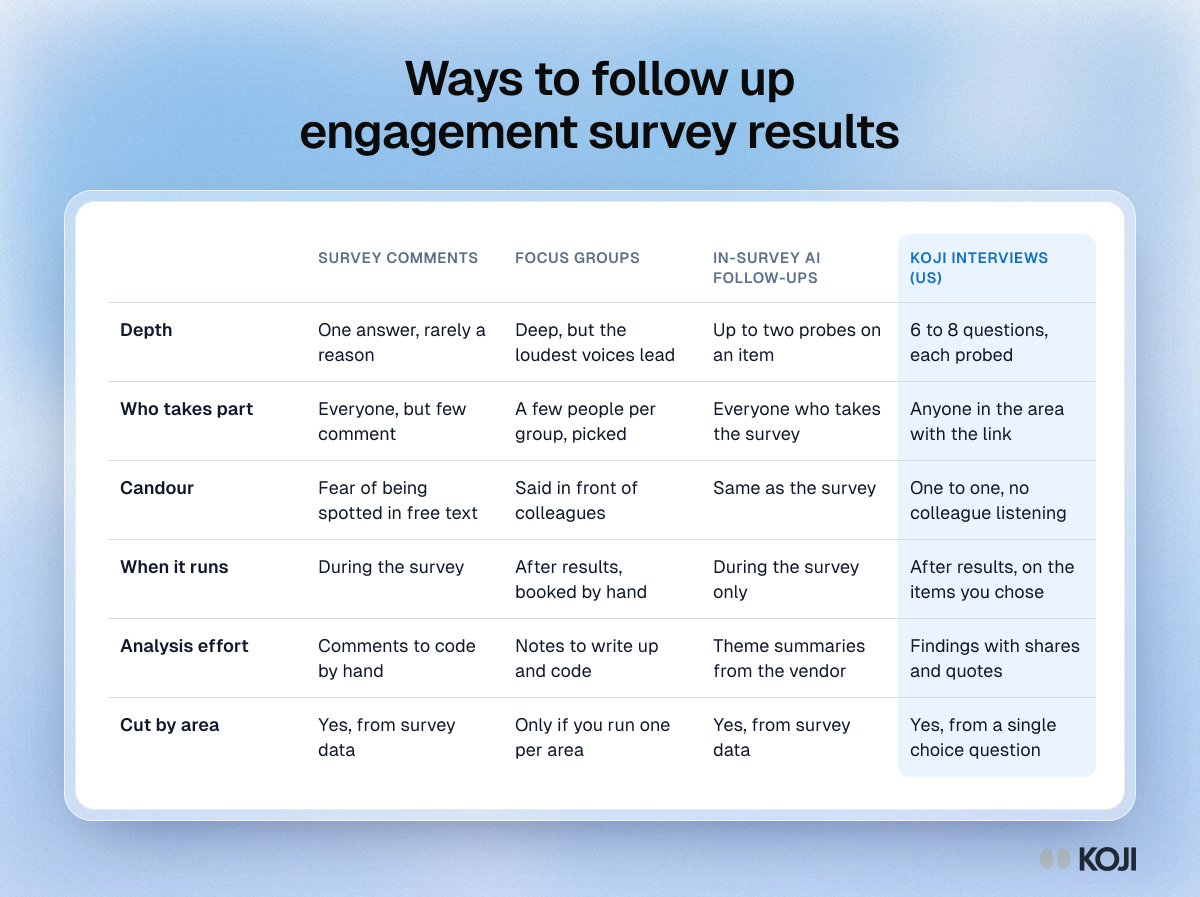
In-survey AI follow-ups are a real step forward. Culture Amp's AI follow-ups add up to two AI-generated follow-up questions to a rating or free-text question in Engagement and Lifecycle surveys, and Qualtrics offers Adaptive Follow-Ups that ask about what the respondent just wrote. If you already use them, keep them on. They run during the survey, though, before you know which items need a why. A follow-up interview runs after results, on the three items you chose, and can go six or eight questions deep.
Reasons to run the follow-up on Koji:
- One interview guide, applied the same way to everyone. Every employee gets the same questions and the same probes, so differences between areas are differences in what people said, not in who moderated.
- Branching by area in one study. Show area-specific questions only to the areas they apply to, so one study covers the whole company without asking anyone irrelevant questions.
- Privacy settings built for employee research. Remove personal details cleans every transcript before analysis, the original is not kept, and if anything was removed the voice recording is not kept either.
- A report you can act on. Findings come with the share of participants behind each one and the supporting quotes, and only interviews that score 3 or more on quality count.
- Text, voice and many languages. Employees answer by typing or speaking, in their own language, at a time that suits them, including frontline staff who never get a survey slot in a meeting.
Questions you might have about AI interviews
Will employees believe it is anonymous? Only if you keep it that way. Use one shared link, not personal links, so the interview is not tied to a person, and the landing page can show an Anonymous badge. Turn on Remove personal details so names employees mention are replaced with labels such as [NAME] before anyone reads the transcript. It can miss some details, so review responses before sharing quotes. Our guide to anonymous employee research with AI interviews goes further.
Will an AI feel cold for something this personal? Employees often say more to an interviewer that cannot judge them or repeat it in the kitchen. The interviewer follows your guide and guardrails and probes for the specific event behind a general complaint. Be aware that the way any interviewer probes can shape answers: an Ohio State study found AI interviews drew out more information but could also nudge opinions, so keep probes neutral and preview the study yourself.
Do we need works council approval, and is it GDPR safe? In many EU countries, yes, you should consult the works council before any new employee listening tool. Koji stores data in the EU, encrypts it in transit and at rest, and never uses customer interview data to train AI models. Enterprise adds a pre-signed DPA, SSO and custom data retention. See works councils and employee research for how to prepare.
When Koji may not be the right fit
If your whole follow-up is three teams of eight people, a skilled facilitator running skip-level conversations may be enough, and an interview tool adds little. If you cannot reach a minimum group size in any area, no method will let you report safely by area, and you should report company-wide themes only. And if your organisation has no capacity to act on anything this quarter, do not run the follow-up yet: asking for more input and then doing nothing is worse than not asking.
Metrics to track
- Participation rate in each flagged area, against the survey's own response rate.
- Completed interviews per area, with every reported area above your minimum group size.
- Share of interviews naming each cause, by area.
- Days from results to action plan, aiming for 21 or fewer.
- Movement on the three focus items at the next pulse.
- The "did you notice anything change?" answer at the next follow-up, which should rise from cycle to cycle.
FAQ
How long after engagement results should follow-up interviews start? Within three to five days of sharing results with employees, and fieldwork should close within ten days, so the readout lands before action plans are due.
How many employees should we interview after an engagement survey? Open it to everyone in the areas you are investigating and aim for at least 12 to 15 completed interviews per area you will report on. Never report a group smaller than your survey platform's minimum reporting size.
Should engagement follow-up interviews be anonymous? Yes. Use one shared link rather than personal links, turn on Remove personal details, and never ask about anyone's own survey answers.
Are follow-up interviews better than focus groups? For sensitive topics, usually. Focus groups are good for building on each other's ideas, but people rarely criticise a manager in front of colleagues. One-to-one interviews reach more people and give you counts by area.
What questions should we ask in engagement survey follow-up interviews? Start with what people would not want to lose, then ask what each focus item looks like from where they sit, when they last noticed it, what they tried, and what one change in 90 days would make the biggest difference. The full guide is above.
Start your follow-up this week
Sign up, open the Engagement Pulse Interviews template in the HR section of the template gallery, swap in your three focus items and preview it today. Or paste the research brief above into "What do you want to research?". To see how Koji supports HR teams more broadly, visit Koji for HR, and read the engagement survey guide for how to set up the survey that comes before this.