How to present stakeholder interview findings to a steering committee comes down to one rule: start from the decision the committee has to make, and show for every finding who said it, how many agreed, and the words they used. Running the interviews as AI-moderated conversations lets you hear 40 to 120 of the client's people in a week, with the same questions for each group, so your counts hold up when a director asks "how many people actually said that?". By the end of this playbook you'll have a 10-day plan counted back from the meeting, a slide structure, an interview guide to copy and the exact setup in Koji.
Why the steering committee readout matters more now
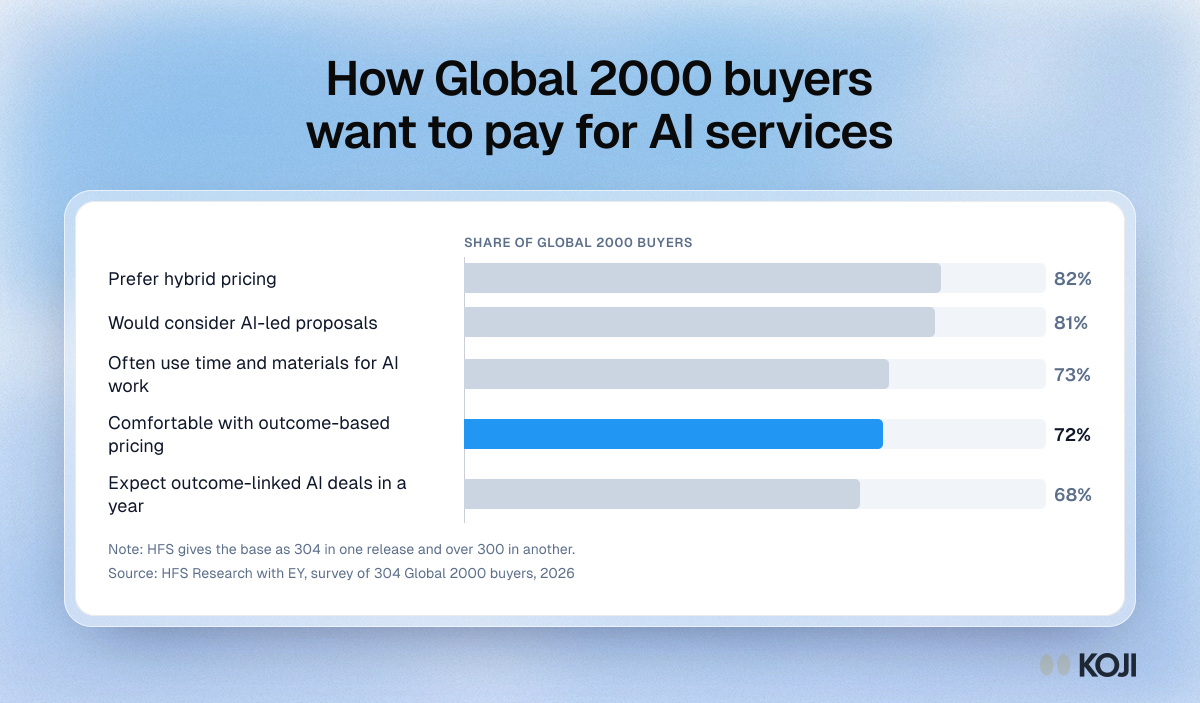
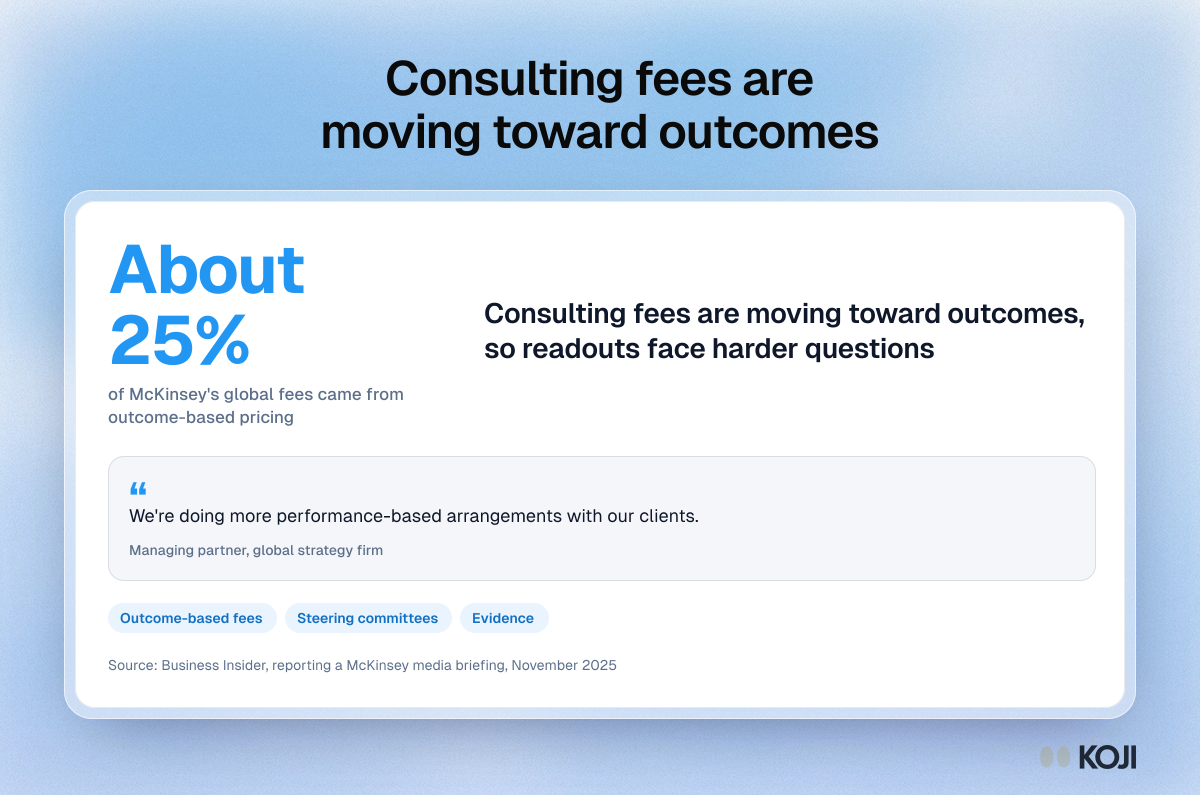
Fees are moving toward outcomes. McKinsey's UK managing partner said in November 2025 that about a quarter (roughly 25%) of the firm's global fees now come from outcome-based pricing: "We're doing more performance-based arrangements with our clients" (Business Insider via Yahoo Finance, 2025). Buyers are open to it: in a 2026 HFS Research survey with EY of 304 Global 2000 executives, 72% said they were comfortable with outcome-based pricing for AI delivery, 82% preferred hybrid pricing, 81% would consider AI-led proposals and 68% expected to sign outcome-linked AI contracts within 12 months. Yet 73% still frequently use time-and-materials contracts for AI-led work (HFS Research, 2026). When part of the fee depends on what happens next, the readout has to land a decision.
The people on the committee are being asked for proof too. Gartner reported in October 2026 that 44% of CEOs struggle to demonstrate AI-driven financial returns to stakeholders (Gartner, 2026). Change programmes have a poor record: only 32% of leaders said their last change achieved healthy adoption (Gartner, 2025).
And everyone now checks the evidence. Deloitte Australia agreed to partially refund a A$440,000 government report after fabricated references and a misattributed court quote were found in it (Fortune, 2025). By August 2026 all four of the Big Four had faced accusations of publishing AI-generated "thought leadership" with errors in it, including a KPMG report where GPTZero said 40 of 45 sources were hallucinated (Consultancy.uk, 2026). Outside consulting, Workiva's 2026 survey found 89% of institutional investors worried about the accuracy of AI-generated information in corporate disclosures, and 47% said they actively look for errors (FM Magazine, 2026).
So a weak readout costs more. If a finding can't be traced to real people, the committee parks the decision, the next phase slips and, on an outcome-linked contract, so does part of your fee.
What good looks like: the Steerco Evidence Pack
It usually goes wrong the same way: 25 interviews, a theme list, quotes picked by whoever wrote the deck, and a room that argues about whether the themes are real. The fix is a pack built backwards from the decision. We call it the Steerco Evidence Pack. Five rules:
- One decision on the first slide. Write the question the committee must answer in their words, with the date they must answer it by. "Do we move to a shared-services finance model in Q2, yes or no?" Everything after it either helps answer that or goes in the appendix.
- Action titles with a count. Every finding slide's title is a full sentence a director could repeat, plus who backs it: "Regional controllers will resist the move unless month-end close stays local (9 of 11 controllers)". Never a one-word theme.
- Split every count by stakeholder group. A steerco is a room of people who each speak for a group. Show each finding across groups: executives, managers, frontline staff, customers if you heard them. A finding that only one group holds is still useful, but say so.
- Label confidence plainly. Use three labels and define them on the method slide. Strong: most people in two or more groups said it unprompted. Directional: a clear pattern in one group, or a minority across several. Single voice: one or two people, kept because the risk is serious.
- Quotes by role, never by name. Stakeholder interviews inside a client are political. Attribute every quote to a role and group ("Site manager, northern region"), and check that no quote identifies its speaker by detail alone.
Then pre-wire: walk each member through the findings about their area a day or two before. Nobody should first see a finding about their own team in front of their peers. This does more for the decision than any slide design.
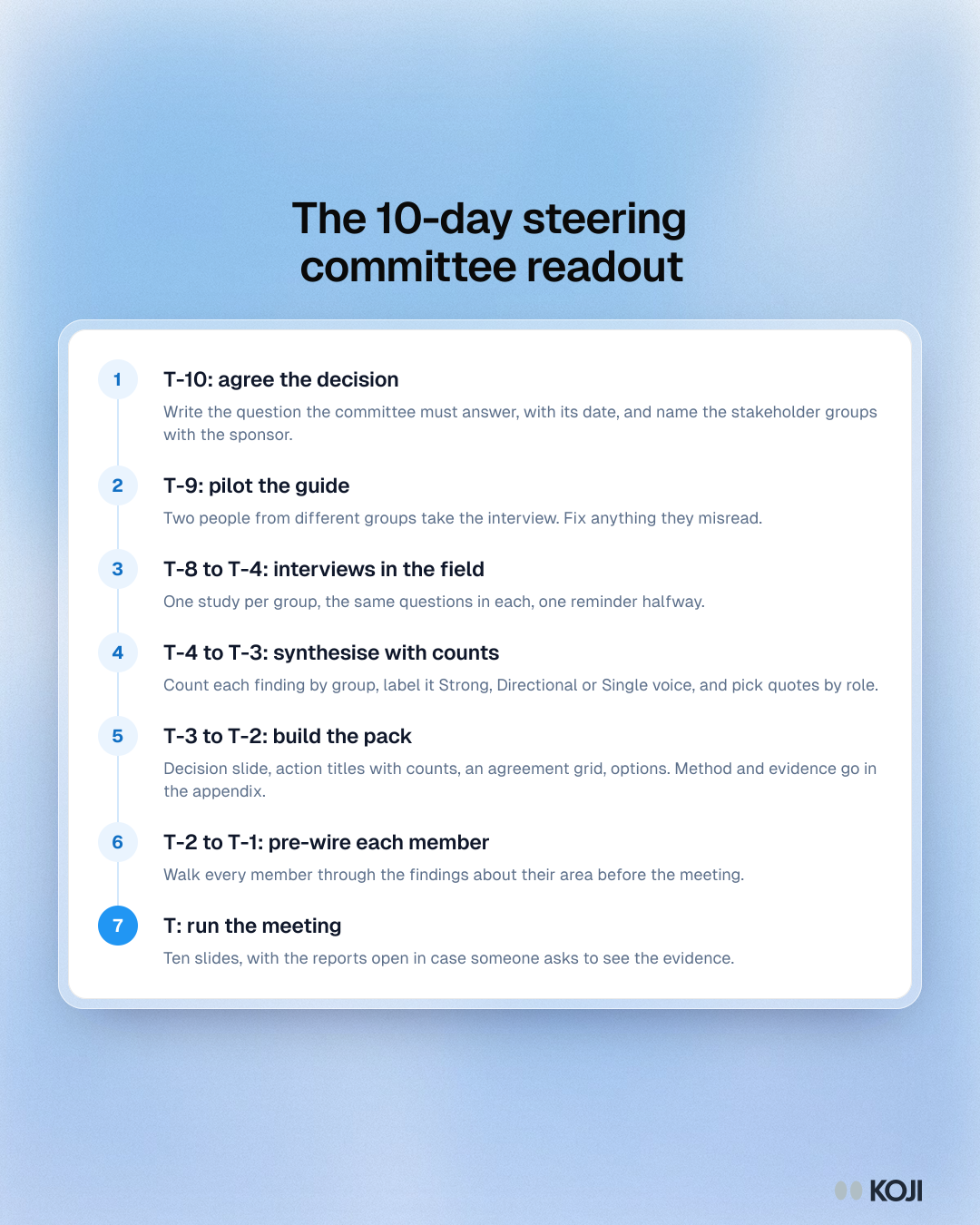
The 10-day plan, counted back from the meeting (T):
- T-10: agree the decision question and the stakeholder groups with the sponsor. Write the brief.
- T-9: pilot the guide with two people from different groups. Fix anything they misread.
- T-8 to T-4: interviews in the field. Send one reminder at T-6.
- T-4 to T-3: synthesise: counts by group, confidence labels, quotes chosen by role.
- T-3 to T-2: build the deck in your firm's template.
- T-2 to T-1: pre-wire each committee member.
- T: the meeting. Ten slides, the rest in the appendix.
How many people? Our rule of thumb is 6 to 12 per stakeholder group, and you stop a group when five interviews in a row add nothing new. With four groups that is 24 to 48 interviews. For a frontline group of several hundred people, go to 15 or 20 so that a regional split is possible.
Common mistakes
- Starting with method. Put it on one appendix slide.
- Themes without counts. "Communication is a concern" invites a debate you can't win. "7 of 9 managers said they learn about changes from their teams first" doesn't.
- Percentages on 30 interviews. "38% of staff" reads as a survey result. Use "11 of 29" and the label.
- Hiding the dissent. If finance disagrees with everyone else, show it. The room will hear it anyway.
- No trail. Every quote and count should trace to a transcript you can open if asked.
Copy this interview guide
Paste this into any tool, or into Koji. Run one version per stakeholder group and change only the wording of the context line.
Opening line: "Thanks for making time. We're speaking with people across [client] about [the decision]. There are no right answers, and what you say is reported by role, not by name."
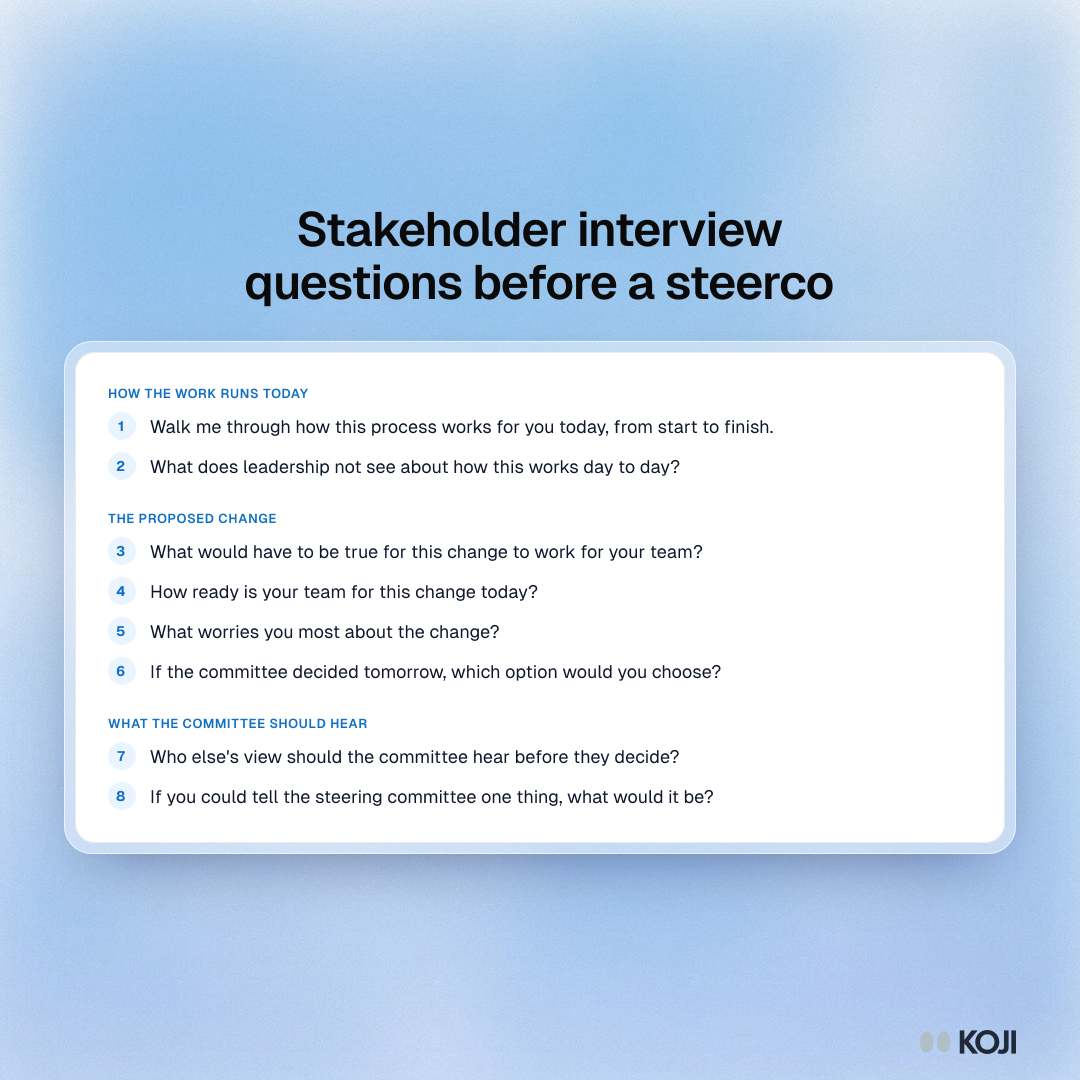
- Open. "Walk me through how [the process in scope] works for you today, from start to finish." Probe: "Where does it slow down or go wrong?"
- Open. "What would have to be true for [the proposed change] to work for your team?" Probe: "What would you need on day one?"
- 1 to 10 scale. "How ready is your team for [the change] today?" Probe: "What would move that score up by two points?"
- Open. "What worries you most about [the change]?" Probe: "Has something like this been tried before? What happened?"
- Single choice. "If the committee decided tomorrow, which option would you choose?" (Option A, Option B, Keep things as they are, Not sure) Probe: "What makes you lean that way?"
- Open. "Who else's view should the committee hear before they decide?" Probe: "What would they say that we haven't heard?"
- Open. "What does leadership not see about how this works day to day?" Probe: "Can you give me a recent example?"
- Open. "If you could tell the steering committee one thing, what would it be?"
Closing: "Is there anything we didn't ask that we should have?"
One-line brief for Koji's "What do you want to research?" box: "Interview managers and frontline staff at [client] about [the proposed change] so the steering committee can decide [decision] by [date]: how the work runs today, what they need for it to work, what worries them and which option they'd choose."
How to set it up in Koji, step by step
- Start a study from a template. In the dashboard's template gallery, the Stakeholder Requirements Gathering template (under Business Analysts) gives you a stakeholder interview brief to adapt. For a change decision, Change Impact Assessment is closer. Or paste the one-line brief above into "What do you want to research?".
- Shape the research brief. Tell the research assistant the decision, the groups and the options. It changes questions and follow-up depth on request and says what it changed.
- Add structured questions where you need a number. Make question 3 a 1 to 10 scale and question 5 a single choice, so the report gives you a chart next to the reasons.
- Make one study per stakeholder group. Reports don't filter by segment, so duplicate the finished study for each group from its card menu. The copy keeps the brief and settings, not the results. Change the opening line for each group.
- Turn on Remove personal details. In each study's privacy settings, Koji takes names, email addresses, phone numbers, addresses and employers out of the transcript when the interview finishes. It can miss some details, so still read the quotes you use.
- Choose voice, text or both.
- Invite people. For anonymous groups, send one shared link per group through the sponsor's internal channels. If you need to track who has responded, import the list as a CSV for a link per person (Interviews and Enterprise plans), knowing that ties each interview to a name.
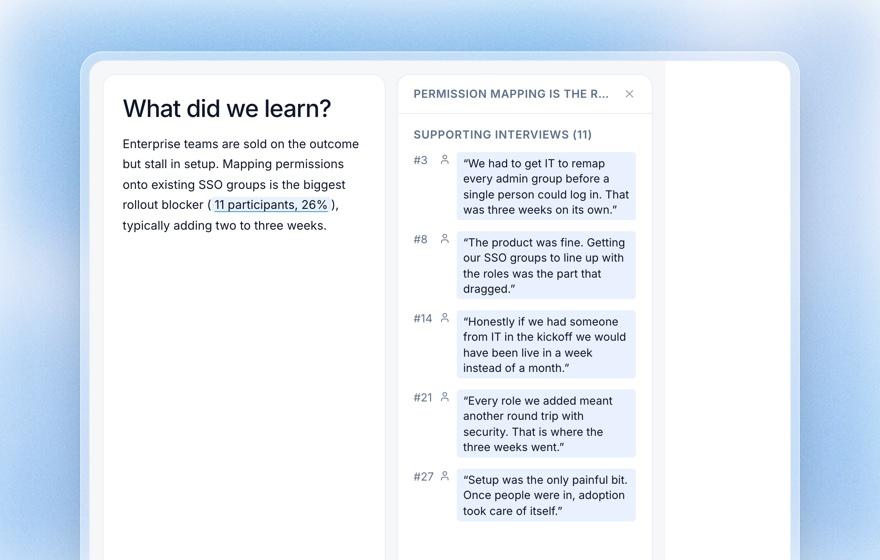
- Read the report, then download the deck. Each finding shows how many participants back it, with their quotes one click away.
Which plan? You can design a study, run interviews and download the report as slides or a PDF on the Free plan. Per-person invite links need Interviews or Enterprise, and a team of consultants working in one workspace needs a plan with enough seats.
What you get, and what to send whom
For each stakeholder group you get a report: a summary, key findings with the share of participants behind each, charts for the scale and choice questions, personas and recommendations. Every interview has a quality rating (relevance, depth, coverage, completion), so you can check weak ones before you count them.

Photo by Memento Media on Unsplash
Download any report as an editable PowerPoint deck or a PDF. The deck has an executive summary, up to eight insight slides each with a quote, a slide per question with native charts, personas and recommendations, and opens in PowerPoint, Keynote and Google Slides. It uses Koji's layout and ends with a slide naming the study and Koji, so move the content into your firm's template. Check that each quote's label is a role, not a name.
Here is how we'd use it the next day:
- The engagement team merges the group reports into one agreement grid: findings down the side, groups across the top, counts in the cells.
- Each committee member gets a two-page pre-read in their pre-wire meeting, showing the findings for their area.
- The partner takes the ten-slide pack into the room, with the appendix and the reports open on a laptop in case someone asks to see the evidence.
The same playbook elsewhere
- Agencies presenting a client debrief use the same counts and quotes, with a method slide that discloses AI moderation. See the agency client deliverable playbook.
- Business analysts running a post-implementation review report what a go-live changed to the same kind of committee. See post-implementation review interviews.
- Founders showing customer evidence to a board use the "who said it, how many" rule too. See how to show customer evidence to your board.
If your steerco follows an AI readiness diagnostic, start with AI readiness assessment interviews and use this pack for the readout.
Why Koji for steering committee readouts
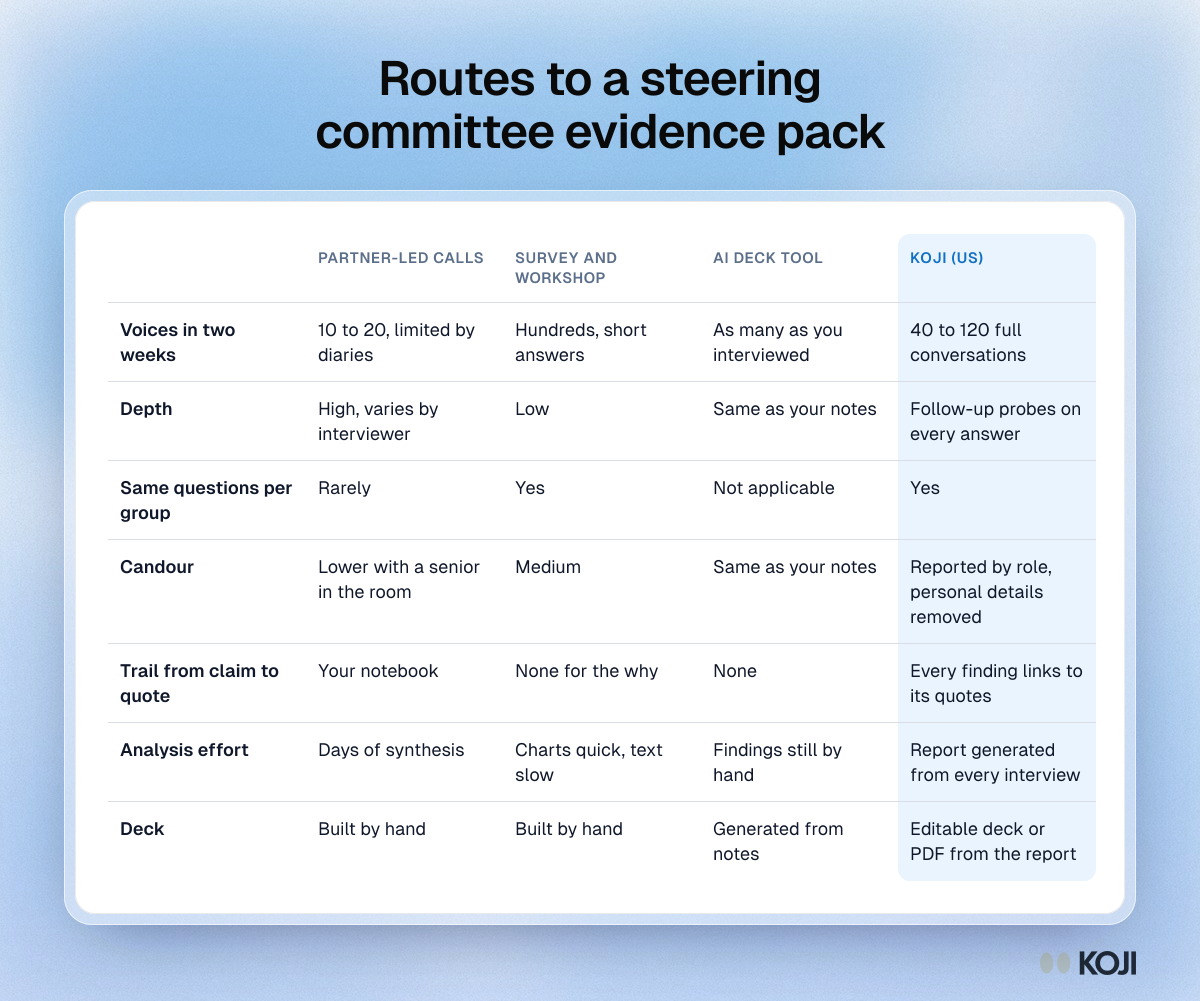
| Partner-led calls | Survey and workshop | AI deck tool | Koji (us) | |
|---|---|---|---|---|
| Voices in two weeks | 10 to 20, limited by diaries | Hundreds, short answers | As many as you interviewed | 40 to 120 full conversations |
| Depth | High, varies by interviewer | Low | Same as your notes | Follow-up probes on every answer |
| Same questions per group | Rarely | Yes | Not applicable | Yes |
| Candour | Lower with a senior in the room | Medium | Same as your notes | Reported by role, personal details removed |
| Trail from claim to quote | Your notebook | None for the why | None | Every finding links to its quotes |
| Analysis effort | Days of synthesis | Charts quick, text slow | Findings still by hand | Report generated from every interview |
| Deck | Built by hand | Built by hand | Generated from notes | Editable deck or PDF from the report |
Other tools work here too: Outset and Usercall both pitch AI-moderated interviews to consultancies (Outset, Usercall), and Usercall quotes consultancy projects individually. Deck tools such as Gamma turn notes into slides fast, but the notes stay the only evidence. What Koji does for this job:
- The trail is built in. Each finding in the report shows how many participants back it and links to their words, which is the question every steerco asks.
- The deck is a start, not a rebuild. Insight slides carry a quote each and charts are native PowerPoint charts, so you restyle rather than retype.
- Every group hears the same questions. Duplicate the study per group and only the context changes, so your counts compare.
- Privacy is one setting. Remove personal details cleans transcripts before analysis, and the original isn't kept.
To see how consultancies and agencies run client research in Koji, visit /for/agencies. All our consultancy playbooks are at /use-cases/consultancies.
Questions you might have about AI interviews
Will the client's staff speak candidly to an AI? People often say more when no senior consultant is listening and they know answers are reported by role. Say so in the invitation, use a shared link per group and turn on Remove personal details. Participants choose voice or text.
Will the committee accept AI-moderated evidence? The same way they'd accept any interview: by seeing who said what. Disclose on the method slide that interviews were AI-moderated and the first synthesis AI-assisted, then show counts by group and quotes. You check every claim against the transcripts before it reaches a slide. That's the step the Big Four cases skipped.
Is the client's data safe? Personal details are removed before summaries, reports and exports see the text, and if anything was removed the voice recording isn't kept either. Read anonymizing customer interview data for what is and isn't caught.
When Koji may not be the right fit
If the committee needs input from six board members, call them: a senior executive interview is part of the relationship, and an AI conversation won't build it. Koji is also wrong for a client whose policy rules out AI processing of staff interviews. And if the readout is in three days, there's no time to field interviews well. Use what you have and say what's missing.
Metrics to track
- Response rate per group. Below 30% of the people invited in a group, ask the sponsor to send a second nudge.
- Interviews rated good or excellent. Count only those in your headline numbers.
- Findings labelled Strong. Three to five is a healthy readout; none means the guide was too broad.
- Decision on the day. Did the committee decide, defer or ask for more? Track it across engagements.
- Follow-on work sold within 60 days.
FAQ
How do you present stakeholder interview findings to a steering committee? Start with the decision. Give each finding an action title, a count by stakeholder group, a confidence label and a quote by role. Put method and evidence in an appendix, and pre-wire each member.
How many stakeholder interviews do you need before a steerco? Our rule of thumb is 6 to 12 per stakeholder group, stopping when five in a row add nothing new. For a large frontline group, 15 to 20 lets you split by region.
Should I show percentages from stakeholder interviews? Use counts such as "9 of 11 controllers" and a confidence label instead. Percentages on small samples read like survey results, and someone in the room will say so.
How do I keep stakeholder interviews anonymous? Report by role and group, never by name. Use a shared link per group rather than per-person links, remove personal details from transcripts, and check that no quote identifies someone by detail alone.
Can I use an AI-generated deck in a client steerco? As a first draft. Check every claim against its quotes, rewrite titles in the client's language, move it into your template and disclose how AI was used.
Start your steerco evidence pack
Start a free study from the Stakeholder Requirements Gathering template, or paste the one-line brief from this playbook into "What do you want to research?", and pilot the guide with two people this week. For how to structure any research presentation, see presenting research findings, and for sharing the report itself, publishing and sharing reports.