You are three weeks from a pitch, and everything you know about the client comes from one sponsor call. Interview every team that will touch the project, ten minutes each, as an AI-moderated conversation they answer when they have a free slot. You walk into the pitch with a "what we heard" page built from their own words, and the sponsor has already seen it. This playbook gives you the timeline, the sample rule, a full interview guide and the exact setup in Koji.
Why proposal discovery matters now
Your sponsor is not the buyer. Gartner's survey of 632 B2B buyers (fielded August to September 2024, published May 2025) found that 74% of buying teams show "unhealthy conflict" during the decision, and that groups now range from five to 16 people across as many as four functions. The same release says groups that reach consensus are 2.5 times as likely to report a high-quality deal. Forrester's 2026 State of Business Buying puts a typical purchase at 13 internal stakeholders and nine external influencers, with procurement in 53% of cycles.

Photo by ThisisEngineering on Unsplash
Now count the people you actually spoke to. Usually one or two. The rest of the room meets you for the first time on pitch day, with their own view of the problem and no reason to trust yours.
The cost of guessing is real. The UK's JFDI/Opinium New Business Barometer, a survey of 250 agencies reported by The Drum in February 2025, found revenue targets up 7% for large agencies, 13% for medium ones and 31% for small ones. Targets rise while each pitch still eats time: a PRCA-backed study of UK PR agencies (Perspectus Global, 2022) counted 27 pitches a year at an average of 62 hours each. Those are PR agencies and the study is four years old, but the shape holds for most agencies: many pitches, a lot of unpaid hours, and a proposal written from the thinnest possible read of the client.
If you scope from one call, you price the problem the sponsor described. You will not see that sales and marketing define the problem differently, or that operations quietly owns the part that decides whether the work lands. A competitor who does see it wins on relevance, not on credentials.
What good looks like
Good proposal discovery is small, fast and visible to the sponsor. Here is the method we recommend, and the rules behind it.
Get the sponsor's permission first. You are asking a prospect's staff to talk to a firm that does not work there yet. Ask the sponsor on the first call: "I'd like to hear from each team in ten minutes, in their own words, so the proposal fits how you really work. Can you send the invitation under your name?" Sponsors who say yes are telling you they want a partner, not a vendor. Sponsors who say no are telling you something too.
Use this sample rule.
| Stakeholders named by the sponsor | What to do |
|---|---|
| Up to 8 | Invite all of them |
| 9 to 20 | Invite all of them, text or voice, ten minutes each |
| Over 20 | Ask for 2 to 3 per function, and ask for one sceptic per function |
Always ask for the sceptic. The person who thinks the problem is overstated is the one who will question your proposal in the room.
Cover functions, not seniority. Marketing, sales, product, operations, finance or procurement, and leadership will usually each see the problem differently. One per function is the minimum. Two is better, because one answer is an anecdote.
Keep it to ten minutes. Eight questions, one scale, one choice, the rest open. People who agree to ten minutes say yes. People who are told "a 45-minute workshop" say "next quarter".
Report by team, never by name. Tell participants their answers are combined with colleagues' and not attributed to them. Then keep that promise. A proposal that quotes "the head of sales said..." will end the next round of candour at that client.
Show the sponsor first. Send the one-page summary to the sponsor two or three days before the pitch. No one on the client side should meet a finding for the first time in the room.
Common mistakes:
- Interviewing only the people the sponsor likes. You hear agreement, not the risk.
- Asking about your services. Ask about their last time the problem hurt. Opinions on a hypothetical agency are noise.
- Showing up with a generic discussion guide. Rewrite the first two questions in the client's vocabulary from their website and job ads.
- Leaving the analysis for pitch week. Close fieldwork a full week before the pitch.
- Treating it as free consulting. You are not giving advice yet. You are listening.
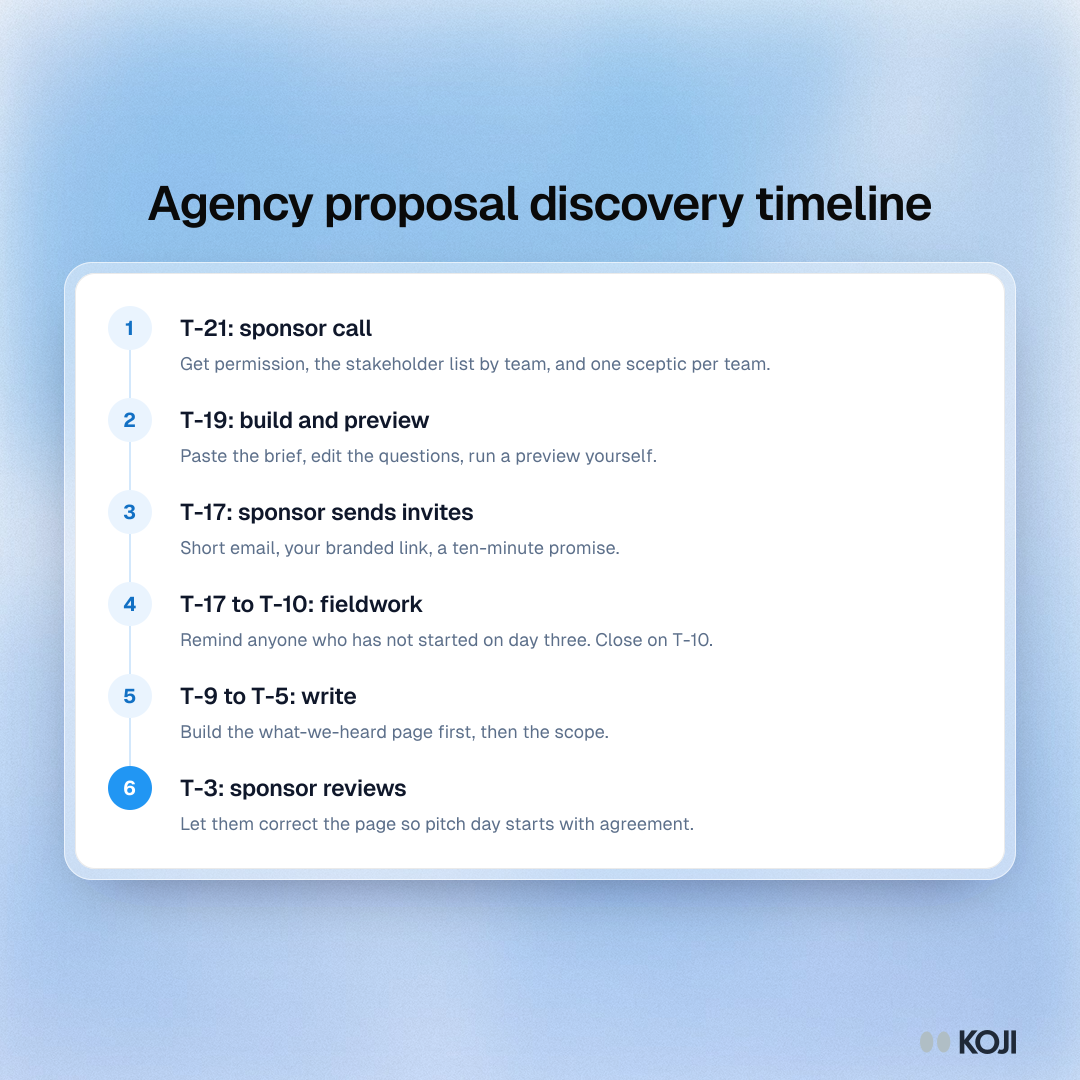
The timeline, counted back from pitch day
Say the pitch is on a Thursday three weeks out. Day zero is that Thursday.
- T-21: sponsor call. Ask for permission, the list of stakeholders by team, and one sceptic per team.
- T-19: build and preview the study. Paste the brief, edit the questions, run a preview yourself.
- T-17: the sponsor sends the invitations. Short email, your branded link, a ten-minute promise.
- T-17 to T-10: fieldwork. A reminder on day three to anyone who has not started. Close on T-10.
- T-9 to T-5: read the report and write the proposal. Build the "what we heard" page first, then the scope.
- T-3: send the page to the sponsor. Let them correct it. Pitch day starts with agreement.
How to set it up in Koji, step by step
You need a Koji account. Text interviews and one-link-per-team invitations work on every plan, report publishing too. Importing the stakeholder list from a CSV with a private link per person, and voice interviews, need the Interviews plan or Enterprise. Check current plans and credits on the pricing page before you commit.
- Start a study from the template. In the dashboard template gallery, filter for agencies and pick the In-Depth Interview (IDI) template. It is built for client qualitative work and keeps the AI follow-ups open and non-leading.
- Paste the research brief. In the "What do you want to research?" box, paste: "We are an agency preparing a proposal for [client]. Interview each named stakeholder in ten minutes to find how marketing, sales, product, operations and leadership each handle [problem] today, where they disagree, what they have tried, and what a good outcome looks like for each team." Koji drafts the questions from it.
- Edit the questions to the guide below. Add a single-choice question for the participant's team and a 1 to 10 scale question for how well today's approach works. Those two give you numbers by team next to the quotes. See how to customize interview questions.
- Set guardrails and context. Add the client's name, what you already know and a guardrail such as "do not mention our fees or other prospects". Upload the sponsor's brief as context so the follow-ups use the client's own words.
- Choose text or voice. Text suits people who answer between meetings. Voice suits senior leaders who would rather talk for ten minutes than type. Text counts 1 credit per interview, voice 3.
- Preview, then invite. Run the preview yourself first. On the Interviews or Enterprise plan, import the sponsor's list as a CSV so each person gets a private link, keep the team and role columns, and see who has not started. On other plans, share one link and rely on the team question. On Enterprise, apply a brand theme so the page carries your logo and colours.
- Read the report. When fieldwork closes, generate the report. Every finding links to the participant quotes behind it, so you can check a claim before it goes on a slide.
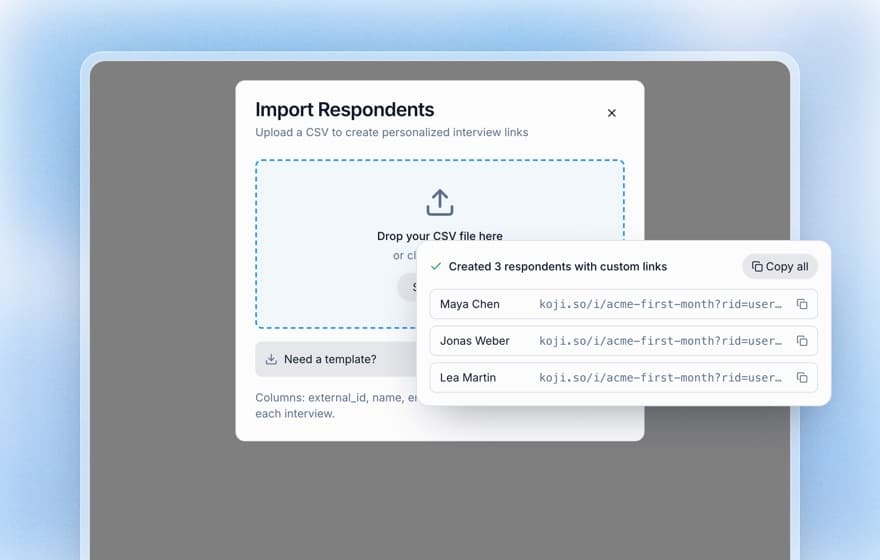
For a round of 12 stakeholders, that is 12 credits as text or 36 as voice, plus 5 credits for each report refresh.
Copy this interview guide
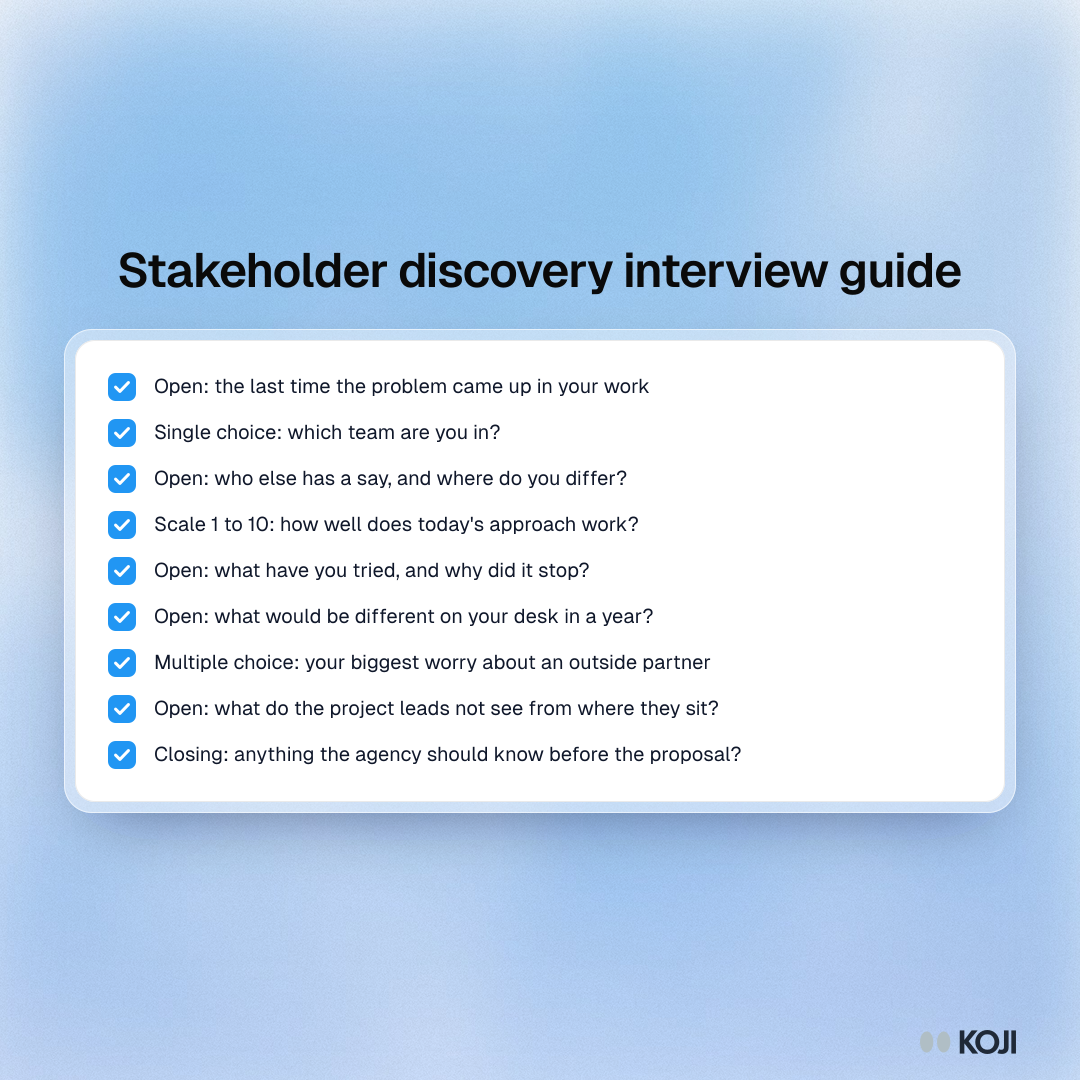
Paste this into Koji or any other tool. Ten minutes, eight questions.
Opening line: "Thanks for ten minutes. [Agency] is looking at [project] with [sponsor]'s team. Your answers are combined with your colleagues' into one summary and nothing is attributed to you by name."
- (Open) "Walk me through the last time [problem area] came up in your work. What happened?" Probe: "What did you do next?"
- (Single choice) "Which team are you in?" Marketing, sales, product, operations, finance, leadership, other. Probe: "What does your team own in this?"
- (Open) "Who else has a say in how [problem area] is handled, and where do you see it differently?" Probe: "What does that disagreement cost you?"
- (Scale, 1 to 10) "How well does the way you handle [problem area] today work?" Probe: "What would move it up by two points?"
- (Open) "What have you already tried, and why did it stop?" Probe: "Who decided to stop?"
- (Open) "If this went well, what would be different on your desk a year from now?" Probe: "How would you know?"
- (Multiple choice) "What would worry you most about bringing in an outside partner?" Cost, time from my team, change to how we work, quality of the work, nothing. Probe: "Tell me about a time that happened."
- (Open) "What is the one thing the people running this project do not see from where they sit?" Probe: "Who should we also talk to?"
Closing question: "Is there anything we have not covered that you want the agency to know before they write a proposal?"
What you get
The report gives you the themes with how many participants raised each, the scale answers as a distribution, the choice answers as charts, and the quotes behind every finding. For this use case, read it in this order on the day fieldwork closes:
- The disagreement map. Where two teams describe the same problem differently. This is the headline of your proposal.
- The scale scores by team. Marketing says 7, operations says 3: that gap is your opening slide.
- The tried-and-stopped list. What they have already done, so you do not propose it back.
- The worry list. Question 7 tells you what to answer in the proposal before anyone asks.
- The names you did not have. Question 8 gives you people to invite to the pitch.
Publish the report or paste the summary into your proposal as the "what we heard" page. Sharing reports takes one click, and recipients need no account. Keep individual quotes unattributed.
The same playbook elsewhere
The pattern is "interview every group that will touch the thing, before you commit". Marketers use it to map the buying group behind a B2B deal. Founders use it to hear the end users before an enterprise pilot sponsor decides. If your pitch spans countries, pair it with the multi-market playbook. For the general case for AI interviews at agencies, see customer research for agencies, and the white-label guide for running them under your brand.
Why Koji for proposal discovery
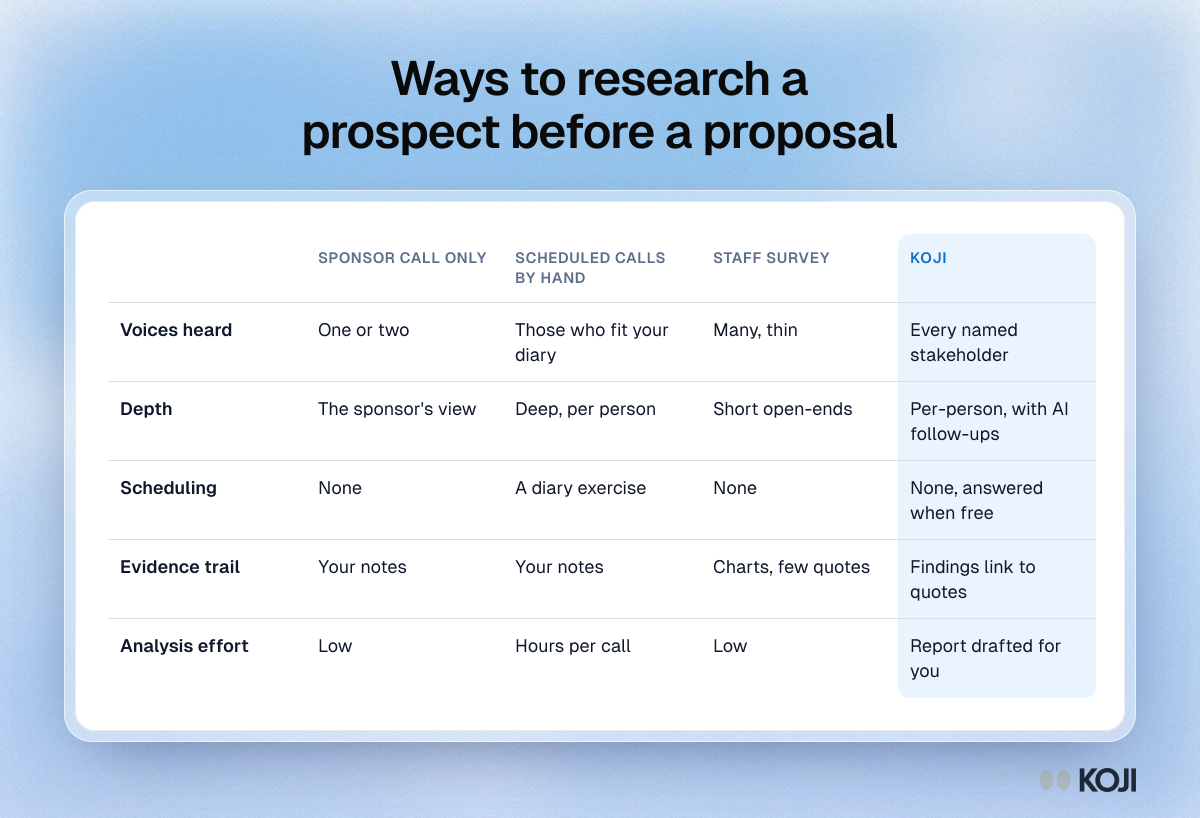
| Sponsor call only | Scheduled calls by hand | Staff survey | Koji | |
|---|---|---|---|---|
| Voices heard | One or two | Those who fit your diary | Many, thin | Every named stakeholder |
| Depth | The sponsor's view | Deep, per person | Short open-ends | Per-person, with AI follow-ups |
| Scheduling | None | A diary exercise | None | None, answered when free |
| Evidence trail | Your notes | Your notes | Charts, few quotes | Findings link to quotes |
| Analysis effort | Low | Hours per call | Low | Report drafted for you |
Reasons it works for this job:
- Private links per person. On the Interviews and Enterprise plans, a CSV import creates one link per stakeholder and keeps team and role next to each response.
- Follow-ups that stay on the question. Structured questions carry a scale and a choice, while open questions get probing follow-ups, so you get comparable numbers and the story behind them.
- No diary tennis. People answer when they have ten minutes, in text or voice.
- A shareable result. The report is published to a link or copied into a deck, with the quotes behind each finding.
- Your brand on the page. Enterprise brand themes put your logo and colour on the interview, which tells the stakeholder who is asking.
Questions you might have about AI interviews
Will a prospect's staff talk to an AI? They talk to it when the sponsor asks them to, the ask is short and the promise is clear. The participant sees the time estimate and a confidentiality note on the welcome page, and can choose text or voice. A ten-minute ask sent by their own sponsor beats a cold request for a call.
Is it a real interview? The AI asks your questions, listens, and follows up on what the person said. It is not a form. It also does not replace the pitch conversation: it makes sure you arrive with something to say about their business.
What happens to the answers? You decide who sees the report. Tell participants in the opening line that answers are combined and not attributed, and report by team. Agree with your sponsor how the data is held, and check your own data-protection duties with whoever advises you on them.
When Koji may not be the right fit
If the client has already signed a paid discovery phase, you have the time and access to run workshops, so use them. If the sponsor will not let you reach anyone but themselves, or there are only two or three stakeholders, a couple of calls are simpler. And if the proposal turns on observing people at work, in a store or on a shop floor, interviews will not replace being there.
Metrics to track
- Share of named stakeholders who finish (aim to learn your own baseline in the first three pitches).
- Number of functions heard from per pitch.
- Proposals where the "what we heard" page was changed by the sponsor before the pitch.
- Win rate on discovery-backed pitches against pitches without discovery, over at least ten pitches.
- Hours spent per pitch, against the 62-hour PRCA-study average as a reference point.
Start your next pitch with the client's voices
Open the template gallery, filter for agencies, pick the In-Depth Interview template and paste the brief above. See how this works for research agencies, browse every playbook for this audience in the use-case library, or start from the sign-up page.