A multi-market qualitative study is one research question answered in several languages, by people who live in different places, with results you can set side by side. The hard part has never been the fieldwork itself. It is knowing whether a difference between Germany and Brazil is a real market difference or just a different moderator, a different translation or a different week. Running the same AI-moderated interview in every market removes most of that noise, and by the end of this playbook you will be able to field one guide in many languages and defend the comparison to a client.
If you run a research agency, this is the project your clients ask for most often and trust least when it comes back. Here is how to run it well, and how to set it up in Koji.
Why multi-market qualitative research matters now
Clients want the "why" in every market they sell in, and they want it faster than a round of local fieldwork partners can deliver. At the same time, the cheap way to get breadth, an online survey panel, has a data quality problem. A 2026 literature review from NORC puts fraud at an estimated 15 to 30 percent across the market research industry and as high as 45 percent on some survey platforms. NORC attributes those figures to earlier studies rather than measuring them itself, so read them as industry estimates, but the direction is not in dispute (NORC, April 2026). If your multi-market read rests on panel open-ends from five countries, you are carrying that risk five times.

Photo by Vitaly Gariev on Unsplash
Language matters to the buyer too. CSA Research surveyed 8,709 consumers in 29 countries in 2020 and found that 76 percent prefer to buy products with information in their own language (CSA Research, 2020). People also answer research questions better in the language they think in. An interview run in a second language flattens the words people reach for.
Then there is the comparability problem, which is older than AI. Harzing's study of 26 countries showed that response styles differ by country, with traits such as power distance and collectivism linked to more agreement and more extreme ratings (Harzing, 2006, summarised on her site). Clarke found the same for extreme responding in a four-country application, and warned that unadjusted cross-cultural comparisons can lead marketing researchers to wrong conclusions (Clarke, 2001). Add a different human moderator in every country and you have stacked a second source of variation on top of the first.
Finally, the depth argument has real evidence behind it now. In a randomized experiment on the Verasight panel with 3,160 respondents, AI-moderated interviews produced 4.8 times as many words in free-response questions as standard written open-ends. The same report found completion fell from 99.4 percent to 40.5 percent, with drop-off concentrated among people less comfortable with AI tools (Verasight, August 2026). Both halves matter, and we come back to the second one below.
The cost of doing nothing is the usual one. You either deliver a thin, translated-survey read that the client has already seen from three other suppliers, or you quote weeks of fieldwork and lose the pitch to someone faster.
What good looks like
Experienced multi-market teams agree on a few habits. None of them are new, but most projects skip at least two.
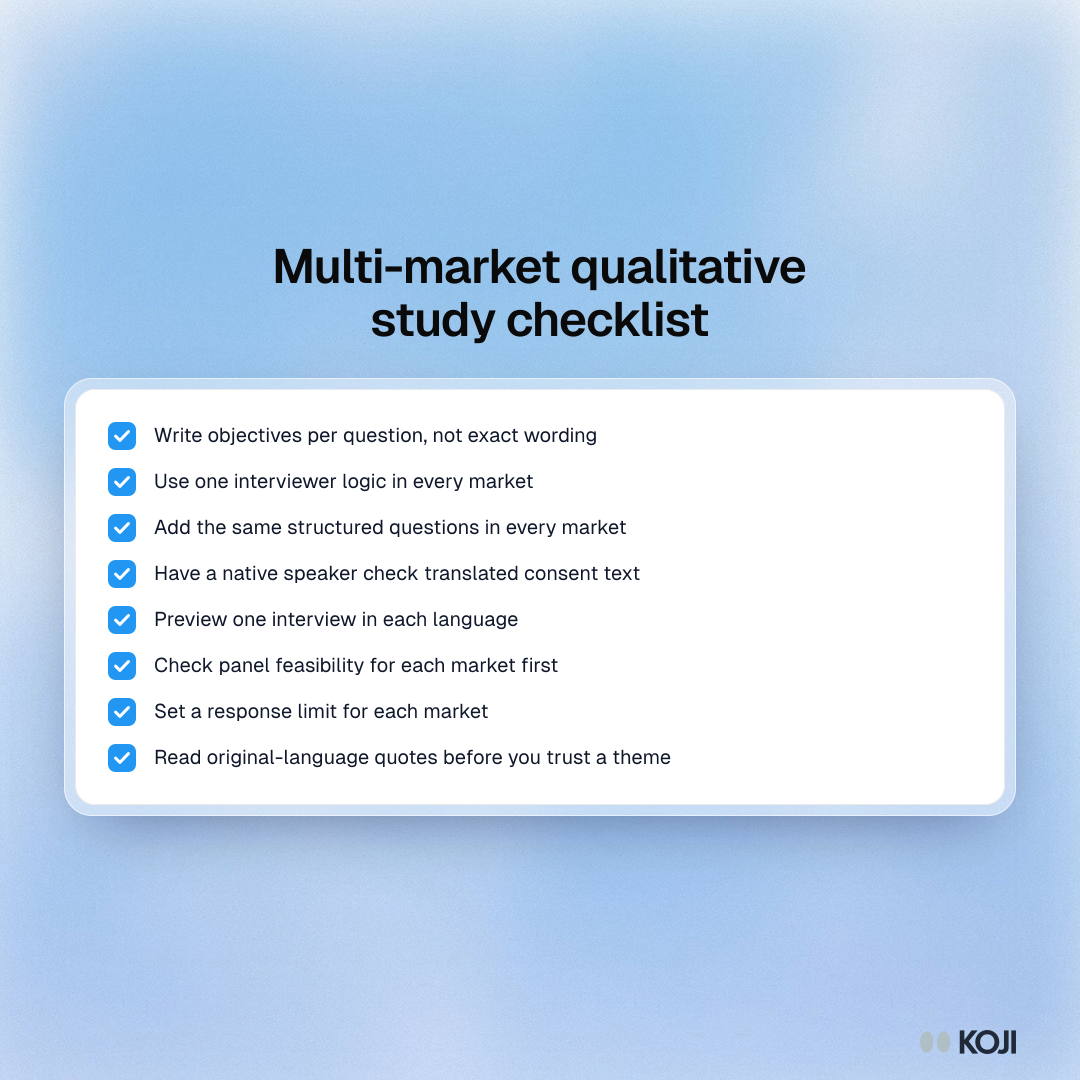
Fix the objectives, not the wording. Quirks' guidance on international qualitative work is to be specific about what you need to learn and loose about how each market phrases it (Quirks). Literal translation of a question can change its meaning. Write each question as an objective ("find out how they decided, in their own words") and let the interviewer carry the local phrasing.
Hold the interviewer constant. Most of the noise in a classic multi-country project is moderator variance: pace, warmth, how hard they probe, how much they lead. If one interviewer logic runs in every market, a difference you see is far more likely to belong to the market.
Pair open conversation with a few identical numbers. A single-choice question on the decision, and a 1 to 10 rating of the concept, asked the same way everywhere, let you compare markets on something countable. Then read the open answers to understand the numbers, and remember Harzing: do not compare raw ratings between countries as if scale use were equal. Compare the reasons behind the ratings, and compare each market against its own baseline.
Size each market on its own. A common rule of thumb is twenty to thirty good interviews per market to see the main themes. Set a response limit per market so a fast-responding country does not crowd out a slow one.
Check the participant, not just the answer. With panel recruitment in particular, read the first interviews in each market before you let fieldwork run on. Short, generic or off-topic answers are visible in the first handful.
Read the originals. Whatever tool codes the themes, read a sample of verbatims in the original language, or have a native speaker do it. A theme label in English is a summary of what someone said, not the thing itself.
Common mistakes:
- Translating the guide word for word and calling it standardised.
- Comparing average ratings across countries without allowing for how each culture uses a scale.
- Letting one market run with a different screener because the local partner "knows the audience".
- Merging all markets into one set of themes before looking at each market alone.
- Treating a machine translation of consent or privacy text as final.
How to set up a multi-market study in Koji
Koji runs the same AI interviewer in each language you enable, so the interview logic stays the same while the language changes. Text interviews work on every plan, including Free. Voice interviews need the Interviews plan or Enterprise. Panel recruitment needs a paid plan, and sharing a study with client or team workspaces is available from the Insights plan.
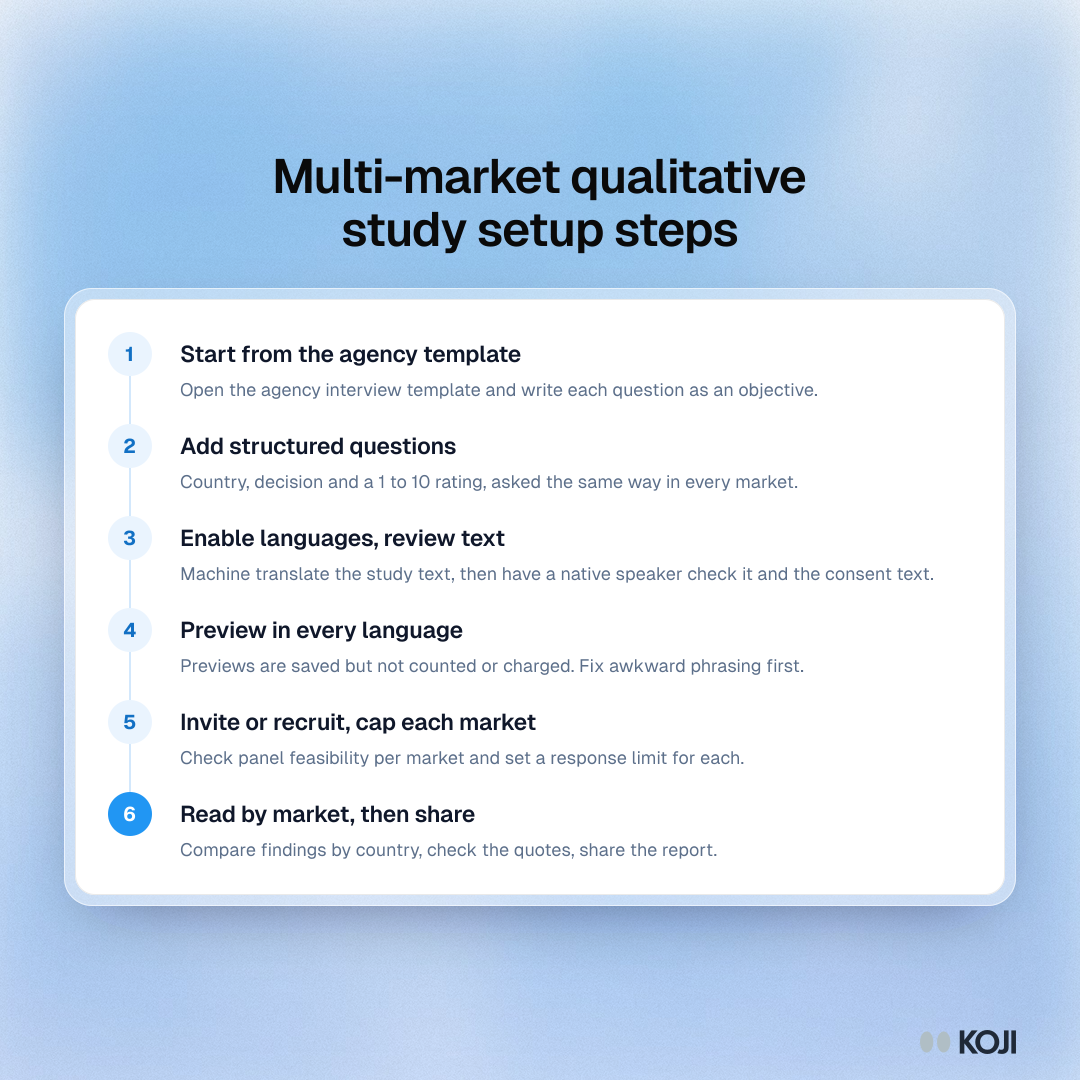
- Start from the agency interview template. In the dashboard's template gallery, open the In-Depth Interview template for agencies. It gives you a rapport opening, behaviour-based questions and probing rules written for client work. Put your client's category and decision into the research brief, write each question as an objective, and add guardrails for anything the interviewer should not discuss, such as the sponsor or pricing.
- Add structured questions for the comparable bits. Use a single-choice question for country or city, one for the decision made, and a 1 to 10 scale for the concept or brand, each with an open follow-up. These numbers line up across markets in the report.
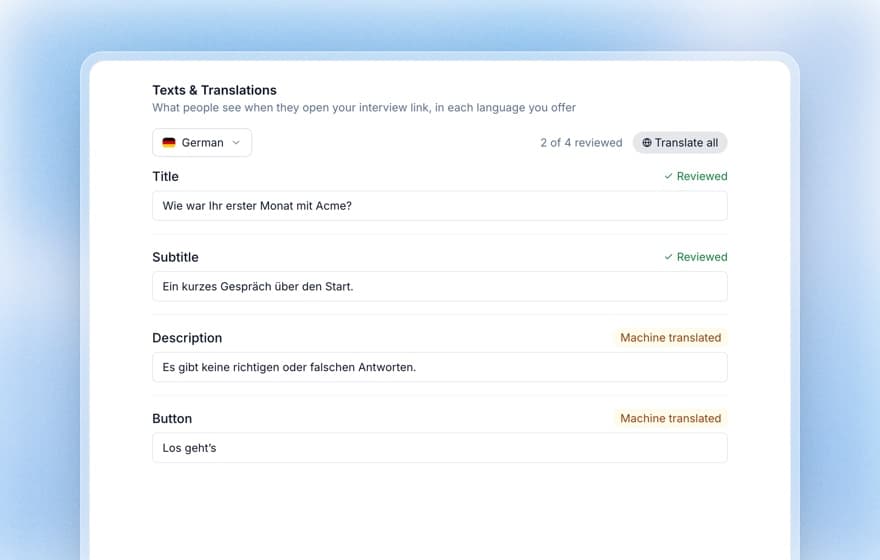
- Enable the languages and review the text. Participants pick their language on the welcome page. The study's own text, such as the title, description and button, can be machine translated into each language in the Texts and Translations editor, and each field is marked as machine translated or reviewed once a person has edited it. Consent text is treated more strictly: a machine translation of it is not shown to participants, who get the source-language version until a person approves the translation. Have a native speaker check that text.
- Preview in every language. Run a preview interview in each language. Previews are saved with their own analysis but are not counted or charged, so use them to catch awkward phrasing before fieldwork.
- Choose voice or text, invite or recruit, and cap each market. Voice suits markets where people prefer to talk. Text suits busy professionals and sensitive topics. Send a custom link per market, or use panel recruitment, where the wizard shows a feasibility estimate for your audience, so check it for every market before you commit. Set a response limit for each market, then read the first handful of conversations and their quality scores before the rest come in.
- Read the report and share it. Open the report, compare findings by market using the country question, and publish it or share it with your client's workspace.
Make the invitation feel local
The welcome page is the first thing a participant sees in their own language. Spend ten minutes here. It shows the estimated time, the privacy promise and the language choice.
Example questions, written for a beverage client testing a new concept across markets:
- "Think about the last time you bought a drink like this. Walk me through it from the moment you decided you wanted one." (open, follow-ups on)
- "Where did you buy it?" (single choice, with the channels that matter in each market)
- "Looking at this concept, how likely are you to pick it over what you buy now?" (1 to 10), followed by "What is behind that number?"
- "What would a friend in your city say if you showed them this?" (open)
- "Is there anything about this that would not work where you live?" (open)
- "Which country do you live in?" (single choice, used to read results by market)
Each market costs credits per completed interview: 1 credit for a text interview and 3 for a voice interview. Twenty text interviews in each of five markets is 100 credits. The same plan in voice is 300 credits. Conversations that score below 3 out of 5 on quality are not charged, on every plan (how the quality gate works).
What you get
For each study you get per-interview analysis, a quality score, and a report with themes, high-impact findings and the supporting quotes behind each one. Themes and labels are written in English for your team, and the supporting quotes stay in the participant's original words, so a reviewer can check the claim against what was actually said.
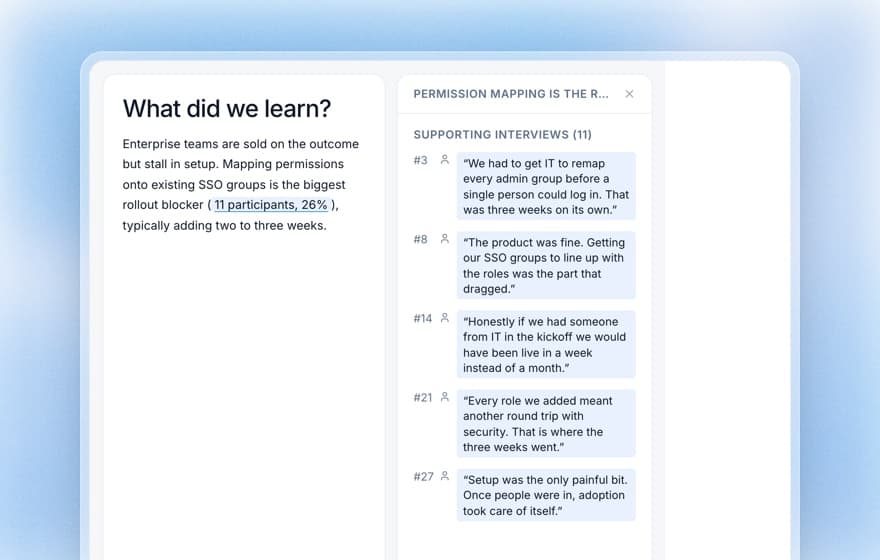
How agencies use it the next day:
- In the debrief: open the report with the client and click through from a finding to the quotes. The argument shifts from "do you believe this" to "do you see the same thing".
- In the deck: use the country question to show the same theme in each market, with a native-language quote next to it.
- In the proposal for wave two: the first wave shows which markets need more interviews and which are already saturated. Report history keeps each version if you add interviews later.
- In the data room: export responses to CSV on any plan if you want to do your own cut.
The same playbook elsewhere
The same one-guide, many-voices approach works wherever a comparison has to hold up. Brand teams run it across regions before a rebrand. HR teams run it across offices to see whether an engagement result is global or local. Customer success teams interview accounts in each region before a renewal cycle. If your client is an in-house team, the neighbouring playbooks are written for them: see pivot decision research for founders for a decision-first structure, and no-decision loss interviews for GTM teams for another playbook built on asking the same questions of many buyers. All Koji playbooks for agencies are listed on the use-case library page for agencies.
Why Koji for multi-market qualitative work
The table sets Koji against the two ways most agencies cover several markets today. Local moderators and fieldwork partners are still the right answer in many cases, and a translated survey is still the right way to count things.
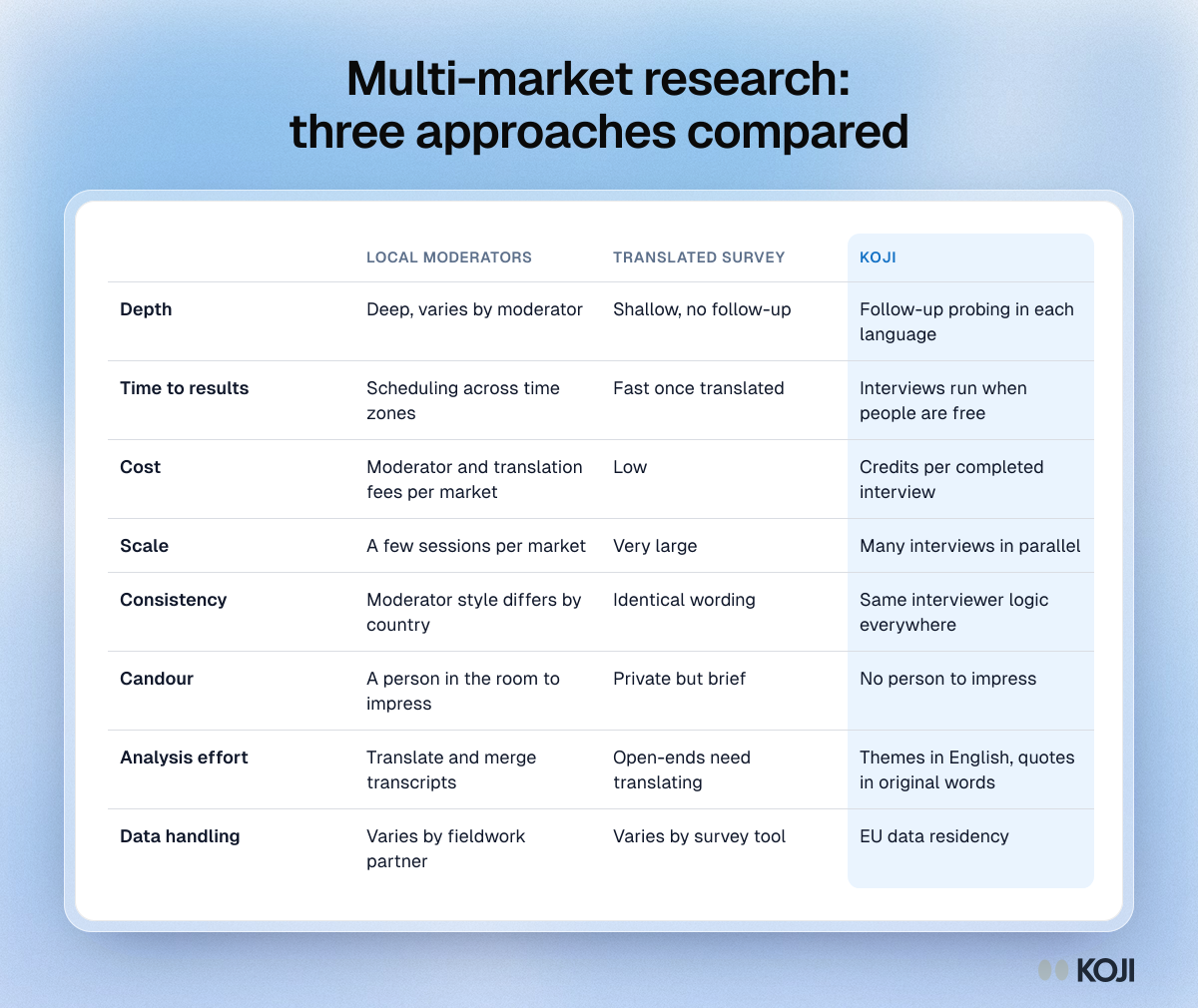
Reasons that hold up in the product:
- One interviewer logic in every language. The same interviewer and probing rules run in each language you enable, so moderator variance stops being a variable in your comparison. The language list in the app has 28 languages.
- Structured questions next to open conversation. Choice and scale questions sit inside the interview, so you get comparable numbers and the reasons behind them from the same person.
- Evidence you can audit. Quality scores per interview, and every finding links back to its supporting quotes.
- Control over what gets said. Guardrails keep the interviewer off topics you name, and you can preview every language before launch.
- Data handling. Koji states EU data residency. If your client needs control of the model keys, Bring Your Own Key is part of the Enterprise plan (bring your own key).
For a wider view of how this compares with a large agency, see Koji vs Kantar, and for the tools market see best multilingual research tools.
Questions you might have about AI interviews
Will people in every market talk to an AI interviewer? Some will not. The Verasight experiment found that completion dropped from 99.4 percent to 40.5 percent when open-ends were replaced with AI-moderated interviews, and that those who finished were not a perfect mirror of those who left. Plan for it: give participants a choice of voice or text, keep the welcome page honest about length and privacy, and compare your completion by market. A market with much lower completion is a finding in itself. Do not read a completed sample as the whole market.
Can the interview handle local idiom and nuance? The interviewer conducts the whole conversation in the language the participant chooses. That does not make it a replacement for local knowledge. Have a native speaker review the preview in each language, and read the original-language quotes before you sign off a theme.
What about quality and fake respondents? Every conversation gets a quality score from 1 to 5, and you can read individual interviews and their scores in the report. Short or off-topic conversations show up as low scores, and anything below 3 is not charged. This is a check on the conversation, not a guarantee about who is on the other end, so check the first interviews from any panel yourself. The deeper reading on this is in survey fraud and respondent quality.
When Koji may not be the right fit
Koji is not the right tool when the project needs an in-person observation, a physical product to handle, a group dynamic you want to watch, or a language outside the 28 in the app. It is also not a substitute for a local expert who knows what a market's taboos are. If the client requires a named senior moderator in the room, or a market where you cannot recruit through a link or the panel, use local fieldwork for that market and use Koji for the rest. Many agencies end up with exactly that hybrid.
Metrics to track
- Completion rate by market, and where in the interview people leave
- Average quality score by market, and the share scoring below 3
- Average interview length by market, as a check on depth
- Share of each market's themes that also appear in the other markets
- Time from brief to first report
- Client questions in the debrief that you answered by opening a quote
Frequently asked questions
How many interviews do I need per market? A common rule of thumb is twenty to thirty good interviews per market to see the main themes. Add more if a market has several distinct segments you need to read separately.
Can I run voice interviews in every market? Voice interviews are available on the Interviews and Enterprise plans, and the language list has 28 languages. Text interviews work on every plan, so you can mix: voice where people like to talk, text elsewhere.
How do I compare markets fairly? Ask the same structured questions everywhere, read each market on its own first, and compare reasons rather than raw ratings, because scale use differs by country.
Does the report translate quotes? Theme labels are written in English, and supporting quotes stay in the participant's own words so you can check them against the claim.
Can I use Koji for part of a project and local fieldwork for the rest? Yes. Many agencies run most markets in Koji and keep local moderators for the markets or methods that need a person in the room.
Start your first multi-market study
Start from the agencies In-Depth Interview template in your Koji dashboard, and run a preview in two languages before you commit to five. For more about how agencies use Koji, see the agencies page and the user research for agencies guide. For the underlying detail on languages, see the multi-language research guide.