Buying group mapping is a set of short interviews with the people who sat in the room when a customer chose you: the one who raised the problem, the ones who checked it and the one who signed. With AI-moderated interviews you can reach three people per account in days instead of booking calls, and buyers are often more direct with an AI than with a seller. By the end of this playbook you can run it before your next planning cycle and walk into the room with a map of who actually decides.
Why buying group mapping matters now
Most B2B marketing still targets one persona. The buyers do not work that way.

Photo by Cherrydeck on Unsplash
- The group is large. Forrester's State of Business Buying, 2026 puts the typical decision at 13 internal stakeholders and 9 external influencers (Forrester, January 2026). Gartner's survey of 632 B2B buyers, run in August and September 2024, found groups of five to 16 people (Gartner, May 2025).
- The group argues. In the same Gartner release, 74% of buyer teams showed "unhealthy conflict" during the decision, and teams that reached consensus were 2.5 times more likely to call their deal high quality.
- AI sits inside the journey. G2's March 2026 survey of 1,076 software buyers found 51% now start research in an AI chatbot more often than in Google, up from 29% in April 2025 (G2, 2026).
- Regret is common. Gartner found 60% of technology buyers renewing or expanding as-a-service contracts expressed regret about nearly every purchase (Gartner, 2023), and put much of it down to how the buying team behaves, not the vendor.
You are measured on pipeline sourced and influenced, CAC and MQL to SQL conversion, with budgets that rarely grow. If your content, ads and ABM lists speak to one title, you pay for reach into a group of 13 and land on one of them. The cost of not mapping is spend aimed at the wrong people, and a message that never reaches the person who can say no.
What good looks like
Your CRM lists contacts. It does not tell you who mattered. The only people who know are the buyers, and memory fades, so ask within a few months of signing.
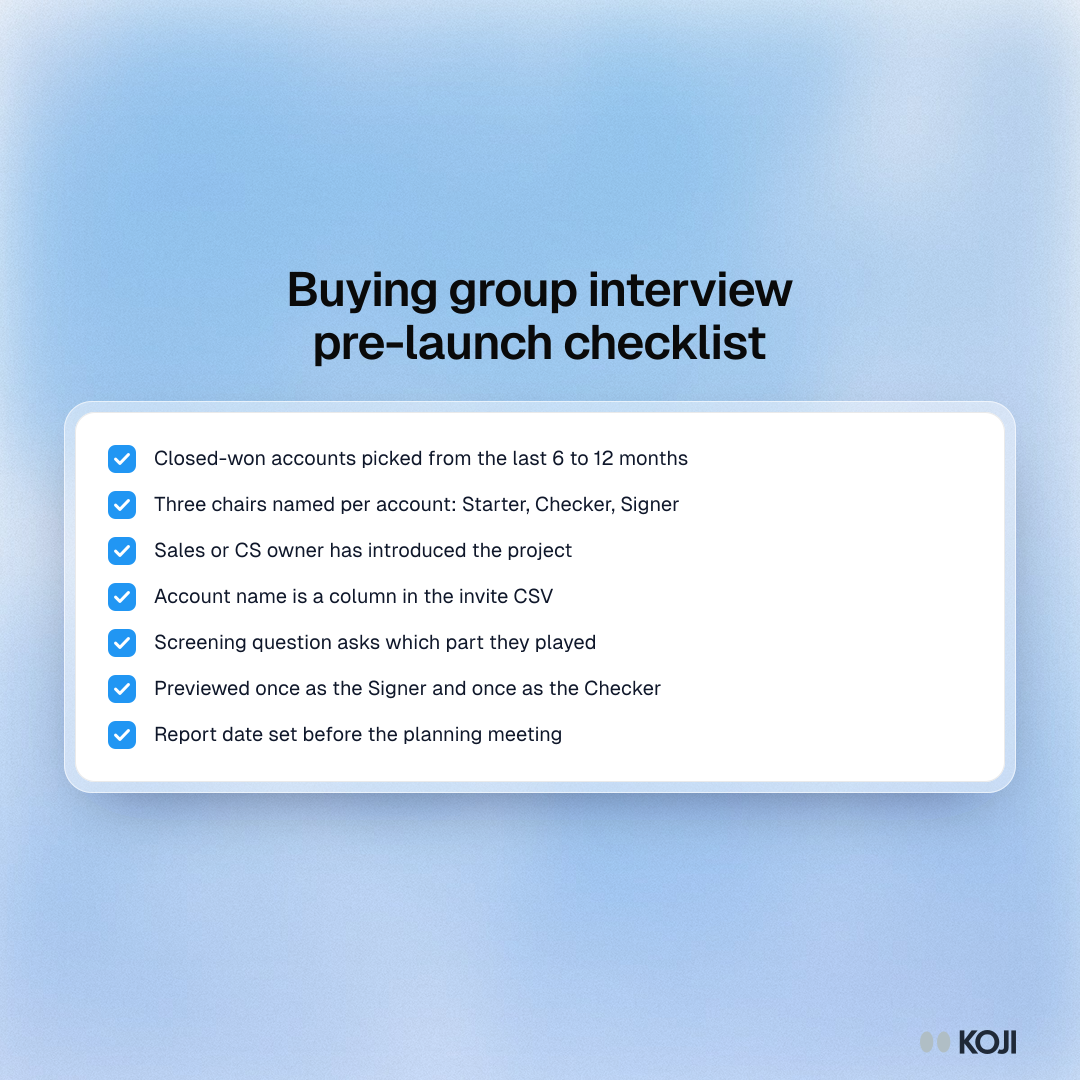
Interview by account, not by champion. Pick closed-won accounts from the last 6 to 12 months and ask three people at each one. I call them the Three Chairs:
- The Starter: raised the problem and started looking.
- The Checker: tested your claim: security, IT, finance, procurement or the end user who had to live with it.
- The Signer: approved the money.
One champion gives you one story. Three people at the same account give you the story, the hidden objection and the real approver.
Sample. Aim for 8 accounts and 18 to 24 interviews. If you have fewer than 8 closed-won accounts, add the last 4 lost or stalled ones and ask the same questions. If you have more than 40, run it twice with different segments and do not mix them.
Timeline counted back from your planning cycle.
- Week 8: pull the account list, pick segments, name the Three Chairs for each account from the CRM.
- Week 7: build the study, take the preview yourself.
- Week 6: ask your sales or CS owner to introduce the project, then send personal invites.
- Weeks 5 to 3: fieldwork. Send one reminder after 4 days.
- Week 2: read the report, build the map.
- Week 1: walk sales through it. Fix your ICP and ABM lists.
Ask about the journey, not your brand. Anchor on a real purchase ("Think back to when the team first started looking"), and ask who joined, in what order, what each person feared and what each trusted. Ask directly where AI assistants came in and what the buyer asked them.
Common mistakes
- Only interviewing the champion. Champions are friendly and incomplete.
- Asking "who was the decision maker?" Buyers name a title. Ask who would have said no.
- Sampling only the wins. The loss and the "no decision" side of the map matters as much; see the no-decision loss interview playbook.
- Letting sales do the inviting alone. Introduce the project, then let the invitation come from marketing with a clear reason.
- Treating the map as final. Buying groups change by deal size. Label every map with the segment it came from.
How to set it up in Koji
You can run the whole study on a Free workspace in text, and on the Interviews plan if you want voice interviews and CSV-imported personal links. Koji's template gallery has a Buyer Persona Interviews template that you can use as a starting point and edit.
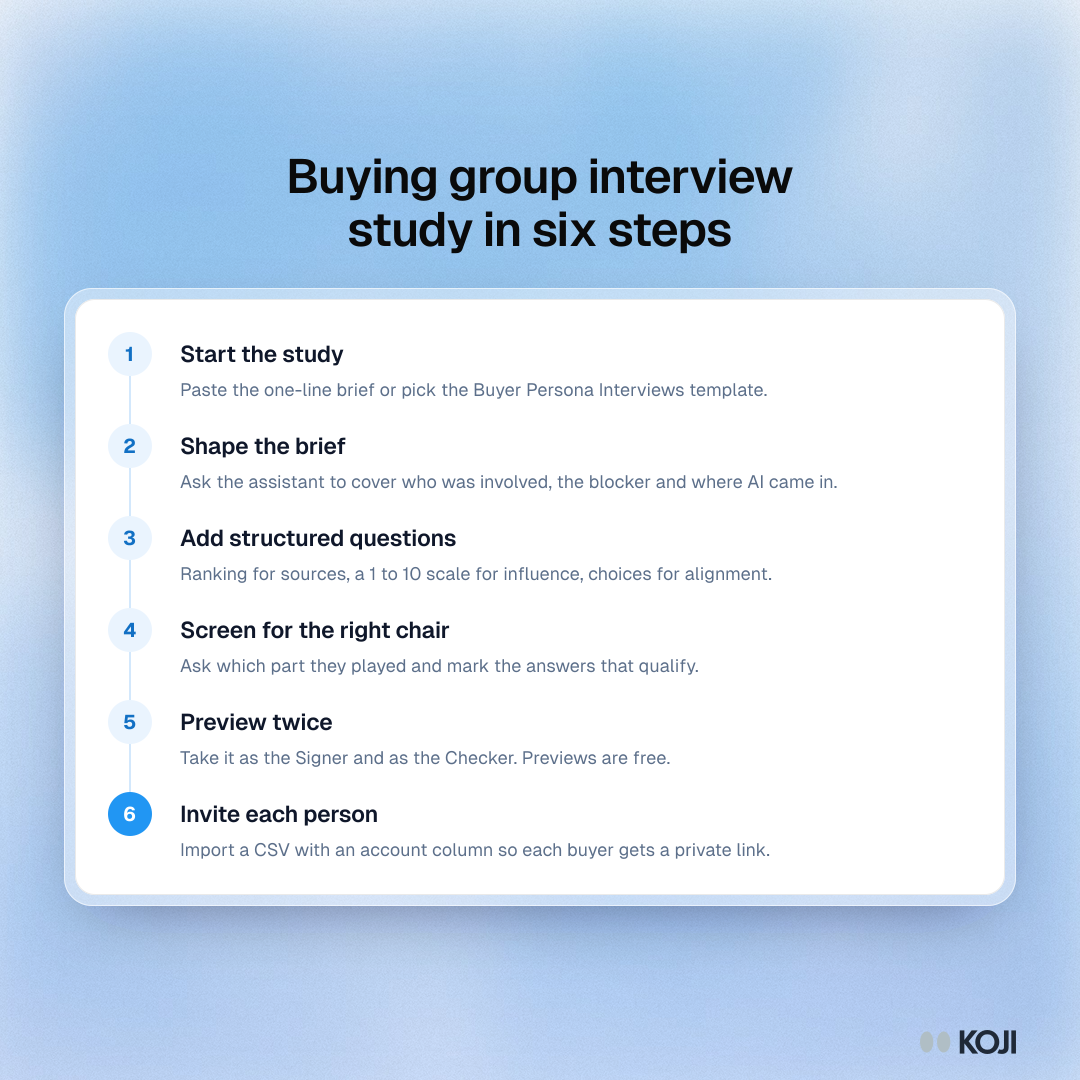
- Start the study. On the home screen, paste your research question into "What do you want to research?" or open the template gallery and choose Buyer Persona Interviews. Use the one-line brief at the end of this section.
- Shape the research brief. Koji's research assistant drafts the goal and questions. Ask it to add the Three Chairs wording and to cover who was involved, what nearly stopped the deal and where AI assistants came in. Change anything by chatting with it.
- Add structured questions where you need a number or a choice. Koji supports open-ended, 1 to 10 scale, single choice, multiple choice, ranking and yes/no. Use ranking for sources and a scale for influence. See Structured Questions in AI Interviews.
- Screen for the right chair. Add a screening question such as "Which best describes your part in the decision?" and mark the answers that qualify. Write screeners with the help of Research Screener Questions.
- Choose voice or text, then take the preview. Previews are free and never reach the report, so run one as the Signer and one as the Checker before you invite anyone.
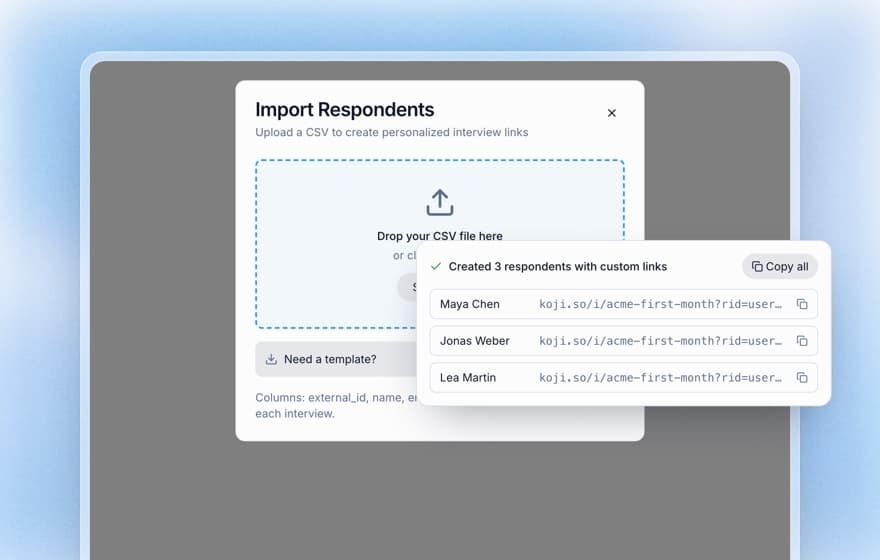
- Invite each person with their own link. On the Interviews plan, import a CSV on the study's Self-recruit tab and each person gets a private link tied to them, with your account name in a column so you can group them afterwards. On other plans, share the interview link and ask for the account in the first question. On Insights and above you can also email an audience an invitation and reminder from that tab.
Koji's report gives themes with supporting quotes, and you can open the responses behind each finding. Only interviews that score 3 or higher on its 1 to 5 quality scale use credits or enter the report.
The one-line brief to paste: Interview recent buyers and the other people who joined the decision: who was involved, what each person needed, which sources they trusted including AI assistants, and what nearly stopped the deal.
Copy this interview guide
You can paste this into any tool. Each question has a type and one probe.
- Opening (open): "Think back to when your team first decided to look for something like this. What was going on?" Probe: "Who else was in that conversation?"
- People (open): "Who was involved from the first idea to the signature? What did each person care about?" Probe: "Who were you most worried would say no?"
- Sources (multiple choice): "Which of these did you use while researching: an AI assistant, a search engine, peers or a community, an analyst report, a review site, vendor websites, a podcast, a colleague?" Probe: "What did you ask the AI assistant, roughly?"
- Shortlist (ranking): "Rank those sources by how much they shaped your shortlist." Probe: "Why is the top one first?"
- Alignment (single choice): "When the group first met, how aligned was it: fully, mostly, split, or one person strongly against?" Probe: "What moved the group?"
- Influence (1 to 10 scale): "How much did you personally shape the final decision?" Probe: "What gave you that influence, or limited it?"
- Blocker (open): "What nearly stopped this purchase?" Probe: "Who raised it and what settled it?"
- Gaps (open): "What did you or others need to see from us that you could not find?" Probe: "Where did you look first?"
- Closing (open): "What should I ask the person who signed that I have not asked you?"
What you get
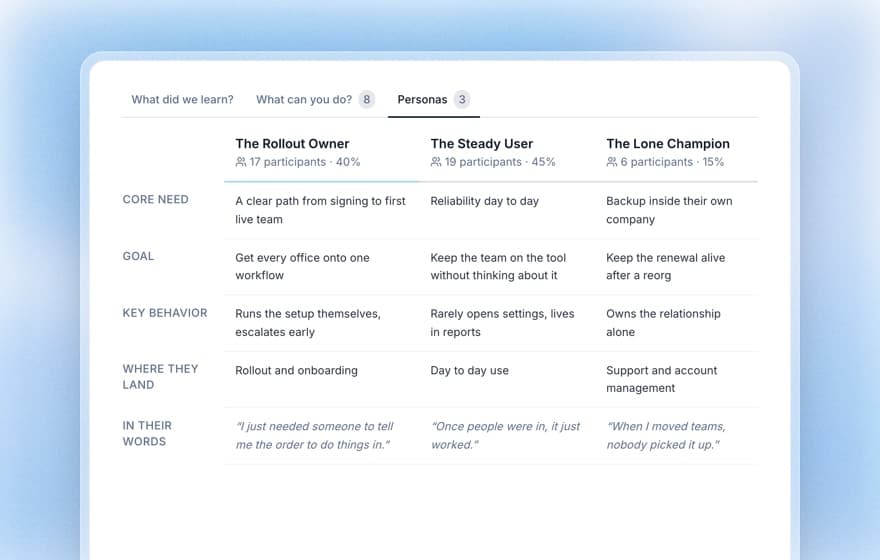
The report shows themes across buyers with quotes you can open and read in full. Use it the next day like this:
- Role by job map. For each account, who played Starter, Checker and Signer. Add the titles to your ABM lists and ad audiences, and drop the ones nobody named.
- Source ranking by role. Which sources each chair trusts, including AI assistants. Put your effort where the Checker looks, not only where the Starter does.
- Objection list. What nearly stopped deals and who raised it. Give sales a one-page answer for each, and fix the page the Checker could not find.
- Alignment pattern. Where groups split, and what unlocked them. This is your best material for sales enablement and for the case studies that actually move a committee.
Take the top three findings to the planning meeting, with one quote from a buyer for each.
The same playbook elsewhere
- Sales and GTM: the same three chairs explain deals that die with no competitor. See No-Decision Loss Interviews.
- Due diligence: deal teams check that customers confirm the story with several people per customer. See Confirmatory Customer Calls.
- Product marketing: launch messaging per chair; start with Customer Research for PMMs.
- Attribution: pair the map with self-reported attribution interviews so you know both who decided and where they first heard of you.
Why Koji for buying group research
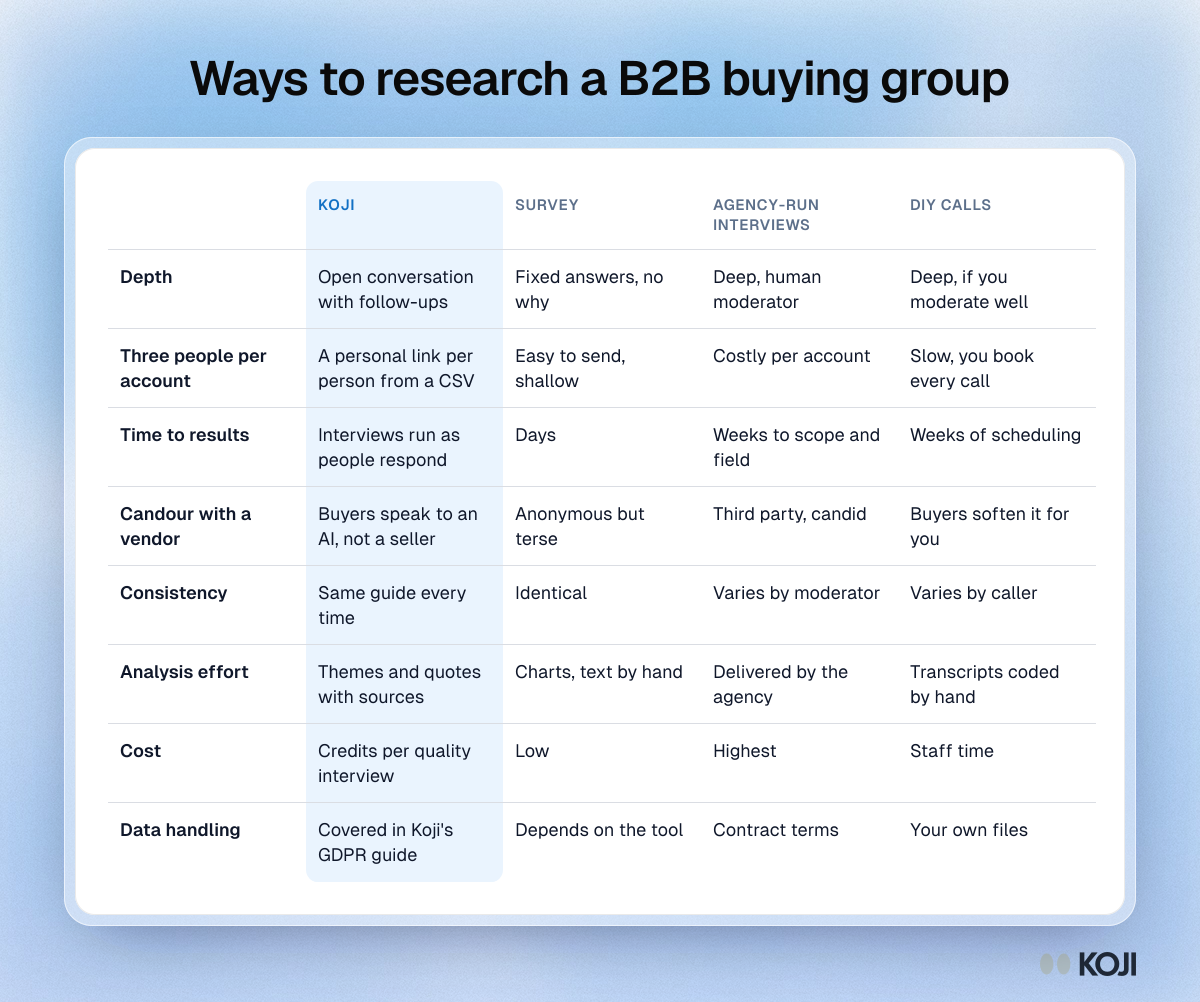
| Criterion | Koji | Survey | Agency-run interviews | DIY calls |
|---|---|---|---|---|
| Depth | Open conversation with follow-ups | Fixed answers, no why | Deep, human moderator | Deep, if you moderate well |
| Three people per account | A personal link per person from a CSV | Easy to send, shallow | Costly per account | Slow, you book every call |
| Time to results | Interviews run as people respond | Days | Weeks to scope and field | Weeks of scheduling |
| Candour with a vendor | Buyers speak to an AI, not a seller | Anonymous but terse | Third party, candid | Buyers soften it for you |
| Consistency | Same guide every time | Identical | Varies by moderator | Varies by caller |
| Analysis effort | Themes and quotes with sources | Charts, text by hand | Delivered by the agency | Transcripts coded by hand |
| Cost | Credits per quality interview | Low | Highest | Staff time |
| Data handling | Covered in Koji's GDPR guide | Depends on the tool | Contract terms | Your own files |
Reasons that matter for this job:
- Personal links. CSV import gives each buyer a private link, so the three chairs of one account stay together.
- Structured and open questions in one interview. Ranking and scales sit beside open follow-ups, so you get both the count and the reason.
- Screening before the interview. People who do not qualify are turned away before they start.
- Quality gate. Only interviews that score 3 or higher use credits or enter the report.
- Evidence. Each finding opens to the quotes behind it, so sales and the CMO can check the claim.
For data handling, read GDPR-Compliant AI User Research.
Questions you might have about AI interviews
Will a buyer talk to an AI about a purchase? Participants see a welcome page that says how long it takes, and can choose text or voice. A short, specific invitation from someone they know works better than a generic one. Use the free preview to hear what they will hear.
Will the answers be too polite? Buyers soften what they say to a vendor's face. They are often more direct with an AI, and the guide asks about the process and other people, not about liking you.
Can I trust the analysis? Every interview gets a quality score, low ones stay out of the report, and each finding opens to the responses behind it. Read ten interviews yourself before you present.
When Koji may not be the right fit
If you sell a handful of enterprise deals a year and know every stakeholder by name, a call from your own executive will beat any interview tool. If your accounts are under a few hundred and nobody has the time to write the invitation, start with the champions you already have and add chairs later. And if you need a statistical sample of the whole market rather than a map of your own wins, run a survey.
Metrics to track
- Share of closed-won accounts with at least two named chairs.
- Interview response rate by chair (Starter, Checker, Signer).
- Share of deals where the Checker was not in your ABM list.
- Pipeline and win rate on accounts targeted with the new list, against the old one.
- Number of objections from the map with a sales answer ready.
FAQ
How many accounts should I interview? Eight closed-won accounts and 18 to 24 interviews is enough to see the pattern. Add four lost deals if you have fewer.
Who should I ask first? The Signer, because they are the hardest to reach and usually know the others.
Do I need voice interviews? No. Text works on every plan. Voice is on the Interviews plan and helps with senior buyers who would rather talk for five minutes than type.
Can I use this with a customer list from my CRM? Yes. Import a CSV on the Interviews plan and each person gets a private link.
Does this replace attribution? No. Attribution shows where people clicked. This shows who decided and why.
Start your buying group study
Start from the Buyer Persona Interviews template in the template gallery, or paste the brief above into "What do you want to research?". See also the Koji page for marketing teams and the marketing playbook library.