Self-reported attribution means asking the people who just bought where they first heard of you, and letting them explain in their own words. Run as AI-moderated interviews instead of a form field, it gives you the podcast, the Slack thread and the colleague's recommendation that your software never logged, and it follows up until the answer is specific. By the end of this playbook you can field a 30-interview study in a week, turn the answers into a channel ranking your CFO will accept, and show where it disagrees with your dashboard.
Why self-reported attribution matters now
Marketing is being asked to prove more with money that is not growing. Gartner's 2026 CMO Spend Survey, run with 401 marketing leaders between January and March 2026, puts marketing budgets at 7.8% of company revenue, up from 7.7% in 2025, and 56% of CMOs say they lack the budget to deliver their 2026 strategy (Gartner, May 2026). When the budget is flat, every misattributed dollar is a dollar you cannot move.

Photo by Annie Spratt on Unsplash
Meanwhile the buying decision is happening where your tools cannot see it. 6sense's 2024 Buyer Experience Report found that 81% of buyers already had a preferred vendor when they first contacted a seller, and 85% had their purchase requirements set (6sense via Business Wire, October 2024). By the time a form is filled in, the choice is mostly made. Your attribution report credits the last visible click.
The group making that choice is also bigger. Forrester's 2026 State of Business Buying, built on a survey of nearly 18,000 business buyers, reports that a typical decision now includes 13 internal stakeholders and nine external influencers, and that GenAI features in 83% of purchases are doubling buying group size (Forrester, January 2026). Twenty-two people shaping one deal do not all arrive through your tracking pixel.
Then there is the gap between what software says and what buyers say. In Refine Labs' Attribution Mirage study of 620 conversions and $21.5 million in closed-won ARR, software credited web search with 78% of conversions while customers named it in 12% of their own answers, and 85% of customers said dark social (social media, podcasts, word of mouth and community) played a part (Refine Labs). Podcasts were credited with 53% of revenue by customers and 0% by software. Refine Labs sells attribution consulting, the data is one agency's US B2B SaaS book, and respondents could name several sources, so treat the exact numbers as directional. The direction is hard to argue with.
The cost of ignoring it is quiet. You cut the podcast that your best accounts mention unprompted, because the dashboard says it sourced nothing. You double down on branded search, which mostly harvests demand someone else created.
What good looks like
Self-reported attribution works when it is treated as an interview about a decision, not a field on a form. Experienced teams do these things.
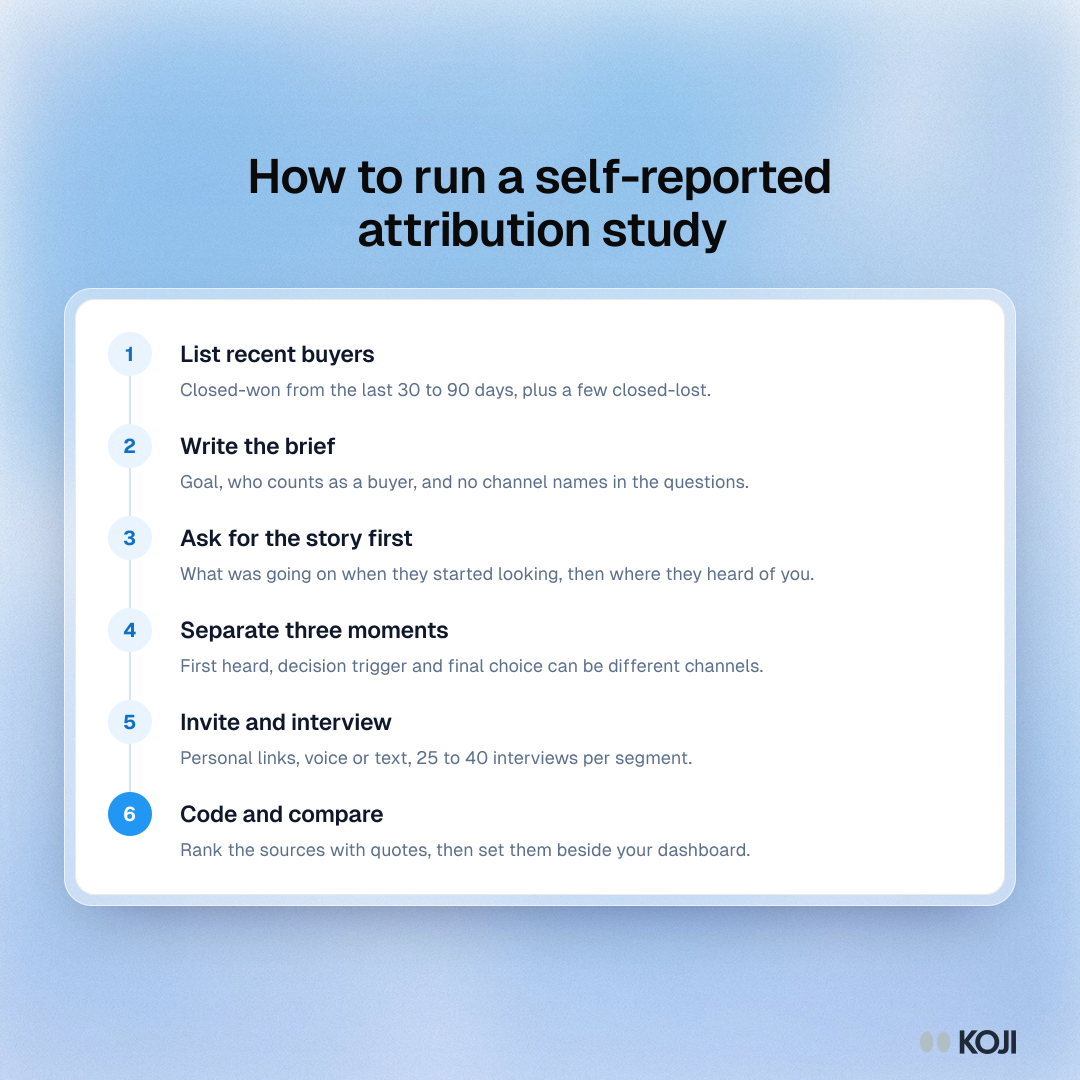
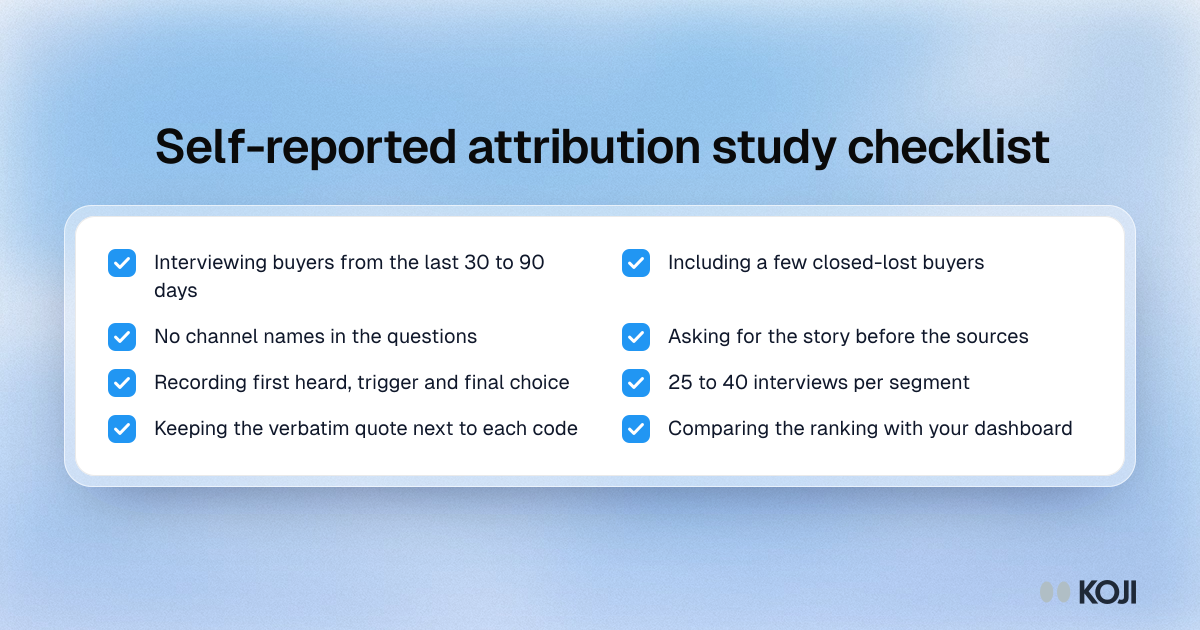
Interview recent buyers, within a few weeks of the decision. Memory of "first heard" fades quickly. Aim for closed-won customers from the last 30 to 90 days, and include a handful of recent closed-lost buyers too, because they tell you which channels create interest that never converts.
Ask for the story, then the sources. Start with "what was going on when you started looking?" and only later ask where they heard of you. People who lead with their own situation name sources more accurately than people asked cold.
Separate three moments. The first time they heard of you, the moment they decided to act, and the moment they chose you are often three different channels. A podcast may create awareness, a peer recommendation may trigger the shortlist and a comparison page may close it. If you record one answer, you lose two of them.
Capture the exact words. "Someone in a Slack group mentioned you" is a different channel from "a LinkedIn post". The phrasing also feeds your messaging, which makes this the same study that serves your voice of customer work.
Use 25 to 40 interviews for one segment. Channel mentions repeat quickly. If a source appears in four or five unrelated stories, it is real. Add more only when you want to compare segments, such as SMB against enterprise.
Code the answers once, openly. Use a short list: podcast, community, peer recommendation, social post, search, analyst or review site, event, existing relationship, other. Keep the verbatim quote next to each code so a sceptical finance lead can read the evidence.
Common mistakes
- Offering a dropdown of channels. You will get the channels you already track.
- Asking only "how did you hear about us?" and stopping at the first answer.
- Interviewing only happy champions. Include the economic buyer and, where you can, someone from the buying group who was sceptical.
- Treating the result as a replacement for tracking. Self-reported data tells you which channels matter. Software tells you what to measure inside them. Use both, and see our guide to what each attribution method can and cannot prove.
- Leading with your brand. Do not say "was it our webinar?" Let the buyer name it.
How to set it up in Koji
- Start the study. From the home screen, type the research question ("How did our last 40 customers first hear about us, and what pushed them to buy?") and start a study. You can also open the template library and begin from the Customer Journey Mapping Interviews template, which already walks a buyer through awareness to decision.
- Shape the research brief. The brief assistant drafts the goal, the target participant and the questions. Tell it who counts as a recent buyer and ask it to avoid naming your brand or any channel. You can ask it to change any part, and it tells you what it changed.
- Add structured questions where you need a number or a choice. Koji supports open-ended, scale, single choice, multiple choice, ranking and yes/no questions. Use one after the story, such as a single choice for "who first brought us into the conversation?" so you can chart it, and keep the rest open so the AI interviewer can follow up.
- Add a screening question. Qualify participants by role and by whether they were involved in the decision, so people who only signed a contract do not skew the answers.
- Choose voice or text, then preview. Take the interview yourself from the Preview tab. Previews do not use credits and do not appear in the report. A text interview costs 1 credit and a voice interview 3, at the time of writing.
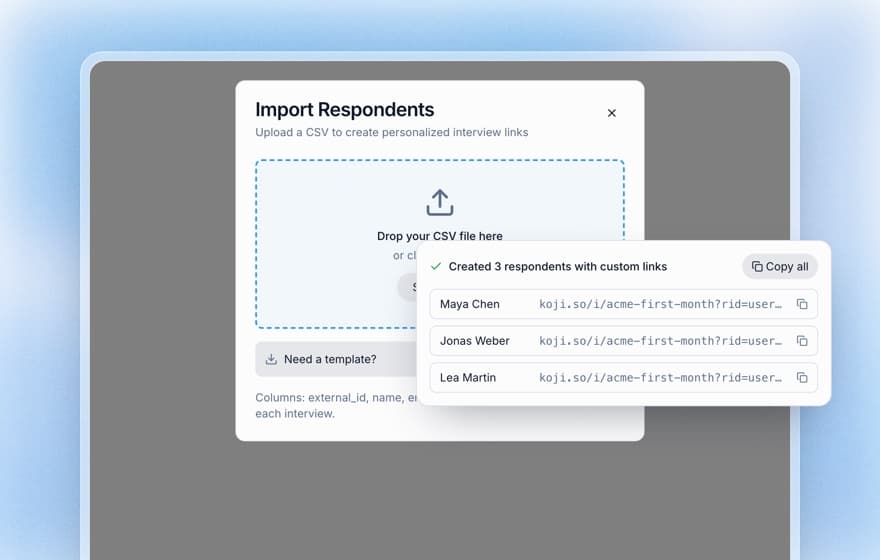
- Invite your customers. Share the interview link, or import a CSV of recent buyers so each person gets a personal invite link that ties the interview to them. Up to 500 rows can be imported at once. Personal links from a CSV import are on the Interviews and Enterprise plans. A first text study fits the Free plan, so check the pricing page for the plan that matches your mix.
- Read the report. Koji groups answers into themes and links each finding to the supporting quotes, so you can show your CFO the sentence behind the percentage.
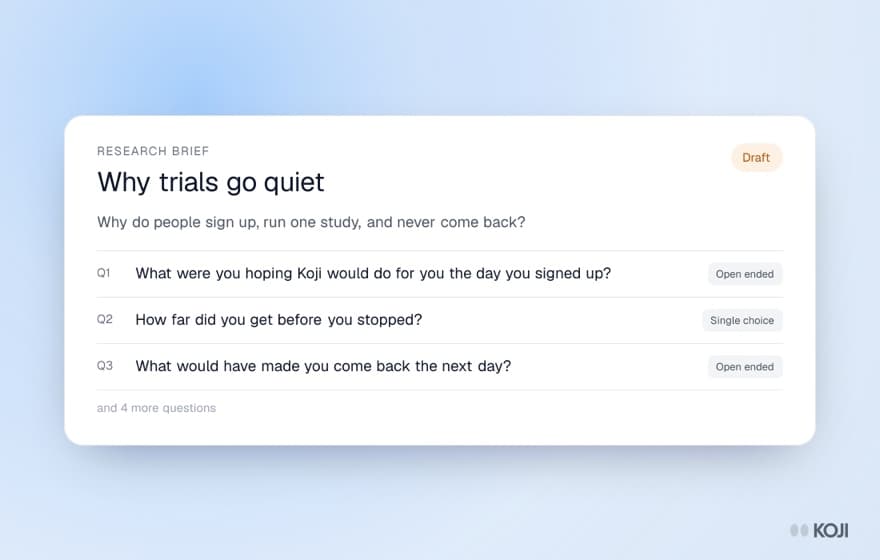
Example questions written for this study:
- "Take me back to when you started looking for a way to solve this. What was going on at the time?"
- "Before you spoke to us, where had you already come across our name, and who or what put it in front of you?"
- "What made you decide this was the month to do something about it?" (follow up: "Who else did you talk to before then?")
- "If a peer asked you how you found us, what would you tell them?"
- "Which of these first brought us into the conversation?" (single choice: a colleague or peer, a podcast or video, a community or group chat, a search, an event, something else)
- "What almost stopped you from choosing us?"
What you get
You get a ranked list of the sources buyers name, split by first heard, decision trigger and final choice, each with verbatim quotes. The next day you can use it in three places.
In the budget meeting, put the buyer-reported ranking beside the software ranking and show the channels where they disagree. In the messaging workshop, use the exact phrases buyers used for the problem, which are better headlines than anything written in a conference room. In the channel review, flag the sources that keep appearing in stories but not in reports, and run a small test on one before cutting or scaling it.
Because Koji keeps each report as a version, you can rerun the same study each quarter and show the mix shifting.
The same playbook elsewhere
The method is not unique to marketing. Sales teams run it as win and loss interviews, asking why a buyer chose or rejected you. Customer success teams run it before renewals, see our renewal risk interviews playbook, and use exit interviews to learn why customers left. Product marketers use it to pressure-test positioning, which is covered in customer research for product marketing managers and value proposition testing. Borrow one thing from win-loss: always interview some people who did not buy.
Why Koji for self-reported attribution
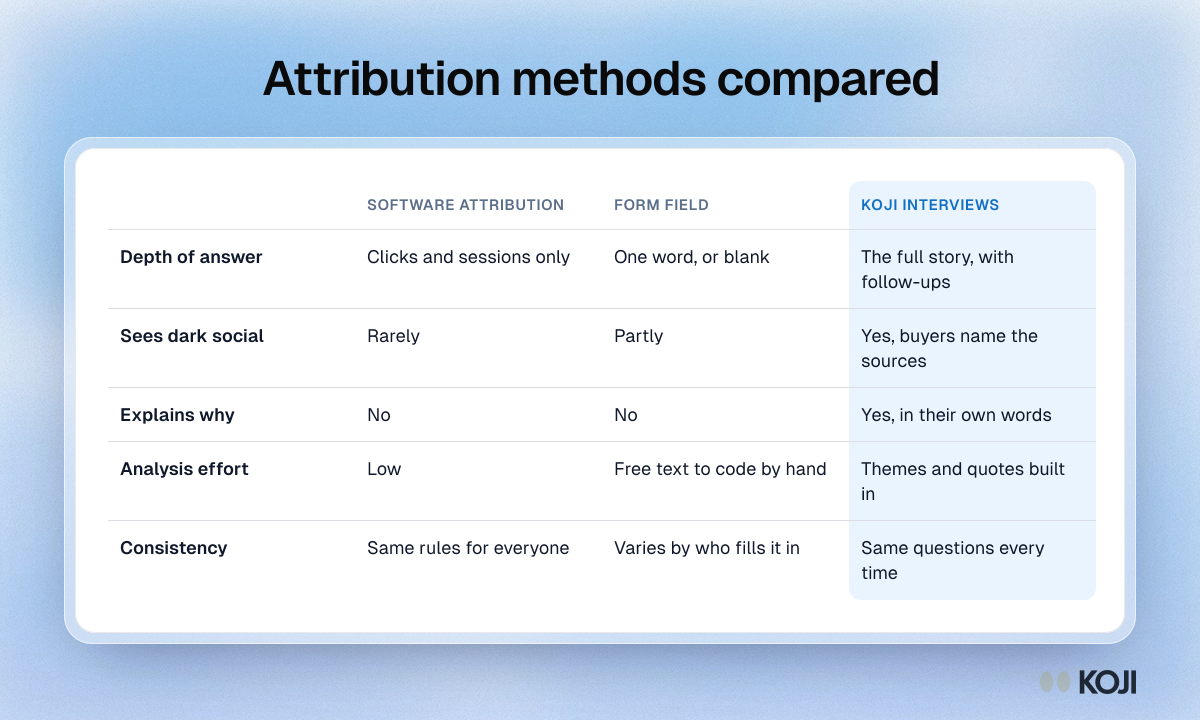
Software attribution is always on and consistent, and you should keep it. A form field is cheap. Neither one explains why. An agency-run interview programme can, but it is slow and priced per project. Koji sits between them for this job.
- Follow-up questions on every answer. The AI interviewer asks the next question based on what the buyer just said, so "a podcast" becomes which podcast, which episode and who recommended it. You set how many follow-ups each question allows.
- Voice or text, in the buyer's language. People answer in the way they prefer, and the participant page offers a language choice.
- Evidence behind every finding. Each report finding links back to the interviews that support it, so a percentage always has quotes next to it.
- A quality gate. Each interview gets a score from 1 to 5, and only interviews scoring 3 or higher use credits or enter the report. Filler answers do not inflate your sample.
- Fits your CRM workflow. Import a CSV of recent buyers, and export responses as CSV for your analysts.
Questions you might have about AI interviews
Will customers talk to an AI about how they found us? Participants see a welcome page that states the length, tells them the conversation is confidential and lets them choose text or voice. Letting people pick a mode and answer when it suits them removes the scheduling friction that makes human-moderated attribution studies hard to get. Your own phrasing in the invite matters more than the interviewer, so say what you will do with the answers.
Will they be polite instead of honest? Politeness bias is real in every method. The interview does not name your brand or offer channels to react to, which keeps answers about their own experience, and guardrails let you list topics the interviewer must avoid.
Can we trust the synthesis? Each finding shows how many participants back it and links to the quotes behind it. Read those quotes for your top three channels before presenting.
When Koji may not be the right fit
If you have fewer than about ten recent buyers, you will learn more from calling them yourself. If your sale is a high-volume consumer purchase with no considered journey, a one-question survey may be enough. And if you need statistical proof of incremental lift, you need an experiment or a mix model, which Koji does not replace. Use the interviews to decide what to test.
Metrics to track
- Share of buyers naming each source at first heard, trigger and decision
- Gap between buyer-reported share and software-reported share per channel
- Number of sources that appear in at least three unrelated stories
- Share of interviews that name a specific show, group or person, not just a category
- Change in channel mix quarter to quarter
FAQ
How many customers should I interview? For one segment, 25 to 40 recent buyers is a practical range. Channel mentions repeat quickly, so add more only to compare segments.
Is this the same as a "how did you hear about us" form field? No. A form field gives you one word. An interview asks for the story, separates first heard from decision trigger, and follows up on vague answers.
Can I use it for closed-lost deals? Yes. Include a handful. They show which channels create interest that does not convert.
Which plan do I need? A first text study fits the Free plan. Personal invite links from a CSV import are on the Interviews and Enterprise plans, so check the pricing page for the current plans and credits.
How often should I rerun it? Quarterly works for most teams, and before each annual planning cycle.
Start your study
Open the template library in Koji and start from the Customer Journey Mapping Interviews template, or read how it works in creating your first study, structured questions, importing participants from a CSV and how the quality gate works. More on this audience is on the Koji for marketing teams page, and every playbook for marketers is collected in the use-case library.