Pay transparency research is a short round of interviews with your own employees, run before you publish pay ranges, pay gap figures or a new pay structure, to find out how that information will be read. Running it with AI-moderated interviews means every job category gets the same questions, people can speak without a manager or HR partner in the room, and you get quotes and counts instead of guesses. By the end of this playbook you will be able to set up a study, run it in a fortnight, and walk into your first reporting cycle knowing which messages will land and which will start a fire.
Why pay transparency research matters now
The EU Pay Transparency Directive (2023/970) told member states to transpose it by 7 June 2026. The text sets the reporting clock: employers with 250 or more workers report their pay gap data every year, with the first report due by 7 June 2027 on 2026 figures. Employers with 150 to 249 workers also file first by 7 June 2027, then every three years. If a report shows an average pay gap of at least 5% in any category of workers that you cannot justify on objective, gender-neutral grounds and do not fix within six months, you owe a joint pay assessment with workers' representatives.

Many countries missed the transposition date. Mayer Brown's briefing for international employers notes that several states, Germany, France, the Netherlands and Spain among them, had not finished by the deadline, and, per Mondaq's summary, the European Commission does not intend to delay. National rules will differ, so check yours with counsel. What does not differ is the work in front of you: the numbers will become visible, and your people will read them.
The trouble is that HR is guessing how they will read them. Salary.com's 2026 State of Pay and Compensation Practices report, a survey of 525 HR and compensation professionals fielded in late 2025, found that 74.8% think employees at their organization are paid fairly, while only 44% believe employees agree. That 44% is HR's estimate, not employee data. The same report found that just 34.3% of organizations are open with employees about how pay is actually determined. Salary.com's separate Trust and Pay research, which did ask employees, found HR had under-predicted how many would call their pay fair (a predicted 45.4% against an actual 54.0%). Guessing is wrong in both directions, and you cannot tell which way you are wrong without asking.
Employees have already formed expectations. A Talker Research study for Globalization Partners in April 2026 polled 4,000 professionals across six countries: 71% expected their employer to apply the most rigorous pay transparency rules company-wide, yet only 34% said they work somewhere that practises pay transparency. The study was commissioned by an HR software vendor, so read the AI findings with that in mind. The gap between expectation and practice is the finding that matters here.
Add the manager layer. Gallup's State of the Global Workplace 2026 puts global employee engagement at 20% for 2025, and manager engagement at 22%, down from 31% in 2022. The managers who will field the first awkward question about a salary band are, on average, not in a good place to do it.
The cost of skipping the research is concrete. You publish a range or a gap figure, a few people compare it with their own pay, and you learn what the story is from the grapevine and the exit interviews. By then the fix is a pay adjustment, not a better explanation.
What good looks like
Treat this as listening research, not a survey. You are not measuring support for transparency. You are finding out what people expect to see, what they will conclude when they see it, and what they will ask their manager.
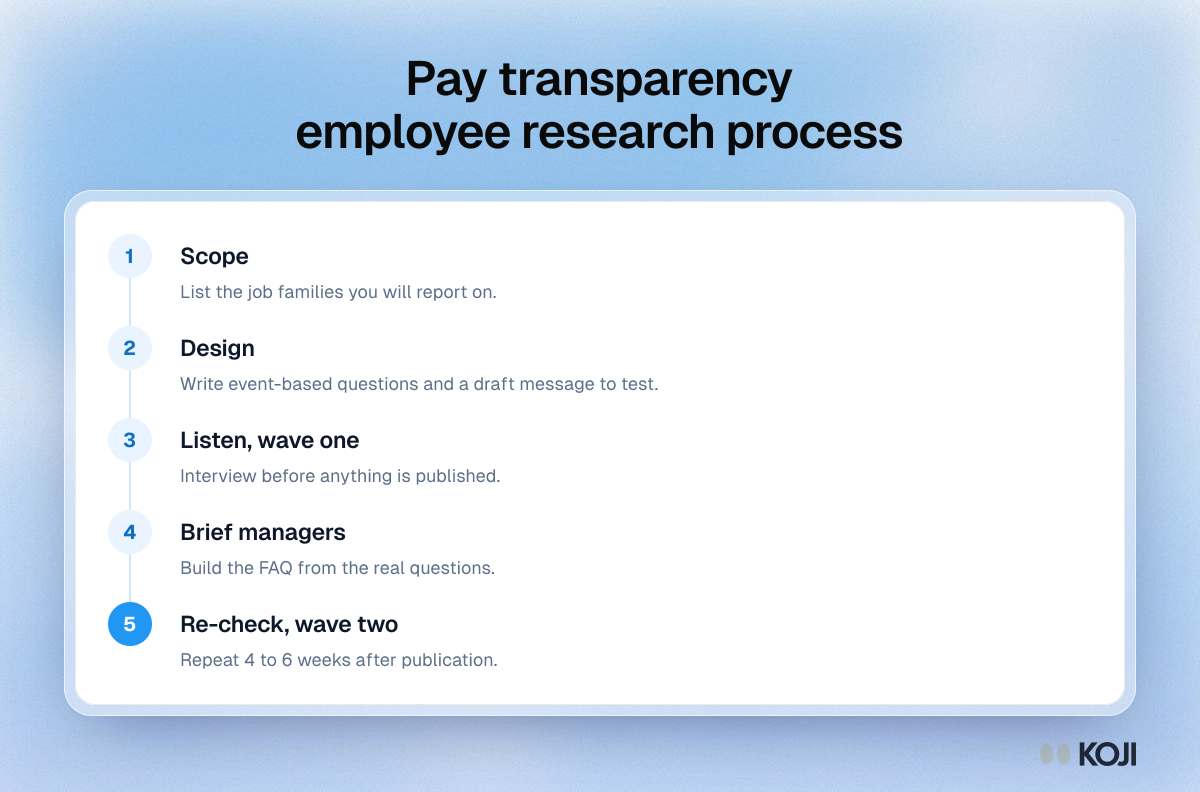
Run it in two waves. Wave one happens before anything is published: draft ranges, job architecture or gap figures are ready, but nothing has been shared. Wave two follows four to six weeks after publication. Wave one tells you how to communicate. Wave two tells you whether it worked and what the real questions turned out to be.
Sample by job category, not by headcount. The directive's own logic is built on categories of workers doing equal work or work of equal value, and so will your employees' comparisons be. Cover each job family you will report on and aim for enough conversations in each to see themes repeat. For a first pass, 15 to 25 per major family is a sensible starting point, widened if the themes are still shifting. This is a qualitative judgment, not a statistical one.
Ask about the last time, not about principles. "Do you support pay transparency?" gets a polite yes. "Tell me about the last time you found out what someone else earned" gets a story, and the story tells you what you need to know. Ask about specific events: a salary conversation, an offer, a promotion, a colleague's offhand remark.
Test the message, not just the mood. Put a plain-language draft of what you plan to publish (a range, a banding explanation, an anonymised gap summary) into the question and ask people to say back what they understood and what they would do next. Where their reading differs from yours, you have found the line to rewrite.
Keep it anonymous by design. Pay is the most sensitive subject you will ever put in front of employees. If the interview asks for a name, an email or a team before it starts, the answers will be polished and short. Collect only the one segment you will act on, usually job family, and drop anything that makes a small group identifiable. In Europe, involve your works council early; our guide to works councils and employee research explains why the design matters as much as the paperwork.
Common mistakes
- Asking "is our pay fair?" instead of asking for events and comparisons.
- Running the study after publication only, so you never see the version of the story that existed before your message.
- Letting HR business partners or line managers hand out the link. Leadership should send it, with a plain statement of who will see what.
- Reporting job-family findings for groups so small that everyone can guess who said what.
- Treating the output as a communications task only. If many people in a job family describe the same inconsistency, the finding is about pay, not wording.
- Promising action you have not agreed. Say what you will share back, and when.
How to set up pay transparency research in Koji
Koji has no dedicated pay transparency template, so you start from the research question. Text interviews are available on every plan, and voice interviews need the Interviews plan or Enterprise. A text interview costs 1 credit and a voice interview costs 3, and only interviews that reach a quality score of 3 or more use credits or appear in the report. A new account starts with 10 free credits, enough to preview and pilot the study.
- Start a study from one sentence. On the home screen, type the question: "How will employees in each job family read our pay ranges and pay gap figures before we publish them?" Koji drafts a research brief you can edit. Add guardrails that tell the interviewer what to avoid, such as discussing named colleagues or asking for exact salaries.
- Write the questions (examples below) and add structured ones where you need a count. A single choice question or a 1 to 10 scale gives you a distribution next to the quotes. The structured questions guide lists the types.
- Ask for job family once. Add a single choice question for job family so you can see which families are speaking and track coverage against your plan. Leave out grade, location and tenure unless you will act on them. Interviews are listed individually, so read each family's conversations together when you synthesise.
- Turn off the lead form and decide what the welcome page says. Under the study's Customize settings, switch off the pre-interview lead form so no name or email is requested, and use the Anonymous badge with your own wording. Be clear about what the badge is: it is a label on the welcome page. What makes the study anonymous is that you collect no identifiers and share one generic link instead of personal ones. Our anonymous employee research guide walks through it.
- Choose text, voice or both. Text suits a distributed team and anyone wary of being recorded. Voice suits people who would rather talk than type. Let people pick.
- Preview, then send from leadership. Take the interview yourself on the Preview tab, which does not use credits or count as a response. Then share the interview link from a senior leader's email or an intranet post, set a response limit, and keep it open for about two weeks.
- Read the report. Themes, counts and supporting quotes build as interviews arrive, and every claim in the report links back to the conversations behind it.
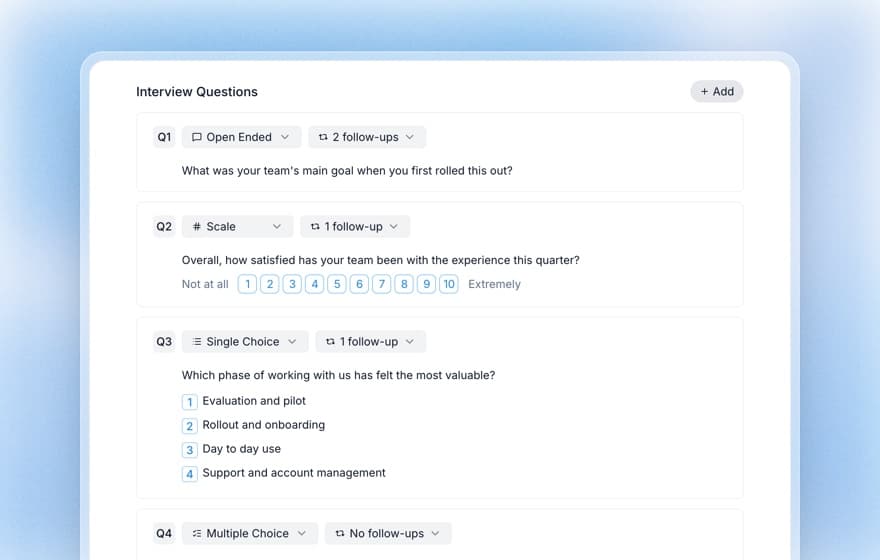
Example questions for this study
- Tell me about the last time you learned what a colleague earns. What happened next?
- Here is the draft wording we plan to publish about pay ranges for your role: [paste the plain-language draft]. In your own words, what does it tell you? What would you do after reading it?
- On a scale of 1 to 10, how confident are you that people doing similar work here are paid on the same basis? What made you pick that number?
- If your manager were asked about this range tomorrow, what do you think they would say, and how would you feel about it?
- Which of these would you most want explained: how bands are set, how someone moves up a band, how gaps are checked, or how to raise a concern? (single choice)
- What would have to be true for you to believe the figures you are shown?
What you get
Koji's report gives you the outputs a rewards lead can use the next day.
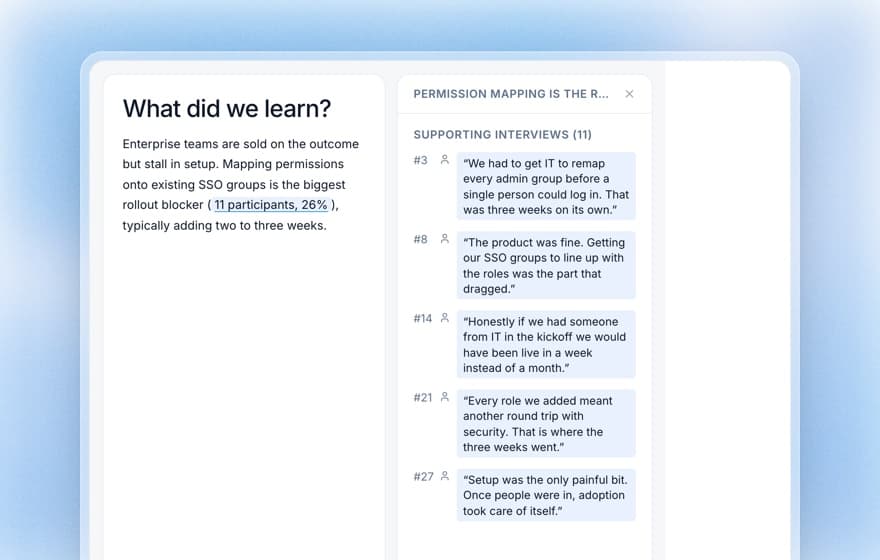
- A map of expectations. Read by family, it shows where people expect to sit in the range, and where that is higher than your band.
- The questions managers will actually get. Use the real wording to build the manager briefing and the FAQ, in place of the questions you imagine.
- Message gaps. The places where what people understood differs from what you meant, with the quotes to prove it.
- Pay-structure signals. Clusters of the same complaint inside one family are a case for your total rewards lead, not your comms lead.
- A wave-two comparison. Run the same questions after publication and compare. The report history keeps each version.
In the week after fieldwork, the usual path is a one-page readout for the CHRO, a manager briefing built from real questions, and a short list of structure issues for the pay committee.
The same playbook elsewhere
The pattern of "test how a change lands before you announce it" carries over. Policy change impact studies, return-to-office decisions and restructuring announcements all benefit from a pre and post wave. Customer success teams run the same logic as exit and churn interviews: ask about the last real event, not about opinions. Investors use it when they interview a target's staff before a deal. The core idea is identical: ask people to narrate what happened, and compare it with what the policy assumes.
Why Koji for pay transparency research
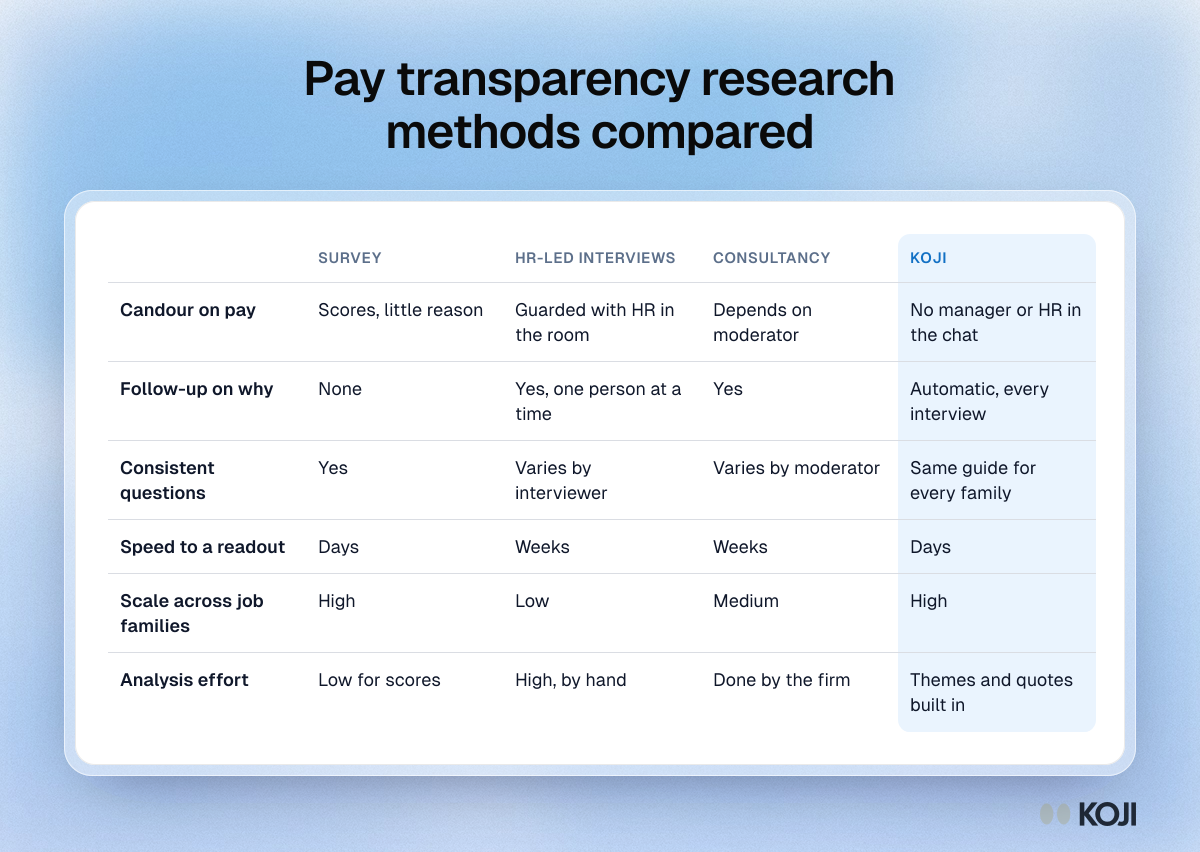
Your realistic alternatives are an annual or pulse survey (often through the engagement platform you already own), HR-led interviews or focus groups, and an outside consultancy. Each has a place. A survey is cheap and good for tracking a number over time. HR-led interviews build trust when the relationship is strong. A consultancy brings legal and benchmarking depth. Where they struggle is on pay, because the subject is personal and the people asking are the people who set the pay.
Reasons Koji fits:
- The interviewer is not HR. Participants talk to an AI moderator with no stake in their pay, with no manager or HR partner in the conversation. Saying "that range makes me angry" can feel easier when the listener has no say in your pay.
- It follows up. When someone says "that does not seem fair", the interviewer asks what they are comparing it with. A survey cannot do that.
- Same questions across every family. Consistent probing means differences between job families come from the people, not from who happened to run the session.
- Numbers and quotes together. Structured questions give you counts, and the report ties each finding back to what people said.
- Quality control built in. Each interview gets a quality score from 1 to 5, and thin or off-topic conversations do not reach the report or use credits. Our access controls guide covers who in your team can see the data.
To compare against the survey and engagement tools you may already own, see Culture Amp alternatives, Lattice alternatives and surveys versus interviews.
Questions you might have about AI interviews
Will employees believe it is anonymous? Only if the design backs the promise. Switch off the lead form, share one generic link, collect job family and nothing narrower, and say plainly who sees what. The Anonymous badge makes the promise visible on the welcome page, and the setup makes it true.
Do we need works council approval? In Germany and several other countries, quite possibly, and it is a legal question for your counsel. A study that cannot identify individuals and reports only aggregates is far easier to agree. Start with the works council guide and bring the council in before you launch.
Will an AI feel too cold for something this personal? Participants choose text or voice, and the report shows themes and quotes without names when you have collected none. You can take the interview yourself in Preview first, so you know exactly what they will experience.
When Koji may not be the right fit
If you need a statistically representative measure of how many employees support a policy, a survey sent to everyone is the better tool, and you can run the interviews alongside it to explain the numbers. If your pay data is not ready, interviews will surface questions you cannot yet answer. And if the matter is a live legal dispute or a formal grievance, take advice and do not run it as a research study.
Metrics to track
- Completion rate and quality scores by job family.
- Share of participants who restate your message correctly (wave one against wave two).
- The five most common manager questions, and how many your FAQ answers.
- Gap between expected and published position in the range, by family.
- Regretted attrition and pay-related reasons in exit interviews, six months on.
- Time from fieldwork close to readout.
FAQ
How many employees should I interview? Cover every job family you will report on, and aim for enough in each to see themes repeat. Fifteen to twenty-five per large family is a sensible start. Widen if new themes keep appearing.
When should I run it? Run wave one before you publish anything, ideally while ranges are still in draft. Run wave two four to six weeks after publication.
Can I ask people about their own salary? You do not need to. Ask about expectations, comparisons and reactions to the draft message. Add a guardrail so the interviewer does not request exact figures.
Which Koji plan do I need? Text interviews work on every plan. Voice interviews need the Interviews plan or Enterprise. Check current plans on the pricing page.
Is this legal advice on the Directive? No. It describes the Directive's published text and a research method. Your counsel should confirm national rules and any works council requirements.
Start your pay transparency study
Open the dashboard, type the question from step 1 and start a study, or see how other HR and People teams use Koji. Every playbook for this audience is in the HR use-case library.