

Short answer: Voiceform is a survey builder where people can answer out loud. You design a form with voice, video and classic question types, respondents record their answers, and AI probing can add a few follow-up questions after a voice answer. Koji is an AI interviewer. It holds a real spoken or typed conversation, follows up on each answer the way a researcher would, and turns every conversation into a report you can trace back to the quotes. If you want to add voice answers to a survey you already run, Voiceform is a sensible choice. If you want the depth of an interview without scheduling one, Koji is built for that.
Koji vs Voiceform at a glance
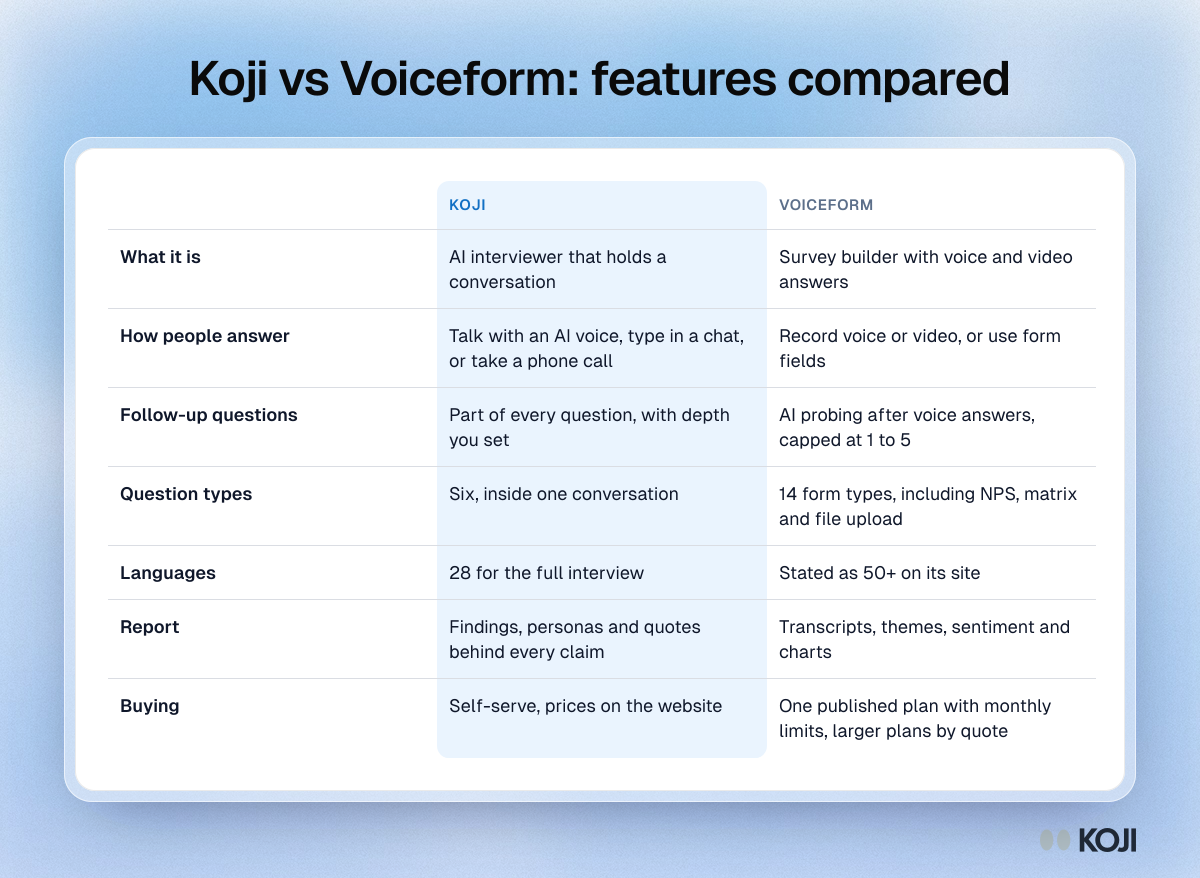
| Koji | Voiceform | |
|---|---|---|
| What it is | AI interviewer that holds a conversation | Survey builder with voice and video answers |
| How people answer | Talk with an AI voice, type in a chat, or take a phone call | Record voice or video, or use form fields |
| Follow-up questions | Part of every question, with depth you set | AI probing after voice answers, capped at 1 to 5 |
| Question types | Six, inside one conversation | 14 form types, including NPS, matrix and file upload |
| Languages | 28 for the full interview | Stated as 50+ on its site |
| Report | Findings, personas and quotes behind every claim | Transcripts, themes, sentiment and charts |
| Buying | Self-serve, prices on the website | One published plan with monthly limits, larger plans by quote |
Why voice answers say more
Typed open-ended questions are where surveys go to die. People write five words and move on. Speaking is different. In a randomised experiment with 1,001 smartphone respondents, Höhne, Gavras and Claassen found that "voice answers have a higher number of words and a higher number of topics than their text counterparts", with no difference in sentiment (Social Science Computer Review, 2024).

Photo by Vitaly Gariev on Unsplash
Voice is not free of costs, and it is worth knowing them before you pick a tool. Revilla and colleagues found voice recording produced longer, more elaborate answers but also substantially higher nonresponse on Android phones (Social Science Computer Review, 2020). And in a study by Lenzner and Höhne, only about 40% of respondents were willing to answer by voice at all (International Journal of Market Research, 2022). Meanwhile classic channels keep shrinking: Pew Research Center reported a typical telephone survey response rate of 6% in 2018, down from 36% in 1997 (Pew Research Center, 2019).
The lesson for tool choice: voice gets richer answers from the people who use it, so give people the choice of voice or text, and make the experience feel worth their time.
What Voiceform does
Voiceform describes itself as "conversational surveys and forms using voice, video, and text" (CB Insights profile). It was founded around 2021 by Philip Brook and Artem Alekhin and has recently moved toward AI-moderated research (Voiceform blog).
What you get:
- A wide question library. Voice response, audio question, video recording, NPS, rating, matrix, multiple choice, checkbox, dropdown, yes/no, date, email, phone and file upload (Voiceform docs).
- AI probing. After a voice answer, AI can generate follow-up questions. You set a probing goal and cap it at 1 to 5 follow-ups, or let the AI decide when an answer is enough (Voiceform docs).
- Automatic processing. Responses are transcribed, translated and themed, with sentiment and charts (voiceform.com).
- Logic and integrations. Skip logic, branching and piping, plus Zapier, webhooks and widgets you can embed in Qualtrics and Forsta Decipher surveys (Voiceform docs).
Voiceform's pricing
Voiceform's pricing page lists one self-serve plan, Lite, available as a free trial. It includes 200 answers a month, 40 AI follow-ups a month, a recording limit of 2 minutes 30 seconds per question and one seat. Larger plans have custom limits and are priced by quote (Voiceform pricing). Older price lists still circulate on third-party sites, so check the live page before you budget.
Voiceform's trade-offs
- It is still a survey. The respondent records an answer to a question on a screen. AI probing adds follow-ups after voice answers, but there is no back-and-forth conversation with a voice that listens and replies.
- Follow-ups are metered. On the Lite plan, 40 AI follow-ups a month covers a small study at most.
- Mixed reviews on speed. Voiceform rates 4.7 out of 5 from 48 reviews on G2, with praise for ease of use and audio answers. Some reviewers describe slow load times and unreliable embeds (G2).
- Language support is unclear. The site says 50+ languages, while one of its own landing pages says transcription covers 13+.
What Koji does
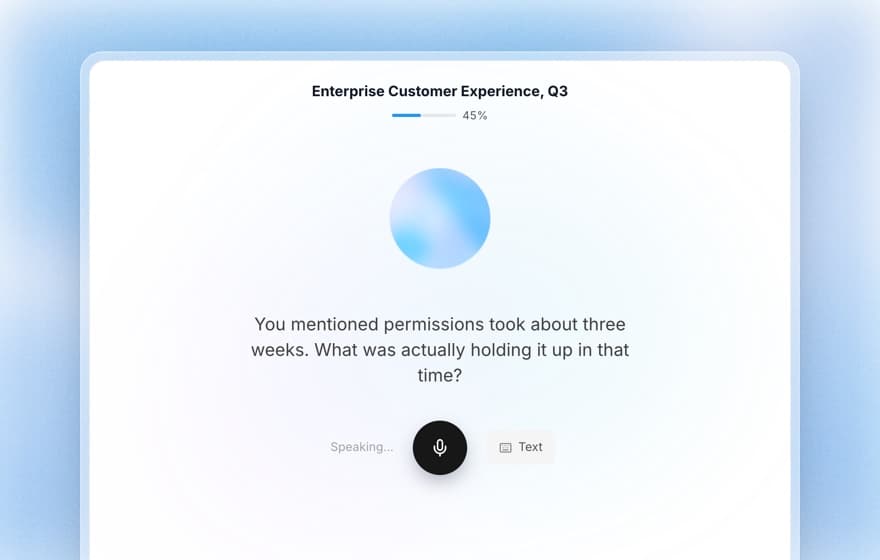
Koji does not ask people to record answers into a form. It interviews them. An AI interviewer opens the conversation, asks your questions, listens to each answer and follows up on what the person actually said, then moves on when it has what it needs.
- Three ways to take part. Participants pick voice or text on the welcome screen. Voice is a live conversation with an AI voice, text is a chat, and phone interviews work through a call-back link or outbound calls you schedule. See AI voice interviews and voice vs text interviews.
- Follow-ups on every question. You set how deep the AI probes per question, with no monthly follow-up allowance to ration. See probing and follow-up questions.
- Six structured question types inside the conversation: open ended, scale, single choice, multiple choice, ranking and yes/no, each charted in the report. See the structured questions guide.
- 28 languages, chosen per study. The whole interview, follow-ups included, runs in the participant's language, and all answers land in one report.
- Screening and previews. Screening questions turn away people who do not qualify, and you can preview the interview by voice or text for free.
- Recruitment built in. Share a link, give each person a personal invite link from a CSV, or recruit from Koji's panel.
Reports with the evidence attached
Every interview gets a quality score from 1 to 5, and only interviews scoring 3 or more enter the report or use credits (how the quality gate works). The report opens with what you learned, then findings, recommendations and personas. Click any claim and the quotes behind it open beside the report (tracing report findings to evidence).
What Koji costs
Koji's prices are on its website. You start free with 10 credits and no card. Insights is €29 a month with 29 credits and Interviews is €79 a month with 79 credits, with Enterprise on contract and extra credits at €1. A text interview uses 1 credit, a voice interview 3 and a phone interview 0.6 credits a minute. Follow-ups are included in the interview, and interviews scoring under 3 are free.
Voice survey or AI voice interview?
The real choice is not between two brands. It is between two formats.
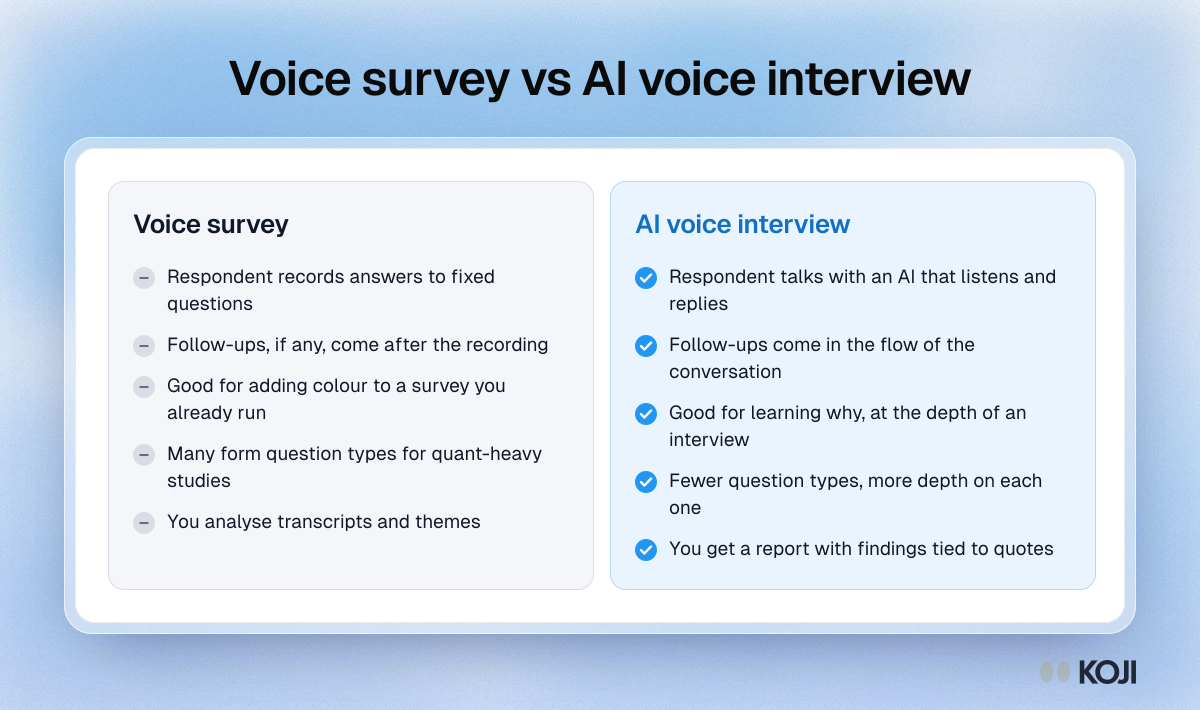
| Voice survey | AI voice interview |
|---|---|
| Respondent records answers to fixed questions | Respondent talks with an AI that listens and replies |
| Follow-ups, if any, come after the recording | Follow-ups come in the flow of the conversation |
| Good for adding colour to a survey you already run | Good for learning why, at the depth of an interview |
| Many form question types for quant-heavy studies | Fewer question types, more depth on each one |
| You analyse transcripts and themes | You get a report with findings tied to quotes |
Which one should you pick?
Pick Voiceform if
- You already run surveys and want voice or video answers on a few open questions.
- You need form features like matrix questions, file uploads or date pickers.
- You want to embed voice questions inside an existing Qualtrics or Decipher survey.
Pick Koji if
- You want people to have a conversation, not fill in a form.
- You need follow-ups on every answer without a monthly cap.
- You want phone interviews for people who will not sit at a screen.
- You want a finished report where every finding links to what people said.
- You want to know a study's cost before you launch it.
The bottom line
Voiceform adds voice to the survey. Koji replaces the survey with an interview. Both get you richer answers than a text box, and the research above says that is worth doing. The difference shows up in the follow-ups and the report: Koji asks the next question the way a researcher would, on every answer, and hands you findings you can check against the quotes.
Hear your customers explain themselves
Start free on Koji with 10 credits. Write your research question, preview the voice interview yourself, and send the link to a few customers today. If you are moving from a form, the survey to AI interview guide shows how to turn your existing questions into a conversation, and the AI voice surveys guide covers when voice works best.


