Short answer: Amazon Mechanical Turk closed for good on September 30, 2026. For academic surveys and behavioral experiments, the closest replacements are Prolific and CloudResearch Connect. Both were built for research, both screen their participants, and both charge a fee on top of what you pay people. For UX and B2B studies where you need specific roles, User Interviews and Respondent recruit qualified people at a higher price per session. And if your MTurk tasks were really a way of asking people questions, Koji recruits from a panel, screens people and runs the interview itself, by text or voice, then writes the report.
This guide covers what happened to MTurk, what requesters still need to do, how the main alternatives compare on data quality and cost, and how to move a study across without breaking it.
What happened to Mechanical Turk
Mechanical Turk ran for 21 years. It was where much of online behavioral science was collected, and where early AI training data was labeled by hand. The end came in three steps:
- July 2026: Amazon stopped accepting new customers at the end of July.
- August 25, 2026: Amazon announced it would close the service completely (CNBC). It gave no detailed reason beyond a review of its programs and services.
- September 30, 2026: the last day HITs could be submitted. Anything still open expired that day.
If you were a requester, two dates still matter (MTurk help and FAQ):
- October 30, 2026 is the last day to approve or reject completed work and award bonuses. It is also the deadline to check the payment details on your Requester account.
- Prepaid balances are refunded in full, within 30 days of the closure.
Download your batch results, worker IDs and qualification lists before the archive goes. You will want them to keep exclusion lists working on your next platform.
Why this matters more than one platform closing
MTurk was not just one option among many. In a content analysis of 88 published articles that used it, 61% were in psychology and related fields (arXiv 1609.08437). That sample is small and dated, but it shows how central the platform was. Whole methods sections, preregistrations and lab budgets assumed it.

Photo by Vitaly Gariev on Unsplash
It was also not the best option for some time. In a two-study comparison of close to 4,000 participants, Peer and colleagues found that without quality filters, 69% of Prolific participants passed both attention checks, against 48% on MTurk and 51% on MTurk through CloudResearch. Two general market research panels came in at 22% (Peer et al., Behavior Research Methods). A later paper by Hauser and colleagues disputed the CloudResearch result, arguing the toolkit's default filters had been switched off, and found CloudResearch's vetted pool did better with them on. The direction is the same either way: a research-first pool with active screening beats an open task marketplace.
So the shutdown is also a chance to fix how you recruit, not just where.
The main MTurk alternatives compared
The table below sets out what each one is for. Fees and prices follow in the sections underneath.
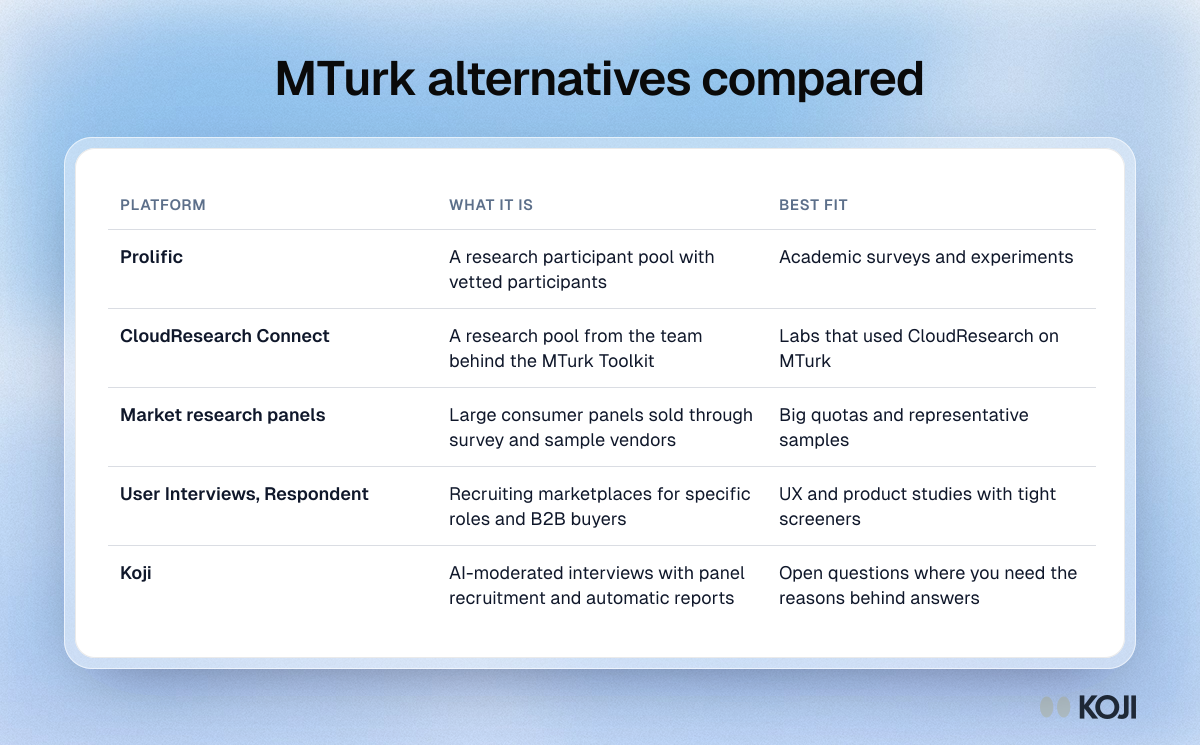
| Platform | What it is | Best fit |
|---|---|---|
| Prolific | A research participant pool with vetted participants | Academic surveys and experiments |
| CloudResearch Connect | A research pool from the team behind the MTurk Toolkit | Labs that used CloudResearch on MTurk |
| Market research panels | Large consumer panels sold through survey and sample vendors | Big quotas and representative samples |
| User Interviews, Respondent | Recruiting marketplaces for specific roles and B2B buyers | UX and product studies with tight screeners |
| Koji | AI-moderated interviews with panel recruitment and automatic reports | Open questions where you need the reasons behind answers |
1. Prolific
Prolific is the default answer for most academic labs, and for good reason. It was built for research from the start, it vets its participants, and it publishes its rules on fair pay.
- Fees: Prolific's standard fee is 42.8% of participant costs for corporate accounts and a discounted 33.3% for academic and non-profit accounts (Prolific researcher help). The fee never comes out of what participants are paid.
- Pay rules: the minimum is £6.00 or $8.00 an hour, and Prolific recommends at least £9.00 or $12.00 (Prolific, ethical rewards). Labs used to paying MTurk rates should budget for a higher cost per completed participant.
- Where it fits: surveys, experiments, and studies hosted in Qualtrics, Gorilla or your own server.
Our Prolific pricing guide works through the fee on a real study budget.
2. CloudResearch Connect
CloudResearch spent years building tools on top of MTurk, including an approved participant list that filtered out low-quality workers. Connect is its own pool, and for labs that already used CloudResearch it is the smallest change.
- Fees: since January 1, 2025 the standard service fee is 40%, with 25% for academic and non-profit accounts (CloudResearch).
- Where it fits: teams who want MTurk-style study setup with stronger vetting.
3. Market research panels
The big consumer panels sold through survey and sample companies can fill large quotas fast, across many countries. They are built for market research quotas, not attention-heavy experiments, which is why they scored lowest on attention in the Peer comparison. Use them for representative samples, with your own attention and consistency checks.
4. User Interviews and Respondent
If your MTurk work was really UX research, a recruiting marketplace is a better fit than any task platform. You describe the person, write a screener, and they find, schedule and pay participants. User Interviews lists $49 per completed consumer session and $98 for B2B, with incentives on top (User Interviews pricing). These suit studies where the right job title matters more than volume. See Prolific vs Respondent for how the two recruiting models differ.
5. Koji
Most of these alternatives replace the recruiting half of MTurk. You still build the survey somewhere else, host it, clean the data and analyze it.
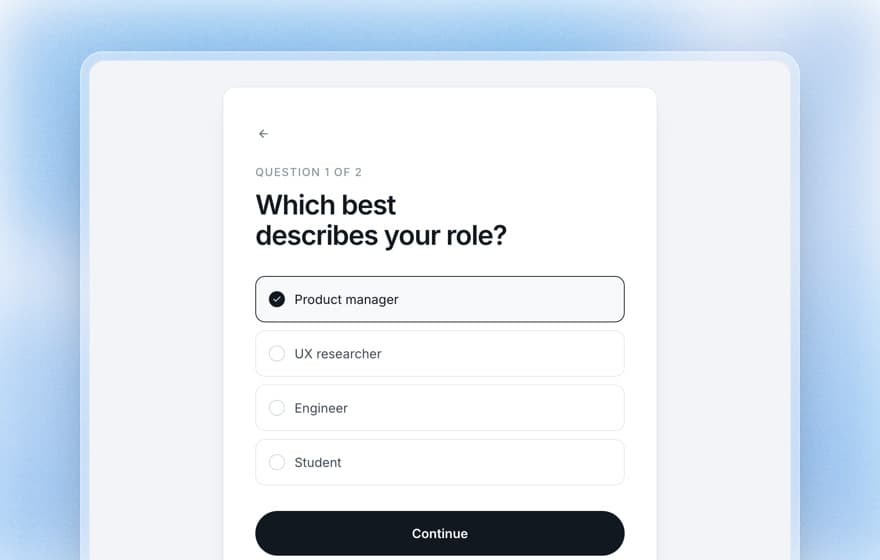
Koji replaces the whole loop when the study is about asking people questions. You write a research question, Koji drafts the interview, and an AI interviewer runs each conversation by text or voice, asking follow-ups when an answer is thin. Six structured question types (open ended, scale, single choice, multiple choice, ranking and yes or no) sit alongside the open conversation, so you still get numbers you can chart.
What maps across from MTurk:
- Recruiting: panel recruitment lets you pick markets, describe your audience in plain language and see the price per interview before you launch. Or invite your own list with personal links from a CSV.
- Screening: screening questions run before the interview, whatever route people came in by.
- Quality control: every interview gets a quality score from 1 to 5. Only interviews scoring 3 or more use credits or go into the report, so a participant who clicks through with filler does not cost you anything.
- Analysis: the report groups themes and links each finding back to the quotes behind it (tracing findings to evidence).
Where Koji is not the answer: reaction-time experiments, image labeling and other micro-tasks. Those need an experiment builder or a data labeling service.
How to move a study off MTurk
Most migrations go wrong in the details: an old exclusion list that no longer matches anyone, or a pay rate that falls below the new platform's minimum. Work through these in order.
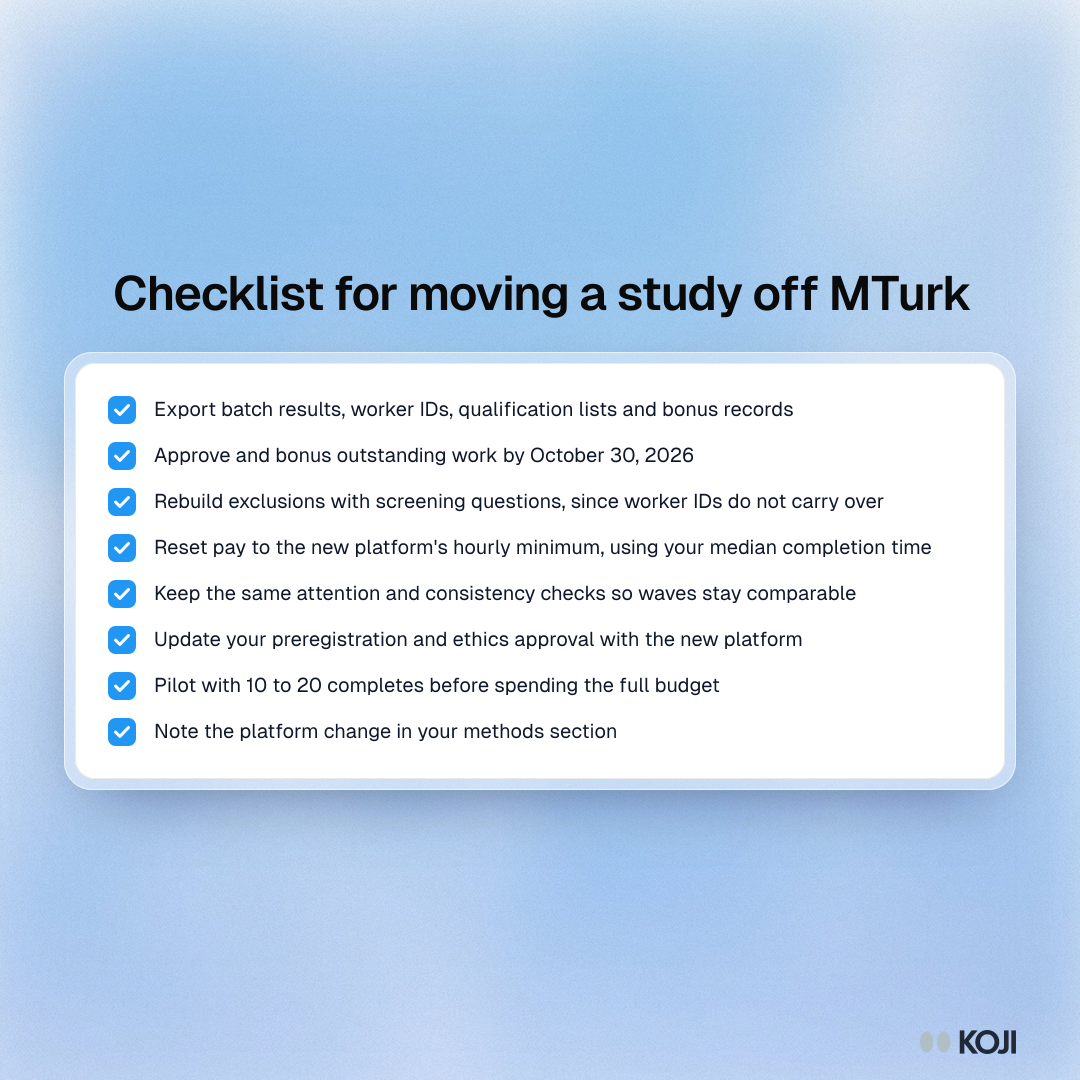
- Export everything before the deadlines. Batch results, worker IDs, qualification lists and bonus records.
- Approve and bonus outstanding work by October 30, 2026. After that you cannot pay workers.
- Rebuild exclusions. Worker IDs do not carry over. Use screening questions and the new platform's own filters instead.
- Reset pay to the new minimum. Prolific's floor is £6.00 or $8.00 an hour; set the rate from your median completion time, not your hoped-for one.
- Recreate attention and consistency checks. Keep the same checks so results stay comparable with older waves.
- Update your preregistration and ethics approval to name the new platform and fee.
- Pilot with a small sample. Ten to twenty completes will show timing problems and screener leaks before you spend the full budget.
- Note the platform change in your methods section. A change of pool can move results, so report it.
Which MTurk alternative should you choose?
- You ran academic surveys or experiments: start with Prolific. If your lab relied on CloudResearch's approved list, compare it with Connect.
- You needed big representative quotas: a market research panel, with your own quality checks.
- You recruited for UX or B2B studies: User Interviews or Respondent.
- You used MTurk to ask people open questions (why they chose something, how they use a product, what went wrong): run them as AI-moderated interviews in Koji, and get the analysis done in the same place.
Run your next study on Koji
If the closure has left a study with nowhere to go, try it as an interview. Write your research question in Koji, preview the interview yourself for free, then send it to a small panel sample or your own list. New accounts start with 10 free credits, a text interview costs 1 credit and a voice interview 3, and launching panel recruitment needs a paid plan, from the Insights plan at €29 a month.
More reading: best Prolific alternatives, Koji vs Prolific, participant recruitment platforms and professional respondents and panel conditioning.
Sources: Amazon Mechanical Turk help and FAQ; CNBC, August 25, 2026; Peer et al., "Data quality of platforms and panels for online behavioral research", Behavior Research Methods; Hauser et al., Behavior Research Methods; content analysis of MTurk studies (arXiv 1609.08437); Prolific researcher help centre; CloudResearch, "Changes to Connect Pricing"; User Interviews pricing page. Fees and policies change; check each provider's current terms.