If you are a startup trying to find what to charge, there are seven ways to test a price, and they answer different questions. The order that works for most early teams is: run a structured price test in interviews with about 30 target buyers to find the range and the reasons, check the answer with a commitment test (a prepayment, a letter of intent or a paid pilot), and only then change the live price and watch what happens. Surveys, live A/B price tests and pricing consultants each have a place, but rarely as the first step.
This guide compares every route on what it tells you, how long it takes, what it costs and where it misleads, so you can pick the one that fits your stage this week.
Why the price deserves a test at all
Price is the lever founders touch least and the one that moves profit most. In a McKinsey Quarterly analysis of a typical S&P 1500 company, Michael Marn, Eric Roegner and Craig Zawada showed that a 1% price increase, with volume held steady, lifted operating profit by 8% (The Power of Pricing, McKinsey Quarterly, 2003). A startup's numbers are smaller and noisier, but the logic holds: a price that is too low is a cost you pay on every sale, forever.
The problem is that the cheapest ways to learn a price are also the least reliable. People are bad at predicting what they would pay.
- A meta-analysis by Jonas Schmidt and Tammo Bijmolt pooled 115 effect sizes from 77 studies and found that hypothetical willingness to pay ran about 21% above real willingness to pay on average, with a bigger gap for higher-priced and specialty products (Journal of the Academy of Marketing Science, 2020).
- An earlier meta-analysis by James Murphy and colleagues across 28 stated-preference studies found a median ratio of hypothetical to actual value of 1.35 (Murphy, Allen, Stevens and Weatherhead, A Meta-analysis of Hypothetical Bias in Stated Preference Valuation, Environmental and Resource Economics, 2005).
So every route below sits somewhere between "cheap, fast and what people say" and "slow, costly and what people do". The skill is using the cheap routes to narrow the range and the expensive ones to confirm it.
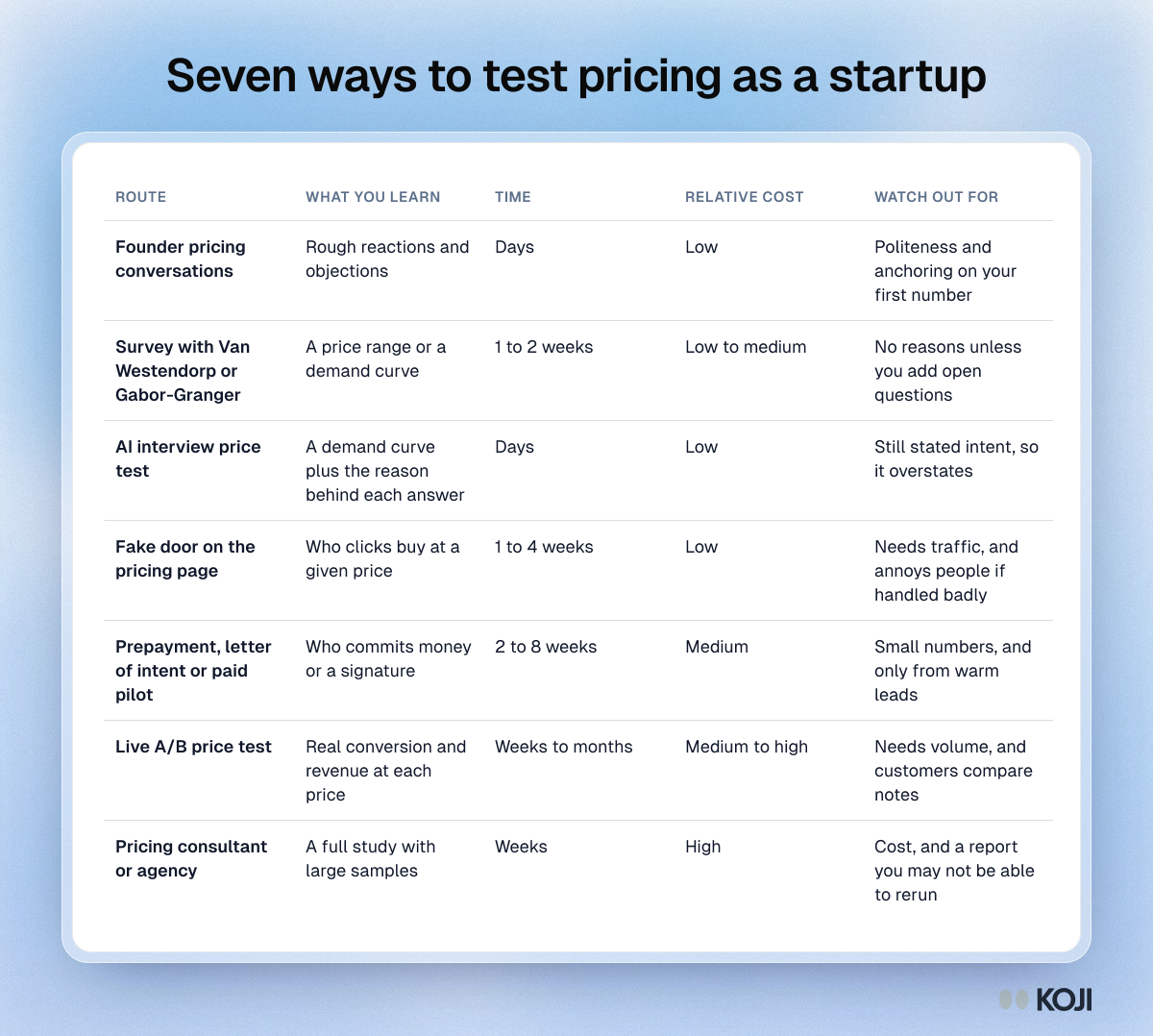
The seven routes at a glance
| Route | What you learn | Time to an answer | Relative cost | Watch out for |
|---|---|---|---|---|
| Founder pricing conversations | Rough reactions and objections | Days | Low | Politeness and anchoring on your first number |
| Survey with Van Westendorp or Gabor-Granger | A price range or a demand curve | 1 to 2 weeks | Low to medium | No reasons unless you add open questions |
| AI interview price test | A demand curve plus the reason behind each answer | Days | Low | Still stated intent, so it overstates |
| Fake door on the pricing page | Who clicks "buy" at a given price | 1 to 4 weeks | Low | Needs traffic, and annoys people if handled badly |
| Prepayment, letter of intent or paid pilot | Who commits money or a signature | 2 to 8 weeks | Medium | Small numbers, and only from warm leads |
| Live A/B price test | Real conversion and revenue at each price | Weeks to months | Medium to high | Needs volume, and customers compare notes |
| Pricing consultant or agency | A full study with large samples | Weeks | High | Cost, and a report you may not be able to rerun |
1. Founder pricing conversations
Who it is for: idea-stage founders with no product and a handful of people to talk to.

You ask buyers what they pay today for the problem, what a solution would be worth and how they would get it approved. It is free and fast, and you hear the language buyers use about money. It is also where most pricing mistakes start. Asking "would you pay €50 for this?" invites a polite yes, and the first number you say becomes the anchor for the rest of the call.
Make these conversations useful by asking about past behaviour (what they bought, what it cost, who signed off) instead of future intent, and by leaving the number for the end. Our pricing research interviews guide has the full question set.
2. A survey with Van Westendorp or Gabor-Granger
Who it is for: teams with a list or panel of a few hundred people who want a number they can chart.
The two classic survey methods answer different questions. Van Westendorp's price sensitivity meter asks four questions (too cheap, a bargain, getting expensive, too expensive) and gives an acceptable range. Gabor-Granger shows a set of prices and asks about purchase intent at each, which gives a demand curve and the price that earns the most. Our comparison of the two methods covers which to use when, and the method references are at /docs/van-westendorp-price-sensitivity-meter and /docs/gabor-granger-pricing-method.
Most survey tools can run them. SurveyMonkey, for example, sells a price optimisation solution built on Van Westendorp with the four questions set up for you (SurveyMonkey). Gabor-Granger in a general survey tool usually means building the price branching yourself and computing revenue per price in a spreadsheet afterwards.
The weakness is the missing why. A curve that drops sharply between €40 and €60 tells you where people stop, not whether it is the price, the value or a budget threshold. Add at least one open question after the price block, and expect short answers.
3. An AI interview price test
Who it is for: early-stage and scale-up teams who want the curve and the reasons in the same study, without writing branching logic.
Here the price questions sit inside a conversation. The participant rates purchase intent at one price at a time, the interviewer moves up or down the ladder by rule, and then asks why in their own words. You get a curve and the reasoning behind each point from the same people.
Koji runs this as a question type, Price Test (Gabor-Granger):
- You enter 3 to 10 prices (5 to 7, evenly spaced, is the recommended range), a currency and an optional unit such as "per month", and choose which answer counts as a buy. The default is "Probably would buy" or higher on a 5-point purchase-intent scale.
- Each person starts at a random price near the middle of the ladder, so nobody anchors on the cheapest one, and Koji usually finds the highest price they would still buy at in about three steps. Then it asks why.
- The report shows the share who would buy at each price, the revenue each price implies and the price that earns the most, with the quotes behind each point. It is labelled directional, because it is stated intent, and the best price is always one of the prices you tested.
- It reads best from about 30 interviews and works in text and voice interviews, not phone calls. The prices lock once responses come in.
Koji is not alone here. Conveo also runs Van Westendorp and Gabor-Granger inside its AI-moderated interviews (Conveo changelog). What Koji adds is that anyone can set one up from a free account, next to every other kind of question, and read the reasons behind every answer in one report. Setup steps are in Set up a price test in Koji, and choosing the prices to test covers ladder design.
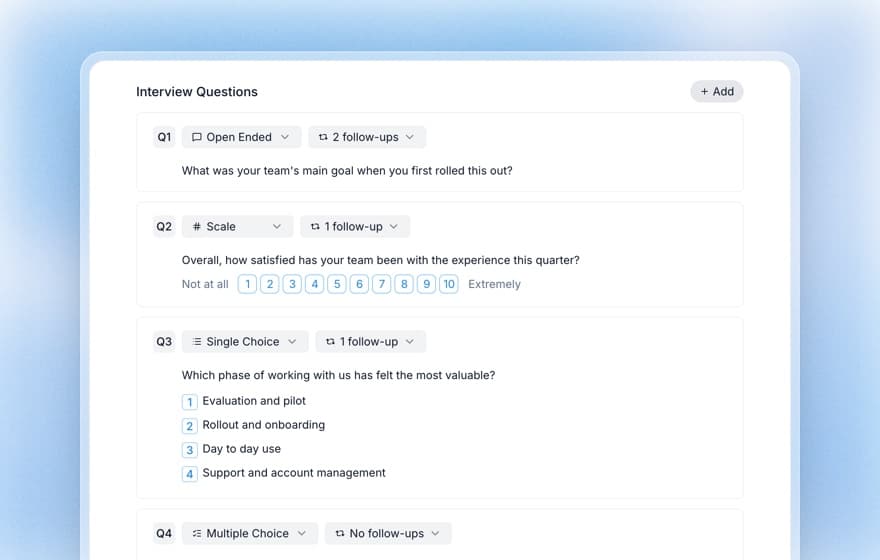
The limit is the same as any survey: it measures what people say. Read the curve as a range to confirm, not a price to ship.
4. A fake door on the pricing page
Who it is for: products that already have a few thousand visitors a month.
You show a price (or a new tier) on the pricing page, count who clicks "buy" or "start trial", and explain on the next screen that it is not available yet. It measures behaviour, which is a real step up from stated intent. It needs enough traffic to see a difference between prices, and it costs some goodwill if the "not yet" screen is clumsy. Offer something real on that screen, such as early access or a call. Our fake door testing guide covers the ethics and the setup.
5. Commitment tests: prepayment, letters of intent and pilots
Who it is for: B2B founders with warm leads, and anyone selling something expensive.

Photo by Amina Atar on Unsplash
Ask for money or a signature at the price you think is right. A prepayment, a refundable deposit, a letter of intent with a price in it or a paid pilot all turn "I would pay" into "I did". This is the strongest evidence a startup can get before launch, and the most useful check on an interview price test: if 60% of interviewees said they would buy at €79 and nobody will sign at €79, the gap is your answer.
The catch is scale. You will get a handful of data points, all from people who already like you. Use it to confirm a price, not to find one.
6. A live A/B price test
Who it is for: scale-ups with enough sign-ups to split.
Show different prices to different visitors and compare conversion and revenue. It is the most direct measure there is, and the hardest to run well. You need volume to reach a clear result, customers who find out they paid more than someone else will tell you about it, and in some markets showing different prices to similar buyers raises legal and trust questions. Many teams run sequential tests instead (one price for a month, then another) and accept the noise.
7. A pricing consultant or research agency
Who it is for: companies facing a big pricing change, a new market or a board-level decision.
A specialist will run conjoint studies, large samples and segment analysis you cannot do alone. It is the right call when the stakes justify weeks and a substantial quote. For a startup setting its first price, it is usually more study than the decision needs, and you get a report you cannot easily rerun next quarter.
Which route when: a sequence that works
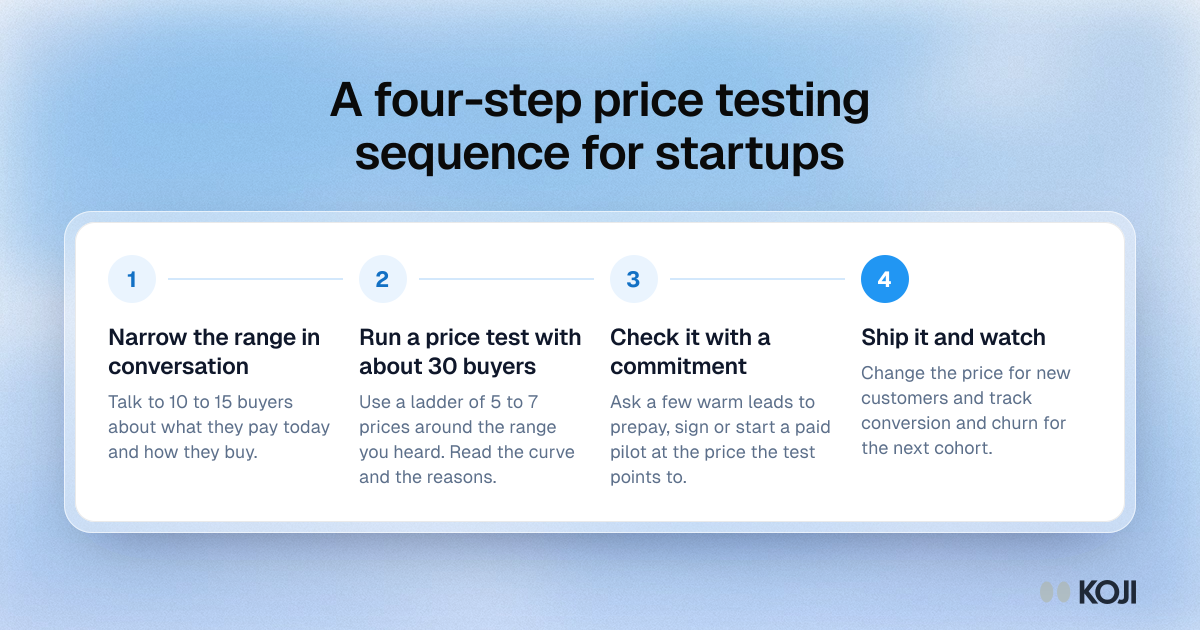
For most startups, the routes stack instead of competing:
- Narrow the range in conversation. Talk to 10 to 15 buyers about what they pay today and how they buy.
- Run a price test with about 30 target buyers. Use a 5 to 7 price ladder around the range you heard, and read both the curve and the reasons.
- Check it with a commitment. Ask a few warm leads to prepay, sign or start a paid pilot at the price the test points to.
- Ship it and watch. Change the price for new customers and track conversion and churn for the next cohort.
By stage:
- Idea stage: steps 1 and 2, then a letter of intent or deposit before you build.
- Early stage, first customers: steps 2 and 3, using your own users and lost deals. Interview churned and lost prospects too, since they are the ones the price stopped.
- Scale-up: steps 2, 3 and 4, plus a live test if you have the volume. Bring in a specialist for a large repricing.
Mistakes that make a price test lie
- Testing a price without the product. If people do not understand what they are buying, the curve measures confusion. Describe the product, or show it, before the first price.
- A ladder that is too narrow. If everyone buys at your highest price, you did not test high enough. If nobody buys at your lowest, start lower.
- Asking the wrong people. Thirty friendly users will all say yes. Recruit people who match the buyer, including some who chose a competitor.
- Treating the top of the curve as the answer. It is the best of the prices you tested, under stated intent. Confirm it with behaviour.
- Skipping the why. Two prices with the same buy rate can fail for opposite reasons (no budget versus no value). The reasons tell you whether to change the price or the product.
Try a price test this week
If you have a rough range and 30 buyers you can reach, you can run step 2 today. In Koji, add a Price Test (Gabor-Granger) question to a study, enter 5 to 7 prices around your range, add an open question about how they decide, and share the link with your own users or recruit from the panel. The report shows where buyers drop off and what they said at each price. Start free on Koji and set up your first price test, then take the winning price to a few warm leads before you change the page.