Sales kickoff prep with buyer interviews means talking to the people who bought from you, left you or stalled in the last quarter, plus a sample of your own reps, and building the SKO agenda from what they said. Run with AI-moderated interviews, you can hear 30 buyers and 15 reps in the weeks before kickoff, in their own words, without a single rep in the room to soften the answers. By the end of this playbook you'll have an eight-week plan counted back from your SKO date, an interview guide you can paste into any tool, and a test for deciding which findings earn a slot on the main stage.
Most kickoffs are planned from the inside out: leadership picks the themes, product marketing builds the decks, enablement writes the roleplays. The buyer shows up as a logo on a slide. This playbook flips that order.
Why buyer interviews belong in your sales kickoff now
The case for SKO is behaviour change, and the evidence says most kickoffs don't deliver it. Gartner's October 2026 guidance for sales enablement leaders opens with the line that most sales kickoffs fail to drive meaningful behavior change (Gartner, 2026). Its August 2026 note adds that traditional kickoff metrics don't win the trust of the C-suite and that CSOs need to show sellers actually changed how they work (Gartner, 2026). Attendance and survey smiles won't defend next year's budget.
Part of the problem is that reps are being asked to change without being shown why. Gartner reports that 41% of sellers are highly reluctant to change how they do their jobs (Gartner, 2026 CSO guidance). A VP telling them the market has shifted rarely moves that number. A buyer saying it, in their own words, about a deal the rep remembers, does.
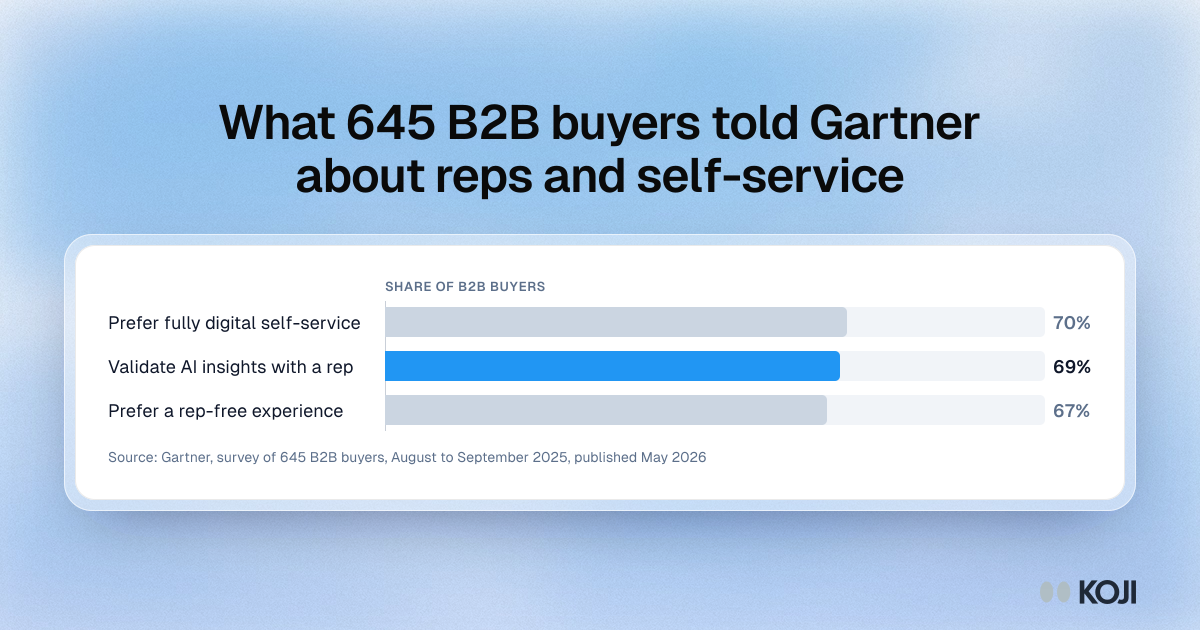
And the market has shifted. In a Gartner survey of 645 B2B buyers run in August and September 2025, 67% said they prefer a rep-free experience and 70% prefer a completely digital, self-service buying experience. Yet 69% prefer to validate AI-generated insights with a sales rep (Gartner, May 2026). The rep-free share was 61% a year earlier (Gartner, June 2025). Forrester found that 94% of business buyers now use AI during their buying process (Forrester, State of Business Buying 2026).
So the job of a rep in 2027 is narrower and harder: show up at the moment a buyer wants to check what the AI told them, and be worth the call. No internal workshop can tell you what that moment looks like in your deals. Your buyers can.
Reps also say they're short on exactly the practice SKO is meant to provide. In Salesforce's State of Sales survey of 4,050 sales professionals, 46% said they rarely get feedback on their sales conversations and 47% said they don't get enough roleplay before customer calls (Salesforce, State of Sales 2026). Roleplays written from real buyer objections are the cheapest fix there is.
The cost of skipping this: another kickoff built on last year's assumptions, a keynote about "the modern buyer" that nobody can act on, and a CRO who can't show the board what changed.
The 8-week buyer evidence plan
Here's the plan we'd run, counted back from the first day of SKO. Most kickoffs land in January or February, so if yours is in mid-January, week 8 is the last week of November.
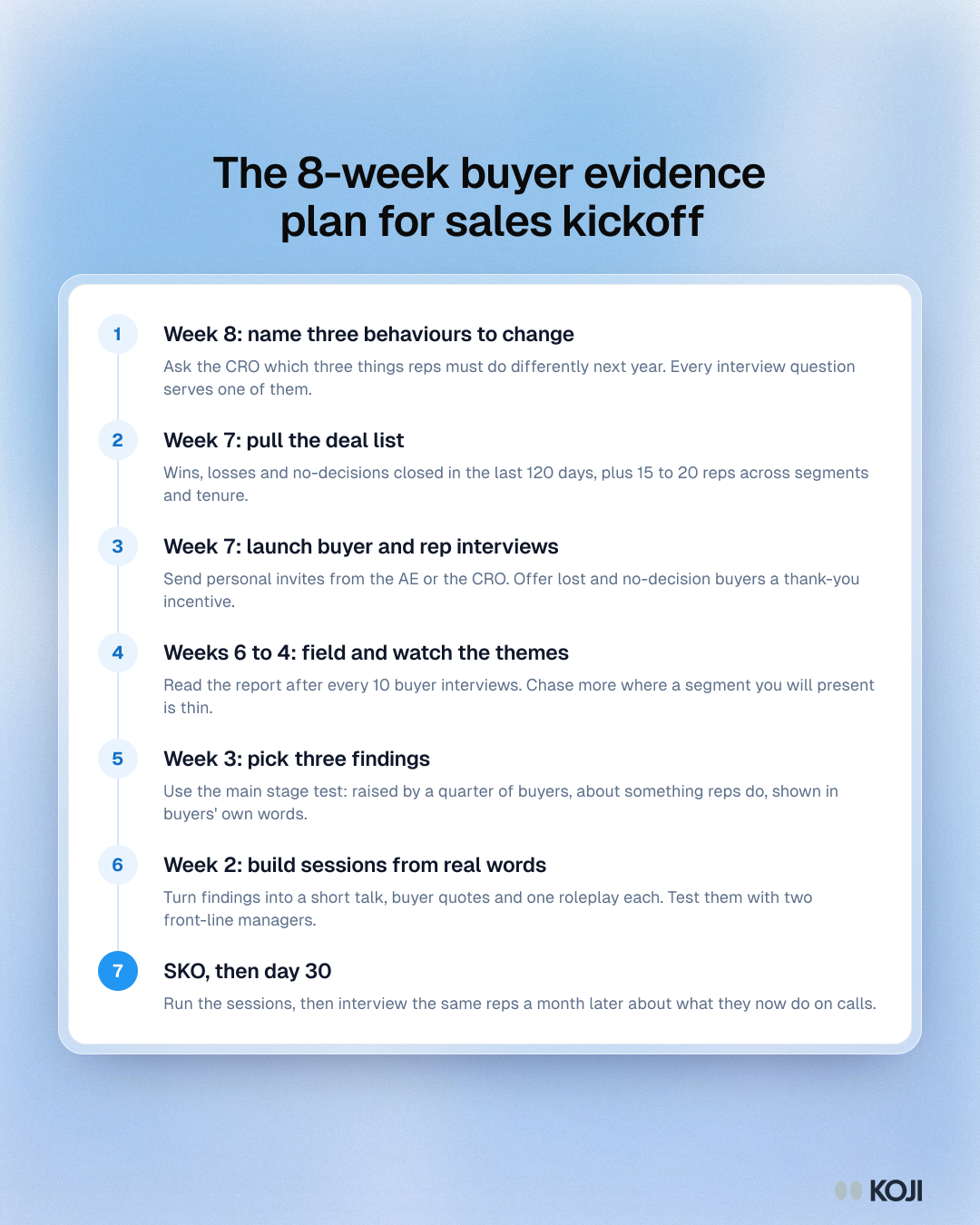
Week 8: name three behaviours. Sit with the CRO and ask one question: what three things must reps do differently next year? "Multithread before the demo." "Handle the AI-shortlist conversation." "Stop discounting in the last week." Every interview question you write has to serve one of these. If it doesn't, cut it.
Week 7: pull the deal list. Take every opportunity that closed won, lost or went to no decision in the last 120 days. Older than that and buyers start filling gaps with guesses. Pick 15 to 20 reps too, across segments, regions and tenure, including two or three new hires.
Week 7: launch. Send personal invites from the account executive's or the CRO's name, not from a no-reply address. Offer lost and no-decision buyers a thank-you incentive; they owe you nothing and the response rate shows it.
Weeks 6 to 4: field. Read the report after every 10 buyer interviews. When a segment you plan to talk about at SKO is thin, chase more interviews there.
Week 3: pick the findings. Use the main stage test below. Three findings, no more.
Week 2: build the sessions. Turn each finding into a short talk, a set of buyer quotes and one roleplay. Run them past two front-line managers before the big room sees them.
SKO, then day 30. Run it, then interview the same reps a month later about what they now do on calls. That's your behaviour-first proof.
What good looks like
Who to talk to. Split buyers into three groups: won, lost to a competitor, and lost to no decision. The no-decision group is the one most teams skip and the one that changes the most minds, because nobody in the CRM can explain it. Aim for the person who ran the evaluation, then a second voice from the same deal when you can: finance, IT or the end user.

Photo by Ninthgrid on Unsplash
How many. For each group you want to say something about on stage, plan for at least 10 to 12 interviews. In Guest, Bunce and Johnson's well-known study of 60 interviews, 92% of the themes had appeared within the first 12 (summarised in Guest et al., 2020). That was one fairly uniform group, so treat 12 as a floor per segment, not a ceiling. A good default is 30 buyers (about 10 per group) and 15 reps. If you sell into two very different segments, double the buyer count rather than spreading 30 thin.
Timing. Interview within 120 days of the close. Ask about specific moments ("the week you got the security questionnaire"), not general opinions about your company.
Reps, separately. Rep interviews ask what they hear, where deals stall and what they'd want to practise. They are not a performance review. Say so in the invite and keep their answers out of anything a manager can trace back to one person.
Finish with action, not a readout. A finding that doesn't change a talk track, a roleplay or a qualification step doesn't belong at SKO.
Common mistakes:
- Starting fieldwork three weeks out. You end up with eight interviews and a slide that says "early signals".
- Interviewing only wins. Wins tell you what to keep; losses and no-decisions tell you what to fix.
- Letting reps choose which buyers get asked. They pick friends.
- Asking "why did you choose us?" The first answer is polite. The second and third layers are where the reasons are.
- Presenting losses as blame. Frame each one as "here's what the buyer needed that we didn't show them", and name no rep.
- Burying the voice in a 60-slide deck. Three findings, each with two quotes, beats twenty charts.
Copy this interview guide
One-line brief to paste into Koji's "What do you want to research?" box:
Interview B2B buyers who chose us, chose a competitor or made no decision in the last 120 days to find the three things our reps must do differently next year, for our sales kickoff.
Opening line: "Thanks for giving us a few minutes. We're preparing our sales team for next year and want to learn from how you made your decision, whichever way it went. There are no wrong answers, and nothing you say goes back to the person who sold to you."
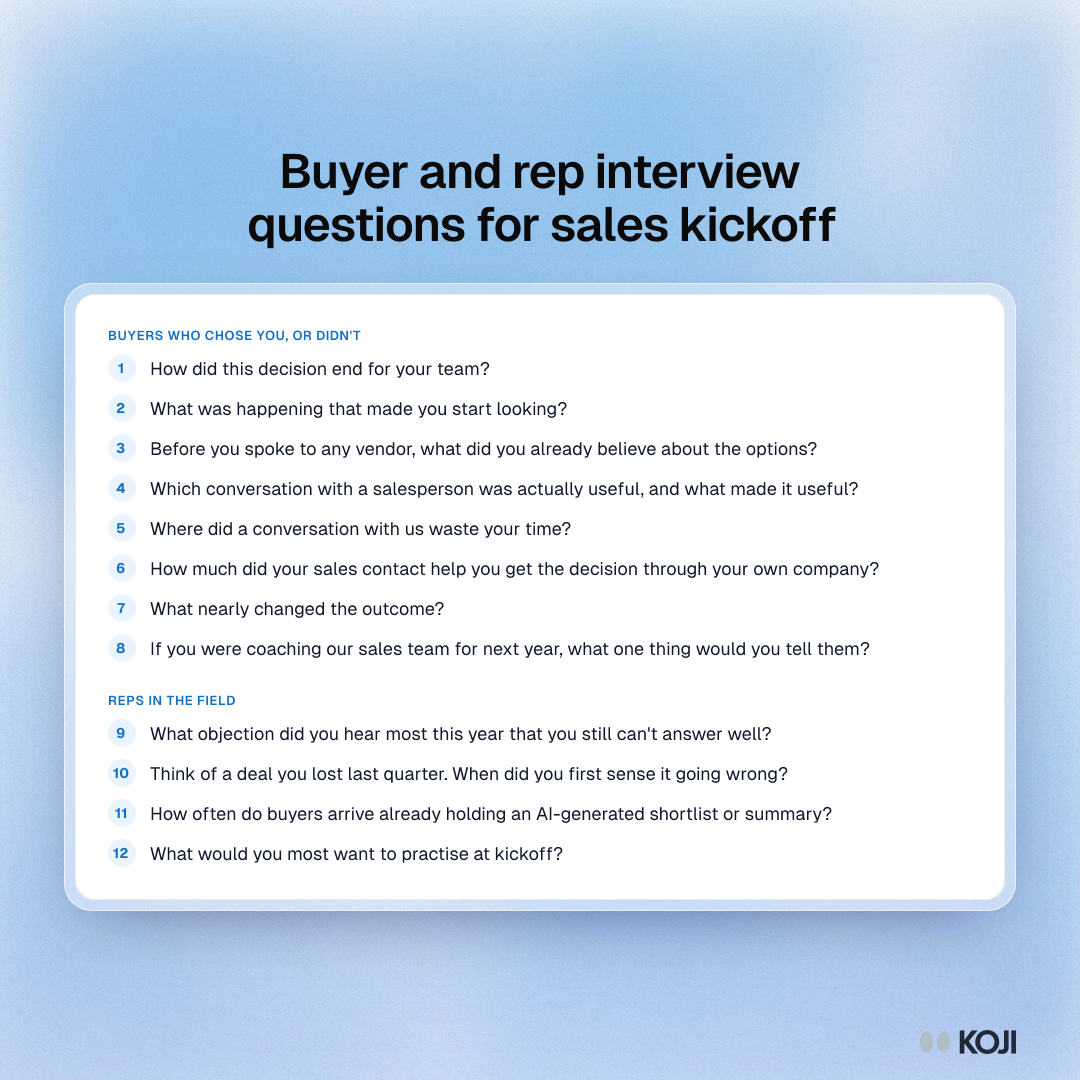
Buyer questions, in order:
- How did this decision end for your team? (Single choice: chose us / chose another vendor / decided not to buy for now.) Probe: none; this sorts the rest of the interview.
- What was happening that made you start looking? (Open.) Probe: "What would have happened if you'd done nothing?"
- Before you spoke to any vendor, what did you already believe about the options? (Open.) Probe: "Where did that come from: colleagues, review sites, an AI assistant?"
- Which conversation with a salesperson was actually useful, and what made it useful? (Open.) Probe: "What did they show or tell you that you couldn't find yourself?"
- Where did a conversation with us waste your time? (Open.) Probe: "What would you have wanted instead?"
- How much did your sales contact help you get the decision through your own company? (Scale, 1 to 10.) Probe: "What would a 10 have looked like?"
- What nearly changed the outcome? (Open.) Probe: "Who inside your company pushed hardest the other way?"
- If you were coaching our sales team for next year, what one thing would you tell them? (Open.) Probe: "Can you give an example from your own evaluation?"
Closing: "Is there anything about how you buy software now that you think most salespeople still get wrong?"
Rep questions (a shorter, separate study):
- What objection did you hear most this year that you still can't answer well? (Open.)
- Think of a deal you lost last quarter. When did you first sense it going wrong? (Open.)
- How often do buyers arrive already holding an AI-generated shortlist or summary? (Single choice: most deals / some / rarely / never.)
- What would you most want to practise at kickoff? (Open.)
How to set it up in Koji, step by step
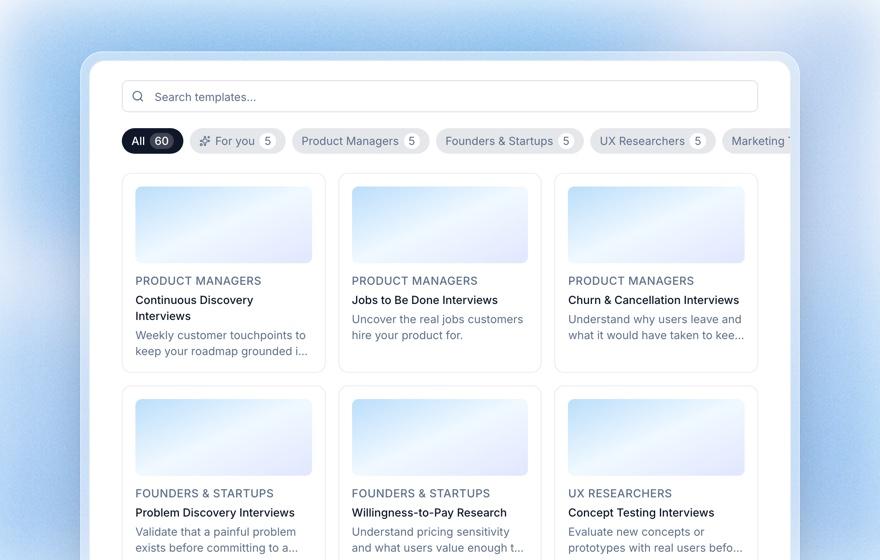
- Start the study. Open the template library and pick Win/Loss Analysis, or paste the one-line brief above into the home screen's "What do you want to research?" box. Either way Koji drafts a research brief: the problem, the decision it informs, who to talk to and the questions.
- Shape the brief. Ask the research assistant in plain words: "Add the three SKO behaviours to the hypothesis", "Make question 1 a single choice", "Only ask what nearly changed the outcome of buyers who chose us." Branching lets you show a question only when an earlier choice or rating answer matches, so won, lost and no-decision buyers each get the follow-ups that fit. Add guardrails for topics the interviewer must avoid, such as discussing prices or an open renewal.
- Add structured questions where you need a number. The outcome question, the 1 to 10 rating and the rep single choice above give you charts by group in the report, with every open answer still probed by follow-ups.
- Choose voice, text or both. Buyers pick on the welcome page. Senior buyers often prefer a voice conversation they can do from a phone between meetings; reps tend to type.
- Preview it. Take your own interview from the Preview tab. Previews are free and never count as responses.
- Invite people. On the study's Self-recruit tab, import your deal list as a CSV and Koji gives each buyer a personal invite link you can send from your own email tool or CRM, as a merge field in a note from the AE. Or email an audience straight from Koji, with reminders, in your study's branding. Turn on an incentive for lost and no-decision buyers: they claim a gift card, a prepaid Visa card or a charity donation, and you approve each one. Turn on remove personal details so names, emails and employers are taken out of transcripts, which matters when buyers name your reps.
- Read the report as it fills. Each interview gets a quality score from 1 to 5, and only those scoring 3 or more enter the report.
Which plan you need. You can build and preview the whole study on Free. Personal invite links need the Interviews or Enterprise plan; email invitations and incentives need a paid plan. See the pricing page for current prices.
What you get, and how to use it at SKO
The report gives you findings ranked by impact, each showing how many participants it rests on, with the supporting quotes one click away. You also get a section per question with charts for the structured questions, and personas built from the interviews.
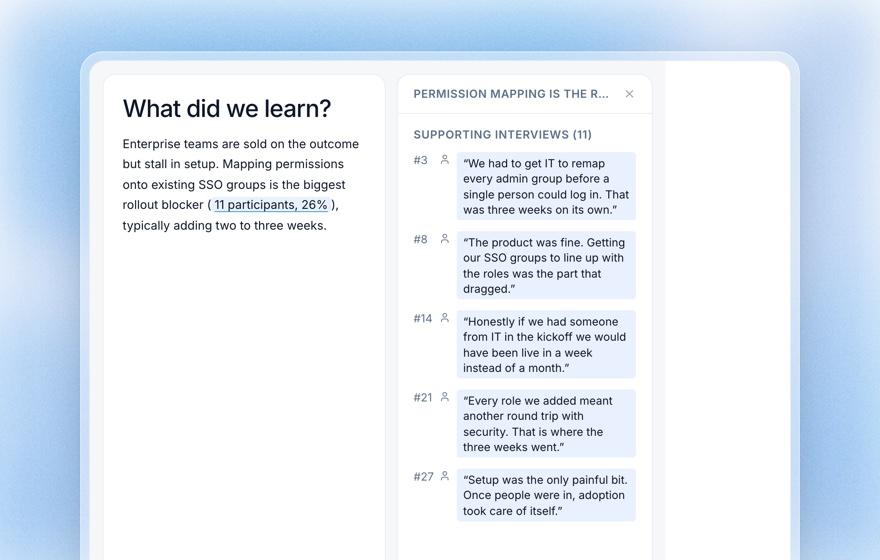
Then download the report as an editable PowerPoint deck, with a slide for each insight and each question and charts you can restyle, or as a PDF. That deck is your raw material: the keynote's three findings, the quotes for the competitive breakout, the objections for the roleplay track. Invite your SKO planning group as workspace viewers so enablement, product marketing and front-line managers can read every interview without taking a paid seat.
The day after the report lands, you should be able to do three things: tell the CRO which three findings will lead the agenda, hand product marketing the buyer's exact words for the new talk track, and give enablement the five objections that become roleplays.
Which findings make the main stage
A report from 30 buyers will hold more themes than a kickoff can use. Run each one through this test.
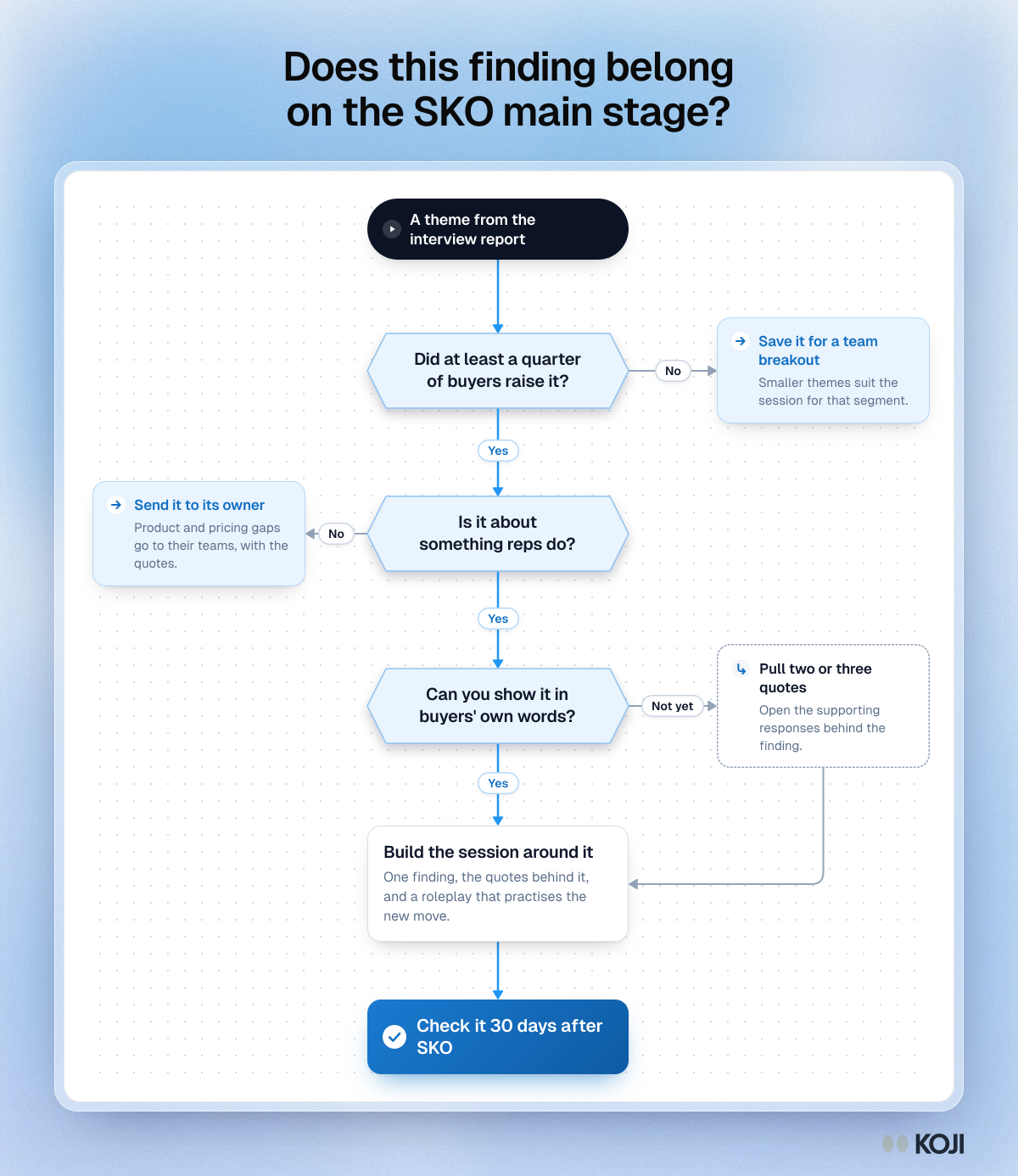
Our rule: a main stage finding is raised by at least a quarter of the buyers you interviewed, is about something reps do, and can be shown in buyers' own words. Smaller themes go to the breakout for that segment. Gaps in product or pricing go to their owners, with the quotes, so they don't eat keynote time.
The same playbook elsewhere
The method of hearing the outside world before an internal event carries over. Customer success teams run it before the annual customer advisory board. Marketing runs it before the yearly messaging refresh. Founders run it before their first sales hire starts, which is the founder-to-first-sales-hire handoff playbook.
Inside GTM, two playbooks feed straight into SKO content: no-decision loss interviews for the deals nobody can explain, and AI-assisted buyer journey interviews for the shortlist buyers build before they ever call you. All GTM playbooks are collected at /use-cases/gtm-teams.
Why Koji for SKO buyer research
Here's how the realistic ways of getting buyer voice into a kickoff compare on what an enablement or revenue leader weighs. This comparison is ours, and Koji is our product; competitor details were checked in November 2026.
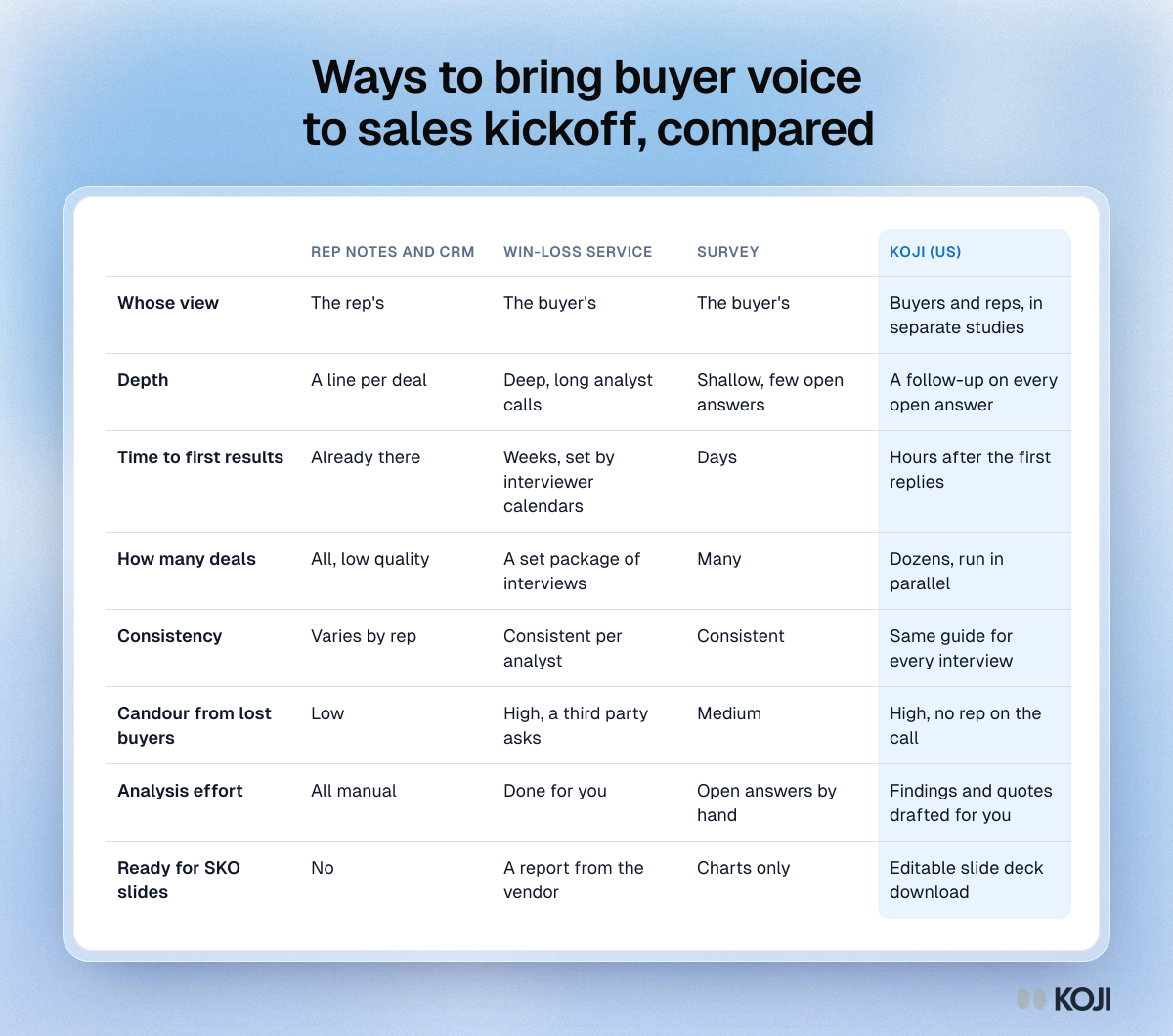
A win-loss service such as Clozd runs in-depth buyer interviews for you and is a strong choice when you want analysts doing the work; its pricing is quoted per program, not published (Clozd pricing). Conversation intelligence tools like Gong capture what buyers said on your own calls, which is useful, but they can't hear the buyer after the deal closed or the meeting they never took with you. Surveys reach many people with shallow answers.
Why teams run SKO research in Koji:
- Every answer gets a follow-up. The interviewer probes each open answer, so "you were too expensive" turns into what the buyer was comparing you with.
- No rep on the call. Buyers who'd soften feedback for a salesperson they liked can say what happened, and remove personal details keeps names out of transcripts.
- Interviews run in parallel. Thirty buyers don't need thirty calendar slots in December.
- The output is already shaped like a kickoff deck. Findings with quotes and an editable slide download, instead of transcripts someone has to summarise over the holidays.
- One guide, every interview. Consistent questions across regions and 30+ interview languages, so EMEA and North America answers can sit on the same slide.
Questions you might have about AI interviews
Will a buyer, especially a lost one, really talk to an AI? The invite comes from someone they know, from your AE or CRO, through a personal link. The welcome page says how long it takes, and they choose voice or text. Lost buyers often find it easier: there's no awkward call with the rep who lost the deal. An incentive helps, and you approve each one.
Will it feel like a sales tactic? Only if you let it. Add a guardrail that the interviewer must not pitch, discuss pricing or offer anything, and keep the opening line about learning, not selling. Preview the interview yourself before anyone sees it.
Is buyer data safe? Turn on remove personal details and Koji strips names, email addresses, phone numbers, postal addresses and employers from each transcript when the interview ends; reports and exports only see the cleaned text. It can miss details, so check quotes before they go on a slide. Low-quality interviews score below 3 and stay out of the report.
When Koji may not be the right fit
If your kickoff is two weeks away, don't start a 30-buyer study now; run five interviews, use them in one breakout and start next year's in week 8. If you sell to a handful of strategic accounts, a senior leader's own calls with those 10 buyers may matter more than any tool. And if you need a third party to own the whole win-loss programme for the year, with analysts and quarterly readouts, a managed win-loss service is the better fit.
Metrics to track
- Buyer interviews completed per group (won, lost, no decision) against the target of 10 or more each
- Share of invited lost and no-decision buyers who completed
- Number of SKO sessions built on a named buyer finding
- Rep-reported behaviour change at day 30, from the follow-up interviews
- Change in the three target behaviours in the CRM or call data a quarter after SKO
- Win rate and no-decision rate in the two quarters after kickoff
FAQ
How far ahead of SKO should buyer interviews start? Eight weeks before the first day. That leaves four weeks of fieldwork, one to pick findings and two to build and test sessions.
How many buyers should I interview for sales kickoff? About 10 to 12 per group you plan to talk about. A good default is 30 buyers across won, lost and no-decision, plus 15 reps.
Should reps take part, or only buyers? Both, in separate studies. Buyers tell you what happened; reps tell you which objections they can't answer and what they want to practise. The gap between the two is often the best SKO session.
How do I present lost deals without demoralising the team? Frame each loss as what the buyer needed and didn't get, never name the rep, and pair every loss with a roleplay that practises the fix.
Can I reuse the study after SKO? Yes. Duplicate it, keep the guide and run it every quarter so next year's kickoff starts with twelve months of buyer evidence, not eight weeks.
Start before week 8 slips
Open Koji, start from the Win/Loss Analysis template or paste the one-line brief, and have your first buyer interviews back before your SKO agenda is locked. For more on how GTM teams use Koji, see Koji for GTM teams, and for the method behind the questions, read the win-loss analysis guide, win-loss interview questions and AI-moderated interviews.