You have closed your first 10 to 20 customers yourself, and now you want a salesperson to close the next 20. The rep cannot repeat what nobody wrote down, and what is written down in your CRM is mostly your own summary of why people bought. This playbook shows you how to interview the customers you closed, in their words, with AI-moderated voice or text interviews in Koji, and turn the answers into a handover dossier a new rep can use in week one.
You will finish with a six-week plan, a nine-question interview guide you can copy, and a one-line brief to paste into Koji.
Why the handoff matters now
A founder closes deals with context a new hire does not have: the intro that warmed the buyer, the story you tell, the objections you have answered forty times. None of it transfers by osmosis. And the buyer you are selling to has changed in the meantime.

Photo by Vitaly Gariev on Unsplash
- More people sign off. Forrester's The State of Business Buying, 2026, based on its Buyers' Journey Survey of nearly 18,000 global business buyers, found that a typical purchase now involves 13 internal stakeholders and nine external influencers (Forrester, January 2026). You probably met two or three of them. Your rep will have to win the rest.
- Buyers talk to a seller late. In Gartner's survey of 646 B2B buyers, run in August and September 2025, 67% said they prefer a rep-free buying experience (Digital Commerce 360 on Gartner, March 2026). By the time a new rep is on the call, the buyer has already formed a view.
- Generic outreach costs you. In Gartner's earlier survey of 632 buyers, 73% said they actively avoid suppliers who send irrelevant outreach, and 69% reported inconsistencies between a supplier's website and what its sellers told them (Gartner, June 2025). A rep who has not read your buyers' words will sound generic.
- Most reps miss quota. The Bridge Group's 2026 AE benchmark reports 48% of reps at quota, down from 51% in 2024 (The Bridge Group, 2026). A founder-built motion that lives in your head makes those odds worse for a first hire, who has no peers to learn from.
The cost of skipping this is concrete. You pay a salary while the rep guesses, you lose the pipeline you would have closed yourself, and you conclude "sales does not work here" when the actual problem was a handover that contained nothing.
What good looks like
The advice from people who have scaled sales teams is consistent on timing: SaaStr's Jason Lemkin recommends closing your first 10 to 20 customers yourself before hiring (SaaStr), and Bain Capital Ventures argues for having the ideal customer profile and written sales documentation in place before you hire (Bain Capital Ventures). What neither tells you is how to produce that documentation without writing it from memory. The answer is to ask the buyers.
I call this the Buy-Story Handover: interview every customer you closed about how they decided, then hand the new rep their words, not yours.
Decision rules
- Fewer than 8 closed customers: keep selling. You do not have a pattern yet. Interview the buyers you have, but treat the result as a hypothesis.
- 8 to 20 closed customers: interview all of them. Each interview takes about ten minutes of the buyer's time, so there is no reason to sample.
- More than 20: interview 15, chosen to cover different company sizes and different ways they found you.
- Always add 5 lost or silent deals. Buyers who said no tell you where your pitch breaks. Use the no-decision loss interview playbook for how to ask them.
- If more than half your wins came from your personal network, say so in the dossier. A rep selling to strangers will not close at your rate.
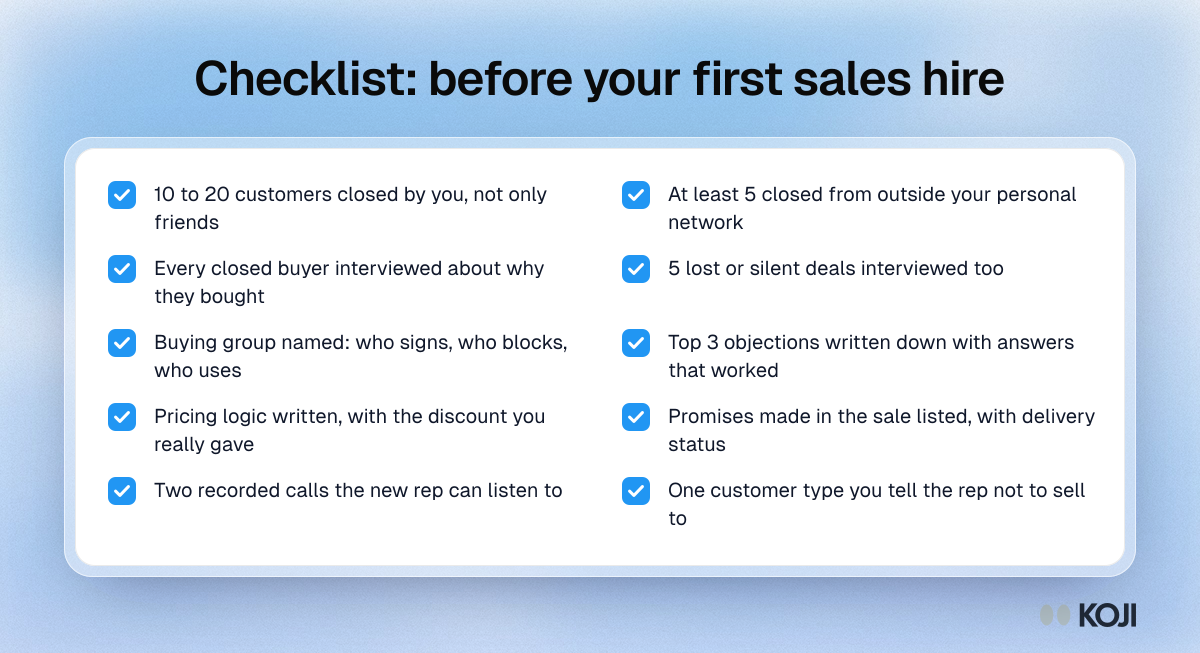
Before you hire, check that you can tick every line of this list.
Common mistakes
- Interviewing only the happy champion. The person who loved you is the easiest to book and the least informative about who nearly blocked the deal.
- Running the calls yourself. Buyers are polite to the founder who sold them. They soften price, speed and gaps. A neutral interviewer gets the version they tell colleagues.
- Asking "would you recommend us?" That tells you about goodwill, not about the decision.
- Handing over a slide deck. A deck holds your pitch. The rep needs the buyer's reasons.
- Waiting too long. Memory fades fast after signature. Interview within weeks of the decision, not quarters.
How to set it up in Koji, step by step
You need the Researcher plan or above to import a list and run voice interviews. The Free plan includes 10 credits, enough for 10 text interviews, if you want to try the guide on a handful of buyers first. A text interview costs 1 credit and a voice interview 3, so 15 voice interviews are 45 credits.
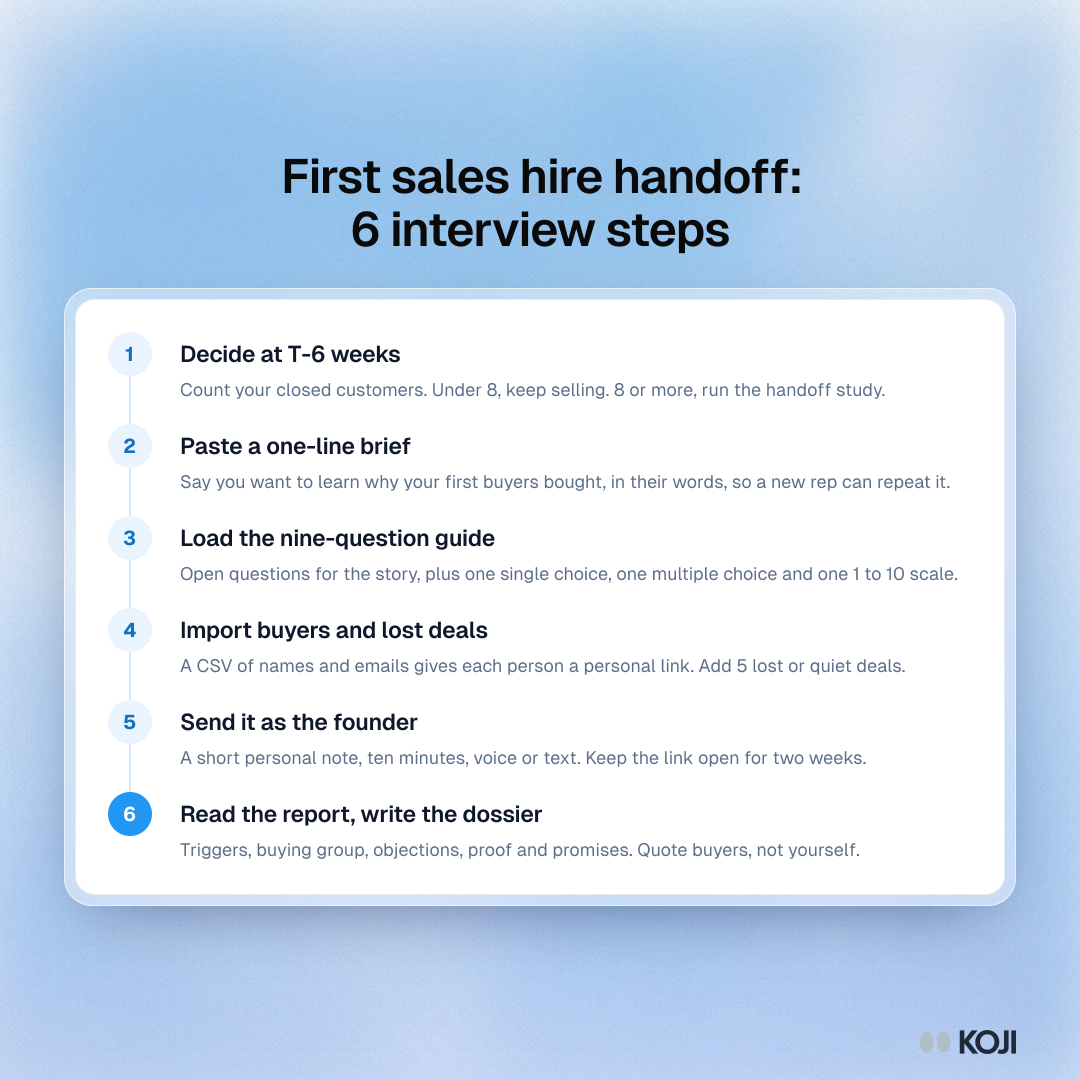
- Decide at T-6 weeks. Count your closed customers against the rules above. Pick a start date for the new rep and count back six weeks.
- Start a study. Open the dashboard template gallery and choose the Win/Loss Analysis template under GTM teams. It already frames the questions as a buying decision, and you will adapt it. Or paste this brief into the "What do you want to research?" box: "Why our first customers bought, who else was involved, what almost stopped them, and what we promised, so a new salesperson can repeat the sale."
- Load the nine questions below. Add structured questions where you want a number or a choice: one single choice, one multiple choice and one 1 to 10 scale. Koji's structured question types also include ranking and yes/no (structured questions guide).
- Choose voice or text. Voice gets longer, more candid answers from busy buyers who would rather talk for ten minutes than type. Text suits people who answer between meetings. Offer both on the same link (setting up voice interviews). Add a guardrail so the interviewer does not quote your prices or discuss other customers.
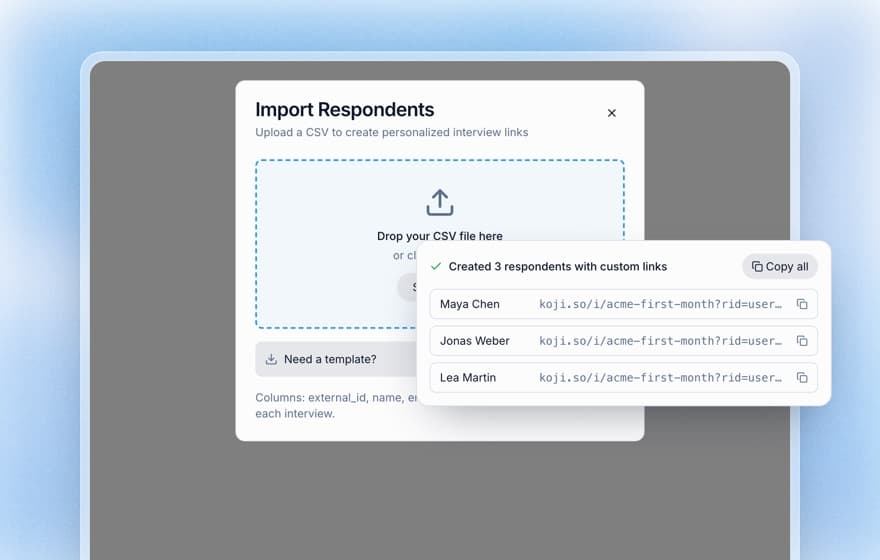
- Import buyers. Upload a CSV of names and emails to give each person a personal interview link, then add the 5 lost or silent deals as a separate group. Send the invitation from your own address with a short, honest note: "I'm preparing to hire our first salesperson and want to hand over how you actually decided. Ten minutes, voice or text, and I will read a summary of what people said." Run a preview interview yourself first.
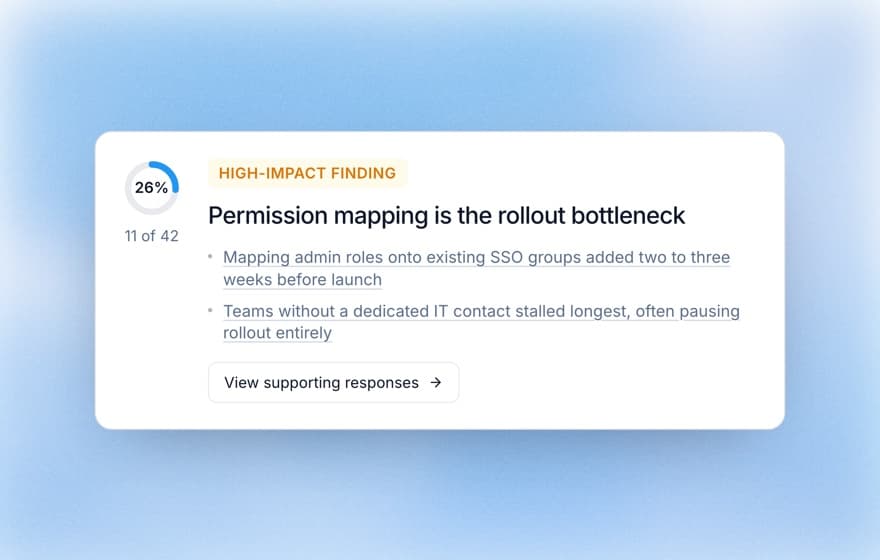
- Close after two weeks and read the report. Koji clusters the interviews into themes and findings, each backed by the supporting quotes. Open the evidence panel for every finding you plan to hand over.
Copy this interview guide
Open with: "Thanks for doing this. I'm collecting how people actually decided to buy, so we can describe it accurately to a new colleague. There are no wrong answers and it takes about ten minutes."
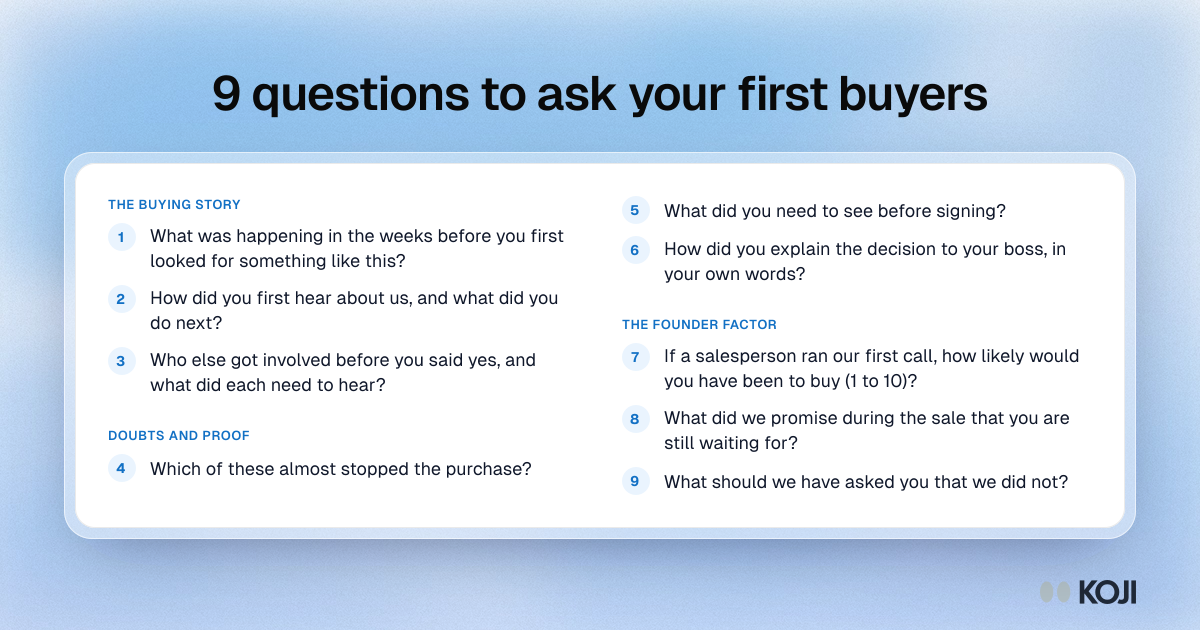
- (Open) What was happening in the weeks before you first looked for something like this? Probe: What had you tried before?
- (Open) How did you first hear about us, and what did you do next? Probe: Who did you ask?
- (Open) Who else got involved before you said yes, and what did each of them need to hear? Probe: Who came closest to saying no?
- (Single choice) Which of these almost stopped the purchase: budget, security or legal review, an existing tool or doing nothing, doubts about a young company, timing, or nothing? Probe: Tell me about that moment.
- (Multiple choice) What did you need to see before signing: a demo on your own data, a reference customer, written pricing, security documents, a trial or pilot, or contract flexibility? Probe: Which mattered most?
- (Open) How did you explain the decision to your boss, in your own words? Probe: What was the first objection you heard back?
- (Scale, 1 to 10) If a salesperson had run our first call instead of the founder, how likely would you have been to buy? Probe: What would they have needed to do?
- (Open) What did we promise during the sale that you are still waiting for? Probe: Who made that promise?
- (Closing, open) What should we have asked you that we didn't?
Question 7 is the one most founders never ask. A low average there tells you how much of your close rate is you.
What you get
The report gives you themes, ranked findings and quotes for each question, plus the scale and choice answers as distributions. You use it the next day, not the next quarter.
Turn it into the handover dossier, five pages:
- Triggers: what was happening when buyers started looking (questions 1 and 2).
- Buying group: who signs, who blocks, who uses, and what each needs to hear (questions 3 and 6).
- Objections and answers: the real doubts, with the answers that worked, quoted (questions 4 and 5).
- Proof and promises: what closed the deal and what was promised on the way (questions 5 and 8).
- Who not to sell to: from the lost and silent deals, and from any buyer who scored question 7 low.
Use the objections and buying-group pages in the final candidate interviews, without customer quotes, to hear what they would do differently. Give the new hire the full dossier in week one, and share the report itself with colleagues through Koji's report sharing (publishing and sharing reports). Record two of your own calls to sit beside it. If you track deals in Pipedrive, the Pipedrive integration can turn deal stages into win-loss interviews, so the next buyer's story is captured as the deal closes.
The six-week timeline
- T-6 weeks: decide, count customers, write the brief.
- T-5: load the guide, preview it, import the list.
- T-5 to T-3: field the interviews.
- T-3 to T-2: read the report, draft the dossier.
- T-2 to T-1: use it in candidate interviews and shape the offer.
- Week 1: the rep reads the dossier and shadows your next three calls.
The same playbook elsewhere
The same method works wherever one person carries knowledge a successor needs. Customer success calls it an account handoff, and the renewal risk playbook uses the same structure for existing accounts. Private-equity operating partners run it as the 100-day customer baseline after an acquisition. Agencies run it as stakeholder discovery before a proposal. Each borrows the same idea: ask the people who made the decision, and write down what they say before the person who knows it leaves the room. For the broader win-loss method, see 50+ win/loss interview questions and the win-loss analysis guide. See every founder playbook at /use-cases/founders.
Why Koji for the handover
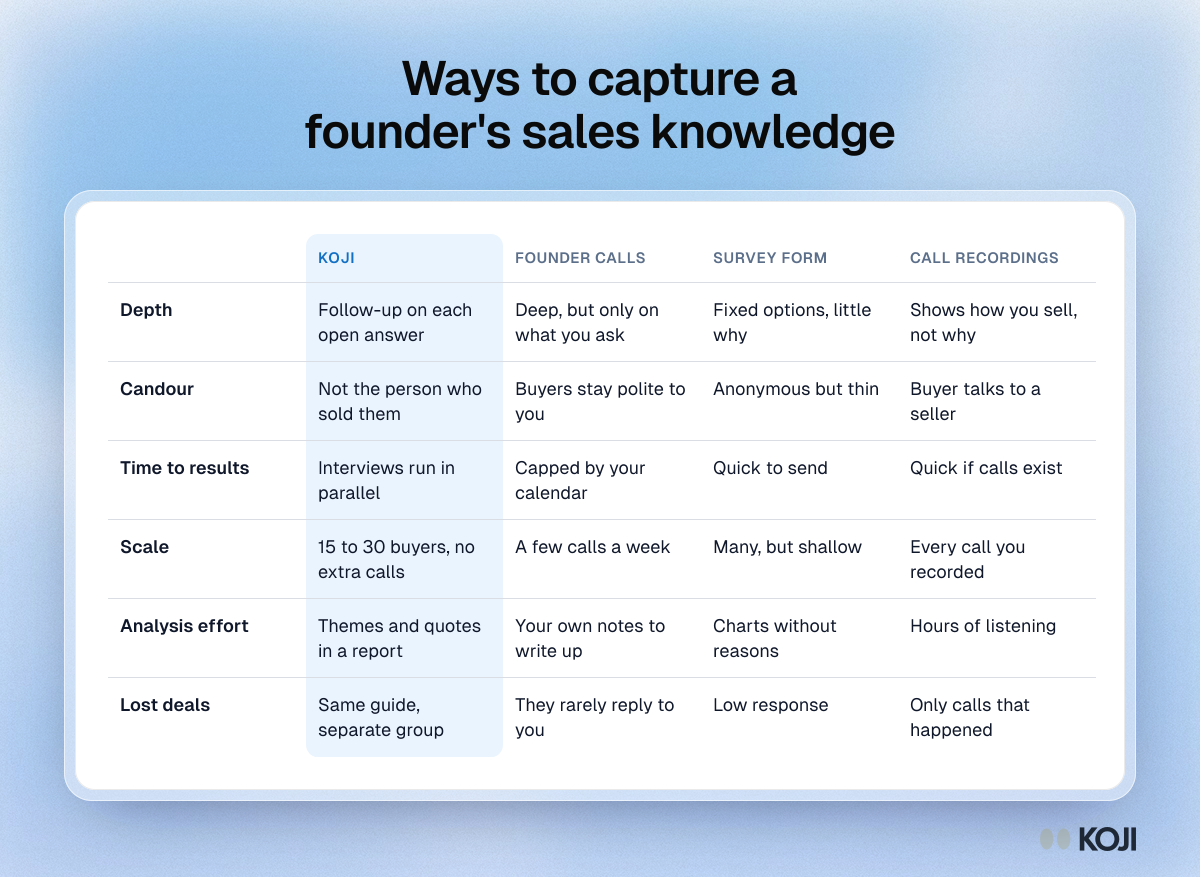
You have four realistic options, and each fits a different job. Calling buyers yourself is great for learning, but they soften what they say to you. A survey form reaches many people and misses the reasons. Reviewing recorded calls shows you how you sell, not why anyone bought. Koji is built for the gap in between.
- Candour. Buyers talk to an interviewer who is not the person who sold them, so the answer to question 7 is easier to give.
- Follow-ups. The interviewer asks a probing follow-up on each open answer, which is where the buying group and the real objections come out.
- Parallel. Fifteen buyers answer in the same week on their own time, by voice or text, instead of filling your calendar.
- Analysis done. Themes, findings and the quotes behind each one arrive in a report, so you spend your time on the dossier.
- Traceable. Every finding links to the interviews behind it, so you can check a claim before you hand it over.
Questions you might have about AI interviews
"Will my customers talk to an AI?" Participants see a welcome page with the time it takes and a note that answers are confidential, and they can switch between voice and text. Buyers who like you are usually glad to help, and a ten-minute conversation on their own schedule is an easier ask than a calendar invite. Say plainly in your invitation that it is an AI interviewer and why you chose that.
"Doesn't a founder need to hear this first-hand?" Yes, and you should still read the transcripts behind the findings that surprise you. What you do not need is to be the one asking, because buyers are less candid with the person who sold them.
"Will the buyer feel handled?" Keep the invitation personal, short and from you. Add a guardrail against quoting prices or naming other customers. See the research brief template for how to frame the ask.
When Koji may not be the right fit
If you have closed fewer than eight customers, or most of them are friends who bought out of loyalty, you do not have a pattern to hand over yet. More interviews will not fix that. Sell, learn, and come back. If you have a large sales team already, this is a smaller step than your enablement programme, and a dedicated win-loss programme is a better fit.
Metrics to track
- Share of closed buyers interviewed. Aim for all of them if you have 20 or fewer.
- Question 7 average. The lower it is, the more of your close rate is founder-specific.
- Share of wins from your network. If it is over half, plan a test outside it.
- Objections with a written answer. Every objection named by two or more buyers should have one.
- New rep's first-deal time. Track how long the first closed deal takes against your own history.
FAQ
How many customers should I interview before my first sales hire? If you have 8 to 20 closed customers, interview all of them. With more than 20, interview 15 who differ in size and source, and add 5 lost or silent deals.
Should the founder run the interviews? No. Buyers soften their answers to the person who sold them. Use an AI interviewer, then read the transcripts of the findings that surprise you.
What do I put in the handover for a new account executive? A five-page dossier: buying triggers, the buying group, objections with the answers that worked, proof and promises, and who not to sell to. Quote buyers directly.
How long does this take? About six weeks from the decision to the rep's first day, with two weeks of that spent collecting interviews. You can compress it if the rep has already started.
Which Koji plan do I need? Voice interviews and CSV import are on the Researcher plan and above. The Free plan includes 10 credits for text interviews, enough to test the guide.
Start this week
Open Koji, choose the Win/Loss Analysis template or paste the one-line brief above, load the nine questions and import your first buyers. Founders can see more at koji.so/for/founders.