Short answer: Toluna Start pairs a large consumer panel with a do-it-yourself survey suite, sold through sales on quoted terms. The best alternative depends on which half you want to replace. For raw sample at the lowest unit cost, buy through the Cint Exchange or Pollfish. For a first-party panel with deep profiling, Dynata. For an annual research subscription with a flat audience fee, Attest or Suzy. For fast academic-style samples, Prolific. And if a panel survey keeps giving you the what without the why, Koji recruits from a panel inside your study and runs AI-moderated interviews with each person, so the report explains the numbers.
Why teams are comparing Toluna right now
Toluna has been around for 25 years, and its founder has just handed over the CEO role. The company appointed Amy Fenton as chief executive, effective October 15, 2026, succeeding founder Frédéric Charles Petit, who stays on the board. A leadership change does not change your contract. But it is a natural moment for an insights team to check whether the platform still fits how they work, especially with renewals coming up.

Photo by Product School on Unsplash
The bigger reason is that the job itself is shifting. In Qualtrics' 2026 Market Research Trends report, based on more than 3,000 researchers, 95% said they now use AI tools regularly or are experimenting with them. Toluna has answered with synthetic respondents. Other teams would rather use AI to talk to more real people, faster. Which camp you are in decides which alternative makes sense.
There is also the data quality question that every panel buyer now faces. In 2025, Dartmouth's Sean Westwood showed in PNAS that an AI agent passed 99.8% of standard survey attention checks, a study that later won a PNAS prize. Tick-box screening no longer proves a human is answering. That puts pressure on every platform below to show how it keeps bots out.
What Toluna offers
Toluna Start is a self-service and managed platform built around Toluna's own consumer community. Its August 2026 panel book lists more than 81 million members across more than 70 countries, with 350+ profiling points for targeting. On top of the panel sit a drag-and-drop survey builder, automated targeting, dashboards and QProbe, an AI feature that spots thin open-text answers and asks a follow-up. Its HarmonAIze suite adds synthetic personas, which Toluna says are built from anonymised data from its US panel.
Toluna does not publish prices. Both G2 and Capterra say you need to contact Toluna for a quote if you need respondents.
Teams usually look elsewhere for one of four reasons: they want published, per-study pricing; they want a different or broader panel; they want qualitative depth rather than survey grids; or they are not comfortable replacing real respondents with synthetic ones.
Toluna alternatives at a glance
Here is how the seven alternatives line up, by what each is best at.
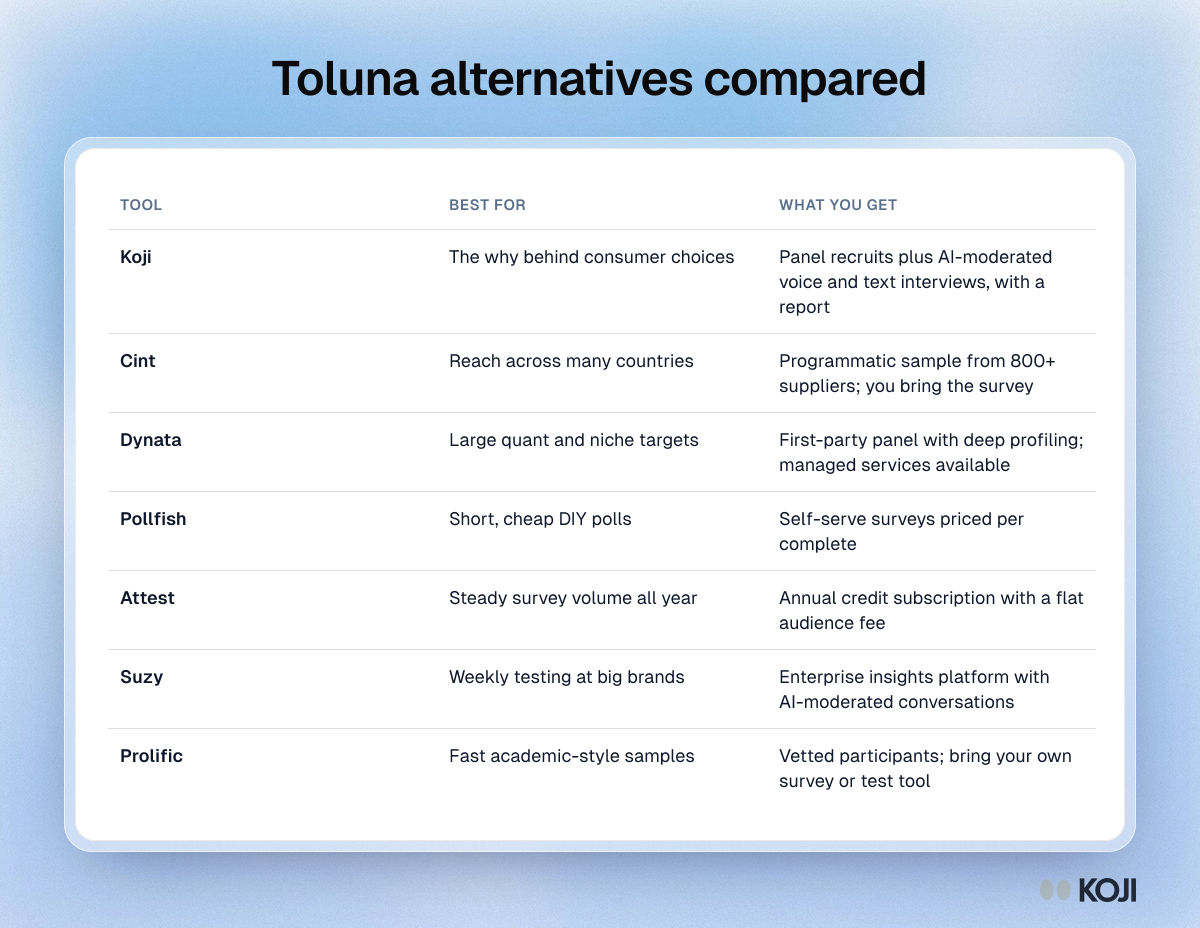
1. Koji: panel recruits plus AI-moderated interviews
Koji is an AI-native research platform. Instead of a survey, each participant has a conversation with an AI interviewer, by text or voice, that asks your questions and follows up on what they say. Structured questions (scales, single and multiple choice, ranking) sit inside the same conversation, so you get charts and the reasons behind them in one pass.
Since September 2026, Koji can supply the people too. On a study's Panel recruit tab you describe the audience in your own words, refine it with targeting criteria, and see the cost per interview in credits before you launch. Koji recruits through the Cint Exchange. A few details matter if you are coming from Toluna:
- Soft launch. Field the first batch, around 10% of your goal, then pause and check the answers before releasing the rest.
- Credits held, not spent. Credits for the whole goal are set aside at launch and anything unused comes back when the recruitment ends.
- Quality gate. Every interview gets a quality score from 1 to 5, and only interviews scoring 3 or more use credits or enter the report. Screened-out and quality-rejected panel interviews don't count toward your participant limit. See how quality scores work.
- 28 languages. When a study runs in several languages, every question, answer option and scale label is translated at publish, and you can choose the language the report is written in.
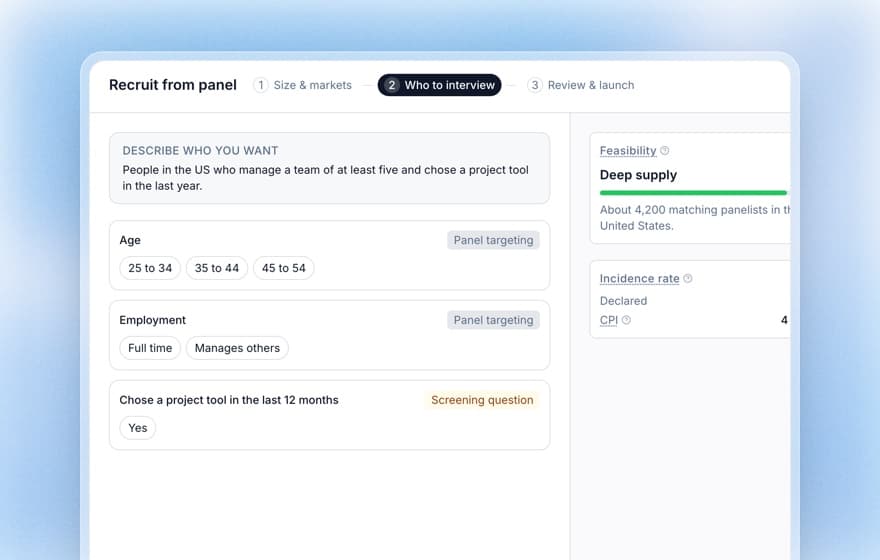
You can also skip the panel and interview your own customers by link, embed, CSV import or phone, and pay them through Koji's built-in incentives, from €10 to €500 per person on paid plans.
Pricing: published. Free starts with 10 credits. Insights is €29 a month with 29 credits, and Interviews is €79 a month with 79 credits. A text interview costs 1 credit and a voice interview 3; panel recruits add the panel price per interview, shown before launch. Launching a panel recruitment needs a paid plan, and voice interviews are on Interviews and Enterprise.
Best for: teams who need to know why consumers choose, switch or stay, without a separate qual project or an annual panel contract.
Watch out for: Koji is built for conversations, not for 40-question tracking grids sent to thousands of people. If you need a national brand tracker, keep a quant tool for that.
2. Cint: the sample exchange
Cint runs the Cint Exchange, a programmatic marketplace that connects buyers to more than 800 sample suppliers, with access to respondents in over 130 countries. It is the supply layer much of the industry buys from. You bring the survey (from your own tool or a platform plugged into the exchange) and pay per completed interview.
Pricing: per complete, quoted by audience, length and incidence. Not published as a rate card.
Best for: teams with their own survey tool who want reach across many countries and suppliers.
Watch out for: Cint gives you respondents, not a study. Questionnaire design, analysis and reporting stay with you.
3. Dynata: first-party panel at scale
Dynata runs one of the largest first-party panels, citing 70 million+ panelists and 125 million+ completed surveys a year. Its panel data page claims an average of 647 data points per respondent across 82 countries, which helps with hard-to-reach targeting. Managed services are available if you want Dynata to run the project.
Pricing: quote-based.
Best for: large quantitative studies and B2B or niche consumer targets where profiling depth matters.
Watch out for: like Toluna, it is sales-led, and the analysis layer is light unless you buy services.
4. Pollfish: cheapest DIY surveys
Pollfish is a self-serve survey platform owned by Prodege. Its DIY tier starts from $0.95 per complete, with full-service projects from $5,000 and enterprise from $10,000 a year. Pricing changed on July 15, 2026: short surveys with broad targeting got cheaper, long surveys with narrow audiences may cost more.
Best for: quick, short consumer polls on a small budget.
Watch out for: short and broad is where it shines. Detailed screening and open-ended depth are not its strengths.
5. Attest: annual subscription, flat audience fee
Attest sells consumer research as an annual subscription measured in credits, where one credit is one answer from one person. It says its multi-panel audience covers 150 million+ people in 59 countries, at one flat audience cost wherever they are. Seats are unlimited and a research expert is included. Attest does not offer pay-as-you-go.
Best for: brand and marketing teams who run steady survey volume all year and want predictable cost.
Watch out for: you commit for a year up front, and the output is survey data.
6. Suzy: agile insights for enterprise brands
Suzy is an enterprise consumer insights platform with access to 70+ panels in 130+ markets, bot detection it calls Biotic, and Suzy Speaks, its AI-moderated conversational product. It does not publish pricing. Third-party estimates based on Vendr data put typical contracts around $88,000 a year, so treat that as a ballpark, not a quote.
Best for: large CPG and consumer brands that test concepts and claims every week.
Watch out for: sales-led and priced for enterprise budgets.
7. Prolific: fast samples, transparent fees
Prolific is popular with academics and product teams for quick, well-vetted samples. You set the participant reward and Prolific adds a platform fee on top: 42.8% for companies, 33.3% for academic and non-profit customers. It says it has a pool of more than a million people, with 200,000+ active.
Best for: behavioural studies, quick validation and unmoderated tasks with general audiences.
Watch out for: it is recruitment only. You need your own survey, test or interview tool.
Why a panel survey alone often misses the point
Most panel platforms, Toluna included, are built to field closed questions fast. That is useful, but the reasons behind an answer usually live in open text, and open text is where surveys fall down. Pew Research Center found that open-ended questions on its online panel average about 18% item nonresponse, against 1% to 2% for closed questions. And the people who do answer often write a few words.
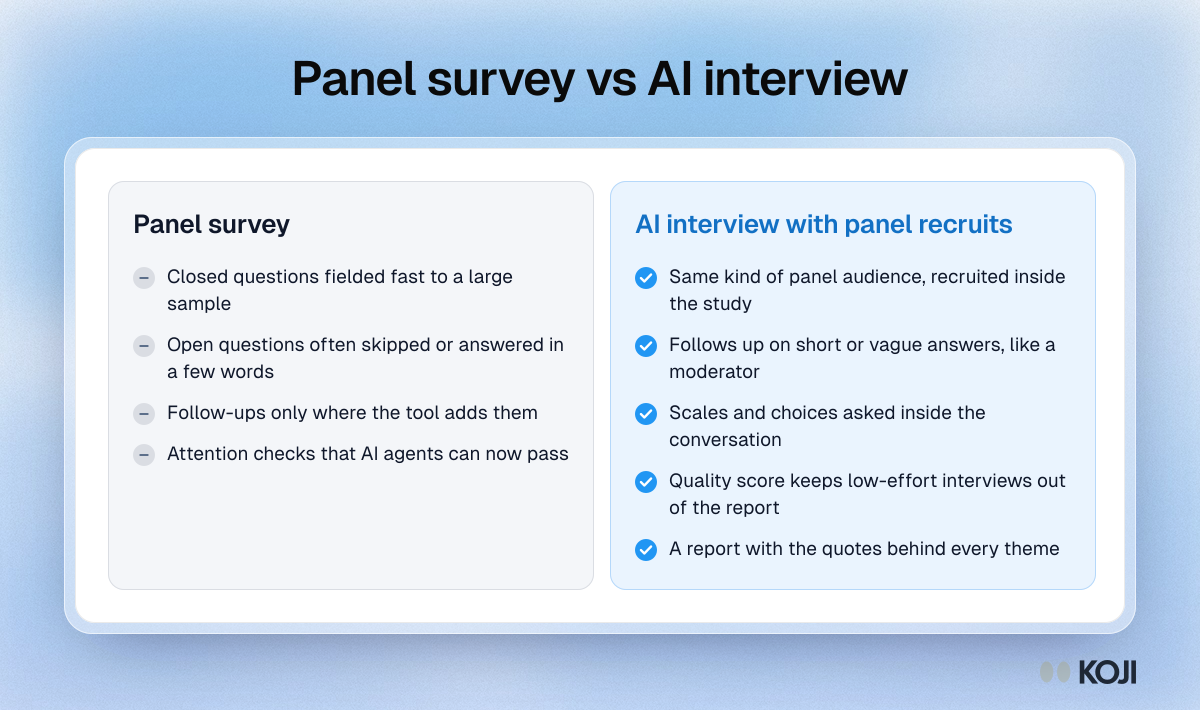
An AI interviewer changes that. It asks the open question, hears a short answer, and asks what happened next or why that mattered, the way a moderator would. A conversation is also harder for a bot to fake than a grid of radio buttons, and Koji's quality gate keeps low-effort interviews out of the report. You can read more on when to use an AI interview instead of a survey and on spotting fake and low-effort respondents.
How to choose
Ask four questions before you sign anything:
- Do you need sample, or a study? Cint, Dynata and Prolific supply people. Attest, Suzy, Pollfish and Toluna add a survey tool. Koji adds the interview and the analysis.
- How will you prove respondents are real? Ask every vendor how they catch bots now that attention checks can be passed by AI.
- Can you see the price before you commit? Pollfish, Prolific and Koji publish theirs. Toluna, Dynata and Suzy quote.
- Do you need the why? If your team keeps running a survey and then a separate qual round to explain it, combine them.
If you are still building your recruiting approach, our guide to finding research participants covers panels, your own users and communities.
Try Koji
Keep a panel for your big quant waves if you need one. For the questions where the reasons matter more than the percentages, open a free Koji account, describe who you want to hear from, and check the cost per interview before you launch. Run a soft launch, read the first interviews, then release the rest. You'll have a report built from real conversations, with the quotes behind every theme, without an annual contract. The panel recruitment guide walks through every step.