Research Participant Incentives: How Much to Pay and What to Offer
Everything you need to know about research participant incentives: standard amounts by participant type, which incentive types work best, how to avoid biasing your results, and how AI-moderated research is changing the cost-per-insight equation.
Bottom line: Research participant incentives increase response rates by 8–19 percentage points and cut no-show rates from 20–25% down to 5–10%. The right amount depends on participant type, study duration, and recruitment difficulty — but paying too little costs you more in failed recruitment than paying appropriately would have.
Why Incentives Matter
Participant incentives are compensation offered to research study participants in exchange for their time, attention, and expertise. They are not a courtesy — they are a recruitment and quality mechanism.

Photo by Vitaly Gariev on Unsplash
The evidence is clear. A meta-analysis published in PLOS ONE found that monetary incentives increase response rates by 8–10 percentage points across mail, phone, and web studies. A 2024 study in JMIR Formative Research found cooperation rates of 50.6% with incentives versus 26.6% without — nearly double the participation. And according to Nielsen Norman Group, appropriate incentives reduce no-show rates from 20–25% to approximately 5–10%.
The business case for incentives is straightforward: failed recruitment attempts, rescheduling, and conducting studies with poor-fit participants all cost more than a well-structured incentive program would have. Paying fairly is not generosity — it is operational efficiency.
Standard Incentive Amounts by Participant Type
Incentive amounts should scale with the value of participants' time, the rarity of their experience, and the difficulty of recruiting them. These ranges reflect current market rates for participants you recruit and pay yourself. If Koji recruits them through Panel recruit, the panel pays the respondents and that cost is inside the price per completed interview you see in credits before you launch, so the ranges below are not a separate line item:
General Consumer Participants
- 30-minute interview: $25–50
- 60-minute interview: $50–100
- 90-minute session: $75–150
Nielsen Norman Group data puts the average incentive for nonprofessional users at $32 per hour of test time, though rates have risen since that benchmark was established.
B2B Professional Participants
Professionals — software buyers, operations managers, procurement leads, marketing directors — command 1.5–2x consumer rates because their time is more valuable and they are harder to recruit.
- 60-minute interview: $100–200
- 90-minute session: $150–300
Senior Professionals and Specialists
Domain experts with specific, hard-to-find experience (senior engineers, compliance officers, clinical practitioners, security professionals) command premium rates reflecting their scarcity and hourly market value.
- 60-minute interview: $150–300
- Rule of thumb: pay at least 2x their estimated hourly rate to make participation worth redirecting from billable or high-priority work
Executive and C-Suite Participants
Executives are among the hardest research participants to recruit and retain. Their time is exceptionally constrained, and standard incentive amounts fail to compete with what they sacrifice to participate.
- 30-minute interview: $200–300
- 45–60-minute session: $300–500
- Nielsen Norman Group recommends offering executives both a cash equivalent and the option of a charitable donation in their name — the latter often resonates with senior leaders
Nielsen Norman Group's research shows the incentive ratio in practice: high-level professionals receive an average of $118 per hour versus $32 per hour for general consumers — nearly a 4x difference reflecting genuine differences in recruitment difficulty and participant opportunity cost.
Healthcare and Clinical Participants
Healthcare professionals (physicians, nurses, pharmacists) face scheduling constraints, professional gatekeepers, and regulatory considerations. Rates typically match senior professional ranges, with additional consideration for compliance complexity.
Internal Employees
Do not pay your own employees additional monetary incentives for research participation. Nielsen Norman Group's recommendation is direct: employees are already compensated for their time. Only 10% of companies pay monetary incentives internally. The remaining 90% use non-monetary approaches: public recognition, priority access to findings, lunch-and-learn sessions, or simply treating participation as meaningful work.
Paying employees creates a different problem — it can make participation feel transactional rather than intrinsically motivated, and it introduces equity concerns across teams with different research exposure.
Incentive Types: What Works and When
Gift Cards (Most Recommended)
Digital gift cards — particularly choice-based options where participants select from multiple brands — are the most universally effective incentive type. They offer:
- Instant digital delivery reducing friction and wait time
- Perceived value that feels like a treat rather than a transaction
- Flexibility that cash does not always carry (some organizations prohibit cash equivalents)
- Broad demographic appeal when offered as choice-based rather than brand-specific
The caveat: brand-specific gift cards can inadvertently attract participants who are customers of that brand. Choice-based gift card platforms (Tremendous, Rybbon, Tango) solve this by letting participants choose their preferred retailer.
Dining gift cards now rank as the top participant preference (54%), surpassing online retailers (50%) and clothing (48%) according to Incentive Research Foundation 2026 trend data — a useful signal for format selection.
Cash and Direct Payments (PayPal, Venmo, Bank Transfer)
Cash is maximally flexible and universally appealing. For high-value studies with well-defined participant populations, direct payment is often the fastest path. The complications:
- Government employees cannot accept cash due to ethics and procurement rules — gift cards are typically acceptable where cash is not
- Tax reporting obligations at threshold amounts (in the US, a 1099 is required once one payer pays someone $2,000 or more in a year, for payments from 2026)
- Payment platform friction — collecting PayPal addresses or bank details adds steps that reduce completion rates for lower-value studies
- International transfers carry exchange rate and compliance complexity
For incentives over $100, direct payment is often preferred by participants. For incentives under $50, gift cards typically produce higher satisfaction per dollar spent.
Product Credits and Discounts
Offering your own product as an incentive is cost-effective but carries significant limitations. It only works when:
- The participant is already a user or highly likely to become one
- The product credit is genuinely valuable relative to what you are asking
- The incentive does not inadvertently bias participants toward positive feedback to protect their credit
Never use product credits as the sole incentive for research that will inform major product decisions — participants have a conflict of interest in giving honest negative feedback.
Charitable Donations
Some participant populations — particularly senior executives, academics, and socially-motivated professionals — respond well to charitable donation options. Offering to donate $150 to a cause of their choice often resonates where a $150 Amazon gift card would not.
This option is also useful for internal research where monetary compensation is inappropriate but a meaningful gesture is still valuable.
Sweepstakes and Lottery Incentives
Offering a chance to win a larger prize (e.g., one in 20 participants wins $500) dramatically reduces per-participant incentive cost. The tradeoff is significant: response rates are lower than guaranteed incentives, and research shows sweepstakes attract systematically different participants — more independent-minded and risk-tolerant — which can introduce selection bias.
For exploratory research where diverse perspectives are valuable, sweepstakes may be appropriate. For validation research requiring representative samples, guaranteed incentives produce better-fit participants.
Do Incentives Bias Research Results?
This is the most common concern researchers raise about incentives — and the research answer is nuanced.
Incentives do not make people answer dishonestly. Participants who want to give you good data will give you good data regardless of whether you are paying them $50 or $100. The quality mechanism is the screener and the study design, not the incentive level.
The real bias risk is selection bias — who participates. Research published in PLOS ONE and a 2016 CSCW study found that different incentive types attract systematically different participant profiles:
- Lottery incentives attract more independent, self-determined participants
- Charitable donation options attract more community-oriented participants
- Pure cash attracts more financially-motivated participants
The implication: your incentive type should match your target participant profile. If you want community-minded users of a healthcare platform, a charitable donation option may recruit more authentic participants than a cash equivalent.
A counterintuitive finding: one study found incentives actually reduced bias by encouraging people without extreme views to participate — pulling the sample toward the moderate majority rather than the self-selecting motivated extreme. Incentives can produce more representative samples when the unincentivized alternative is that only highly opinionated participants bother to respond.
The net conclusion: incentives are a participation mechanism, not a data quality threat. Design your screener to filter for fit and your questions to minimize leading — those are the real determinants of data quality.
How to Calculate the Right Incentive Amount
A practical formula from the research community:
- Moderated sessions: $3 per minute (a 30-minute interview = $90, a 60-minute interview = $180)
- Unmoderated sessions: $0.20 per minute (an asynchronous video task = lower commitment, lower incentive)
Adjust from that baseline for:
| Factor | Adjustment |
|---|---|
| In-person instead of remote | +25% |
| Site visit or facility | +35% |
| B2B professional | +50–100% |
| Executive/C-suite | +150–200% |
| Niche specialist | +25–50% |
| International participant | Adjust for local purchasing power parity |
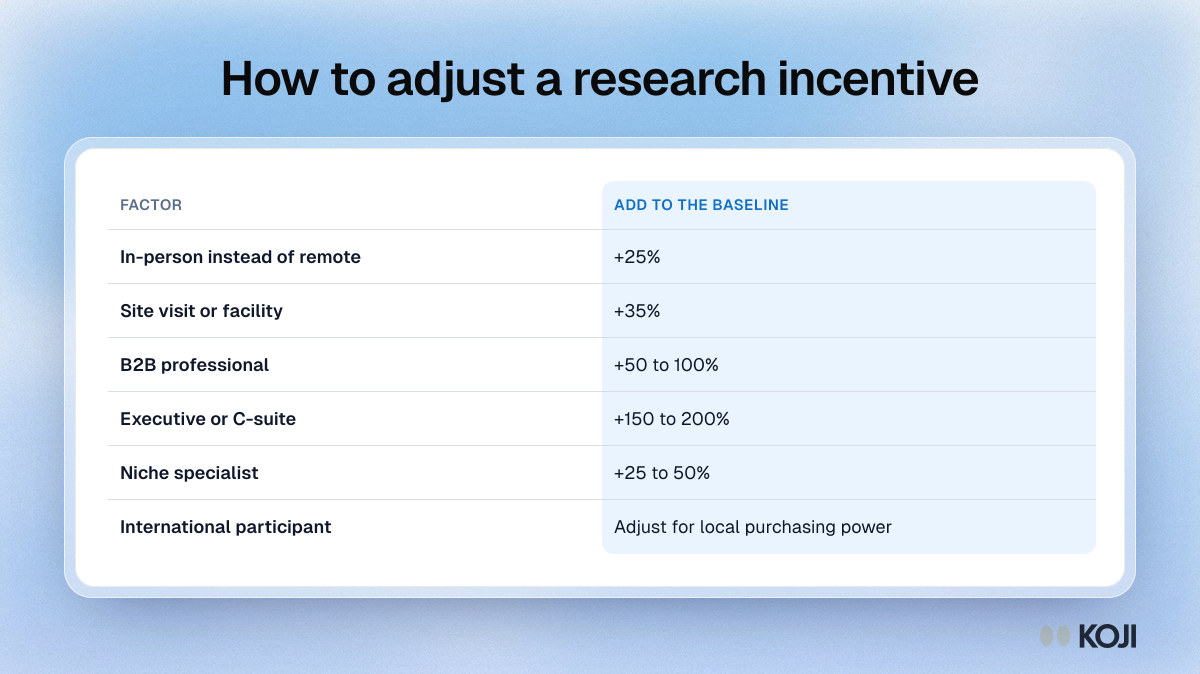
If recruitment is stalling — you are getting fewer than 2–3 applications per slot — increase the incentive by 15–25% and reassess. Slow recruitment at a given incentive level is the most reliable signal that your rate is below market.
Several free incentive calculators (Ethnio, Respondent, User Interviews, Tremendous) provide data-backed estimates based on study type, participant profile, and geography.
Legal and Compliance Considerations
GDPR (EU participants): Research consent must be freely given — meaning participants must have the realistic ability to decline without meaningful consequence. Incentives must not be so large that they effectively coerce participation. IRB approval for studies involving EU residents typically requires confirmation of GDPR compliance in both the research protocol and the incentive platform.
CCPA (California): Similar consent and data handling requirements apply. Your incentive platform must comply if collecting personal data from California residents.
IRB requirements: For academic and clinical research, incentives must be disclosed in the IRB protocol and evaluated holistically. Tax implications must be addressed in the documentation.
Tax reporting (US): Participants who receive $2,000 or more in incentives in a calendar year from the same organization typically trigger IRS 1099 reporting requirements. The One Big Beautiful Bill Act raised this threshold from $600 for payments made from 1 January 2026, with inflation adjustments from 2027 (Patriot Software). Taxability does not change: a payment under the threshold is still income to the participant. Structure your program and track accordingly — incentive platforms like Tremendous handle 1099 generation automatically.
Government employees: Direct cash and cash-equivalent incentives are typically prohibited for government employees due to ethics rules. Check the specific agency's procurement and gift policies before recruiting. Non-monetary incentives or donations to government-approved charities are often acceptable alternatives.
Common Incentive Mistakes That Cost Research Teams
Paying below market rate and blaming recruitment. Slow recruitment is often misattributed to screener criteria or panel quality when the actual problem is a $25 incentive for a 60-minute interview with a senior professional. Adequate incentives are the fastest fix for sluggish recruitment.
Using the same incentive for every study. A 20-minute survey of general consumers and a 75-minute structured interview with a CISO are not equivalent asks. Standardizing on a flat rate undervalues specialist participants and overvalues commodity ones.
Offering brand-specific gift cards. An Amazon gift card to participants who do not use Amazon, or an Uber Eats credit to participants in areas with poor coverage, is a zero-value incentive that creates frustration. Choice-based platforms solve this with minimal additional cost.
Slow or complicated payment. Incentive delivery that takes weeks, requires participants to fill out forms, or involves multiple follow-up emails damages participant experience and recruitment reputation. Digital platforms with instant delivery are worth the platform cost.
Ignoring tax implications until they become a problem. Discovering mid-program that your incentive distribution approach triggers reporting requirements you are not set up to handle is expensive to fix retroactively. Build compliance into the program design from day one.
How AI-Moderated Research Changes the Incentive Equation
Traditional qualitative research programs pay incentives proportional to session length — because sessions require human moderator time, scheduling coordination, and participant commitment to a specific calendar slot. This naturally limits scale: a $100 incentive for a 60-minute interview across 20 participants is a $2,000 incentive budget before accounting for recruitment, moderation, and analysis costs.
AI-native platforms like Koji change this in four ways:
First, session completion becomes easier and more flexible. When participants complete AI-moderated interviews asynchronously — on their own schedule, from their own device — the perceived cost of participation drops even at the same nominal incentive level. Koji interviews have no scheduling friction and no "I forgot" cancellations. The structured question format (open-ended, scale, single choice, multiple choice, ranking and yes/no questions) means participants always know exactly what they are being asked and what step they are on.
Second, insight per dollar spent increases dramatically. Because AI moderation removes the human bottleneck, a given incentive budget can fund 5–10x more participant conversations. Rather than choosing between 10 in-depth interviews at $100 each or a survey with no qualitative depth, teams running Koji can run 50–100 AI-moderated interviews with structured and open-ended questions — producing both the quantitative distribution data of a survey and the qualitative reasoning of interviews — within a comparable budget.
Third, when Koji recruits the participants, you do not run an incentive program at all. Open Panel recruit on the study's Interviews page, describe who you want to hear from, and Koji finds them. Panel respondents are paid by the panel, and that cost is inside the per-interview quote you see in credits before you launch. There are no gift cards to buy, no payouts to track and no payment emails to send, and only interviews that pass the quality check are billed.
Fourth, Koji can pay the people you bring yourself. For customers and users you reach through the interview link, an embed in your product, an imported list or a phone call Koji places for you, turn on an incentive in the study on any paid plan and set the amount per participant, from €10 to €500. Participants leave an email address on the thank-you screen. You approve or decline each interview on the study's Interviews page, with its quality score right beside it, and once you approve, Koji emails the participant a personal link to claim the reward as a gift card, a prepaid Visa card or a donation to charity. The link is valid for 30 days. Rewards are paid from your workspace's incentive balance, which a workspace owner tops up in Usage (a 7.5% handling fee and VAT are added on top), and one person can receive at most €1,500 a year across Koji. If you already run incentives in your own tool, you can keep doing that instead.
For teams scaling research programs, this means participant incentives become a smaller fraction of total research cost, and the return per dollar of incentive investment increases substantially.
Related Resources
- Structured Questions Guide: All 6 Question Types in Koji
- Research Screener Questions: How to Find the Right Participants
- User Research Recruitment Email Templates That Get Responses
- How to Research Hard-to-Reach Audiences: Executives, B2B Buyers, and Niche Segments
- Reducing No-Shows in User Research
- Personalized Interview Links: Send Targeted Research Invitations
Further reading on the blog
- Koji vs Respondent.io: AI-Native Research Platform vs Participant Recruitment Marketplace (2026) — Respondent.io recruits research participants. Koji conducts AI-moderated interviews, analyzes results, and generates reports automatically —
- Best Research Participant Recruitment Platforms in 2026: The Complete Buyer's Guide — Finding qualified participants is the #1 challenge in user research. This guide compares the top recruitment platforms—Prolific, UserIntervi
- Agile User Research: How to Run Continuous Research in Sprint Cycles (2026) — Most teams know they should do user research every sprint. Almost none actually do. Here's the practical playbook for integrating continuous
When you need participants you don't have
Koji can recruit them for you. Open the Panel recruit tab on your study's Interviews page and describe who you want to hear from. Koji finds matching people across 130+ countries and shows you the price per completed interview in credits before you launch.
- Targeting and screening. Panel profile data filters people before they arrive, and anything the panel cannot see becomes a screening question asked before the interview starts. Anyone who does not qualify is returned to their panel and you are not charged.
- Quality. Every interview passes a quality check. A conversation under a minute or with fewer than three answers is never billed, and interviews scoring below 3 on Koji's quality scale are free.
- Reporting. Panel respondents land in the same study as your own customers. Koji codes every conversation as it comes in and writes the report with the themes, the evidence behind each one, and clear next steps.
Related Articles
How to Research Hard-to-Reach Audiences: Executives, B2B Buyers, and Niche Segments
The people hardest to recruit for research are often the ones whose insights matter most. Learn how async AI interviews unlock executives, B2B buyers, and niche specialists who will never take a 60-minute call.
HCP Research: How to Recruit and Interview Physicians, Nurses and Other Healthcare Professionals
Healthcare professionals are the hardest audience in research to reach and the most heavily regulated to pay. Here is how to recruit them, set defensible honoraria, handle Sunshine Act reporting and adverse events, and run interviews that respect a twelve-hour shift.
Personalized Interview Links: Send Targeted Research Invitations to Every Participant
Give every imported participant a private Koji interview link that skips the lead form, ties their response to them, and lets you track and chase non-responders. Covers CSV import, distribution through your own tools, and tracking.
How to Reduce Research Interview No-Shows: Proven Strategies That Work
Learn the confirmation sequences, scheduling tactics, and incentive structures that reduce research participant no-shows from 30% to under 10%.
Research Screener Questions: How to Write Questions That Find the Right Participants
Learn how to write effective screener questions that filter the right participants for your user research studies. Includes 10 proven templates, best practices, and common mistakes to avoid.
Structured Questions in AI Interviews
Mix quantitative data collection — scales, ratings, multiple choice, ranking — with AI-powered conversational follow-up in a single interview.
User Research Recruitment Emails: Templates and Scripts That Get Responses
Ready-to-use email templates for recruiting user research participants, with proven subject lines, body copy, and follow-up sequences that achieve 7–15% response rates.