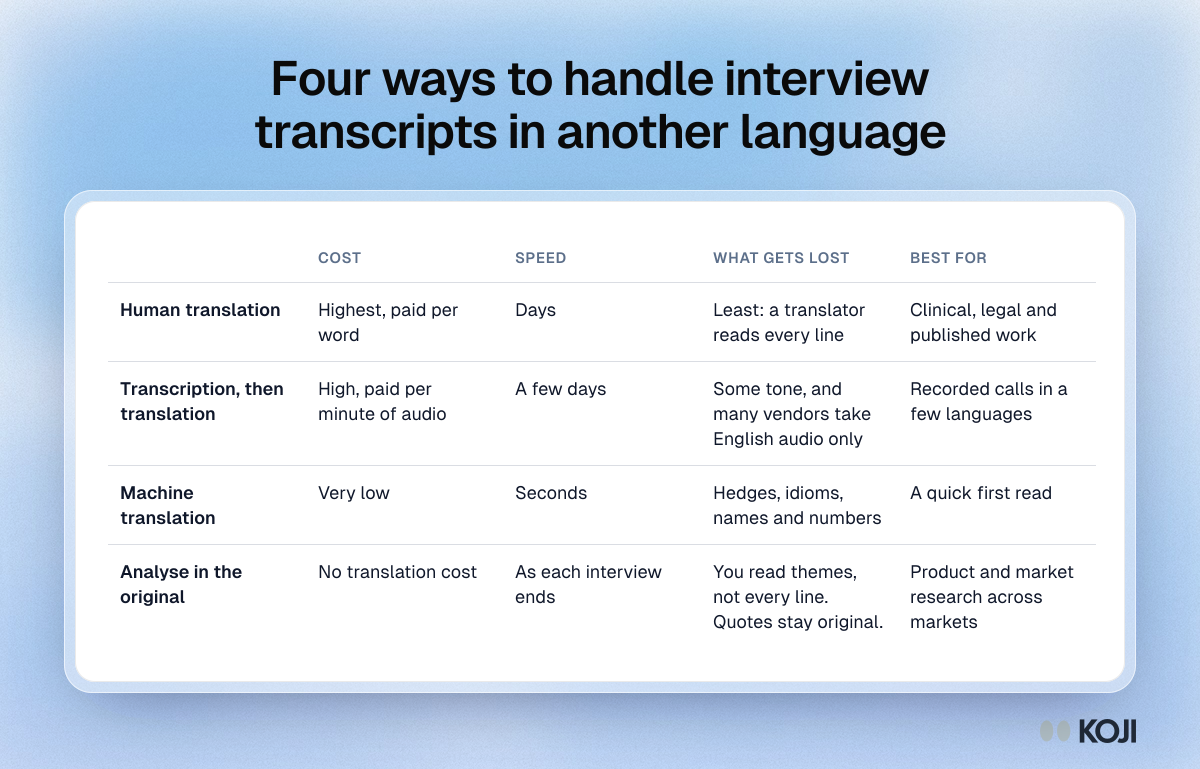
The short answer: there are four ways to get interview transcripts from another language into yours. Human translation is the most accurate and costs roughly $1,350 to $3,600 per hour of interview. Machine translation costs about a dollar an hour and takes seconds, but loses tone and idiom. A transcription service plus translation sits in between and often covers English audio only. The fourth route skips translating transcripts at all: analyse each interview in the language it was held in, write the findings in your team's language and keep the original quotes beside every claim. For most product and market research, that fourth route, plus a native speaker checking a sample, gives you the findings without paying to translate every "um" and "you know".
If you want to try the fourth route this week, the setup is in How to set it up in Koji below. The rest of this guide compares all four honestly, with costs from vendor price pages, so you can pick the one that fits your study.
Why the language of the interview matters in the first place
People say more, and say it more precisely, in their own language. CSA Research surveyed 8,709 consumers in 29 countries in 2020 and found that 76% prefer to buy products with information in their own language, and 40% will not buy from websites in other languages at all (CSA Research, Can't Read, Won't Buy, 2020). If people avoid reading a product page in a second language, they will not give you their best thinking in one during a 30-minute interview.

Photo by Vitaly Gariev on Unsplash
So the interview should happen in the participant's language. The question this guide answers is what happens next, when the transcript is in Japanese, Portuguese or Polish and the people who need the findings read English or German.
Translation is not a neutral step. Van Nes and colleagues put it plainly in the European Journal of Ageing: interpreting meaning is the core of qualitative research, and translating is itself an act of interpretation, so meaning can be lost at every hand-off (van Nes et al., 2010). Every route below loses something. The aim is to lose the least where it matters most to your decision.
How much text is an hour of interview?
Costs for translation are quoted per word or per minute, so it helps to know what an hour of talk turns into. A common estimate for American English conversation is about 150 words per minute (VirtualSpeech, citing the National Center for Voice and Speech). A study of large telephone conversation corpora at the Linguistic Data Consortium measured an average of 196 words per minute (Yuan, Liberman and Cieri, Interspeech 2006).
That puts a one-hour interview at roughly 9,000 to 12,000 words of transcript, interviewer included. Ten interviews in one market is around 100,000 words. Keep that number in mind as you read the prices.
The four routes, compared
Route 1: Human translation of full transcripts
A professional translator works from the source transcript and produces a full version in your language. Vendor rate guides put full human translation at about $0.15 to $0.30 per word in 2025, and machine translation with human post-editing at about $0.05 to $0.15 per word (Tomedes, translation rates). Rates move with the language pair, the subject and the deadline.
At 9,000 to 12,000 words, that is roughly $1,350 to $3,600 per interview hour for full human translation, or $450 to $1,800 with post-editing. Ten interviews in one market can run past $10,000 before anyone has coded a theme.
What you get is the best version of each sentence, from someone who knows both languages. Large studies back this up: when Google researchers had professional translators score output with full document context, human translations were consistently rated above the best machine systems of the time (Freitag et al., Experts, Errors, and Context, TACL 2021).
Expect it to take days for a batch of interviews, not hours.
Who it is for: clinical, legal and academic work where the transcript itself is evidence, and studies that will be published with the translated text.
Route 2: A transcription service, then translation
Many teams start by sending audio to a transcription vendor and then pass the transcript to a translator. Check what the vendor actually covers before you plan on this. Rev lists human transcription at $1.99 per minute, guaranteed in 12 hours or less, and its human transcription is for English audio. Its translated subtitles start from English files and cost $6.49 to $15.99 per minute depending on the target language (Rev pricing). That helps when your interviews are in English and your team reads Spanish. It does not help with a Japanese interview that your English-speaking team needs to read.
Other vendors take foreign-language audio and bill translation by the length of the recording, since they transcribe first and translate second (GoTranscript help centre). Their calculators give a quote per language pair.
Who it is for: teams with recorded calls in a handful of languages who want one vendor to handle both steps and can wait a few days.
Route 3: Machine translation of the transcripts
Paste the transcript into a translation tool or send it through an API. Google Cloud Translation charges $20 per million characters for its standard model, with the first 500,000 characters each month free (Google Cloud, Translation pricing). An English transcript of 9,000 to 12,000 words is roughly 55,000 to 72,000 characters, so one interview hour costs roughly a dollar, and the free tier covers several interviews a month.
It is fast and cheap, and the gist is usually right. The losses are the things researchers care about: hedges ("I suppose it's fine"), irony, idioms, politeness that softens a complaint, and words that have no clean equivalent. Spoken language makes this harder. Speech is full of restarts, fillers and half sentences, and researchers evaluating speech translation note that conversational, disfluent language is one of its hardest problems (IWSLT 2023 evaluation). Names, numbers and product terms also go wrong in ways that are easy to miss.
Who it is for: a quick first read of a few interviews, or a team that will check every quote it reports against the original.
Route 4: Analyse in the original language, report in yours
This route does not translate transcripts at all. Each interview is analysed in the language it was held in. The findings, themes and summary are then written in the language your team reads, and the quotes that back each finding stay in the participant's own words.
It is close to what experienced multilingual researchers already do: a bilingual analyst codes in the original language and translates only the quotes that end up in the report. The difference is who does the first pass. With an AI-moderated interview tool, the first pass happens as each interview finishes, so you are not paying per word for transcripts nobody will read end to end.
The trade-off is that you are trusting an analysis you cannot read line by line in the source. That is why the original quotes matter. They are the audit trail. A native speaker can open any claim, read the quotes behind it and say whether the theme fits.
Who it is for: product, UX and market research across several markets, where the decision rests on themes and patterns rather than on every sentence.
Which route should you choose?
Most teams over-buy translation. They pay to translate every word of every transcript, then read the summary. Start from what the study has to produce and work back.
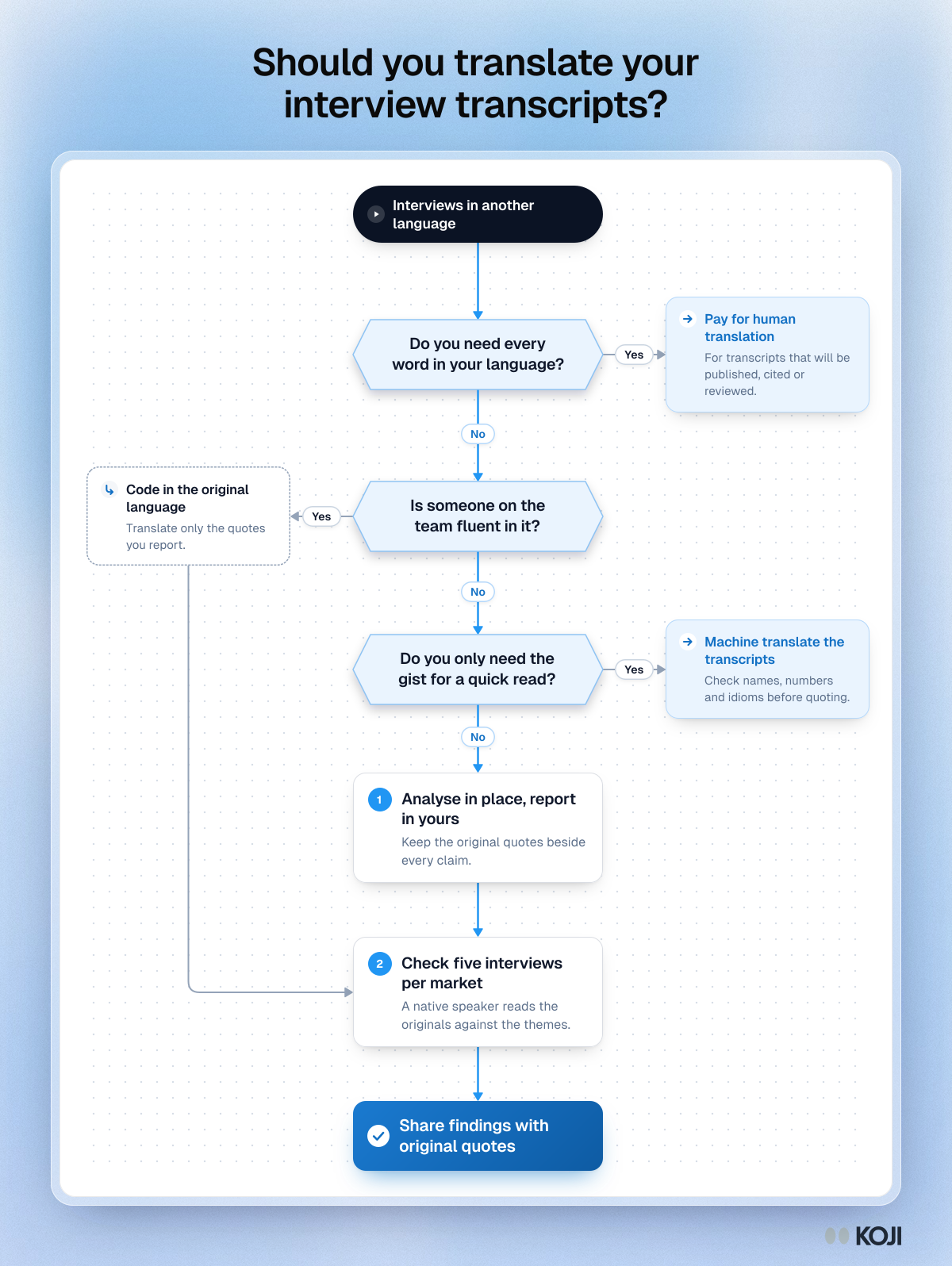
- Do you need every word in your language? If the transcript itself will be published, cited or reviewed by a regulator, pay for human translation. Nothing else holds up.
- Is someone on the team fluent in the interview language? If yes, have them code in the original and translate only the quotes you report. You get the most nuance for the least cost.
- Do you only need the gist for a quick read? Machine translation is fine for that. Check names, numbers and idioms before you quote anything.
- Otherwise, analyse in place and report in your language. Then check it, below.
How to check findings you did not read in the original
Whichever route you pick other than full human translation, build in one check: have a native speaker read five original interviews per market against the themes. Ask them three things. Does each theme describe what people actually said? Is any quote being read more strongly or more mildly than the speaker meant? Is anything important missing?

Photo by Vitaly Gariev on Unsplash
Five is not a statistical sample. It is enough to catch a theme that rests on a mistranslated word or a polite complaint read as praise. If the check turns up problems in two or more of the five, read more before you share anything.
Two other steps help a multi-market study stay comparable. Translate the questions carefully before fieldwork, using a team approach rather than a single back-translation (our guide to TRAPD). And if you compare rating scales across countries, check that the groups read the scale the same way first (measurement invariance).
How to set it up in Koji
Koji runs interviews in the participant's language and writes the report in yours. Here is the setup, verified in the product as of this writing:
- Turn on the interview languages in the study's Context tab. Koji supports 33 languages for text and voice interviews, and translates the questions, answer options and scale labels into each language when you publish. You can review and edit each language's wording before it goes out.
- Share one link. Each participant lands in their own language and can switch with the language picker.
- Pick the report language from the flag picker beside Regenerate on the Report page, or under Languages in the Context tab. It can be any supported language, not only the interview languages, so a Dutch study read by an English-speaking team gets an English report. If you change it, regenerate the report to rewrite it.
- Check the evidence. Every finding links to the quotes behind it, and those quotes stay in the participant's own words. Koji checks each quote against the transcript and does not show one it cannot find there. Send the original quotes to your native-speaker reviewer for the five-interview check.
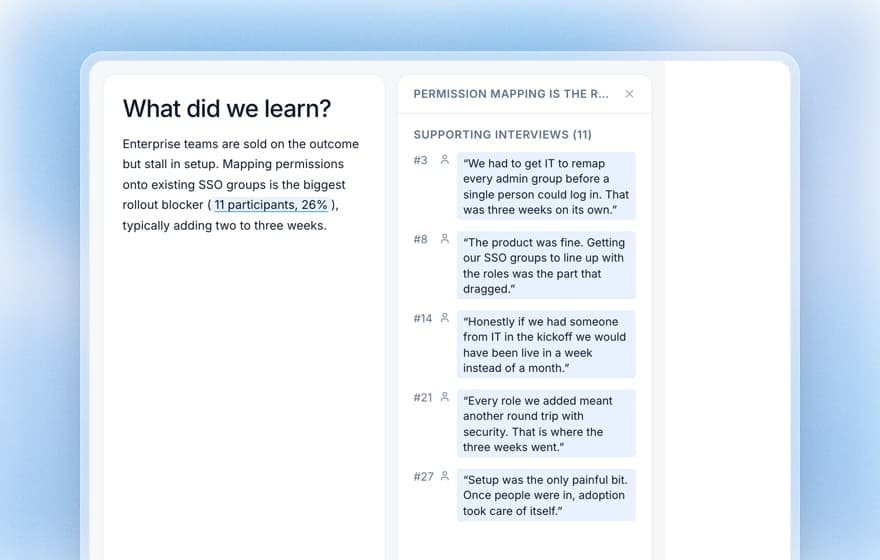
What Koji does not do is translate transcripts into a full second copy. If your study needs a complete translated transcript, export the originals as CSV and use Route 1 or 3 for the interviews that need it. The multi-language research guide covers the rest of the setup, and our roundup of multilingual research tools compares other platforms.
Common mistakes
- Translating before deciding what you need. You may only need 30 quotes translated, not 100,000 words.
- Running interviews in English to save on translation. You save money and lose the answers people would have given in their own language.
- Trusting machine-translated quotes in a report. A misread hedge can turn a mild complaint into a crisis, or the reverse. Check every quote you put in front of leadership.
- Comparing markets on themes alone. Themes from different languages can look alike for different reasons. Read the quotes side by side before you claim two markets agree.
Start with one market
Pick one market where you have no fluent speaker, run eight to ten interviews in that language, and have the report written in your team's language. Then do the five-interview check with a native speaker. If the themes hold up, you have a route you can repeat in every new market for the cost of the interviews alone. Start a study free on Koji and turn on a second interview language in the Context tab.