Flowchart
Should you translate your interview transcripts?
A decision path for interviews held in a language your team does not read
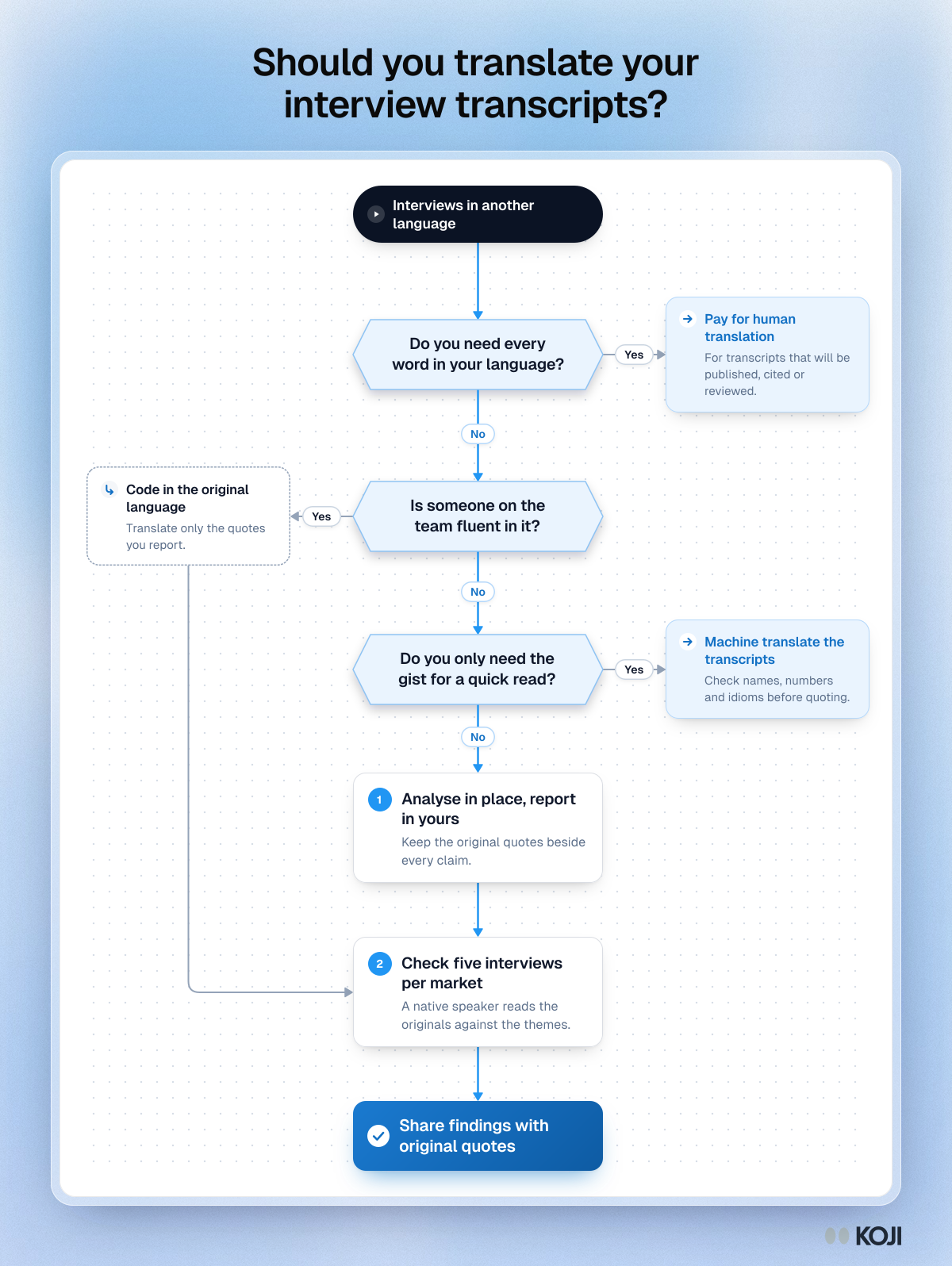
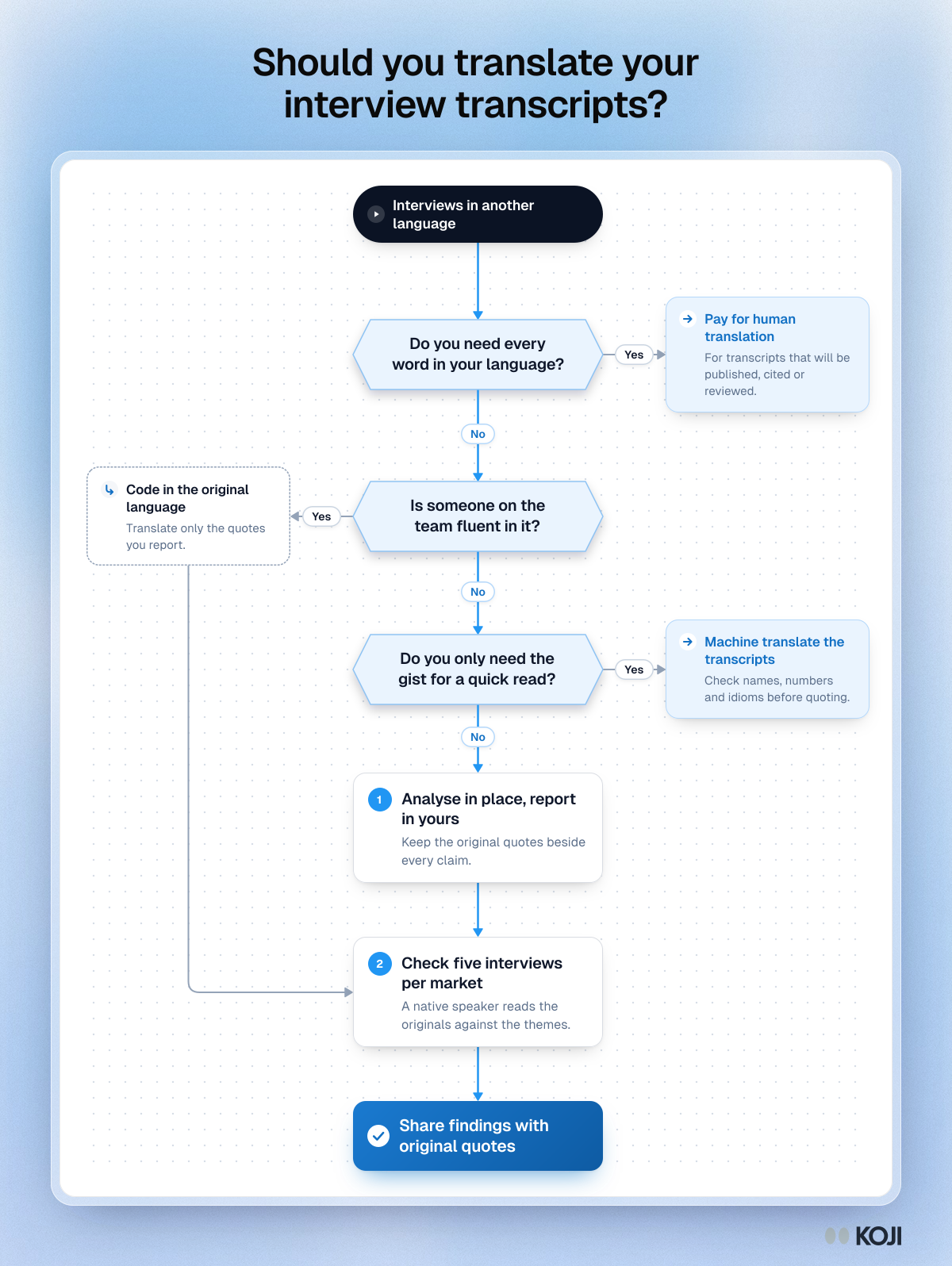
A decision flowchart for research teams with interviews in a language they do not read. It asks whether you need every word translated, whether anyone on the team is fluent, and whether a gist is enough, then ends with a native-speaker check of five interviews per market. Koji supports the analyse-in-place route by writing the report in your language while keeping quotes in the original.
Where this appears
What's in this flowchart
Start: Interviews in another language
- Do you need every word in your language?
- No: go to 2.
- Yes: Pay for human translation. For transcripts that will be published, cited or reviewed.
- Is someone on the team fluent in it?
- No: go to 3.
- Yes: Code in the original language. Translate only the quotes you report. Then go to 5.
- Do you only need the gist for a quick read?
- No: go to 4.
- Yes: Machine translate the transcripts. Check names, numbers and idioms before quoting.
- Analyse in place, report in yours. Keep the original quotes beside every claim.
- Check five interviews per market. A native speaker reads the originals against the themes.
- Finish: Share findings with original quotes.
Use this image
Free to use in your docs, decks and posts under CC BY 4.0, as long as you credit Koji with a link to this page. To embed it, paste this into your page:
html
<a href="https://www.koji.so/visuals/translate-interview-transcripts-decision-flowchart"><img src="https://www.koji.so/visuals/translate-interview-transcripts-decision-flowchart/translate-interview-transcripts-decision-flowchart.png" alt="Flowchart for handling interview transcripts in another language: three questions leading to human translation, machine translation or analysis in place." width="1200" height="1596" /></a>
<p>Source: <a href="https://www.koji.so/visuals/translate-interview-transcripts-decision-flowchart">Should you translate your interview transcripts?</a>, Koji</p>