Updated November 2026 for 2027: rechecked every platform and price on the vendors’ own sites, added Askable and Ethnio, dropped Userbrain (a testing tool more than a recruiter), corrected Respondent’s pricing (it now charges a flat fee per session), noted that CleverX runs AI-moderated interviews, replaced an unsourced budget figure with User Interviews’ own research, and moved Koji out of the ranking into its own section.
Short answer: for professionals with specific job titles, look at Respondent or CleverX. For a verified consumer or academic sample, Prolific. For strict participant checks, Askable. To recruit your own customers, Great Question (a participant CRM) or Ethnio (intercepts on your site or app). For unmoderated usability tests with a panel attached, Userlytics. For in-the-moment diary studies, dscout. And if the people you need are already your users, you may not need a panel at all, only a way to reach and interview them.
User Interviews is still a strong recruiter. People look for an alternative for three reasons: its per-session fee plus incentives gets expensive for B2B studies, its January 2026 sale to UserTesting raised questions about where the product goes next, and it recruits the participant but leaves the session and the analysis to you.
Why teams look for a User Interviews alternative
Recruitment is where research most often stalls. In User Interviews’ own 2024 State of User Research survey, 62% of researchers said finding enough participants who match their criteria was a problem, 61% called the time it takes to recruit a major issue, and 57% named participant quality and reliability (User Interviews, State of User Research 2024).

Photo by Mwila Kaunda on Unsplash
The demand for studies keeps climbing. In Maze’s Future of User Research Report 2026, a survey of nearly 500 researchers, designers and product people, 66% saw demand for research rise, up from 55% the year before (Maze, 2026). More studies means more participants to find and pay.
And it is a large share of the budget. In User Interviews’ 2025 Research Budget Report, headcount, tools and participant recruitment together took 71% of research budgets. When recruitment sits in that bucket, a few dollars a session matters.
The ownership change. UserTesting bought User Interviews in January 2026. User Interviews keeps running as its own product, and UserTesting says customers don’t have to move (UserTesting press release). Nothing has forced anyone off it, but agencies and in-house teams that buy recruitment every month now have a good reason to compare.
What User Interviews costs today
- Pay as you go: $49 a completed session for consumers and $98 for professionals, with an extra fee per session for advanced B2B targeting.
- Essential (billed annually): from $41 a consumer session and $82 a professional session, in bundles of 60 or 150 sessions. A larger annual tier brings that to $36 and $72.
- Custom: from 250 sessions a year, priced by sales.
- Incentives are paid on top. If User Interviews pays them for you, it adds a 3% fee.
Source: User Interviews pricing, checked November 2026. For the full breakdown, see User Interviews pricing explained.
How we chose
We compared platforms that a research team, a fieldwork manager at an agency or an in-house insights team could use instead of User Interviews to supply participants, checked on each vendor’s own site in November 2026, on:
- Audience: consumers, professionals (B2B) or your own users
- Verification: identity, LinkedIn, voice or behaviour checks
- Pricing model: a fee per session, a percentage on incentives, per seat, or a quote
- What else it does: recruit only, or also run sessions or tests
- Who it suits: UX teams, academics, agencies, market researchers
The order follows how close each platform is to what User Interviews does: recruiting people for interviews and tests. Koji publishes this page, so it is not in the ranking. It has its own section after the list.
The 8 best User Interviews alternatives for 2027
1. Respondent: best for niche professional audiences
Best for: B2B studies that need specific job titles, industries or seniority. Pricing: pay as you go at $40 a moderated session for consumers and $80 for professionals, or $25 and $40 for unmoderated sessions. Annual commitments from $7,500 a year lower the per-session fee. Incentives are paid on top (Respondent pricing).
Respondent is the closest like-for-like swap: you write a screener, review applicants and pay incentives through the platform. Its own incentive calculator suggests $35 for a 30-minute US consumer session.
Watch out for: senior B2B people expect higher incentives, so the incentive often costs more than the fee. See Respondent pricing for worked examples.
2. Prolific: best for verified consumer and academic samples
Best for: academic and behavioural studies, consumer surveys and unmoderated tasks where data quality comes first. Pricing: you pay each participant (at least £6 or $8 an hour, and Prolific recommends £9 or $12) plus a platform fee of 43%, or 33% for academics and non-profits. No subscription (Prolific).
Prolific is known for identity and attention checks and a large pool you can filter with detailed screeners.
Watch out for: the fee sits on every incentive, so long or well-paid sessions add up. It suits short tasks and surveys better than hour-long B2B interviews.
3. CleverX: best for B2B professionals with sessions included
Best for: teams that want verified professionals and would rather buy the session and the recruit together. Pricing: Pro at $149 per user a month, no commitment, plus credits at $1 each for completed responses. An AI-moderated interview with a recruited professional is 125 credits (35 for a consumer). A human-moderated one is 250 (40 for a consumer). Incentives are separate on every plan. Enterprise is a custom annual plan (CleverX pricing).
CleverX has grown from a B2B panel into a platform that also runs surveys, prototype tests and moderated interviews.
Watch out for: the seat fee comes before any credits, so it pays off for regular studies more than a single one.
4. Great Question: best for recruiting your own customers with a CRM
Best for: product and research teams that mostly talk to their own customers and want consent, contact history and incentives in one place. Pricing: self-serve at $129 a seat a month, up to 5 seats. Participants from external panels are paid for in credits as you go (Great Question pricing).
Watch out for: per-seat pricing, so count who will actually run studies.
5. Askable: best for strict participant verification
Best for: high-stakes research where you need to be sure each participant is who they say they are. Pricing: an annual plan with participant incentives included, which replaced Askable’s credits in June 2026. Prices on request (Askable).
Askable checks people with AI fraud detection, voice clips and LinkedIn, and lets you hand-pick participants or have them matched.
Watch out for: an annual plan suits a steady research programme more than one study.
6. Ethnio: best for intercepting your own website or app visitors
Best for: product teams with enough traffic to recruit straight from their site or app. Pricing: per seat. Individual from $12 a seat a month and Pro from $82 a seat a month, billed annually. Web intercepts need a paid plan and native app intercepts are Enterprise only (Ethnio pricing).
Ethnio shows a screener to real visitors, qualifies them as they answer and books them in.
Watch out for: it only reaches people already using your product.
7. Userlytics: best for usability tests with a panel attached
Best for: UX teams that want recruitment and unmoderated or moderated usability testing in one place. Pricing: project-based per participant session with a 5-session minimum. Enterprise annual plans from about $30 a session. A self-recruitment subscription from $699 a month, paid annually (Userlytics pricing).
Watch out for: it is built for testing interfaces. For open discovery interviews, a pure recruiter plus your own call tool may be cheaper.
8. dscout: best for in-the-moment diary studies
Best for: longitudinal studies where people record moments from their own lives on their phones. Pricing: a subscription with consumable credits. Prices are not public. dscout says it is not meant for teams with a budget under $20,000 (dscout).
Watch out for: an enterprise-sized commitment. If you only need people for one-off calls, a recruiter costs less.
Which alternative for which job
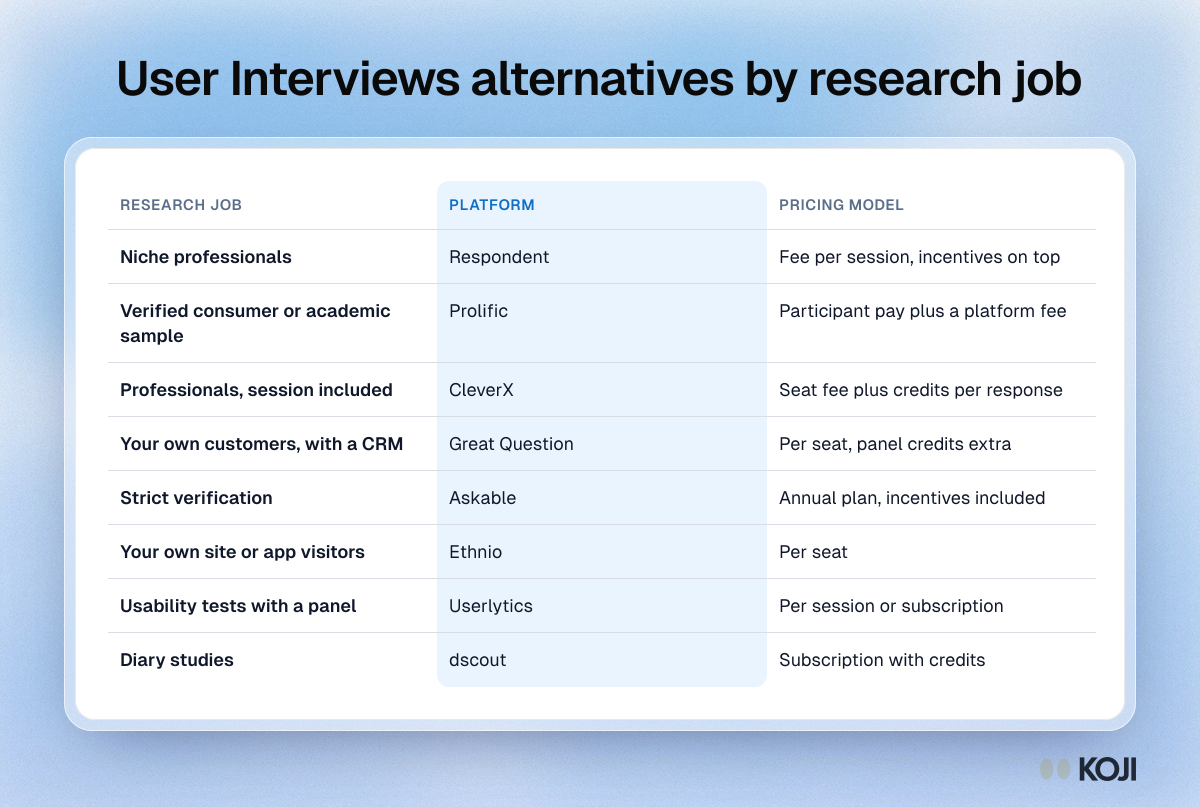
| Research job | Platform | How it charges |
|---|---|---|
| Niche professionals | Respondent | $40 consumer, $80 professional per moderated session, plus incentives |
| Verified consumer or academic sample | Prolific | Participant pay plus 43% fee (33% academic) |
| Professionals, session included | CleverX | $149 a user a month plus credits per completed response |
| Your own customers, with a CRM | Great Question | $129 a seat a month |
| Strict verification | Askable | Annual plan, incentives included, quote |
| Your own site or app visitors | Ethnio | From $12 a seat a month, billed annually |
| Usability tests with a panel | Userlytics | Per session (5 minimum) or from $699 a month |
| Diary studies | dscout | Subscription with credits, not public |
Checked November 2026 on each vendor’s own site. Prices change often, so confirm before you buy.
How to choose in four questions
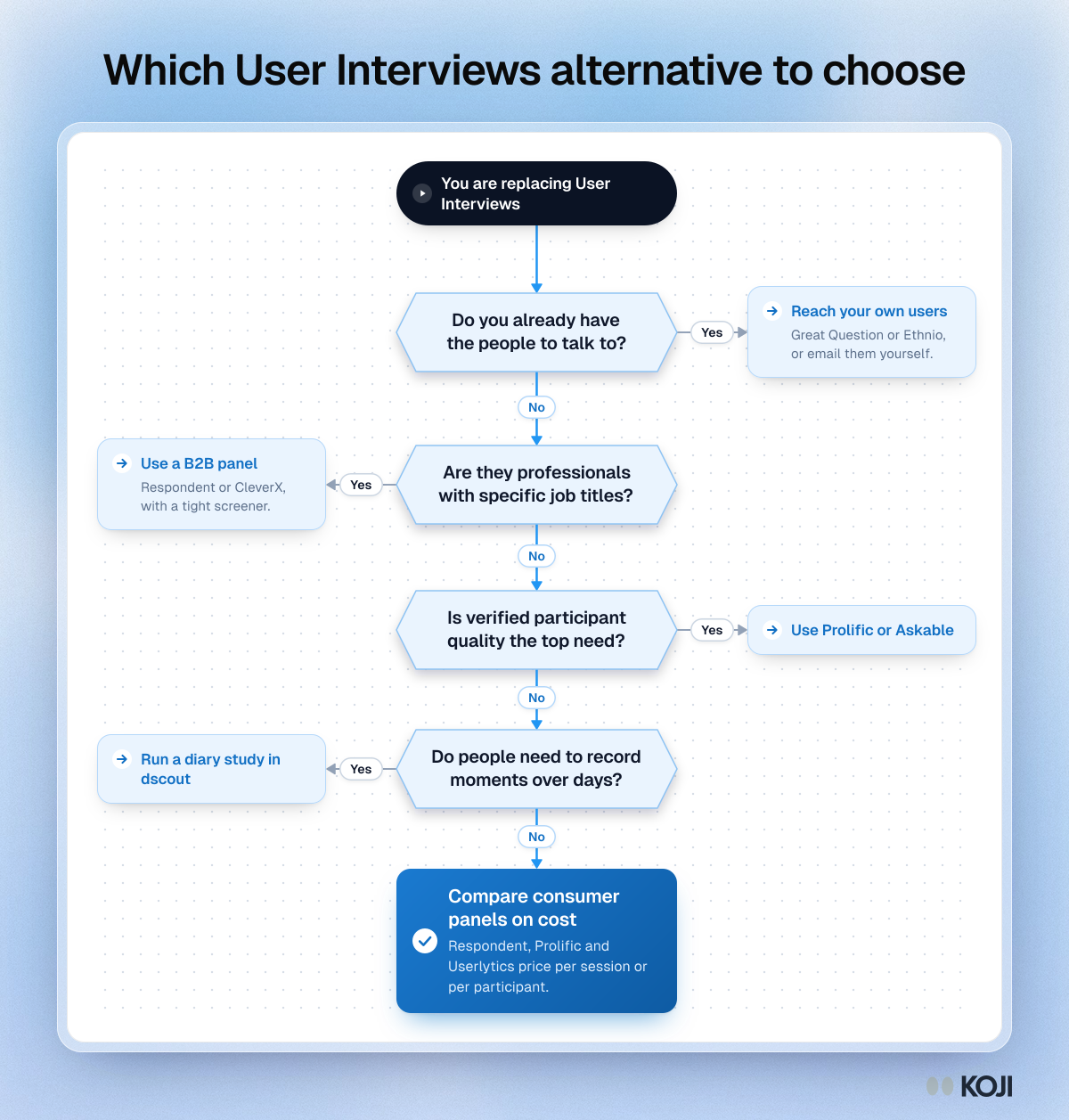
- Do you already have the people? If your customers, community or email list are the audience, you need a way to reach them (Great Question, Ethnio, or your own email), not a panel. The recruitment email templates help here.
- Are they professionals with specific job titles? Use Respondent or CleverX, and write a tight screener. The B2B screener questions guide has templates.
- Is verified quality the top need? Prolific for consumer and academic samples, Askable when you need identity checks on every person.
- Do you need people to record moments over days? That is a diary study, so dscout.
If none of those apply, you are comparing consumer panels on cost: Respondent, Prolific and Userlytics all price per session or per participant. Whatever you pick, budget the incentive separately. The research incentives guide has typical amounts by audience.
For agencies and fieldwork teams. If you recruit for client studies every month, the per-session fee is only half the cost. The other half is the hours spent scheduling, moderating and writing up. Count both before you switch.
Where Koji fits (our product)
Koji publishes this page, so here is plainly what it does instead of a recruiter, and when it isn’t the right choice.
What it does. Koji runs AI-moderated interviews by voice or text, in more than 30 languages, and writes the report. It gives you several ways to fill a study:
- Koji’s research panel, on paid plans. Describe the audience in plain words, see the price per interview before you launch, and choose text, voice or both. A soft launch fields about 10% of the goal first so you can check quality before releasing the rest.
- Your own people. Import a list or email an audience from Participants, with reminders, or share one interview link.
- Incentives from €10 to €500 per participant, paid through Koji.
Every route lands in the same study and report. Each interview gets a quality score from 1 to 5, and only interviews scoring 3 or more use credits or enter the report. Agencies running client studies can see how it fits their work on Koji for agencies.
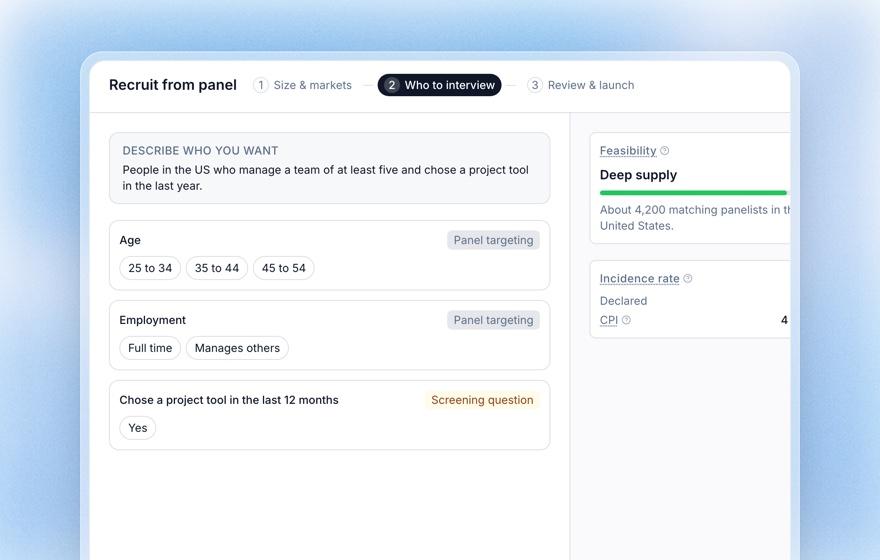
What it costs. A free account comes with 10 credits, no card. Paid plans are Insights at €29 a month and Interviews at €79 a month. A text interview uses 1 credit and a voice interview 3, at €1 a credit. Panel participants are priced per interview on top, shown before you launch. See the pricing page for current plans.
When it’s the wrong choice. If you need people for live sessions on your own video calls, in-person focus groups, diary studies or long academic surveys, use one of the platforms above. Koji recruits for interviews that Koji runs.
Read the panel recruitment guide for the setup, or start a study free.
See also: Best participant recruitment platforms · User Interviews vs Respondent · How to recruit user research participants