Short answer: UserTesting and Userlytics do the same core job: they record real people using your website, app or prototype while they think aloud, unmoderated or live. The difference is scale and how you pay. UserTesting is the bigger enterprise platform, now part of a company called Auros, sold on annual contracts with no public prices; Vendr puts the typical contract at about $40,000 a year. Userlytics publishes more of its pricing, includes unlimited seats, and sells panel sessions from $30 to $34 each on its annual Enterprise plan, or platform access from $699 a month if you bring your own participants. Pick UserTesting if you need its enterprise depth and the User Interviews network. Pick Userlytics if you want similar methods at a price you can estimate. If your question is about motivations rather than usability, Koji runs AI-moderated interviews at a published price per interview.
What changed in 2026
UserTesting had a busy year, and it changes what you are buying:
- January 2026: UserTesting acquired User Interviews, the participant recruiting marketplace. At the time it said it served more than 3,000 customers, including 75 of the Fortune 100 (Business Wire).
- August 2026: Advanced Targeting brought the User Interviews network into UserTesting, giving customers access to more than 7 million participants across 34 countries.
- Late September 2026: the company renamed itself Auros, built on what it calls 7.6 million verified people (Business Wire). UserTesting continues as a product brand, and contracts are unchanged.
Userlytics shipped steadily too: AI Insights and automated annotations in April 2026, then Study Pulse, a live status view for each study, alongside AI chart summaries, AI transcript translations and quantitative reporting in August (Userlytics).
UserTesting vs Userlytics at a glance
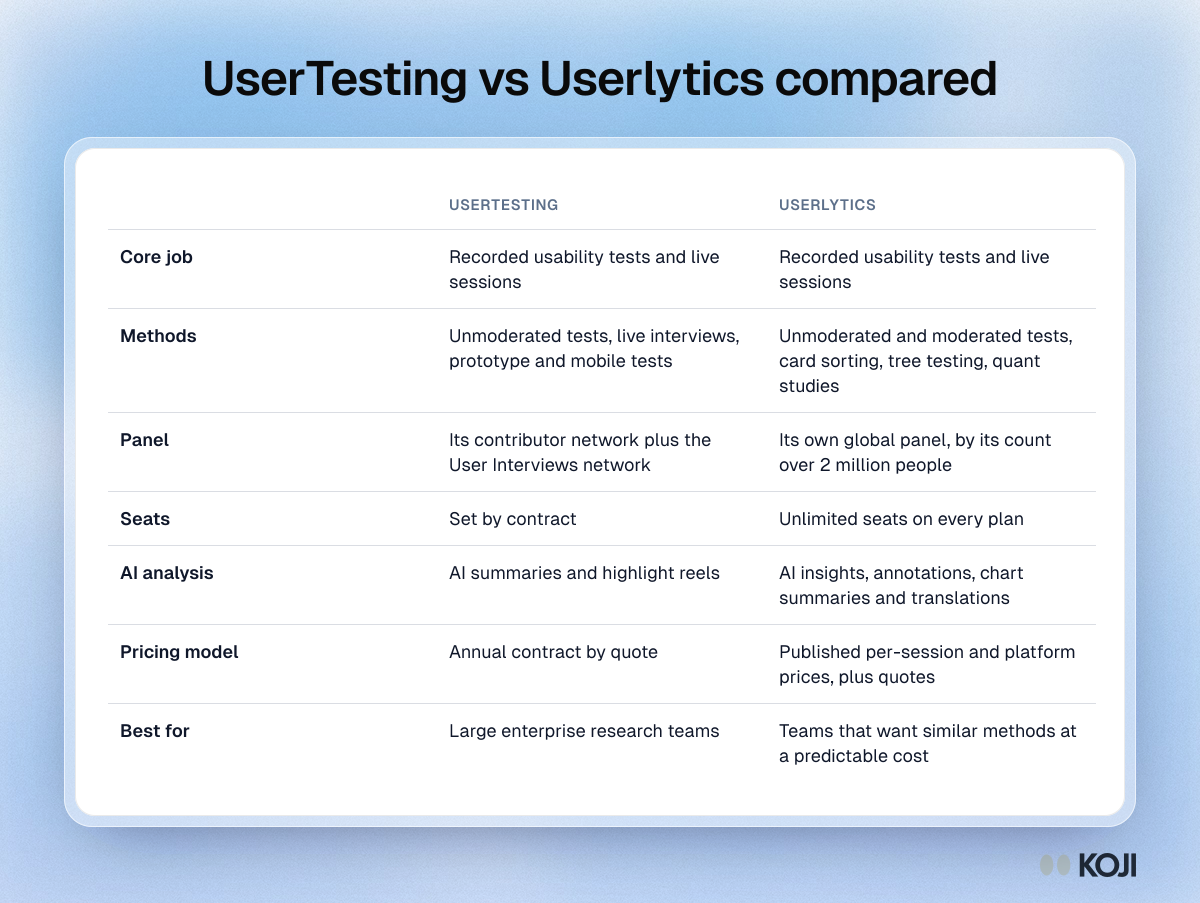
| UserTesting | Userlytics | |
|---|---|---|
| Core job | Recorded usability tests and live sessions | Recorded usability tests and live sessions |
| Methods | Unmoderated tests, live interviews, prototype and mobile tests | Unmoderated and moderated tests, card sorting, tree testing, quant studies |
| Panel | Its contributor network plus the User Interviews network | Its own global panel, by its count over 2 million people |
| Seats | Set by contract | Unlimited seats on every plan |
| AI analysis | AI summaries and highlight reels | AI insights, annotations, chart summaries and translations |
| Pricing model | Annual contract by quote | Published per-session and platform prices, plus quotes |
| Best for | Large enterprise research teams | Teams that want similar methods at a predictable cost |
UserTesting: the enterprise default
UserTesting is the platform most large companies already know. You write a test with tasks and questions, its contributors take it, and you get back videos of them thinking aloud as they use your product. Live Conversation adds scheduled moderated sessions with its contributors or your own customers.
Where it is strong:
- Fast unmoderated tests on consumer products, often with results the same day.
- Clips and highlight reels that make a usability problem impossible for a stakeholder to ignore.
- Enterprise controls, a customer success manager, and now Advanced Targeting for harder-to-reach audiences.
What it costs: UserTesting does not publish prices. Contracts combine seats with credits that pay for sessions. Vendr's marketplace data puts the median contract at roughly $40,000 a year, with recent figures between $39,870 and $41,200 depending on the sample, and a range from about $12,000 to over $100,000 (Vendr). Our UserTesting pricing guide breaks down seats, credits and renewals.
Where it is weaker: the entry contract is large for a small team, and live sessions still need a person to run each one.
Userlytics: the same methods, a price you can estimate
Userlytics covers much of the same ground: unmoderated and moderated tests on websites, apps and prototypes, plus card sorting, tree testing and quantitative studies. It says its panel holds more than 2 million participants across 150+ countries (Userlytics), and every plan includes unlimited seats and unlimited concurrent tests.
What it costs: Userlytics sells four plans that work as four different models:
- Project Based: pay per session with no subscription, minimum 5 sessions, price on request.
- Enterprise: annual, with panel sessions advertised as low as $30 in the plan table and $34 in the summary on the same page.
- Premium: platform access from $699 a month, paid annually, for participants you recruit yourself.
- Limitless: custom quote, unlimited concurrent tests and seats.
An account manager is included only on plans over $12,000 a year (Userlytics pricing). Our Userlytics alternatives guide walks through what those numbers mean on a real budget.
Where it is weaker: a smaller brand inside large companies, and the two per-session prices make it harder to compare quotes than it should be.
Who runs the sessions
Both platforms record sessions. Neither runs a conversation for you. In an unmoderated test the participant follows your script alone, so if they say "this is confusing" there is nobody to ask what they mean. In a live session, a researcher has to be there for every hour of it, plus scheduling, notes and synthesis.

Photo by Austin Distel on Unsplash
That cost is easy to miss when comparing licences. Twenty one-hour moderated sessions are twenty hours of moderation before anyone has written a finding. The choice between UserTesting and Userlytics changes the bill, not the hours.
Questions to ask before you sign either contract
Quotes from both vendors are built from parts, so ask for every part in writing.
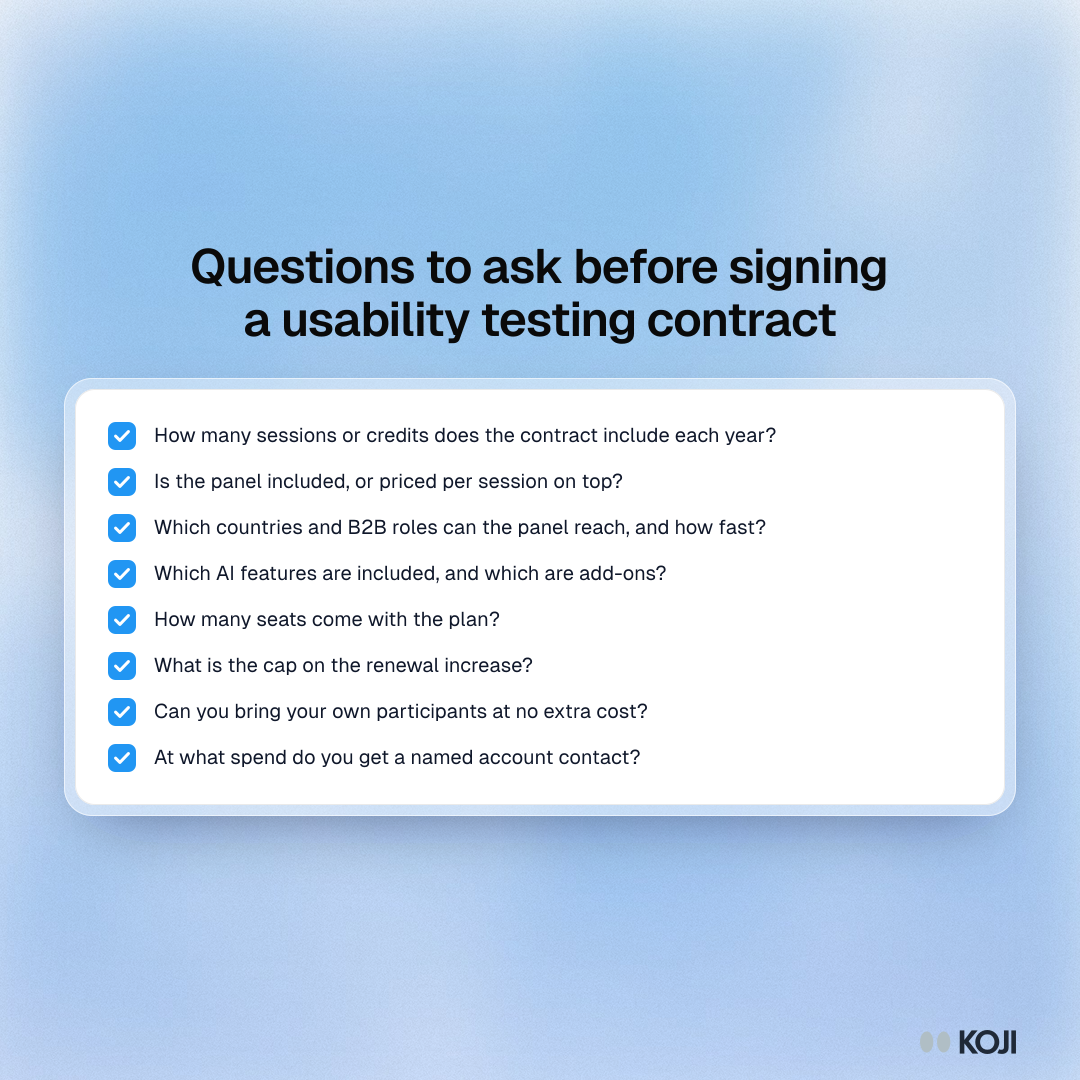
- How many sessions or credits does the contract include each year?
- Is the panel included, or priced per session on top?
- Which countries and B2B roles can the panel reach, and how fast?
- Which AI features are included, and which are add-ons?
- How many seats come with the plan?
- What is the cap on the renewal increase?
- Can you bring your own participants at no extra cost?
- At what spend do you get a named account contact?
Which should you choose?
- Choose UserTesting if you run research across many teams, need the User Interviews network for specific audiences, and already have a budget near the typical contract.
- Choose Userlytics if you want recorded usability testing with unlimited seats, a large global panel and pricing you can estimate before a sales call.
- Choose neither if your question is not "can people use this screen?" but "why do people choose, leave or ignore us?" That is an interview question, and a recorded task test is the wrong shape for it.
Where Koji fits
Koji does not record screens. It is an AI interviewer for the questions usability tests leave open. You write a research question, Koji drafts the interview, and each participant talks to it by voice or text. The interviewer follows up on vague answers, so "it felt expensive" turns into what they compared it with and what would have made it worth it.
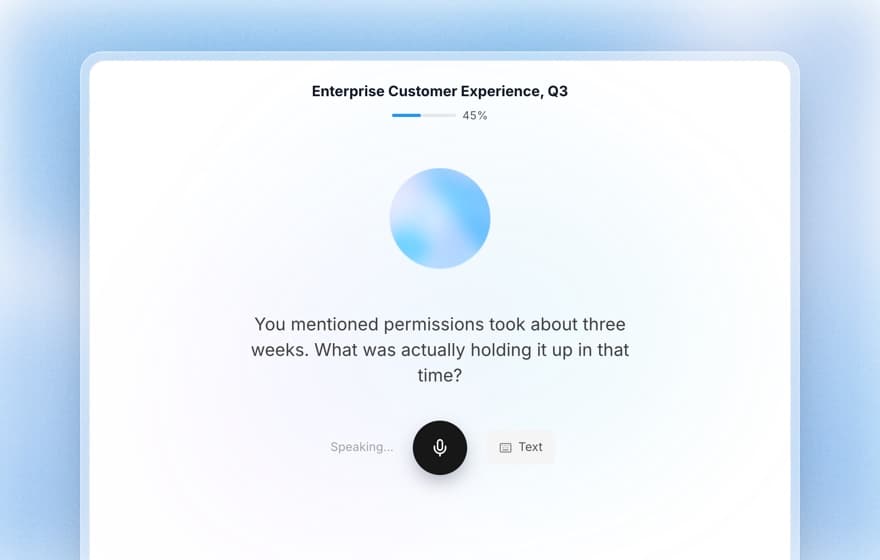
- Nobody has to moderate. Interviews run in parallel, by voice or text, in many languages.
- Recruiting is built in. Use panel recruitment with screening questions, or invite your own customers with personal links.
- You pay for useful interviews only. Each interview gets a quality score, and only those scoring 3 or more out of 5 use credits or reach the report.
- The analysis is done for you. The report groups themes and links every finding to the quotes behind it.
A text interview costs 1 credit and a voice interview 3, at €1 a credit. The Insights plan is €29 a month and the Interviews plan €79, and new accounts start with 10 free credits.
Koji is not a replacement for watching someone struggle with a prototype. Many teams pair one usability tool with Koji for the reasons behind the behavior.
Try both approaches on one question
Before you sign an annual contract, take one open question from your roadmap and run it in Koji. Preview the interview for free, send it to ten customers or a small panel sample, and read the report the same day. Then decide how many recorded usability sessions you still need.
More reading: Koji vs UserTesting, Koji vs Userlytics, UserTesting alternatives and UserTesting vs User Interviews.
Sources: UserTesting acquisition announcement (Business Wire, January 2026); UserTesting Advanced Targeting announcement (August 2026); Auros rebrand announcement (Business Wire, September 2026); Vendr UserTesting pricing data; Userlytics pricing and plans page; Userlytics comparison page; Userlytics news, Study Pulse and AI releases (2026). Prices change often; check each vendor's current terms.