Short answer: UserTesting and User Interviews now belong to the same company, but they still do different jobs. UserTesting is a research platform: you build tests, its contributor network takes them, and you watch videos of real people using your product, unmoderated or live. User Interviews is a recruiting marketplace: it finds, screens, schedules and pays participants, and you run the sessions in your own tools. UserTesting is sold on annual contracts with no public prices; Vendr puts the median at $41,200 a year. User Interviews publishes a rate card starting at $49 per completed session, with incentives on top. Since January 2026 both sit under one owner, which in September 2026 renamed itself Auros. If what you really need is to talk to customers and get the analysis done for you, Koji runs AI-moderated interviews at a published price per interview.
What changed in 2026
This comparison used to be about two separate vendors. Not any more.
- January 7, 2026: UserTesting announced it had acquired User Interviews (Business Wire). At the time, UserTesting said it served more than 3,000 customers, including 75 of the Fortune 100, and User Interviews said its network held more than 6 million participants. Both said there were no immediate changes to products, pricing or workflows.
- August 12, 2026: UserTesting launched Advanced Targeting, which brings the User Interviews participant network directly into UserTesting, giving customers access to more than 7 million participants across 34 countries (UserTesting).
- Late September 2026: the company rebranded as Auros, "the human network behind AI", built on what it calls 7.6 million verified people (Business Wire). Auros is now the corporate brand and the name for its AI data, evaluation and research services. UserTesting and User Interviews continue as product brands, and the company says contracts and day-to-day operations are unchanged.
So the real question for a buyer is no longer "which company?" It is "which of these two products does the job I have?", and whether either is the right shape for how your team researches.
UserTesting vs User Interviews at a glance
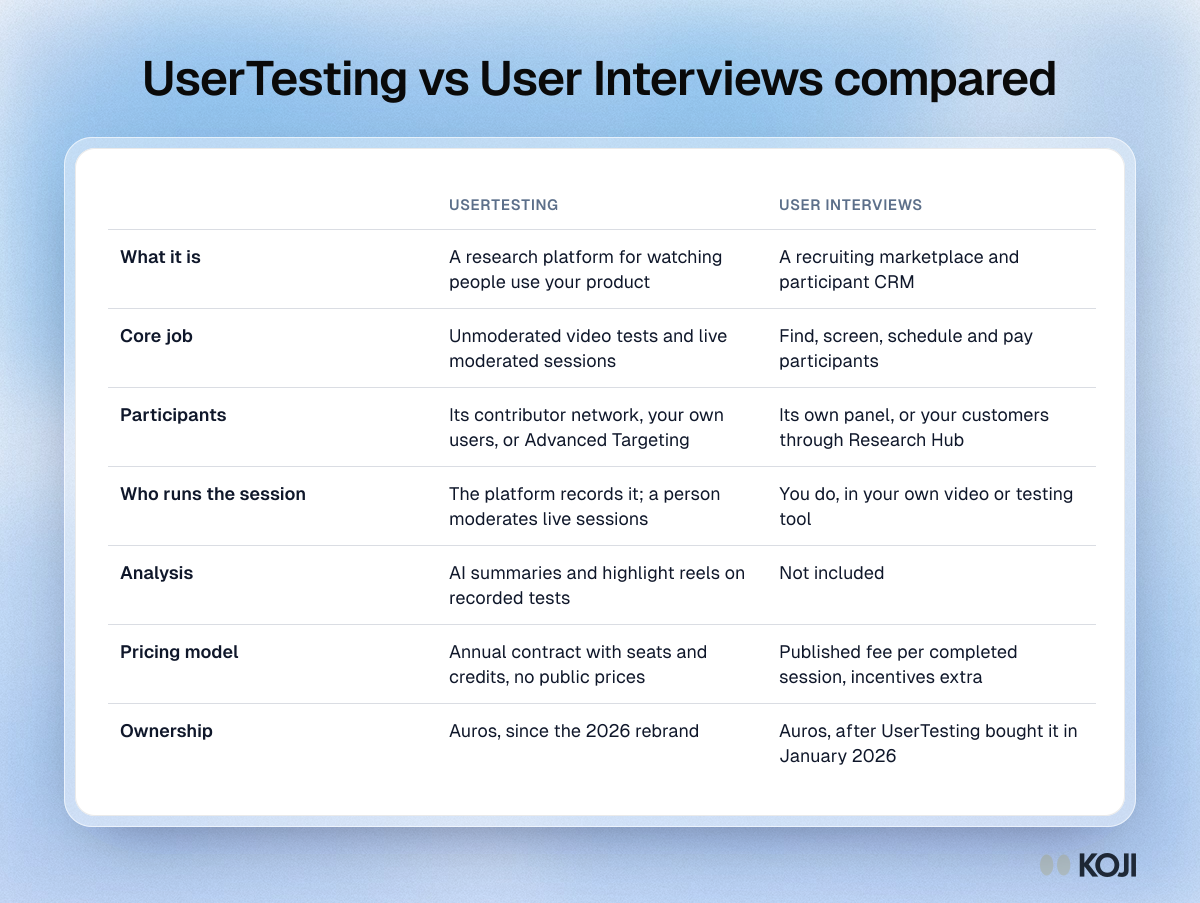
| UserTesting | User Interviews | |
|---|---|---|
| What it is | A research platform for watching people use your product | A recruiting marketplace and participant CRM |
| Core job | Unmoderated video tests and live moderated sessions | Find, screen, schedule and pay participants |
| Participants | Its contributor network, your own users, or Advanced Targeting | Its own panel, or your customers through Research Hub |
| Who runs the session | The platform records it; a person moderates live sessions | You do, in your own video or testing tool |
| Analysis | AI summaries and highlight reels on recorded tests | Not included |
| Pricing model | Annual contract with seats and credits, no public prices | Published fee per completed session, incentives extra |
| Ownership | Auros, since the 2026 rebrand | Auros, after UserTesting bought it in January 2026 |
UserTesting: watch people use your product
UserTesting is built around video. You write a test with tasks and questions, send it to participants, and get back recordings of them thinking aloud as they use your website, app or prototype. For live work, its Live Conversation feature lets you schedule a moderated interview with someone from the contributor network or one of your own customers.
Where it is strong:
- Fast unmoderated usability tests on consumer products, with results often back the same day.
- Video clips that show a stakeholder exactly where people get stuck.
- Enterprise features: single sign-on, role controls, a customer success manager, and now the User Interviews network through Advanced Targeting.
What it costs: UserTesting does not publish prices. You buy an annual contract made of platform seats and credits that pay for participant sessions. Vendr's data across 359 purchases puts the median at $41,200 a year, with a range from about $12,000 to $113,642 (Vendr). Our UserTesting pricing guide breaks down seats, credits and renewal terms.
Where it is weaker: the panel leans toward consumers, so senior B2B roles are slower and dearer to fill. And live interviews still need a person to moderate every one.
User Interviews: find the right people
User Interviews does not run your research. It gets the right people into your calendar. You describe who you need, write a screener, and it recruits from its panel, schedules sessions, sends reminders and pays incentives. Research Hub adds a participant CRM so you can manage your own customers as a panel.
Where it is strong:
- A large panel and detailed targeting, including B2B roles through an Advanced B2B targeting add-on.
- A published rate card, which is rare in this market.
- Research Hub, for managing your own customers as a reusable panel.
What it costs: User Interviews' pricing page lists $49 per completed session on Pay As You Go for consumer participants and $98 for B2B, with Advanced B2B targeting as an add-on (User Interviews). Incentives are paid on top. The same page now warns that Pay As You Go usage limits are coming soon and steers buyers toward subscriptions, so check the terms before you plan a year around it. We worked through real study budgets in User Interviews pricing.
Where it is weaker: it stops at the calendar invite. You still moderate every session, take notes, and do the analysis.
Running the sessions is the hidden cost
Neither product removes the most expensive part of qualitative research: the hours a person spends running and making sense of conversations. With User Interviews, a researcher moderates every call. With UserTesting's live sessions, the same is true; its unmoderated tests skip moderation but cannot ask a follow-up when an answer gets interesting.

Photo by LinkedIn Sales Solutions on Unsplash
That time adds up. Lyssna's 2025 synthesis survey of 300 practitioners found that 60.3% say time-consuming manual work is their biggest frustration, and reading through responses was the most time-consuming step for 59%. Meanwhile demand keeps climbing: Maze's 2026 Future of User Research report found that 69% of researchers now use AI in at least some projects, up 19 points in a year (Maze), largely to get through that backlog.
This is why many teams now pair a recruiting source with an AI interviewer instead of a human moderator:
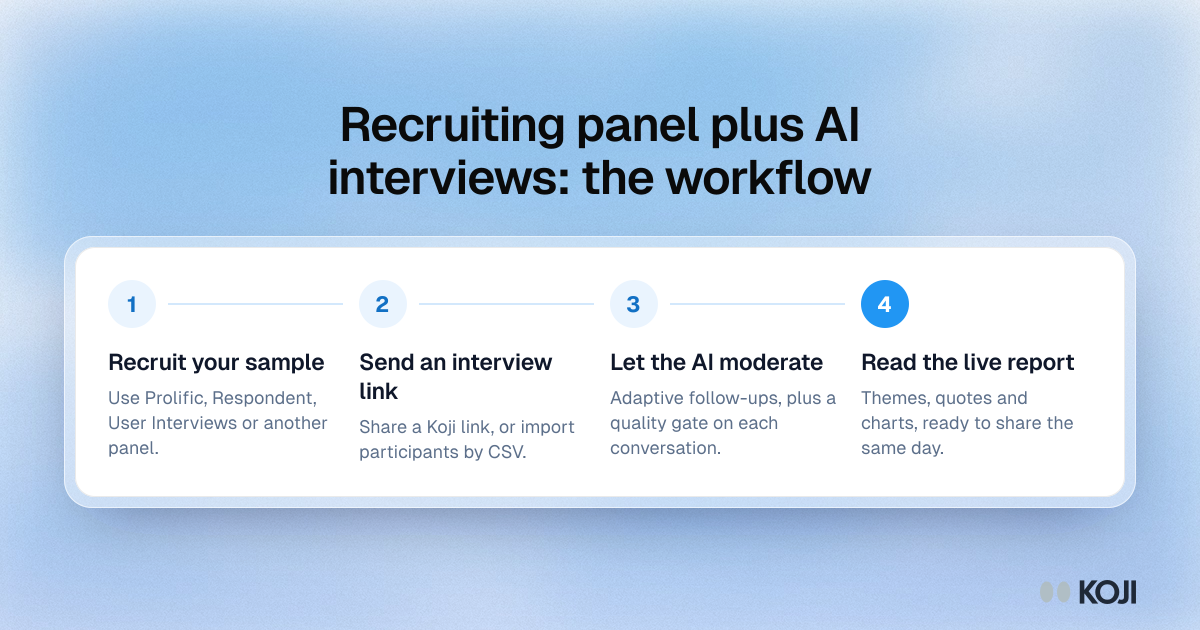
- Recruit your sample. Use Prolific, Respondent, User Interviews or another panel.
- Send an interview link. Share a Koji link, or import participants by CSV.
- Let the AI moderate. Adaptive follow-ups, plus a quality gate on each conversation.
- Read the live report. Themes, quotes and charts, ready to share the same day.
Which one should you choose?
Choose UserTesting if:
- Your main question is about usability: can people find, complete or understand something?
- You need video of real behaviour for stakeholders.
- You run tests every week and have a budget for an annual contract.
Choose User Interviews if:
- You already have a moderation and analysis process and just need the right people.
- You recruit B2B roles that consumer panels struggle to reach.
- You want a published price per session rather than a negotiated contract.
Choose both (now easier under one owner) if you run usability tests and recruit hard-to-find interviewees for moderated work.
Choose something else if the bottleneck is not finding people but having the conversations and analysing them.
The AI interview alternative: Koji
Koji is an AI-native research platform that runs the interviews and the analysis for you. You type what you want to learn, an assistant drafts the brief, and an AI interviewer holds each conversation by voice or text in 28 languages, asking follow-up questions as it goes.
- Published, per-interview prices. A qualified text interview uses 1 credit and a voice interview uses 3. Credits cost €1. Start with 10 free credits and no card, buy credit packs as you go, or choose Insights at €29 a month (29 credits) or Interviews at €79 a month (79 credits).
- You only pay for usable interviews. Every interview gets a quality score from 1 to 5, and only those scoring 3 or more use credits or enter the report.
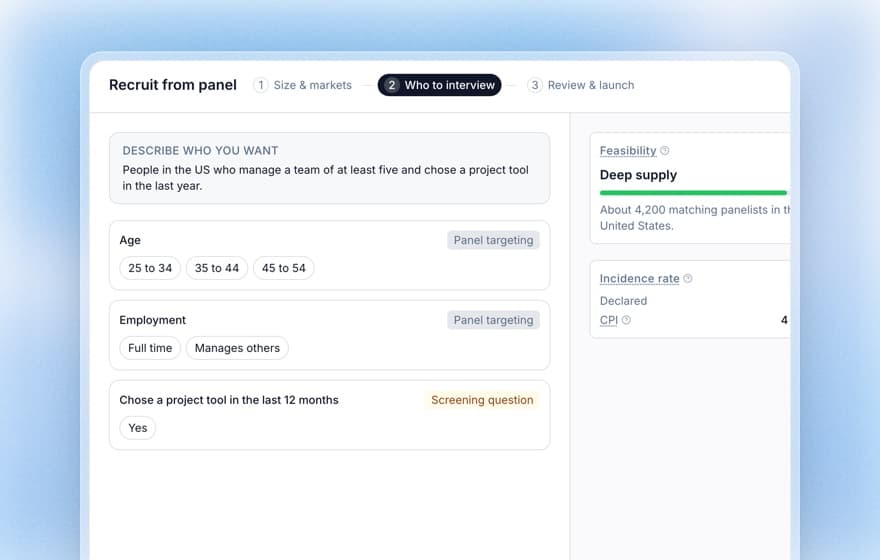
- Recruit from Koji's panel. On a paid plan, describe your audience, add screening criteria and see the cost per interview before you launch. Credits are held at launch, unused credits come back at the end, and fraudulent completes you report are refunded once the report is accepted.
- Or use your own people. Share one link, or import a CSV so each customer gets a personal invite link (Interviews and Enterprise plans). Screening questions work the same whichever way people arrive.
- Analysis included. Reports build as interviews arrive, with themes, findings, recommended actions and personas, and you can trace every finding to the quotes behind it.
Where UserTesting and User Interviews are ahead: Koji does not record video of people using your product, so for watching someone struggle with a prototype, UserTesting is the better tool. And if you need a human researcher to run a sensitive live conversation, User Interviews will fill that calendar.
Try it on your next study
Before you sign an annual contract or prepay a block of sessions, run one study the new way. Write your research question in Koji, preview the interview for free, and send it to ten customers or a small panel sample. You will have transcripts and a report the same day, and a clear sense of which parts of your research still need a human in the room.
Start free with Koji. 10 credits, no card.
More reading: Koji vs UserTesting, Koji vs User Interviews, UserTesting alternatives and User Interviews alternatives.
Sources: UserTesting and User Interviews acquisition announcement (Business Wire, January 2026); UserTesting Advanced Targeting announcement (August 2026); Auros rebrand announcement (Business Wire, September 2026); Vendr UserTesting pricing data; User Interviews pricing page; Lyssna, Research Synthesis Report 2025; Maze, Future of User Research Report 2026. Prices change often; check each vendor's current terms.